

|
|
|
POSTCARDS AND GREETING CARD | ||
| Album page (select picture to enlarge) |
Picture side of card ( text, description) |
 |
|---|---|---|
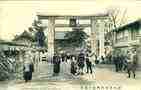 |
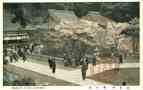
"Western portal of stone, the Shitennoji" at Osaka. | Type 4 German divider - left, "T" |
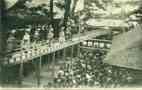 |
"Shimonoseki, 12 notable places: Akama Shrine Sentei festival."
This May 2 event still features a procession to
Akama Jinguu ( )
by finely dressed ladies to console the spirit of the sentei "former emperor," i.e., the child Antoku, who perished nearby
with the Taira forces at Dannoura in 1185. )
by finely dressed ladies to console the spirit of the sentei "former emperor," i.e., the child Antoku, who perished nearby
with the Taira forces at Dannoura in 1185. |
Type 2 divider - left rubber stamp: "AUG 30 1910" logo 1 |
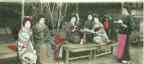 |
Christmas card: unidentified locale, scene of a teahouse and the girls employed there--one of the typical postcard subjects. The card measures 65 x 144 mm and is slightly thicker than postcard stock. | Printed: Drawing of the outorii at Miyajima (Hiroshima Ken), looking toward shore and Itsukushima Jinja. "A merry Christmas and A Happy New Year". Signed: "Jos. J. Simon / Shanghai". |
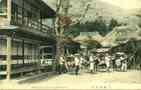 |
"Hakone, Hashimoto-ya teahouse". Four kago-kaki "palanquin-bearers" all have customers, who are covered with laprobes. The two indistinct faces on the left might be men; the right-hand two are women. | Type 4 German divider - left, "T" stamp removed; all-Japanese hand cancel (partly removed) from "____shita"; sent to USA "Apr. 14 This country beats them all. Could stay here 2 mo - I am going home in few days. Regards to your family. Howard L. Platt". |
 |
" Kiyomizudera, Okunoin" () in Kyoto. An added design is stamped in red in the shape of the Buddhist wish-fulfilling jewel. (This shape of the jewel can be seen at the temple.) The card evidently is aimed at sales to visiting pilgrims: "West country [pilgrimage, stop] number 16: Otowayama Great-mercy-hall, Kyoto's Kiyomizudera". The temple continues to be number 16 on the Kyoto-area "west country"
(saikoku, ) route of pilgrimage in honor of Kannon.
|
Type 1 divider - center, "T" with "Made in Japan" logo 2 The white-border postcard type is typical of the late 'teens and the 1920s. |
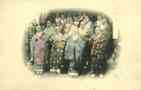 |
A gathering of Buddhist clergy, perhaps in Kyoto. The temple name on the banners at right and left is Dai___in. (But it is not Daiunin or other names of this pattern that I have seen.) One is reminded of a striking Meiji-period photograph by Kusakabe Kimbei, which shows a crowded Buddhist procession descending a hillside walkway. (See the books listed under References on the Introduction page for reproductions.) The photo carries what seems to be a kameraya's code "A9." | Type 2 no divider This pre-1907 card left an ample message area on the picture side. |
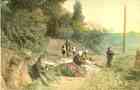 |
Unidentifed locale: A family harvesting daikon radishes. The vegetables in the white-tinted pile have been stripped of their leaves. Those in the red-tinted pile also are daikon, as the leaves show. Is the red color the creation of the colorist or an actual red radish? (Compare the slender, modern long red 20-day daikon .) In the field to the right stands what may be a shock of millet.
|
Type 3, yuubin hakaki as second line on top; dashed divider - left, with ornamental ends and "Made in Japan"; logo 3 4 dotted address lines and solid bottom line |
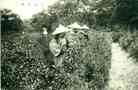 |
"Uji, tea picking" (Kyouto Fu). This card brings the viewer down to the worker's view of the tea bushes--in contrast to aloof long shots to show the patterns made by tea fields patched along hillsides. (Compare, e.g., the 1907 photograph in Worswick's book. [See References on the Introduction page.]) | Type 3, divider - center The card can be assigned to the 1918-1933 period. |
| Copyright © 2003 C.J. Brunner |
 |
 |
 |
Comments or questions? Contact: Kurisu |