|
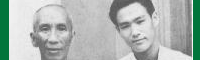
GRANDMASTER YIP MAN'S BIO
Perhaps no other name is spoken in wing chun circles with greater reverence
than that of Grandmaster Yip Man. A teacher of the art until his death in 1972,
Yip Man is often credited with moving wing chun from an obscure fighting system
known only in China to a world-renowned style of kung fu studied by thousands.
Despite the fact that Yip Man was the first sifu ever to open a wing chun
school accessible to the general public, no one was more surprised over the
rapid and intercontinental spread of the art than Yip Man himself. Now practiced
from Wales to Malaysia with strong followings in Australia and the United
States, the wing chun Yip Man taught has become the grand irony of the martial
arts world, having acquired its recent popularity in spite of Yip Man's own
insistence that it be taught to only Chinese students for the sake of
maintaining its heritage and purity.
THE EARLY DAYS
Yip Man's pivotal if unintentional role in the development of what some writers
have termed wing chun's "golden age" began with his training under Chan Wah
Soon, the first of three wing chun masters to instruct him. Accounts of Yip
Man's age when he began his lessons vary, but most versions of the story agree
he started wing chun at a very young age. In his book Wing Chun Bill Gee,
William Cheung cites an often repeated anecdote regarding the commencement of
Yip's training under Chan. According to the story, Yip approached Chan while
they both resided in Fatshan, Kwangtung Province, with a request for acceptance
as one of Chan's disciples. The Year may have been 1895, making Yip twelve years
old at the time. A biography of Chan in the Wing Chun Archives puts him in
Fatshan working as a money changer--hence his nickname Jow Chien ("Money
Changer") Wah--and teaching wing chun on the side, by some accounts for a total
of thirty-six years. Yip carried three hundred pieces of silver with him to his
meeting with Chan, thinking to buy an apprenticeship in wing chun with the
money. Chan, believing the boy must have stolen the money from his parents,
escorted Yip back home to discover the truth of the matter. To his astonishment,
Yip's parents reported that the young Man had saved up the coins on his own. Man
had been born to a wealthy family, his father Yip Oi Doh being a respected and
influential member of the merchant class in Namhoi County, so Man's legitimate
access to that kind of money was certainly a possibility. Upon discovering this
evidence of Man's ambition and determination, Chan accepted him as both his
youngest and his final student. Yip trained under Chan until Chan's death in
1905, thereafter continuing His wing chun with Ng Chung So, one of Chan's top
disciples. After two more years of study, Yip left Fatshan for Hong Kong and
enrolled in St. Stephen's college at Stanley to pursue an academic education.
YIP MAN'S TRAINING IN HONG KONG
While enrolled at St. Stephen's, a classmate, hearing of Yip's training in
kung fu, dared him to challenge an old kung fu practitioner living on a boat
anchored in Hong Kong Bay. Yip accepted the dare and duly sought out and
challenged the old man. The old man accepted his challenge and, despite Yip's
growing reputation as an unmatched fighter, beat him handily. Only after his
defeat did Yip discover that the old man was actually master Leung Bik, a direct
descendant of the original wing chun lineage reaching back to Wing Chun herself.
After the melee, Leung took Yip as his only student in the art and advanced his
wing chun even further, both expanding his theoretical grounding in the art and
his refining his technique. (Another version of Yip Man's biography omits the
story of the challenge while still confirming that Yip met Leung in Hong Kong
and became his student. Yet a third version suggests that Leung himself
contrived to meet Yip and invite him to train.)
THE RETURN TO FATSHAN
According to William Cheung's biographical account, Yip returned to Fashan at
age 24 and found a position as the Captain of the Local Police Patrols of Namhoi.
Yip worked as a law enforcement officer for several years to come, teaching wing
chun in his spare time, but always, in accordance with wing chun tradition,
restricting his lessons to a just a few carefully selected students. "Yip Man,"
an article posted in English translation at the Wing Chun World web site,
asserts that Yip's first private student was a silk merchant named Chow Ching
Chung, who hired Yip on the basis of his martial arts reputation.
Yip continued in this manner until China succumbed to the communist revolution
in 1949. Historical accounts seem to concur that Yip felt forcedto flee mainland
China and return to British-occupied Hong Kong as a consequence of the communist
uprising, though what the specific connection between the communists and Yip's
forced departure was remains unclear. One source asserts that while working as a
police officer under the communist government Yip killed someone in the line of
duty and feared communist repercussions for the death. Meanwhile, author John F.
Di Virgilio suggests that Yip had been involved in governmental resistance to
the revolutionaries and feared communist reprisals for his military activity. In
any case, Yip at the age of 54 abandoned his family home and fortune to seek
sanctuary off shore.
THE FIRST PUBLIC WING CHUN SCHOOL
Reaching Hong Kong alone and destitute, facing certain poverty, Yip Man quickly
fell back on his martial arts expertise to earn a living. He decided to break
with the wing chun tradition of limiting instruction to a select few and opened
a public wing chun school in the union hall building for restaurant workers.
Here again biographical accounts conflict with each other on the details. Di
Virgilio's version of events has Yip opening the school on his own, relying
soley on his own ideas and resources to get underway. In the article "About the
Late Grandmaster Yip Man, " on the other hand, Yip encounters an old friend,
Chung Choui, who is teaching martial arts at two locations and invites Yip to
take over the instruction at one of them so that Yip could support himself. In
Wing Chun Bil Jee, William Cheung offers yet a third sequence of events,
asserting that a master of White Eyebrow kung fu named Leung Shan found Yip in
Macao "in an impoverished state" and personally conducted him to Hong Kong.
In this version, it was Leung Shan who taught kung fu at a school "on the
premises of the Restaurant Worker's Union in Hong Kong." There Leung provided
Yip with a small apartment and saw to his personal needs. For his part, Yip
would often watch the classes Leung hosted every night after the restaurant
closed. Yip made a habit of poking light-hearted fun at Leung and the White
Eyebrow kung fu taught as he watched. After taking this ribbing for some time
without reaction, Leung finally became fed up and challenged Yip so as to teach
him a lesson. Though Leung was younger and larger than his opponent, he was no
match for the wing chun Yip had spent a liftime perfecting and "was easily
defeated." Upon besting him in combat, Yip revealed himself to be a wing chun
grandmster and took Leung as his first Hong Kong student.
The chronicle of Yip Man's life at the Wing Chun World web site, however, runs
counter to all three of the previous accounts, contending that when Yip arrived
in Hong Kong he met up with "his good friend Hui Yee, the Chairman of the
Restaurant Union," who knew of Yip's martial arts background and subsequently
invited him to teach martials arts for the Union. In this version Yip Man
accepts the invitation and conducts wing chun classes "on the roof of the
apartment where the Restaurant Union was." However Yip Man established his
teaching practice in Hong Kong, he managed to create with it the seeds of a
martial arts revolution that, through the efforts of some of those he taught,
would take root in countries spanning the world. Though Yip Man himself never
taught outside the Chinese sphere of influence, his disciples carried his wing
chun around the globe. Among those who helped spread wing chun, Sifu William
Cheung, a student Yip Man taught in his home for a number of years, went on to
found the World Wing Chun Kung Fu Association and demonstrate wing chun in the
United States and Australia.
Leung Ting, Yip Man's final student, took wing chun to the United States in the
form of the American Wing Tsun Organization, the variation in spelling owing to
a different phonetic transliteration of the same Chinese words. Victor Kan Wah
Chit, who studied under Yip in the 1950s, began teaching Wing chun in London,
England, in 1975. And Leung Ting, whom Yip man accepted as a private student in
the the late 1960s, went on to form the International Wing Tsun Martial-Art
Association, an organization which has become, according to material in the Wing
Chun Archives, the largest Chinese martial arts organization in existence today,
boasting members from nearly fifty countries the world over.
YIP MAN'S WING CHUN LEGACY
In the article "Defending the Motherline," martial arts scholar Joyotpaul
Chaudhuri observed that it was Yip Man's personal misfortune that drove him to
teach wing chun publicly. Had he been able to retain his family fortune, "as a
man of property, he probably would have remained a leisurely patriarch
practicing wing chun in Fatshan in southern China." So the final irony of the
story of wing chun is that Yip Man's loss has become the martial arts
community's gain, his misfortune compelling him to preserve and propagate a
centuries-old fighting system that without him might well have passed into
oblivion unheralded and uncelebrated.
VISIT
MELBOURNE AUSTRALIA HERE
|
|