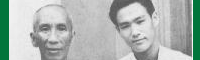
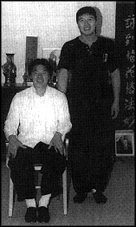
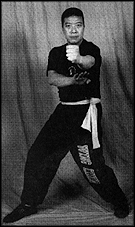
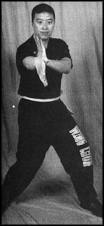
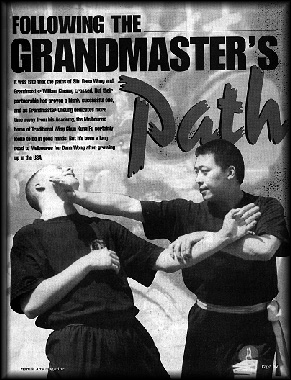
 It
was fate that the paths of Sifu Dana Wong and Grandmaster William Cheung
crossed. But their partnership has proven a highly successful one, and as
Grandmaster Cheung dedicates more time away from his Academy, the Melbourne home
of Traditional Wing Chun Kung Fu certainly looks to be in good hands. But it's
been a long road to Melbourne for Dana Wong after growing up in the USA. It
was fate that the paths of Sifu Dana Wong and Grandmaster William Cheung
crossed. But their partnership has proven a highly successful one, and as
Grandmaster Cheung dedicates more time away from his Academy, the Melbourne home
of Traditional Wing Chun Kung Fu certainly looks to be in good hands. But it's
been a long road to Melbourne for Dana Wong after growing up in the USA.
Born in Boston in 1955, where he also grew up,
Dana suffered the taunts, especially at school, as a member of the only Asian
family in his neighbourhood. "I used to get teased a lot and that's where I
first developed the interest in the martial arts as a method of defending
myself," he said.
At first turning to books, which at the time
dealt mainly with Ju Jitsu, Dana tried to emulate the pictures he saw in the
books. But at the age of 11, he soon found his way into the Okinawan Uechi Ryu
Karate school run by Sensei George Mattson, one of the few schools in Boston at
the time.
It's also ironic to note that another source of
encouragement came from seeing Bruce Lee in action on television in the Green
Hornet, given that the man who was to play such a major role in Dana's life
years down the road, Grandmaster William Cheung, played an important role in the
teaching and training of Lee as a youngster. "I saw Bruce Lee on television and
I just got swept up in the drama. I thought, well here's this guy, he's small
like me, and he wins. There's got to be something in it!"
But being an Okinawan system, Dana found the
rigours of the training to be quite intimidating and he quit after three months.
Later, he came across Tiger Crane Kung Fu at a local youth club which he had
joined initially just to "fit in" and play basketball.
"They brought a Sifu (Kwong Tit Fu) over from
Hong Kong just to teach at the club. He got me started in Tiger Crane Kung Fu. I
did that for about two years and I started to find out that Kung Fu systems were
more suited to what I was looking for. Karate systems at the time seemed to me
to be more power oriented, but I didn't have much size and strength. I was just
a skinny kid."
After Master Kwong moved on, Dana spent another
year practising Northern Praying Mantis Kung Fu under Grandmaster Chan Pui but
found it impractical and too stylised for fighting. Eventually, after graduating
from university with a Bachelor of Science in communications, he moved back into
the Karate fold with Chinese Kenpo Karate under Sifu Joe Esposito.
"I took a break from martial arts when I started
working. Before I knew it, I went from someone who did everything, to someone
who wasn't doing anything except working. I started thinking about getting back
into martial arts. To me, Kenpo was the best style as it had a Kung Fu influence
to it and it didn't seem as power oriented as most Karate styles. I practised
that for about two years."
But after rupturing a disc in his back in an
accident, Dana was forced out of training and into therapy. "I had to give up
everything for a while. And even after rehab, I found I couldn't kick properly."
It was this freak occurrence which first turned Dana Wong onto Wing Chun which
he found he could physically cope with due to the stance and the fact that most
kicks are delivered below the waist.
"At that time, there wasn't anyone practising
Wing Chun in the Boston area and that's what turned me onto Grandmaster Cheung.
I'd read about him in some of the Australian magazines. I called Grandmaster
Cheung and asked if there was someone I could train with in the USA. This was
about 1981-82."
Taken by the enthusiasm of this young man half a world away, Grandmaster Cheung
replied to Dana that he himself would come to Boston to teach him the ways of
Wing Chun. "I was completely blown away. He'd never met me and didn't know me
from anyone else."
It's obvious that this point in Dana Wong's life
was a major turning point. "I don't really see myself as being much different
from the students I teach, except that I'm maybe a little further down the line.
Somethimes I say to them that it wasn't anything other than fate that I crossed
paths with someone as prominent in the martial arts world. I never thought I'd
amount to much with the back injury and the way things were going with work. And
I'd dabbled in all these different styles as I was growing up, but I'd never
finished with any of them. That's what motivated me to get back into it, and
look at me now, I've had 14 years with Grandmaster Cheung."
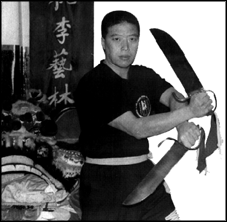 Commencing
his involvement with Grandmaster Cheung in 1982, Dana found out that the
Grandmaster's style of Wing Chun differed from what he had learned as a
teenager, a modified version of the traditional art. "There wasn't the
pigeon-toed stance or the 60-40 weight distribution on the feet, it was more
50-50 and more footwork was involved." Commencing
his involvement with Grandmaster Cheung in 1982, Dana found out that the
Grandmaster's style of Wing Chun differed from what he had learned as a
teenager, a modified version of the traditional art. "There wasn't the
pigeon-toed stance or the 60-40 weight distribution on the feet, it was more
50-50 and more footwork was involved."
After working in seminars and private sessions
with Grandmaster Cheung between 1982 and 1988, fate again intervened in Dana's
private life. "I was fed up with working in the graphics field and sick of the
games once I moved into management. I reassessed what I wanted to do. I thought
about going back to school, and then I wondered whether it was too late for me
to become an instructor. I thought about taking the time and coming out to
Australia."
Further motivated by the end of a long-term
relationship, Dana finally decided to board the plane for Australia after a
brief period of training and teaching in Boston. "After about four years, the
Grandmaster wanted me to open a school in Boston, and after arguing the point,
as I didn't feel I was ready for that level of commitment, I eventually opened a
small club 12 months later which I ran for about two and a half years before I
came out to Australia in 1988."
Initially, Dana felt he would be in Australia
for a short period of time, to train full-time and reach his instructor grade
before going back to Boston and opening a school. But grandmaster Cheung
convinced Dana to stay on for another 12 months, during which time the
Grandmaster opened a school in Dandenong. "At the time, I didn't really want to
be teaching, I wanted to finish my own training. The Grandmaster pressed me into
teaching but brought some other instructors out to look after the City academy.
I then trained with him every day, and he convinced me to stay longer."
After two years teaching in Dandenong, Dana Wong
moved to Grandmaster Cheung's World Wing Chun Kung Fu Academy in Melbourne where
he is currently the full-time chief instructor, a position he has held for the
past six years. And Dana is set to further entrench himself in Australia when he
gets married and is currently seeking permanent residency.
Indeed, Dana Wong has since grown to be an
important member of the local martial arts' fraternity, especially in the
traditional Wing Chun Kung Fu family. "I never thought I'd be the sort of person
you'd want to read about in a magazine. I even have problems with the students
calling me Sifu, as I always think of him."
Dana is a great advertisement for Wing Chun, and
he feels quite strongly about the benefits of the principles behind Wing Chun.
"From the obvious, there's the self-defence point of view to which its more
suited to than tournaments. It's more applicable to a street situation than a
sporting situation. But there's also the pursuit of a physical skill, where
people learn to persist at something. I think that's a trait which is dying out
in today's society."
Wing Chun has had its problems over the years in
Australia but things are finally starting to come together Dana feels,
especially with the type of people who he sees coming though the academy today.
"Ten years ago you had people coming through on the end of the Bruce Lee kick,
having seen him on the screen. Now days, you come in to a class and the people
cover whole walks of life and all ages. It's definitely something everyone can
do."
From a 'political' point of view, the lack of
communication between the different Wing Chun factions is something which has
bothered Dana Wong over the years. "There's still some animosity between the
parties and I think some healing time is required. It seems to be personal
rather than philosophical which I find hard to understand given the reasons I
first got into martial arts."
Whatever the future for Wing Chun, Dana Wong has
already made a mark on the local scene, and the local Wing Chun community can
only be made richer for his involvement and enthusiasm towards the art.
|