 |
|
|
|
|
|
|
|
|
|
|
|
|
|
|
|
|
|
|
|
|
|
|
|
|
|
|
|
|
|
|
|
|
|
|
|
|
|
|
|
|
|
 |
|
|
|
Mini - Lesson #1: Cuisenaire Rods |
|
|
|
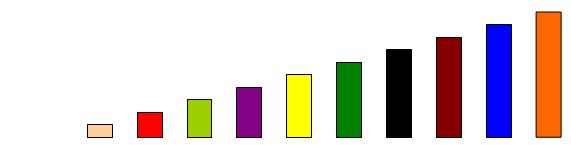
This is a great activity to introduce students to the value of numbers 1 through 10 by developing number sense. Initially students would be given 5 to 10 minutes to play with the rods (or any manipulative). After students would anaylze the rods to find relationships. Below is a diagram of the types of rods found in a Cuisenaire set. |
|
|
|
 |
|
|
|
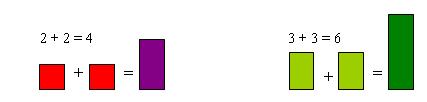
Some of the relationships students may point out include the increasing size of the rods, that some rods may be combined to equal the length of a longer rod, and that when you add two rods of the same color the resulting rod is equal in length and color as shown directly above. (Note: for the odd number 7 where a combination of two same color rods is not possible, the rod is black.)
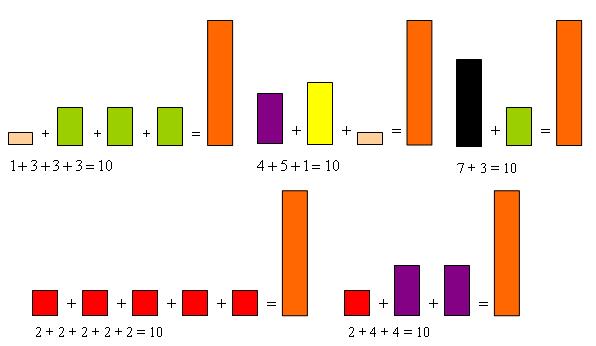
To build conceptual understanding students in each group will find 10 different combinations of rods that will equal the length of the orange rod. Some possible solutions are shown below. |
|
|
 |
|
|
 |
|
|
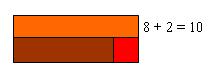
This is another way to visually show students how to add rods to equal the orange in length. |
|
|
|
|
|
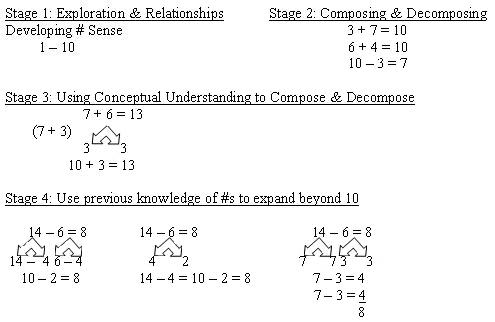
By using various rods to equal the length of the orange rod both conceptual and procedural skills are used. To increase procedural fluency students will work in pairs to compose and decompose the rods. Using this approach assures that students will not be primarily utilizing memorization skills but will be thinking mathematically and applying learned concepts, namely number sense and the quantity behind the numerical symbol. |
|
|
|
 |
|
|
|
After mastering number sense and basic composing and decomposing, extension activities would be based on changing the value of the rods. For example, instead of the yellow rod being equal to 5, as in my previous examples, it would be equal to 1. Students will then configure the value of the other rods and composing and decomposing would follow. Introducing equations, the composing/decomposing stage, is crucial for procedural fluency skills to develop and for manipulatives to hold substantial learning value.
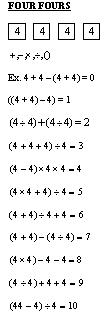
A problem solving activity for students to work on in groups to promote adaptive reasoning skills would be the four fours. The objectives is to use all four fours to equal 1 through 10. Addition, subtraction, multiplication, division, and parenthesis can be used. The first equation, which must equal 0, can be given as an example. |
|
|
 |
|
|
|
|
|
|
By concluding lessons with challenging group problem solving activities students ability to construct and solve problems grows. In this example, which is applicable to many brain teasers and word problems, students are able to to deepen their conceptual understanding by using procedures and formulas needed for higher level mathematics. |
|
|
|
|
|
 |
|
|
|
Math Home |
|
Mini -Lesson #2 |
|
Mini - Lesson #3 |
|
|
|
Group Math Lesson |
|
|
|
|
|
|
|
|
|
|
|
 |
|
|
|
Back to Home |
|
|
|