


Kristi Irwin, Lissette Rua, Anne Kratzer, & Jeremiah Olson
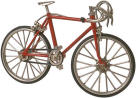
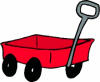
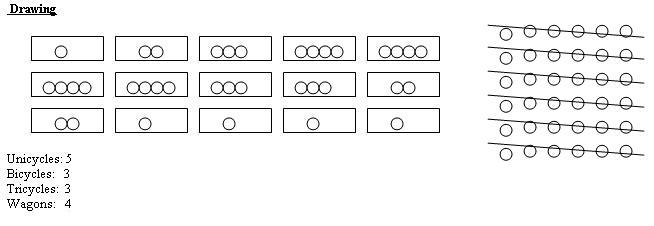
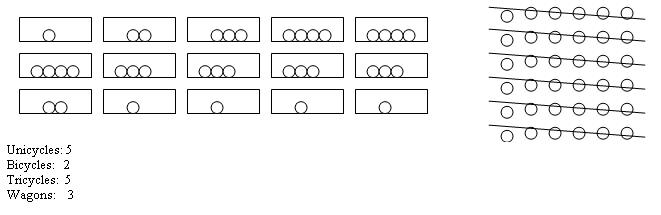
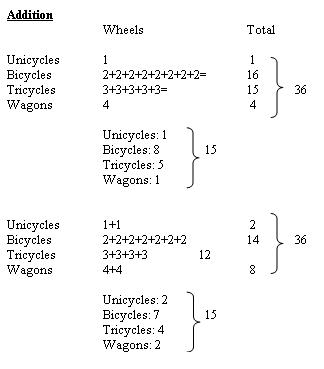
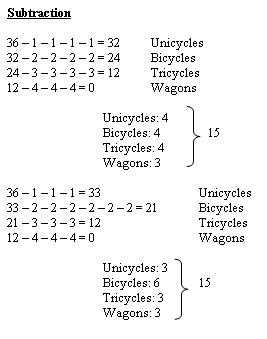
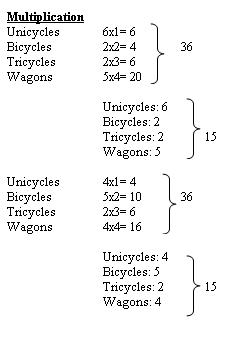
How many combinations of Tricycles, Bicycles, Wagons, and Unicycles could you find in a garage that contains exactly 15 vehicles with a total of 36 wheels? There is at least one Tricycle, one Bicycle, one Wagon, and one Unicycle in the garage at all times.
a. Fluency in disseminating numbers.
b. Building and enhancing number sense.
c. Formulating and representation of operation(s) to solve a problem.
d. Analyzation of solution to verify accuracy.
Stage Goal 6: Demonstrate and apply a knowledge and sense of numbers, including numeration and operation (addition, subtraction, multiplication, division), patterns, ratios, and proportions.
B. Investigate, represent and solve problems using number facts, operations (addition, subtraction, multiplication, division) and their properties, algorithms and relationships.
B.2. Solve one and two step problems involving whole numbers, fractions, and decimals using addition, subtraction, multiplication, and division.
The Illinois State Board of Education expects late elementary school students to be able to apply numerical operations in a way that relates to analyzation of possible events and occurences in their environment. This problem integrates students previous knowledge in how to multiply, add, and subtract to a new situation. It builds on previous knowledge students hold working with these concepts and challenges them to produce a reliable operation that will allow for multiple calculations to solve the problem. After solving for solutions, students must also be able to verify their work and check for accuracy. To help students connect procedures with representing a problem this particular question is open to multiple solution methods with varying ways to set up and solve the equation. By examining and comparing the methods students identify pointing out similarities, differences, advantages, and disadvantages, students connections will strengthen and conceptual understanding of numerical operations will improve.
1. Introduce problem. Do the four vehicles have the same amount of wheels? How can this help you solve the problem? (Make sure students are aware that there must be a total of 36 wheels in the garage.)
2. Have students compare various predictions.
3. Discussion.
a. Ask students (groups) to explain their solutions. Students need to explain the method(s) they used to
find the solution. Teachers role: Encourage students to find as many solution methods as possible.
b. Teacher and students will determine common themes used to find solutions. Teachers role: Walk
around to check students understanding and scaffold appropriately to encourage critical thinking.
c. Students (groups) will post their solutions on the chalkboard. As a class, determine and compare the
solution methods students used to determine their answers.
1. Ask students to figure out the maximum number of vehicles if
there is a specific number of any one vehicle.
For example, 6 wagons and 36 wheels or 7 tricycles and 36
wheels.
2. Ask students to figure out the minimum number of vehicles using
the same examples.

