| Scout Versus Tank |
 |
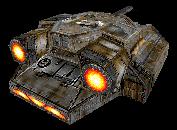 |
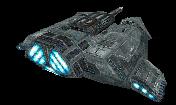
| Combat-Basic: To gain the foothold required to fight these behemoths of Wulfram II, you must know much, much more than simply what terrain is best. As you all ready know the above passage, flat terrain is the "anti-scout" when it comes to tank versus scout battles. However, a simple hill will never save you if you do not have the tactics devised to eliminate the your enemies. The first step to attacking a tank is to allow them to come to you if you are not able to find some form of hiding nearby them already. Once they are close enough, you must always remember what the experienced tank pilot will remember. When they fire that pulse, they will not rely on mere chance that they will hit you head on with their shell. Instead, they will fire it near enough to you that the blast radius consumes you and throws you off course. Therefore, you must remember to sidestep before even coming into view of your opponent. Shifting a small amount to the side, you can then jam on your thrusters and come out directly upon your tank enemy. With your altitude meter up 3/4 of the way you can easily look down upon your enemy without the uncomfortable shifting of crosshairs in unleveled terrain, which is why it is suggested. Above the tank, they will also have a difficult time looking up at you and following you on their screen. With your sidestep and altitude raising accomplished, you must be prepared to shift from your forward movement with the "w" key to strafing with the "a" or "d" and shift key. Those two keys that also allow you to sidestep are for strafing as well. Combined with shift, you will quickly slide clockwise or counterclockwise around your enemy. (Note: be sure to keep your crosshairs on the tank to do this.) Circling the tank continuously, use your chain gun and your repair beam (sparingly) to achieve victory in most situations. Fuel: One reason that so many players decide against piloting the scout is their lack of fuel. To make up for this, a scout has been given very high fuel regeneration when compared to a tank. However, be aware that even this high refuel rate will not assist you when in a skirmish against a tank. The scout's low tank even at maximum capacity must be watched if you seek victory. Just to do this, you must remember two main concepts. Number one, always use either strafe key with shift to gain that extra fuel in battle. Number two, always try and limit your usage of your secondary weapon and instead use full out attack with the chain gun. When in combat with one tank after another in quick succession, it is vital that you also remember to keep your crosshairs as close to the center of your target as possible for more damage and less fuel consumed. Combat-Advanced: Having mastered the basic skills and concepts of scout versus tank combat, you may now move on to more complicated tactics and moves. First off, aside from repeatedly circling your tank, you can use a simple technique called a "crossover". The crossover technique only requires you to get close enough to the tank so you would be able to strafe (as this strategy is best used when combined with strafing) and simply go right over your target tank. This will require them to turn 180 degrees to hit while you tear at their rear hull for a huge advantage. However, some tanks will take the chance to jump, which is where your close range radar comes in. When you hear the tell tale thrust of their engines or see them vanish into the air, look at your short range radar to follow their aerial path and quickly rush to their landing zone where you can begin the attack during the jump cool down time. If they decide not to jump, try to watch which way the enemy is turning to face you and strafe around them the opposite way to gain yet another edge on your victim. Another common strategy can be used in several situations. Once close to your target tank, quickly move like you are going to do a crossover but remain on top of them. Quickly raising your altitude to one hundred percent, you can thrust your crosshairs way down until you are pointing at your victim. Using difficult strategies, you can remain on top for a good amount of time and attack before they try to move from beneath you. (Note: this maneuver should be used sparingly due to lack of success.) The final strategy that is used by many scouts that will be mentioned is one of the most irritating to non-scout pilots. It is known to most as "peeking". Peeking is where you simply remain in your hiding spot and periodically pop up to fire a few shots before lowering yourself below range once more. This will allow you to get a few early shots off for a good advantage before you get into a dogfight with the tougher tank. Since you are in control of when firing will take place, they will have to follow you constantly until you charge out and assault them, giving you a brief edge in battle. To follow up this attack, you can do the normal charge and after one or two circles of your enemy tank you can quickly motor back behind your hill. Back there, lower your altitude for a quick refuel if need before raising it once more to finish off the tank is the situation allows it. |
| Terrain: The main disadvantage that many tank pilots (if not scout pilots) do not realize right off the bat is how much scouts are affected by flat terrain. The tank's primary weapon, the autocannon, has an exceedingly higher damage rate compared to the scout's chain gun. Specifically, the tank does ten hit points per hit while the scout does eight with the chain gun, Not only that, the autocannon also has a maximum range 150 meters higher than the chain gun. Combined, those two aspects alone team up to tear apart a scout in the initial run in an open terrain battle. Therefore, it is highly discouraged that you attempt rushing a tank if you do not lure them within four to three hundred meters of you first. The secondary weapon of the tank, the pulse shell, also greatly adds an advantage in all terrain, if slightly more of flat areas. The smart tank pilot will almost never rely on the luck of firing a pulse shell directly at the versatile scout. Instead, they will fire their explosive shell at the ground before your scout. This is due to the large blast radius given to a pulse shell which not only damages you, but also will send your scout for a ride. This is not unlike the impact of a flak shell or mine, though the explosion throws you a lot less distance. With all these difficulties in flat terrain, it is suggested that instead of obliterating yourself you should find hilly terrain (craters also count) to attack or lure and attack a tank. Even a maze or the pillars found in Fort Ruin will be sufficient to hide your scout from the devastating tank arsenal before you throw your own scout assault at your opponent. |
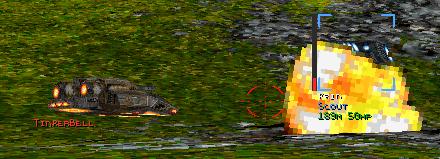
| What a dead on pulse shell will do to you... |
 |
 |
| To Main |