 |
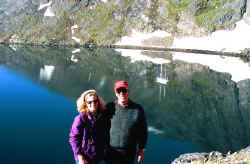
| Mark & Nancy at O’Brien Harbour |
Sunday, July 29th. Bright sunshine and fresh snow on the peaks signal the beginning of an auspicious day. We take a casual approach to the morning as we plan to await high tide to depart. With the very great tides of Hudson Bay, tidal currents through MacGregor and Gray Straits are severe, so we will depart at high water slack, in order to enjoy a favorable current, as we swing northeast out to sea. In final tribute, old Torngak has a special treat awaiting us as we near the harbor entrance point. In the roiling current in the straits are a number of herds of Harp seals, swimming in groups like synchronized Olympic competitors. Perched as far out on the point as the rocks will permit is a solitary adult polar bear, obviously earnestly hoping one unwary member of the water follies would stray near enough to the point that he might be afforded dinner. Summer must be a difficult time for a predator adapted to taking marine mammals on the ice, but he was making his best effort. Working our way in as close as seemed prudent in an area poorly charted, we rolled videotape and snapped camera shutters in the fervent hope that some sort of image may emerge to enable us to support our claim.
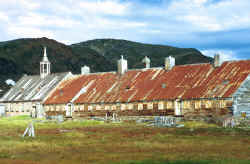 |
| Hebron, Labrador |
On our way north we had stopped at the historic Moravian Mission sites at Hebron and Ramah, both north of Cape Mugford. We would pass them by on our way south, but they deserve mention here. The Hebron site is still largely intact and is protected as a Canadian National Historic Site. Remains of the original timber framed structure, prefabricated in England in 1829, and the church and school dating from 1833, remain as testament to the piety, as well as the craftsmanship, of the Moravians. Abandoned in 1959, the Hebron site served as a school for Inuit children and trading post for 130 years. While we are not pious sorts, these structures, in this incredibly remote and challenging location, inspire awe. Unlike some other denominations’ efforts, the Moravians are still very much beloved by most Labrador Inuit. Their schools taught with bi-lingual instructional methods two hundred years before most others even used the term, and traditional native foods were generally served the resident Inuit students. Forty years after the closing of the Hebron mission, it is still very much missed by many, and resentment remains that the government did not see fit to continue funding the mission school after the Moravians were unable to do so. Occasional "Come Home" gatherings are held at Hebron with the reverence of a pilgrimage. The Moravians succeeded where others failed primarily because their preeminent emissary, Jens Haven, took the trouble to study the language before attempting to establish the Nain site in 1771. In later years the Moravians did similar work in western Alaska, including compiling a complete lexicon of the Yupik Eskimo language.
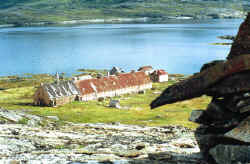 |
| Hebron, Labrador |
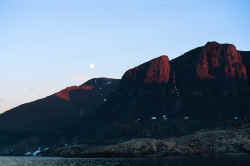 |
| Full Moon, Mugford, Labrador |
Ramah, situated well up a spectacular fjord, was of interest to us for a different reason. While once a mission site as well, there are only rudimentary foundations remaining. Our interest was geologic and anthropologic, in addition to scenic. Nancy is trained as a geologist, and both of us enjoy a very amateur interest in the history of Native Americans. The two interests are quite obviously united by a particularly fine-grained, hard, sedimentary rock composed predominantly of silica, known as Ramah chert. Chert has the property of fracturing conchoidally much like glass, and was the preferred material for stone-age tools. Ramah chert is of the highest quality, was used by numerous native groups for thousands of years, and found its way at least a thousand miles south via trade. We wanted a few pieces of this American Rosetta Stone.
Fine weather, nights only a few hours long, and a waxing moon gave us fair passage offshore, as we entered Mugford Tickle at 00:00 July 31st. Having been through this narrow pass three times before, we felt confident enough to do so in near darkness, even though the current can be severe. Slack tide, and a moon that cast its beams directly at us, affording sight of any ice growlers floating too low to appear on radar emboldened us further, and we anchored in Amity Harbor just as a dazzling display of the Aurora Borealis began. Nancy was so taken by the Northern Light show that our customary anchoring hand signals failed us, but we slept well as the sky was clear, the wind calm, and the bottom a firm holding mud. The morning brought caribou and a large black bear rooting methodically along the beach.
We will spend several days in the Cape Mugford area as it is among Labrador’s most spectacular, then work our way south along the coast as we decide whether or not to return to Portland via the east side of Newfoundland, as we have been along the west coast three times. Time, weather, and mechanical gremlins will decide the matter for us in due course. In the mean time a little rock hunting for Labradorite, and stops at a couple of old whaling and fishing stations should keep us focused on more than the abundant beauty of this coast.
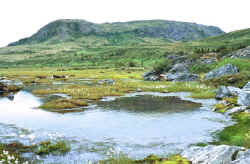 |
| Nutak, Labrador |
Labrador is one of the few places we know that has actually "de-developed", and has in essence been returning to the wild state. Since the Cod Moratorium of 1992, hundreds of small out-ports have been abandoned, and once thriving "fishing premises" are now ghost towns or historic sites like Battle Harbor. Whaling stations have long since been deserted, missions closed, and trading posts turned to humus. Even in her 1951 Geographic article, Miriam MacMillan points out, after the Bowdoin’s encounter with a fishing schooner, that 1,400 schooners each season once went north along this coast. By 1951 there were fifty. Now there are none. There are only those of us who seek solitude and the place less frequented, more challenging and difficult to attain, if only to reaffirm to ourselves how truly skilled, adventurous, and committed to the purpose those who came here years before us really were. All of this will change, of course, as the few existing roads are pressed farther northward each year. On this voyage we have seen only one other vessel in the last 800 miles of our cruise—a small cruise ship bound from Montreal to Churchill on the western shore of Hudson Bay, her passengers eager to pay for the same sights of auroras, ice, mountains, missions, seals and bears that brought us here. While I was grateful for the latest satellite information from her Ice Master, it saddens me to think that Labrador, like beautiful places everywhere, stands in danger of becoming yet another theme park. But if that is what is required to preserve all that is offered here, it may prove the price that must be paid.