 |
| Battle Harbour, Labrador |
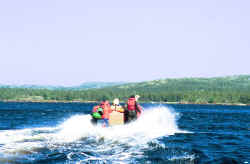 |
| Mary’s Harbour water taxi |
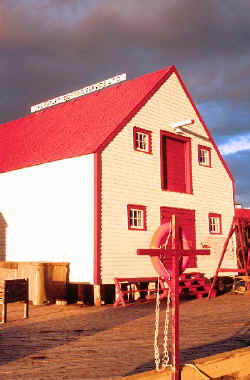
Battle Harbour, of course, is the site of the most famous "Outport" in Labrador. Once known unofficially as the "Capitol of Labrador", Battle Harbour was established as a fish premises about 1775 by the John Slade Company of Poole, England, and became the pre-eminent center for cod, salmon, and seal fisheries on the Labrador. Through a succession of two more ownerships, the site operated continuously in this trade until the collapse of the cod fishery in 1991. Long before then it had become the site of the first Grenfell Hospital to bring health care to Labrador, the venue for most legal and administrative affairs, location of the Marconi wireless station from which was transmitted the news of the press conference in which Peary asserted his claim of attaining the North Pole, and the source of production of millions of tons of salt cod over two hundred twenty years.
Battle Harbour has been extensively restored by the Battle Harbour Historic Trust. Magnificent buildings such as the Grenfell cottage, the Battle Harbor Inn, and other historic buildings are not only open to the public, but also available to rent as lodgings for private getaways, family reunions, or conferences. It remains largely undiscovered because of difficulty of access, although road and air service to near-by Mary’s Harbour is good, and water taxi service is available to Battle Harbour. The trust desperately needs funding to continue its work, and graciously welcomes yachts as well as lodgers.
We are weather bound here waiting out yet another full gale, and to allow sea ice, just a few days cruise to the north, to move offshore. The south west 40k gale today and tomorrow should help somewhat in that regard, and in the mean time we will enjoy the hospitality here as we steep ourselves in the history and tradition of this place that offers us the same that it gave schooners bound Down the Labrador for hundred of seasons before.
Friday July 13, 2001. Kangekluktanna Bay, Tunungayualok Island, Labrador. 56° 04’N, 61° 13’W. Winds easterly 30K, water temperature 37° F, air temperature 39° F. 1529 miles logged since departing Portland.
We call this place Wooden Shoe Cove. It was first recommended to us by a couple from Portsmith, NH, when we met them not far from here, a year ago, as they were returning from several years in Greenland aboard their husky North Sea work boat style motor-sailor. Their red Little Bear reminded me of the nursery rhyme, "Winkin, Blinkin and Nod, sailed off in a wooden shoe", as well as the pair of red wooden shoes my Danish stepmother had once worn to garden. Unable to pronounce the Inuit name, we penciled in that moniker on our chart. Although quite deep, the cove offers good protection from all but west winds, and we pushed hard last evening to reach its security, as unsettled weather continues to mark our passage this season.
Unsettled would be the most generous way to describe the climate to this point. Don’t get me wrong. Years fishing in Alaska taught me a long time ago never to bitch about the weather, as that was certain to bring about a change for the worse. I’ll simply let the log speak for itself. Since my last dispatch from Battle Harbour on July first, the weather forecast has posted a gale warning five days, and a storm warning two. Fog has been heavy every day, and rain frequent. Fortunately we have seen this coast before, so we know how stunningly beautiful it really is. This season, so far, we have been unable to attest to that fact. We simply haven’t seen much of it. However, we take some comfort in the realization that August is the best month here, as elsewhere in the high northern latitudes, and that the farther north one goes the more stunning this coast becomes. The up side to the series of southwesterly storms is that the remaining pack ice has now been pushed well off shore where it will finally disperse.
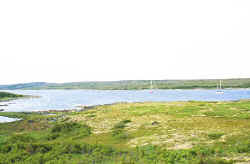 |
| Tamara & Rosita, Curlew Harbour, Labrador |
On July 8th we left Smokey Tickle to work our way around Cape Harrison. The cape is generally the choke point for late season pack ice pushed onto the coast by the Labrador Current and ice reports had coverage in the vicinity of the cape as high as eight-tenths sea ice. Fax images were poor, as heavy cloud coverage had obscured aerial observations. On the abandoned public wharf at Smokey were a small coastal freighter, a fishing boat, and two yachts. In addition to Nancy and me on Tamara, Woods Hole Oceanographic Institute Right Whale specialist Michael Moore, his wife Hanna and their four sons had moored their aluminum Kanter 55, Rosita. We had made their acquaintance while weather bound in Battle Harbour, and had made the run up the coast, past the famous Wonder Strand referred to in the Icelandic Sagas, in consort with their blood red cutter.
The Moores were on the final leg of a year long circuit of the Atlantic, during which they had conducted hydro-acoustic surveys for whales, while their sons learned much more of the world, the sea, and other cultures than most of us hope to assimilate in our lifetimes. For all of us made fast to the wharf the salient question was, "Where is the ice." Nothing surpasses local knowledge or a good on scene report, so we graciously allowed the freighter and fishing boat to proceed us. A few hours later a radio call to the freighter reported that only numerous large bergs, and their more dangerous spawn, low floating "growlers", remained. The pack was gone. Although the thick fog required a very sharp lookout, we were relieved to be clear of the pack, and we rounded Cape Harrison. I’d been in the pack ice a few times before, in the Bering Sea, but even though Tamara is built of steel, I had no intention to intentionally put her in the ice. Sadly for us, however, as we came to enjoy their company very much, the Moores decided that the time had come to begin their cruise toward home, school, jobs and family. Rosita turned south.
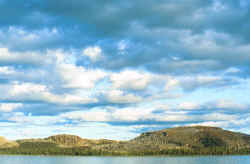 |
| Davis Inlet, Labrador |
A day later we arrived in Makkovik, a predominantly Inuit community on the mid-Labrador coast that we enjoyed very much on our prior cruise. The people of Makkovik take great pride in their village, and are exceptionally hospitable and helpful. We found it to be the best place to refuel, take on water and stores, go out for a meal off the boat and prepare for the next leg of the cruise. It was in Makkovik that a Canada Fisheries and Ocean officer, who remembered us from the year before, informed me that he had just received satellite imagery that showed that the pack ice cleared off Cape Harrison on July 6th. Our timing had been about as good as we could have hoped.
While tied up to the wharf at Makkovik, we could observe the common docking procedure of the coastal freighters that serve the Labrador coast. As large wharves are not feasible due to cost and the remote location, the ships are instead moored stern-to the wharf, enabling them to lower a stern ramp for vehicles and roll on/roll off cargo. This maneuver necessitates dropping anchors off the wharf, pivoting on the chain, and then backing down until mooring lines can be passed ashore. In the confined harbors, without bow thrusters or even twin-screw propulsion, this requires an extraordinary degree of seamanship.
A day’s run from Makkovik, through numerous islands and rock outcrops, lays Hopedale, a Moravian village established in 1782 by Jens Haven. Haven, a Dane, was a master carpenter who felt called to the church. Aware of the tragic attempt by the Moravians to establish a mission near Makkovik in 1752, Haven studied the native language and customs in Greenland prior to making three reconnaissance voyages to Labrador. This preparation allowed Haven to avoid the violent confrontation with the Inuit that had scuttled the 1752 attempt, and enabled the future success of numerous mission sites. An original mission building remains in Hopedale, and is Canada’s oldest wooden structure east of Quebec.
The first successful mission set up by Haven was at Nain, another couple of day’s run to the north. Established in 1771, the timber-framed buildings were pre-fabricated in England, and erected on site by Haven and three other missionaries on land granted by the Crown of England. The Moravians initiated mission and trading activities in that year. The Crown facilitated this effort, as it furthered the policy of precluding intrusion by the French, and was in an area that the Crown monopoly Hudson Bay Company had ignored. Thus the missions could bring the influence of the Crown to the region, while costing the exchequer nothing, as the missions were to be self-supported by trade in fish and fur. Nain remains the primary center of Labrador Inuit population. It is there that we will top off our fuel tanks, take on final stores, and send this dispatch.
A few miles beyond Nain is the tree line, but no diminution in beauty is brought about by that fact of geography. To the contrary, the geology begins to dominate the geography, and it is indeed spectacular. The Cape Mugford area (named after the master of the ship first bringing the Moravians to the region, and the landfall beacon for a long succession of Moravian ships all named "Harmony") evokes images of the American Southwest. Remains of the 1773 mission at Okak, existing buildings of the 1829 mission at Hebron, and other sites stand as testament to the tenacity, as well as the craftsmanship, of the Moravians. Caribou, bird rookeries, the beginning of Polar bear range, and superb Arctic Char fishing all combine to make one easily forgo trees for a few weeks. We will make our way along the coast as far north as we are able, with our objective being Iqaluit, Nunavuit, at the head of Frobisher Bay, Baffin Island. That is, of course, if the ice and currents of Hudson Straits permit our passage. With the blessings of the spirits of the Torngat, we will have a safe and rewarding passage.