What is an Atom?
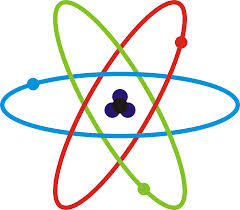 The atom is a basic unit of matter that consists of a dense central nucleus surrounded by a cloud of negatively charged electrons. The atomic nucleus contains a mix of positively charged protons and electrically neutral neutrons (except in the case of hydrogen-1, which is the only stable nuclide with no neutrons). The electrons of an atom are bound to the nucleus by the electromagnetic force. Likewise, a group of atoms can remain bound to each other by chemical bonds based on the same force, forming a molecule. An atom containing an equal number of protons and electrons is electrically neutral; otherwise it is positively or negatively charged and is known as an ion. An atom is classified according to the number of protons and neutrons in its nucleus: the number of protons determines the chemical element, and the number of neutrons determines the isotope of the element.
Chemical atoms, which in science now carry the simple name of "atom," are minuscule objects with diameters of a few tenths of anemometer and tiny masses proportional to the volume implied by these dimensions. Atoms can only be observed individually using special instruments such as the scanning tunneling microscope. Over 99.94% of an atom's mass is concentrated in the nucleus, with protons and neutrons having roughly equal mass. Each element has at least one isotope with an unstable nucleus that can undergo radioactive. This can result in a transmutation that changes the number of protons or neutrons in a nucleus. Electrons that are bound to atoms possess a set of stable energy levels, or orbitals, and can undergo transitions between them by absorbing or emitting photons that match the energy differences between the levels. The electrons determine the chemical properties of an element, and strongly influence an atom's magnetic properties. The principles of quantum mechanics have been successfully used to model the observed properties of the atom.
Origin
 The name atom comes from the Greek ἄτομος (atomos, "indivisible") from ἀ- (a-, "not") and τέμνω (temnō, "I cut"), which means indivisible, something that cannot be divided further. The concept of an atom as an indivisible component of matter was first proposed by early Indian and Greek philosophers. In the 18th and 19th centuries, chemists provided a physical basis for this idea by showing that certain substances could not be further broken down by chemical methods, and they applied the ancient philosophical name of atom to the chemical entity. During the late 19th and early 20th centuries, physicists discovered subatomic components and structure inside the atom, thereby demonstrating that the chemical "atom" was divisible and that the name might not be appropriate. However, it was retained. This has led to some debate about whether the ancient philosophers, who intended to refer to fundamental individual objects with their concept of "atoms," were referring to modern chemical atoms, or something more like indivisible subatomic particles such as leptons or quarks, or even some more fundamental particle that has yet to be discovered.
The large majority of an atom's mass comes from the protons and neutrons that make it up. The total number of these particles (called "nucleons") in a given atom is called the mass number. The mass number is a simple whole number, and has units of "nucleons." An example of use of a mass number is "carbon-12," which has 12 nucleons (six protons and six neutrons).
The actual mass of an atom at rest is often expressed using the unified atomic mass unit (u), which is also called a dalton (Da). This unit is defined as a twelfth of the mass of a free neutral atom of carbon-12, which is approximately 1.66×10⁻²⁷ kg. Hydrogen-1, the lightest isotope of hydrogen and the atom with the lowest mass, has an atomic weight of 1.007825 u. The value of this number is called the atomic mass. A given atom has an atomic mass approximately equal (within 1%) to its mass number times the mass of the atomic mass unit. However, this number will not be an exact whole number except in the case of carbon-12 (see below). The heaviest stable atom is lead-208, with a mass of 207.9766521 u.
As even the most massive atoms are far too light to work with directly, chemists instead use the unit of moles. One mole of atoms of any element always has the same number of atoms (about6.022×1023). This number was chosen so that if an element has an atomic mass of 1 u, a mole of atoms of that element has a mass close to one gram. Because of the definition of the unified atomic mass unit, each carbon-12 atom has an atomic mass of exactly 12 u, and so a mole of carbon-12 atoms weighs exactly 0.012 kg.