previous page in this Vignetting
article
Now , there are 3 types of accidental vignetting.
They are , mechanical , natural and optical vignetting.
Mechanical vignetting is the easiest to see in the viewfinder as the
light fall off areas on the frame are quite well defined.
Most often this is a users poor choice of filters or lens hoods.
A simple check with these lens accessories removed will instantly
inform the user as to the trouble.
Natural vignetting is something which is very hard to get around , and
is present in ALL lenses regardless of cost or brand name.
Also referred to as the ¨cos4 law of illumination falloff¨ it
is all do do with angles and the distance light has to travel to the
corners of the frame.
Wide angle lenses tend to suffer greater than standard focal length or
tele lenses.
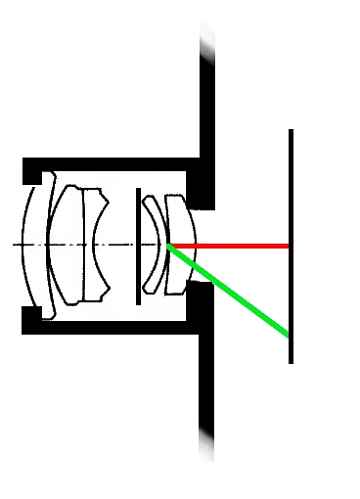
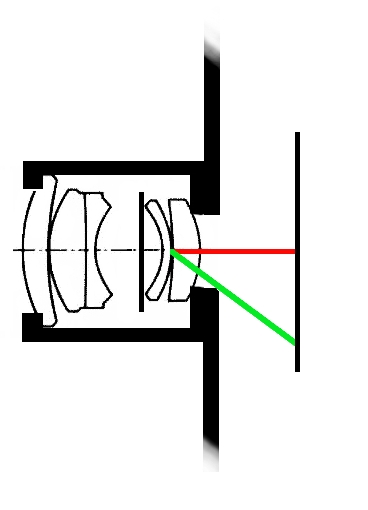
See how the green line is longer than the red line.
The longer distance means less light.
Lens manufacturers try very hard to get as equal illumination across
the film plane , but they can only do so much.
Some point and shoot cameras with EXTREMELY simple lenses can have this
vignette effect , especially if their lens is slightly wide angle.
If you suspect your lens has excessive natural vignetting this can be
tested easily , as it does not go away with any aperture or focus
setting and it affects ALL pictures with that lens.
next page in this Vignetting article