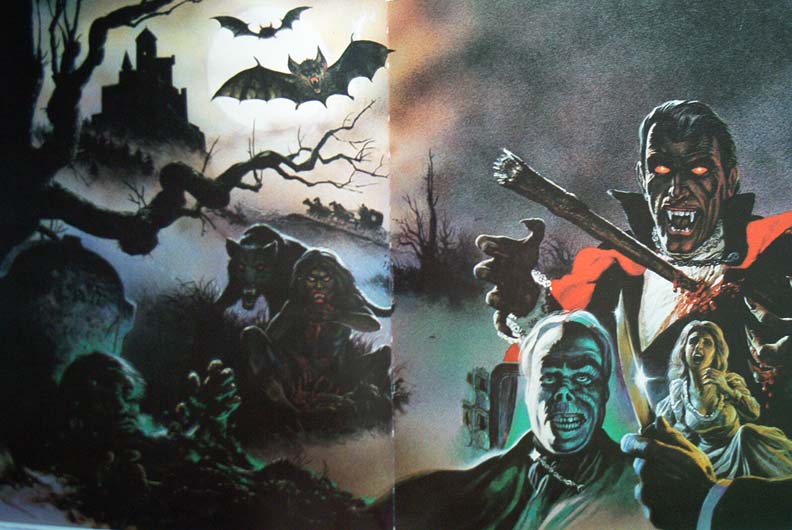
Picture taken from Fantastic People - Magical Races of Myth and Legend
The Undead
We give unto you our flesh and blood
Our friends and our acquaintances
Enemies and those we dislike
All are given in your name.
One day we too shall come into your embrace
As this one that we submit now shall come
We ask in your name, and the names of your divine family
That you accept into your cold realm that which we offer
That which was living, has now demised
That which spoke is now silent
What was warm is now cold
That which was young
Is now old
And gone.
Take into your kingdom the deceased.
And may they forever rest in peace.
-Funeral Rite, given at service by the Priest of Mortimus
Picture taken from Fantastic People - Magical Races of
Myth and Legend
The presence of an Afterlife is undisputed amongst theologians. The exact nature of such an Afterlife is, unfortunately, unknown - those reincarnated cannot remember, and those who live on beyond the grave cannot - or will not - reveal it's secrets. Even spirits seem under a compulsion not to reveal details of the Afterlife, which has frustrated many over the centuries.
The cycle of life seems simple, at a glance. One is born, grows, possibly reproduces as one ages, before one's eventual demise in one of myriad ways. However, the presence of many of the most feared types of opponent does show that this simple formula isn't exactly right, and that it can be altered or manipulated by other factors, some of them divine, some of them mortal (the powerful Necromancers Guild are especially of note here).
While there are many types of undead encountered, scholars rue the fact that many common people cannot differentiate between several of the types of undead, which has led to a lack of knowledge about some of the lesser encountered varieties. Thus, this document, helpfully compiled by the Corpus Mortimus, is intended to help shed light and understanding on those that persist with a kind of un-life after death.
- Sir Cedric Glenarvon
Servant of the Cold Lord Mortimus

In alphabetical order...
Banshees
Death Knights
Ghasts, Ghouls & Lacedons
Ghosts
Liches
Mummies
Revenants
Skeletons
Vampires
Wights
Wraiths
Zombies
The
banshee or groaning spirit, is the spirit of an evil female elf -- a very rare
thing indeed. Banshees hate the living, finding their presence painful,
and seek to harm whomever they meet.
Banshees appear as floating, luminous phantasms of their former selves. Their image glows brightly at night, but is transparent in sunlight. Most banshees are old and withered, but a few who died young retain their former beauty. The hair of a groaning spirit is wild and unkempt. Her dress is usually tattered rags. Her face is a mask of pain and anguish, but hatred and ire burns brightly in her eyes. Banshees frequently cry out in pain -- hence their name.
Banshees
loathe all living things and thus make their homes in desolate countryside or
ancient ruins. There they hide by day, when they cannot keen, and wander the
surrounding countryside by night. The land encircling a groaning spirit's lair
is strewn with the bones of beasts who heard the groaning spirit's cry. Once a
groaning spirit establishes her lair she will remain there.
The treasure of groaning spirits varies considerably and often reflects
what they loved in life. Many hoard gold and fine gems. Other groaning spirits,
particularly those that haunt their former homes, show finer tastes, preserving
great works of art and sculptures, or powerful magical items.
It is nearly impossible to distinguish the cry of a groaning spirit from
that of a human or elf woman in pain. Many a knight gallant has mistaken the two
sounds, and then paid for the mistake with his life. Banshees are exceptionally
intelligent and speak numerous languages, including the common, elven, and
other demihuman languages. Banshees occasionally use their destructive powers to
seek revenge against their former adversaries in life.
A
death knight is the horrifying corruption of a paladin or lawful good warrior
cursed by the gods to its terrible form as punishment for betraying the code of
honor it held in life.
A
death knight resembles a hulking knight, typically taller than 6 feet and
weighing more than 300 pounds. Its face is a blackened skull covered with shards
of shriveled, rotting flesh. It has two tiny, glowing orange-red pinpoints for
eyes. Its armor is scorched black as if it had been in a fire. The demeanor of a
death knight is so terrifying that even kender have been known to become
frightened. A death knight's deep,
chilling voice seems to echo from the depths of a bottomless cavern. A death
knight converses in the language it spoke in its former life, as well as up to
six additional languages.
Death knights are former good warriors who were judged by the gods to be
guilty of unforgivable crimes, such as murder or treason. Death knights
are often cursed to remain in their former domains, usually castles or other
strongholds. They are further frequently condemned to remember their crime in
song on any night when the moon is full; few sounds are as terrifying as a death
knight's chilling melody echoing through the moonlit countryside. Death knights
are likely to attack any creature that interrupts their songs or trespasses in
their domains.
Ghouls
are undead creatures, once human, who now feed on the flesh of corpses. Although
the change from human to ghoul has deranged and destroyed their minds, ghouls
have a terrible cunning which enables them to hunt their prey most effectively.
Ghouls are vaguely recognizable as once having been human, but have become horribly disfigured by their change to ghouls. The tongue becomes long and tough for licking marrow from cracked bones, the teeth become sharp and elongated, and the nails grow strong and sharp like claws.
Ghasts are so like ghouls as
to be completely indistinguishable from them, and they are usually found only
with a pack of ghouls. When a pack of ghouls and ghasts attacks it will quickly
become evident that ghasts are present, for they exude a carrion stench in a 10'
radius
Lacedons are a marine form of ghoul - they are very rare due to the lack of corpses to feed on, which explains the more prolific amounts of Sea-Zombies instead of Lacedons.
Ghosts are the spirits of humans who were either so greatly evil in life or whose deaths were so unusually emotional they have been cursed with the gift of undead status. Thus, they roam about at night or in places of darkness. These spirits tend to hate goodness and life, hungering to draw the living essences from the living.
:
In most cases, a ghost is confined to a small physical area, which the
ghost haunts. Those who have heard stories of a haunted area can thus attempt to
avoid it for their own safety.
A ghost often has a specific purpose in its haunting, sometimes trying to
``get even'' for something that happened during the ghost's life. Thus a woman
who was jilted by a lover, and then committed suicide, might become a ghost and
haunt the couple's secret trysting place. Similarly, a man who failed at
business might appear each night at his storefront or, perhaps, at that of a
former competitor.
Another common reason for an individual to become a ghost is the denial
of a proper burial. A ghost might inhabit the area near its body, waiting for a
passerby to promise to bury the remains. The ghost, in its resentment toward all
life, becomes an evil creature intent on destruction and suffering.
In rare circumstances, more than one ghost will haunt the same location.
The classic example of this is the haunted ship, a vessel lost at sea, now
ethereal and crewed entirely by ghosts. These ships are most often encountered
in the presence of St. Elmo's fire, an electrical discharge that causes
mysterious lights to appear in the rigging of a ship.
In many cases, a ghost can be overcome by those who might be no match for
it in combat simply by setting right whatever events led to the attainment of
the ghost's undead status. For example, a young woman who was betrayed and
murdered by someone who pretended to love her might be freed from her curse if
the cad were humiliated and ruined. In many cases, however, a ghost's revenge
will be far more demanding, often ending in the death of the offender.
The
dreadful fear caused by the ghost, which ages a victim 10 years, is not well
understood by the common man, who often ascribes it to the fact that a ghost is
``dead.'' If this were the case, then certainly skeletons and zombies would have
the same effect, which they do not.
Common folklore further confuses this fact by relating details of the ghost's physical form: the classic example of which is the headless horseman, thought by many to be particularly frightening simply because he had no head. Under this belief, one could face a ghost if only one had the courage to stand up to him. Such a mistaken impression has cost many lives over the years. Actually, the fear is caused by the supernatural power of the ghost, and has nothing whatsoever to do with courage.
The
lich is, perhaps, the single most powerful form of undead known to exist. They
seek to further their own power at all costs and have little or no interest in
the affairs of the living, except where those affairs interfere with their own.
A lich greatly resembles a wight or mummy, being gaunt and skeletal in
form. The creature's eye sockets are black and empty save for the fierce
pinpoints of light which serve the lich as eyes. The lich can see with normal
vision in even the darkest of environments but is unaffected by even the
brightest light. An aura of cold and darkness radiates from the lich which makes
it an ominous and fearsome sight. They were originally wizards of great power.
Liches are often garbed in the rich clothes of nobility. If not so attired, the lich will be found in the robes of its former profession. In either case, the clothes will be tattered and rotting with a good chance of being magical in some way.
A
lich is able to employ spells just as it did in life. It still requires the use
of its spell books, magical components, and similar objects. It is important to
note that most, if not all, liches have had a great deal of time in which to
research and create new magical spells and objects. Thus, adventurers should be
prepared to face magic the likes of which they have never seen before when
stalking a lich. In addition, liches are able to use any magical objects which
they might possess just as if they were still alive.
Defeating a lich in combat is difficult indeed, but managing to actually
destroy the creature is harder still. In all cases, a lich will protect itself
from annihilation with the creation of a phylactery in which it stores its life
force. This is similar to a magic jar spell. In order to ensure the final
destruction of a lich, its body must be wholly annihilated and its phylactery
must be sought out and destroyed in some manner. Since the lich will always take
great care to see to it that its phylactery is well hidden and protected this
can be an undertaking fully as daunting as the defeat of the lich in its
physical form.
Liches
are usually solitary creatures. They have cast aside their places as living
beings by choice and now want as little to do with the world of men as possible.
From time to time, however, a lich's interest in the world at large may be
reawakened by some great event of personal importance.
A lich will make its home in some ominous fortified area, often a strong
keep or vast subterranean crypt.
When
a lich does decide to become involved with the world beyond its lair, its keen
intelligence makes it a dangerous adversary. In some cases, a lich will depend
on its magical powers to accomplish its goals. If this is not sufficient,
however, the lich is quite capable of animating a force of undead troops
to act on its behalf. If such is the case, the lich's endless patience and
cunning more than make up for the inherent disadvantages of the lesser forms of
undead which it commands.
Although
the lich has no interest in good or evil as we understand it, the creature will
do whatever it must to further its own causes. Since it feels that the living
are of little importance, the lich is often viewed as evil by those who
encounter it. In rare cases, liches of a most unusual nature can be found which
are of any alignment.
The lich can exist for centuries without change. Its will drives it onward to master new magics and harness mystical powers not available to it in its previous life. So obsessed does the monster become with its quest for power that it often forgets its former existence utterly. Few liches call themselves by their old names when the years have drained the last vestiges of their humanity from them. Instead, they often adopt pseudonyms like ``the Black Hand'' or ``the Forgotten King.'' Learning the true name of a lich is rumored to confer power over the creature.
Mummies are corpses native to dry desert areas, where the dead are usually entombed by a process known as mummification. When their tombs are disturbed, the corpses become animated into a weird unlife state, whose unholy hatred of life causes them to attack living things without mercy. Mummies are usually (but not always) clothed in rotting strips of linen. They stand between 5 and 7 feet tall and are supernaturally strong.
Mummies
are the product of an embalming process used on wealthy and important
personages. Most mummies are corpses without magical properties. On occasion,
perhaps due to powerful evil magic or perhaps because the individual was so
greedy in life that he refuses to give up his treasure, the spirit of the
mummified person will not die, but is transformed into an undead horror. Most
mummies remain dormant until their treasure is taken, but then they become
aroused and kill without mercy.
A mummy lives in its ancient burial chamber, usually in the heart of a crypt or pyramid. The tomb is a complex series of chambers filled with relics. These relics include models of the mummy's possessions, favorite items and treasures, the bodies of dead pets, and foodstuffs to feed the spirit after death. Particularly evil people will have slaves or family members slain when they die so the slaves can be buried with them.
Revenants are vengeful spirits that have risen from the grave to destroy their killers. The revenant appears as a spectral, decayed version of its appearance at the time of its death. Its pallid skin is drawn tightly over its bones. The flesh is cold and clammy. The sunken eyes are dull and heavy-lidded but, when the revenant faces his intended victim, the eyes blaze with unnatural intensity. The revenant bears an aura of sadness, anger, and determination.
The
sole purpose of the revenant's brief existence is to wreak vengeance on its
killer, together with anyone who may have aided in the murder. It stops at
nothing to achieve its purpose and can locate its intended victim wherever he
may be. Accomplices are also tracked down if they are in the company of the
killer, but if they are elsewhere they are ignored until the killer is dealt
with. If the associates of the killer are with him in a party, they are dealt
with after the killer is dead.
The revenant's body does decay, though at a slower rate than normal.
Within three to six months, the corpse decomposes rapidly and the revenant's
spirit returns to the plane from which it came. When the revenant has completed
its mission, the body immediately disintegrates and its spirit finally rests in
peace. A revenant does not attack
innocents except in self-defense. If necessary, the revenant can use cunning to
get to its prey.
Revenants
give murder victims a chance to avenge their own murders. They pursue their
goals alone without desire or need for allies. However, if the revenant faces a
All skeletons are magically animated undead monsters, created as guardians or warriors by powerful evil wizards and priests. Skeletons appear to have no ligaments or musculature which would allow movement. Instead, the bones are magically joined together during the casting of an animate dead spell. Skeletons have no eyes or internal organs. Skeletons can be made from the bones of humans and demi-humans, animals of human size or smaller, or giant humanoids like bugbears and giants. There have even been reports (although unconfirmed) of a skeletal dragon, but these must bear further scrutiny.
Skeletons
have no social life or interesting habits. They can be found anywhere there is a
wizard or priest powerful enough to make them. Note that some neutral priests of
deities of the dead or dying often raise whole armies of animated followers in
times of trouble. Good clerics can make skeletons only if the dead being has
granted permission (either before or after death) and if the cleric's deity has
given express permission to do so. Otherwise, violating the eternal rest of any
being or animal is something most deities disapprove of highly.
Skeletons have almost no minds whatsoever, and can obey only the simplest one- or two-phrase orders from their creators. Skeletons fight in unorganized masses and tend to botch complex orders disastrously. It is not unheard of to find more than one type of skeleton (monsters with animals, animals with humans) working together to protect their master's dungeon or tower.
In ages long past, the word ``wight'' meant simply ``man.'' As the centuries have passed, though, it has come to be associated only with those undead that typically inhabit barrow mounds and catacombs. From a distance, wights can easily be mistaken for any number of humanoid races. Upon closer examination, however, their true nature becomes apparent. As undead creatures, wights are nightmarish reflections of their former selves, with cruel, burning eyes set in mummified flesh over a twisted skeleton with hands that end in sharp claws.
Like
the other undead that infest the world, wights live in barrow mounds, catacombs,
and other sepulchral places. They despise light and places which are vibrant
with living things. As a rule, the wight is hateful and evil, seeking to satisfy
its hatred of life by killing all those it encounters.
Although wights are often found in small groups, they are actually
solitary creatures. Without exception, encounters with multiple wights will be a
single leader and a number of lesser creatures which it has created to serve it.
In these cases, the leader of the group will be more than willing to sacrifice
some or all of its minions to assure its own survival or victory.
The wraith is an evil undead spirit of a powerful human that seeks to absorb human life energy. These horrible creatures are usually seen as black, vaguely man-shaped clouds. They have no true substance, but tend to shape themselves with two upper limbs, a torso, and a head with two glowing red eyes. This shape is a convenience born from the habit of once having a human body.
A
wraith is an undead spirit of a powerful, evil human. As such, it is usually
found in tombs or places where such men and women would have died. Since such
men and women are frequently buried together, in the case of the wealthy, or
with their families, wraiths are most commonly encountered in packs. Those that
died or were buried alone might still be encountered in packs, because a human
who dies from the touch of a wraith becomes a wraith under the sway of its
slayer. The treasure of the wraith is usually its possessions in life, now
buried with it, or those of its victims. Wraiths exist only to perpetuate evil
by absorbing the life force of as many people as possible. A character who
becomes a wraith is nearly impossible to recover, requiring a special quest.
The wraith cannot communicate, except through a speak with dead
spell. They do not even seem to communicate with each other, except as master to
slave for combat strategy. Any attempt to speak to a wraith is met with scorn,
unless by a very powerful party. In that case, the wraith desires only to flee.
Wraiths can be dominated by powerful evil creatures, particularly other undead,
priests, and wizards, and made to serve their will.
Zombies are mindless, animated corpses controlled by their creators, usually evil wizards or priests. The condition of the corpse is not changed by the animating spell. If the body was missing a limb, the zombie created from it would be missing the same limb. Since it is difficult to get fresh bodies, most zombies are in sorry shape, usually missing hair and flesh, and sometimes even bones. This affects their movement, making it jerky and uneven. Usually zombies wear the clothing they died (or were buried) in. The rotting stench from a zombie might be noticeable up to 100 feet away, depending upon the condition of the body. Zombies cannot talk, being mindless, but have been known to utter a low moan when unable to complete an assigned task. Zombies are typically found near graveyards, dungeons, and similar charnel places where they are likely to have been buried or left to rot.
A more powerful type of zombie, the Ju-Ju Zombie, is made when a wizard drains the life force from a man-sized humanoid creature with an energy drain spell. Their skin is hard, gray, and leathery. Ju-Ju zombies have a spark of intelligence. A hateful light burns in their eyes, as they realize their condition and wish to destroy living things. They understand full-sentence instructions with conditions, and use simple tactics and strategies. Since they became zombies at the moment of death, their bodies tend to be in better condition. They are dexterous enough to use normal weapons, although they must be specifically commanded to do so. These are truly dangerous creatures, and, if encountered, flight is a most advisable course of action.
The zombie lord is a living creature that has taken on the foul powers and abilities of the undead. They are formed on rare occasions as the result of a raise dead spell gone awry. Zombie lords look as they did in life, save that their skin has turned to the pale grey of death, and their flesh is rotting and decaying. The odor of vile corruption and rotting meat hangs about them, and carrion feeding insects often buzz about them to dine on the bits of flesh and ichor that drop from their bodies. The zombie lords can speak those languages they knew in life and they seem to have a telepathic or mystical ability to converse freely with the living dead. Further, they can speak with dead merely by touching a corpse. When forced into combat, it relies on the great strength of its two crushing fists. The odor of death surrounding the zombie lord is so potent it causes horrible effects in those who breathe it for any period of time.
Zombie
lords seek out places of death as lairs. Often, they live in old graveyards or
on the site of a tremendous battle -- any place there may be bodies to animate
and feast upon. The mind of the zombie lord tends to focus on death and the
creation of more undead. The regions around their lairs are often littered with
the decaying bodies, half eaten, of those who have tried to confront the foul
beast. The zombie lord comes into
being by chance, and only under certain conditions, which have not been
definitely confirmed by any means - few are foolhardy enough to try this method
of finalizing the theoretical procedure once and for all.
