
The Study of Sanskrit
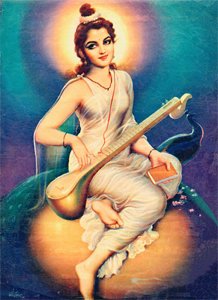
Sarasvati, Goddess of knowledge in India -- By Wong Ka Man, Kevin (2003240144)<
|
Morphology - Verbs - Tenses
Phonology - Sandhi
Influence - Hinduism - Buddhism
Culture - Numerals
|
Sanskrit is the most ancient language in the Indo-European family of world languages and it is proved to be of unique importance for the study of the Indo-Aryan languages on account of its antiquity and well-preserved structure. Sanskrit ( Sanskrit is mostly used as a ceremonial language in Hindu religious rituals in the forms of hymns and mantras. Its pre-classical form of Vedic Sanskrit, the liturgical language of the Vedic religion, is one of the earliest attested members of the Indo-European language family, its most archaic text being the Rigveda. It would be misleading to call Sanskrit a dead language because for many centuries huge numbers of works in all genres and on all subjects continued to be written in Sanskrit. Original works are still written in it, although in much smaller numbers than formerly. Many students still learn Sanskrit as a second or third language, classical music concerts regularly feature Sanskrit vocal compositions, and there are even television programs conducted entirely in Sanskrit.
|
|||||||||||||||||||||||||||||||||
 ) means properly (
 )
crafted (
)
crafted ( ) or a refined (grammatically)
language. It is regarded as the language of the Gods. Indeed it is believed that
the phonology of all speech was created when Lord Nataraaja sounded his double
drum.
) or a refined (grammatically)
language. It is regarded as the language of the Gods. Indeed it is believed that
the phonology of all speech was created when Lord Nataraaja sounded his double
drum.