 |
| "No! It's not an ape!" - Professor Trevor "Broom" Bruttenholm |
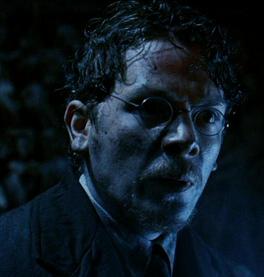
| Professor Broom instinctively fights for and seeks to understand Hellboy from the beginning. Hellboy's nature as a creature who is easily misunderstood is evident in his first appearance. Broom dismisses idea that Hellboy is an ape and tells the soldier to lower his light so as not to scare the creature. He identifies the "stone in its hand" as Hellboy's actual hand and keeps Whitman and the rest of the group from opening fire. He gives young Hellboy a Baby Ruth bar and coaxes him down from a high ledge into a blanket. In this way, his role as Hellboy's protector and nurturer takes shape from their very first meeting. |
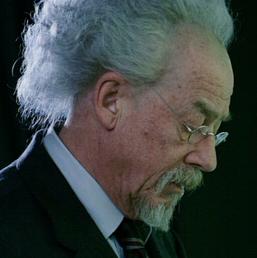 |
| As Broom grows older, he is faced with the reality of his own mortality. Diagnosed with malignant sarcoma and given only a few weeks to live, he must make arrangements for Hellboy's future. The diagnosis scene shows Broom's reliance upon the supernatural as well as the film's odd collision of Pagan and Christian religious symbols. As he is buttoning his shirt, we see his ever-present Rosary and in the next scene, he gets confirmation of the diagnosis by dealing the Death card from a Tarot deck. |
| This is the only time we see Broom actively utilizing esoteric tools, but it confirms his response to Sgt. Whitman's question, "Are you a Catholic?" to which he replied, "Yes, among other things." It is important, though, that the primary religious symbol associated with Professor Broom is the cross, both on his Rosary and in his first appearance as he is overshadowed by an enormous crucifix. There is another layer of importance in this scene. When he is offered hospitalization and pain management, Broom declines. He says he would rather be at home and that he has arrangements to make for his son. He is not the only one to call Hellboy "son" and Hellboy's other father is making arrangements of his own. But the idea of Hellboy as Rasputin's son is almost more of a ruse for the sorcerer. "It is close to me, the child's true name," he tells Broom later in the film, "Would you like to know it?" Broom's response is telling. "I know what to call him," he says, "Nothing you can do or say can change that. I call him�son." It is shortly after this moment that Broom is killed by Kroenen. But Broom does not struggle or fight. He knows he can't win. He surrenders, offering himself to be killed instead of clinging to life. "I'm ready," he says, as he finally removes the Rosary from his wrist. This is a fundamental difference between Broom and Rasputin. Rasputin is characterized by his ability to cheat death, constantly re-emerging throughout history in successive attempts to bring his dream, his legacy to fruition. He believes himself to be of utmost importance and trusts in no one but himself to get the job done. Broom knows he is going to die, one way or another. The way he accepts his death as an inevitable part of life when he is diagnosed is a signal that he is not just surrendering to Rasputin and Kroenen because he is old and can't fight. He surrenders to them the same way he surrenders to the cancer - calmly and resolutely. Broom does not fear death. Rasputin, with all his apparent strength and ruthlessness, seems to fear death above all else, constantly trying to guarantee eternal life for himself. Broom is at peace with his eternal destiny, as those who are in Christ are at peace. Indeed, if there is a center to Broom's spirituality, it would appear to be the cross. In that spirit, Broom here becomes a type of Christ figure, willingly sacrificing his life for Hellboy's sake. His death is not just a self-sacrifice, but an act of faith. He has named John Myers as his successor and trusts that he will be the guiding light Hellboy needs. He has faith that Hellboy has within him the power to make the right choice and that he will not fail in overcoming Rasputin. He doesn't try to rig the game in his favor the way Rasputin does. He knows he is the final clue to lead Hellboy to Russia, where he will face his greatest danger. "It was you," Broom says to Rasputin, "The scraps of paper, Liz's sudden relapse and return." Rasputin replies, "Bread crumbs on the trail. Like in a fable. They both distract him and lead him exactly where I want him to go." Rasputin here reveals that he still sees Hellboy as a child, easy to manipulate. Broom trusts in Hellboy's maturity, even though he hasn't seen it. This very night, Hellboy is not there to protect his father because he has broken out again and is jealously following Liz on her date with Myers. At the moment of Broom's death, he is on a rooftop, spying on the girl he loves and eating cookies with a nine year-old. When Broom sees that he has broken through a wall to follow Liz he says to himself, "A child. Always a child." Broom also trusts in a kind of destiny for Hellboy. It is not one that he will create, however, but one which Hellboy will find for himself. He knows Hellboy will be tempted and torn in Russia. He also knows that Hellboy must face this trial in order to finally become the man he is meant to be. Broom trusts in a higher purpose for the red one's presence on Earth. He trusts in good to overcome evil and for the love he has invested into Hellboy's life to come to fruition. This is the final act on Broom's part to pay the price for Hellboy's salvation. It is after Broom's death that Hellboy truly begins to own his responsibilities as a man and it is in Russia that he finally comes to ultimate salvation - for himself and for the world. |
| All Written Site Content Copyright 2001-2007 Kevin C. Neece |
 |
|
 |
 |