| "What makes a man a man? Friend of mine once wondered. Is it his origins? The way he comes to life? I don't think so. It's the choices he makes. Not how he starts things, but how he decides to end them." --John T. Myers |
 |
 |
 |
 |
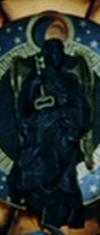
| "And I looked and beheld an angel. And in its right hand, the key to the bottomless pit." - Grigori Efimovich Rasputin |
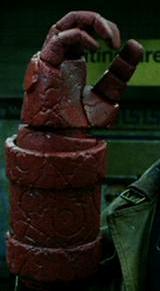
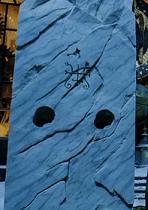
| "You are the key," Ilsa tells Hellboy, "The Right Hand of Doom. Your stone hand. What did you think it was made for?" She asks this question as though the explanation should have been obvious to him. Like Rasputin, she sees Hellboy's future as inevitable and clear. Rasputin knows that Hellboy does not see things this way. So, he imposes a choice upon Hellboy whose outcome he believes he can force. He holds a powerful gambit - Liz. Ilsa promises Hellboy "an Eden, for you and her" if he will do as they say. When he will not agree to open the locks, Rasputin finally says, indicating Liz, "In exchange for her soul, then." Hellboy still refuses. Rasputin then removes Liz's soul from her body, killing her in front of Hellboy. "Her soul awaits you on the other side," Rasputin tells him, "If you want her back, open the door and claim her." Still this is not enough and Hellboy will not agree. Rasputin has rigged the game again, though. "Your true name is inscribed around the locks that hold you," he tells Hellboy, "You cannot break them, no matter how strong you are." Only by saying the name can Hellboy be set free from the stocks. Again he refuses. Finally, Rasputin notices Broom's Rosary around Hellboy's wrist. He breaks it off, shows it to him and throws it away, saying, "Become the key." Only then does Hellboy finally show signs of capitulation. He slumps in the stocks and eventually, "for her," recites the name after Rasputin, "Anung un Rama." The locks break off and Hellboy undergoes a transformation. |
| He begins to truly look like a demon. It is here that Hellboy finally capitulates to his demon nature, his monster side. The horns he filed off to fit in grow long and he appears to be unmistakably evil. The smoke emerging from his mouth is no longer from a cigar, but from hellish fires within him. He is crowned with fire and the light in his eyes is extinguished. This is the son Rasputin wanted to create - the slave who would usher in the new world. At this point, Hellboy seems mindless, simply obeying Rasputin's commands without thought. He looks at Liz distantly, as though he doesn't know her. Ron Perlman has said that in this scene, he eventually realized he was playing a different character. This truly is another Hellboy. The two identities warring within him are divided. By surrendering to Rasputin's demands, everything that is programmed into his nature takes over. All seems irrecoverably lost. Hellboy is truly capable of evil and of being overtaken by evil. In the same way, we as humans have within us the capacity to sin, to wholly give ourselves over to the evil that is planned for us by the forces of darkness. Hellboy is a character who is even more profoundly apt to do this than any human, being himself a spawn of Hell. But even Hellboy is not beyond salvation. When Rasputin threw the Rosary, it landed near John Myers, the one charged to succeed Professor Broom. Seizing it, he calls out to Hellboy, "Remember who you are!" and throws it to him. So, identity and destiny are again linked, but this time they are not inevitable and unchangeable. Hellboy has returned to being who he started out to be, but the identity to which Myers appeals is that of the person Hellboy has become. In this moment, Myers states that identity is not determined by appearance, by birth or by a name. Hellboy catches the Rosary and the image is profound. |
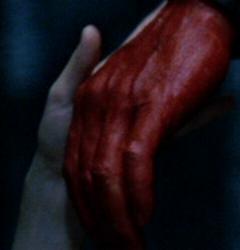
| It is this image that brings Hellboy back to his senses. I must at this point make it clear that writer/director Guillermo Del Toro has indicated that the Rosary is intended less as a symbol of Christ and more as a symbol of Professor Broom. Though the cross emblazoned in his hand holds strong spiritual symbolic imagery, Del Toro insists that it is the returning memory of his adoptive father first and foremost. Del Toro does, however, identify himself as a Catholic. One way or another, here we see the mark of his father - his true father - burned into his flesh, a sign that the guidance and love of his father, indeed his self-sacrifice, is an indelible part of Hellboy's being. Myers says, "You have a choice. Your father gave you that." "No you don't!" Rasputin insists and commands him to open the final lock. But Myers has shown him that beyond birth and breeding, beyond names and appearance, beyond origin, the thing that truly defines a person is choice. This is true of salvation in Christ. It is our choices that show who we are. No matter who we have been or where we come from, we have the choice to accept salvation. God allows us the freedom of choice just as Professor Broom allowed it to Hellboy. God knows that those who are His will choose to follow and that those who choose to follow will truly be His. No matter what evil we are capable of, we can repent, as Hellboy does. |
| Breaking off his horns, he frees himself from Rasputin's control. "What have you done?" asks the infuriated Rasputin. Hellboy responds by impaling the wizard with one of his horns. "I chose," he tells him, and drops the horns, leaving Rasputin behind and picking up Liz's body. As he exits, Rasputin shouts that Hellboy will never know what he is truly capable of. "I'll just have to live with that," he responds, knowing that the potential Rasputin is talking about would be a potential for evil. Hellboy stops in his tracks and looks down, seeing one of Rasputin's eyes crushed beneath his foot. As Rasputin is overtaken by the creature within him, we see that Hellboy has, both literally and figuratively, crushed Rasputin's vision. Hellboy has finally overcome the darkness within himself, finally made peace with his nature as man and as monster. He has reached an understanding of both identity and destiny, overcoming both Hell and Boy. He is saved. Like the moment when a person puts his or her faith in Christ, Hellboy's rejection of Rasputin is the point where he claims the salvation already prepared for him by his father. I don't want to insinuate that Hellboy is intended as a sort of Christian allegory. As I stated earlier, the image of the cross is reflective of Professor Broom. One cannot deny, though, that in the same way that the Rosary makes an imprint on Hellboy's hand, so Christ's salvation is burned into our hearts, embedded into our lives when we come to faith in Him. Additionally, coming from a Catholic director, I have to believe that it is not insignificant that the symbol of Hellboy's redemption, the thing that pulls him back from the very edge of Hell is a cross. This film does not make either Professor Broom or Hellboy out to be Christians, certainly not in the strictest sense, though Christian symbols and themes are part and parcel of the work that they do. There are Pagan influences here - some real, most imaginary. The point, though, is not to get too sticky on the religious details, but to recognize that Hellboy represents a truly redeemed figure, one who is brought from being destined as a tool for ultimate destruction to being a champion for good who battles the forces of darkness. In Hellboy is the most profound form of repentance, the deep power of love and the ultimate importance of choice. We are all faced with the choices Hellboy faces - Heaven or Hell, man or boy, good or evil. We all are both human and monster, straddling the line between beauty and ugliness. We all also have the power to choose. In that, we have the greatest gift God has given us short of salvation itself. Though, without choice salvation could not truly be attained. Goodness, mercy, maturity, love, kindness, forgiveness, compassion - these are all choices, as are evil, cruelty, childishness, hatred, ruthlessness, vindictiveness and selfishness. The choices we make, between our ways and God's ways, between Christ and damnation, are what make us who we are. |
| All Written Site Content Copyright 2001-2007 Kevin C. Neece |
 |
|
 |