 |
| "What I will do tonight can never be undone!" - Grigori Efimovich Rasputin |
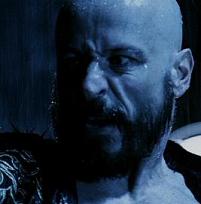
| Now we move into the realm of Hellboy's primary father figures. Chronologically within the film, his first father is Rasputin. Though the other characters show up earlier in the picture, Rasputin is the first to have contact with Hellboy because he is the one who brings him into the world with the Ragnarok device. It is important that Rasputin never sees Hellboy during this sequence. Like a birth father who doesn't stay around to meet his own child, Rasputin leaves Hellboy early on. He then tries to rekindle a relationship with him years later after Hellboy has already deeply attached himself to his adoptive father, Professor Broom. To Rasputin's credit, he couldn't help but abandon Hellboy because he was dead. But he has a way of cheating death. "In 1916, at a dinner in his honor," Professor Broom says of the occult advisor to the Romanovs, "he was poisoned, shot, stabbed, clubbed, castrated and finally drowned. And yet we saw him here tonight." True to form, Rasputin is reborn some sixty years after the Ragnarok incident and the birth of Hellboy. "I grant you everlasting life, youth and the power to serve me," he said to Ilsa just before his death in 1944. It appears to have worked, as she shows up with Kroenen at an ancient shrine years later to perform a blood ritual that will resurrect her master. |
| Rasputin's return is visually strong and involves interesting imagery. When the guide is killed, his blood flows into the labyrinthine grooves in the floor and into its center, from which a resurrected Rasputin arises. The image of the labyrinth mirrors the way Rasputin views life and destiny. All the various paths from all sides of the circle lead inexorably to its center. In the same way, Rasputin sees all paths leading to a definite, unchanging and unavoidable destiny. He believes in the inevitability of the future once it has been guaranteed by magical means. Interestingly enough, in the center of the labyrinth is Rasputin himself. As the harbinger of the destruction and rebirth of the world, Rasputin sees himself at the center of mankind's destiny. When he emerges from the labyrinth, he is covered in bright red blood. It is significant that his return sees him emerging as a big, red monster, as this reinforces his connection to Hellboy. When we see him emerge, it is easier than ever before to see him as Hellboy's true father. It is also important that Rasputin emerges with no eyes. He represents blind faith, total commitment to an ideal without a true understanding of its ultimate consequences. While Rasputin considers himself a man of vision, he really has no vision of his own at all. He is merely a puppet of the Ogdru Jahad and is as expendable to them as the guide who unwillingly gave his life moments before. When he first appears to Hellboy outside the museum, Hellboy recognizes his voice. "It was the first lullaby you ever heard, my son," Rasputin tells him, "I ushered you into this world. I alone know your true calling, your true name." Rasputin is putting into Hellboy's mind the question of his origins and what they may have to do with his identity, and therefore his destiny. In this one line, the connectedness of the themes of identity and destiny is made clear, as Rasputin sees Hellboy's name as the gateway to his true calling. It is the influence of a lesser father that ends the confrontation, though. Exhibiting a response very much in the character of Sgt. Whitman, Hellboy reaches for his gun and says, "Name this." Pointing it in the direction of Rasputin, he finds the sorcerer has vanished. Without the commingling of the character traits of all his fathers, Hellboy would not be the person that he is. It is this very conflict between nature and nurture that make him elusive to Rasputin. Evil cannot control Hellboy as easily as it would like. It is here that we first see Hellboy as a saved or redeemed character. The theme of redemption is strong in the film and Hellboy's relationship to Rasputin shows the difference between who he was made by Hell to be to be and who he has become. In a very real sense, Hellboy has been saved from Hell. He has been physically removed from the influence of evil and has been raised with a new set of values. He is still conflicted, though, because he has not come into his own identity as a man. He hasn't claimed his identity for himself. This reflects the reality of the salvation of Christ, in that while it is purchased for us, it is not ours until we claim it, that is to say that we are justified by our faith. Now we begin to come to it. Here is some of the direct symbolic value Hellboy has for Christians. This theme of redemption is just beginning to emerge at this point of the film, but it is of central importance to the story and to the development of the characters. Rasputin is a father with original claim, but no love. He offers no choice, thereby denying Hellboy's value as a person. He sees Hellboy as a tool more than a son. When he tells him, "I alone know your true calling, your true name," it is not out of love. He does not want to help Hellboy solve his inner crisis, but rather to use that crisis to his advantage. By causing him to question the fatherhood of Professor Broom, Rasputin hopes to gain enough leverage to bend Hellboy's will to his advantage. Like Satan, he appeals to human questions of possibility and potential, only to exploit those questions by using them to lead Hellboy into ultimate destruction. Hellboy is useful to Rasputin for one purpose only. His Right Hand of Doom is the key to open the locks that hold the Ogdru Jahad - the seven gods of chaos - in their crystal prison. After this purpose is accomplished, Rasputin's fatherly overtures will vanish, as the one he now calls "son" becomes a slave. In this same way, Satan tempts mankind with the promise of belonging, of becoming like God and of reaching our full potential, in the end making us merely slaves to sin and to his own desire for destruction. It is true that we have great potential. But God calls us by another name. |
| All Written Site Content Copyright 2001-2007 Kevin C. Neece |
 |
|
 |
 |