|
|
||
|
Description of Kailiauk
The quotations below are all taken from Savages of Gor, and Blood Brothers of Gor, by John Norman.
"They will have difficulty recruiting efficient aid," said Samos, "for few white men are allowed to tread the Barrens, and those who are permitted to, encroach upon their fringes are normally permitted to do so only for purposes of trade." "Are
you truly determined to enter the Barrens?" asked the fellow.
"Yes," I said.
"How many kaiila do you have?'' he asked.
"Two," I said,
"one to ride, another for the trade goods." "That is
fortunate," said the fellow. "No more than two kaiila are to be
brought by any single white man into the Barrens. Too, no party of white
men in the Barrens is permitted to bring in more than ten kaiila."
"These are rules in
Kailiauk?" I asked.
"They are the rules
of the red savages," he said.
"Then," said
I, "only small groups of white men enter the Barrens, or else they
would be on foot, at the mercy of the inhabitants of the area."
"Precisely,” said
the fellow. I considered the Barrens.
They are not, truly, as barren as the name would suggest. They are barren
only in contrast, say, with the northern forests or the lush land in river
valleys, or the peasant fields or meadows of the southern rain belts. They
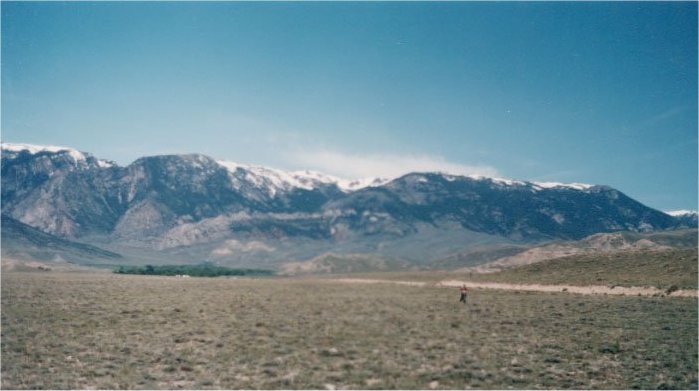
are, in fact, substantially, vast tracts of rolling grasslands, lying east
of the Thentis Mountains. I have suspected that they are spoken of as the
Barrens not so much in an attempt to appraise them with geographical
accuracy as to discourage their penetration, exploration and settlement.
The name, then, is perhaps not best regarded as an item of purely
scientific nomenclature but rather as something else, perhaps a warning.
Also, calling the area the Barrens gives men a good excuse, if they should
desire such, for not entering upon them. To be sure, the expression
'Barrens' is not altogether a misnomer. They would be, on the whole, much
less arable than much of the other land of known Gor. Their climate is
significantly influenced by the Thentis Mountains and the absence of large
bodies of water. Prevailing winds in the northern hemisphere of Gor are
from the north and West. Accordingly a significant percentage of
moisture-laden air borne by westerly winds is forced by the Thentis
Mountains to cooler, less-heated air strata, where it precipitates,
substantially on the eastern slopes of the mountains and the fringes of
the Barrens. Similarly the absence of large bodies of water in the Barrens
reduces rainfall which might be connected with large-scale evaporation and
subsequent precipitation of this moisture over land areas, the moisture
being carried inland on what are, in effect, sea breezes, flowing into low
pressure areas caused by the warmer land surfaces, a given amount of
radiant energy raising the temperature of soil or rock significantly more
than it would raise the temperature of an equivalent extent of water. The absence of large bodies of water adjacent to or within the Barrens also has another significant effect on their climate. It precludes the Barrens from experiencing the moderating effects of such bodies of water on atmospheric temperatures. Areas in the vicinity of large bodies of water, because of the differential heating ratios of land and water usually have warmer winters and cooler summers than areas, which are not so situated. The Barrens, accordingly, tend to be afflicted with great extremes of temperature, often experiencing bitterly cold winters and long, hot, dry summers. At the edge of the Thentis
Mountains, in the driest areas, the grass is short. As one moves in an
easterly direction it becomes taller, ranging generally from ten to
eighteen inches in height; as one moves even further east it can attain a
height of several feet, reaching as high as the knees of a man riding a
kaiila. On foot, it is easier to become lost in such grass than in the
northern forests. No white man, incidentally, at least as far as I know,
has ever penetrated to the eastern edge of the Barrens. Certainly, as far
as I know, none has ever returned from that area. Their extent,
accordingly, is not known. "The issues are
complicated," said Samos. "I do not know, truly, how I should
cast my vote." Tornadoes and booming,
crashing thunder can characterize the Barrens. In the winter there can be
blizzards, probably the worst on Gor, in which snows can drift as high as
the mast of the light galley. The summers can be characterized by a
searing sun and seemingly interminable droughts. It is common for many of
the shallow, meandering rivers of the area to run dry in the summer. Rapid
temperature shifts are not unusual. A pond may unexpectedly freeze
in En'Kara late in Se'Var, a foot or two of snow may be melted in a matter
of hours. Sudden storms, too, are not unprecedented. Sometimes as much as
twelve inches of rain, borne by a southern wind, can be deposited in less
than an hour. To be sure, this rain usually runs off rapidly, cutting
crevices and gullies in the land. A dry river bed may, in a matter of
minutes, become a raging torrent. Hail storms, too, are not infrequent.
Occasionally the chunks of ice are larger than the eggs of vulos. Many
times such storms have destroyed flights of migrating birds.
Kailiauk
is the easternmost town at the foot of the Thentis mountains. It lies
almost at the edge of the Ihanke, or Boundary. From its outskirts one can
see the markers, the feathers on their tall wands, which mark the
beginning of the country of the red savages.
Kailiauk
is the easternmost town at the foot of the Thentis mountains. It lies
almost at the edge of the Ihanke, or Boundary. From its outskirts one can
see the markers, the feathers on their tall wands, which mark the
beginning of the country of the red savages. "It is here," said Grant, turning about on his kaiila. "See the wands?" "Yes," I said. We were now some two pasangs east of Kailiauk. "Here is one," said Grunt, "and there is another, and another." "I see," I said, shading my eyes. The grass was to the knees of the kaiila. It came to the thighs of the slave girls, in brief one-piece slave tunics, of brown rep-cloth, with deep cleavages, in throat coffle, bearing burdens on their heads. The wand before us was some seven or eight feet high. It is of this height, apparently, that it may be seen above the snow, during the winter moons, such as Waniyetuwi and Wanicokanwi. It was of peeled Ka-la-na wood and, from its top, there dangled two long, narrow, yellow, black-tipped feathers, from the tail of the taloned Herlit, a large, broad winged, carnivorous bird, sometimes in Gorean called the Sun Striker, or, more literally, though in clumsier English, Out-of-the-sun-it-strikes, presumably from its habit of making its descent and. strike on prey, like the tarn, with the sun above and behind it. Similar wands I could see some two hundred yards away, on either side, to the left and right. According to Grunt such wands line the perimeter, though usually not in such proximity to one another. They are spaced more closely together, naturally, nearer areas of white habitation. (Savages of Gor)
We
stood within the compound of Ram Seibar, a dealer in slaves. It is a
reasonably large compound, for he also handles kaiila. It is, I
would estimate, something over three hundred feet square, or, say, a
bit less than a tenth of a pasang square. It contains several slave pits
but only three were now occupied. It also contains several larger
and smaller wooden structures, primarily holding areas, barracks for men
and various ancillary buildings. The entire compound is enclosed by a
wooden palisade. On the largest building, the main sales barn, about
seventy feet wide and a hundred and twenty feet in length, there
flies the pennon of Seibar, a yellow pennon on which, in black, are
portrayed shackles and a whip. A
distinction must be drawn between the side blocks and the central, or
main, block, in a vending area. I shall describe the situation,
specifically, as it exists in the sales barn of Ram Seibar. It is not
untypical of the arrangements in many such places, particularly in
outlying areas. To be sure, there is, it seems, from market to market, and
from city to city, an almost infinite variety of ways in which women may
be, and are, displayed and sold. This is not surprising since the
institution of female slavery, on Gor, is both extremely successful and
quite ancient. There
are one hundred copper tarsks to one silver tarsk in Kailiauk. The ratio
is ten to one in certain other cities and towns. The smallest Gorean coin
is usually a tarsk bit, usually valued from a quarter to a tenth of a
tarsk. Gorean coinage tends to vary from community to community. Certain
coins, such as the silver tarsk of Tharna and the golden tarn of Ar, tend,
to some extent, to standardize what otherwise might be a mercantile chaos.
This same standardization, in the region of the Tamber Gulf and south,
along the shore of Thassa, tends to be effected by the golden tam of Port
Kar. Coin merchants often have recourse to scales. This is sensible
considering such things as the occasional debasings of coinages, usually
unannounced by the communities in question, and the frequent practice of
splitting and shaving coins. It is, for example, not unusual for a Gorean
coin pouch to contain parts of coins as well as whole coins. Business is
often conducted by notes and letters of credit. Paper currency, however,
in itself, is unknown I
felt a small tug at my sleeve, and then felt my arm delicately held. I
felt a soft cheek pressed against my arm." Master," whispered a
voice. I looked down, and the girl, with loose, auburn hair, looked up.
She smiled. "Accompany me to Randolph's tavern," she said.
"I will give you much pleasure." About her throat, narrow,
sturdy and closely fitting, was a steel collar. I stepped back, that I
might see her better. She wore a short, fringed, beaded shirtdress. This
came high on her thighs. It was split to her waist, well revealing the
sweetness and loveliness of her breasts. It was belted upon her with a
doubly looped, tightly knotted rawhide string. Such a string is more than
sufficient, in its length, and in its strength and toughness, to tie a
woman in a number of ways. She was barefoot. About her left ankle there
was, about two inches high, a beaded cuff, or anklet. Her garb was
doubtless intended to suggest the distinctive, humiliating and
scandalously brief garment in which red savages are sometimes pleased to
place their white slaves. One difference, however, must surely be noted.
The red savages do not use steel collars. They usually use high, beaded
collars, tied together in the front by a rawhide string. Subtle
differences in the styles of collars, and in the knots with which they are
fastened on the girls' necks, differentiate the tribes. Within a given
tribe the beading, in its arrangements and colors, identifies the
particular master. This is a common way, incidentally, for warriors to
identify various articles, which they own.
In
my opinion one of the mistakes of the white cavalries of the perimeter
areas was their reliance on the crossbow, which is primarily an infantry
weapon. It does, of course, have various advantages. It has considerable
striking power, it may be kept ready to fire almost indefinitely, and, for
most men, it is easier to fire with accuracy from the saddle than
the straight bow. It will also, at short ranges, penetrate most of the
hide shields used by the red savages. Its major
disadvantage is its slowness in rate of fire. The cavalry crossbow does
have an iron stirrup in which the rider, without dismounting, may
insert his foot, thus gaining the leverage necessary for drawing the cable
back with both hands. If the rider is right handed he usually
inserts his right foot in the stirrup and leans to the right in drawing
the cable; this procedure is reversed, of course, usually, if the
rider is left handed. While this procedure permits the rider to reload
without dismounting and tends to improve, at some cost to striking power,
the bow's rate of fire, it still provides, in my opinion, no adequate
compensation for the loss of rapidity of fire. I think it not unlikely
that the red savage could discharge three to five shafts in the time a
single quarrel could be set in the clumsier weapon. In my opinion,
if the crossbow, of the lighter, more quickly loading type, had proved to
be a superior missile weapon in the typical combats practiced in the
Barrens the red savages would have had recourse either to it, or to
something analogous to it. But they have not. "Make
way!" we heard. "Make way!" There was then the thudding of
the clawed pads of kaiila, several of them, almost upon us. "Ho!
Ho!" called their drovers, riding behind them, swirling their coiled
rawhide ropes in the air. I and the others backed against the wall of the
compound of Ram Seibar. The kaiila, perhaps a hundred and fifty of them,
thundered past. I did not think such beasts should be run through the
streets, but it sometimes pleases their drovers to do so. It had happened
more than once since I had been in Kailiauk. The kaiila were presumably
from the northern ranches and would be sold in Kailiauk, and in the towns
to the south. The kailiauk in question,
incidentally, is the kailiauk of the Barrens. It is a gigantic, dangerous
beast, often standing from twenty to twenty- five hands at the shoulder
and weighing as much as four thousand pounds. It is almost never hunted on
foot except in deep snow, in which it is almost helpless. From kaiilaback,
riding beside the stampeded animal, however, the skilled hunter can kill
one with a- single arrow. He rides close to the animal, not a yard from
its side, just outside the hooking range of the trident, to supplement the
striking power of his small bow. At this range the arrow can sink in to
the feathers. Ideally it strikes into the intestinal cavity behind the
last rib, producing large-scale internal hemorrhaging he closely behind
the left shoulder blade, thence piercing the eight-valved heart. The kailiauk bull is 'Tatanka. The suffix 'sa' designates the color red, as in 'Mazasa', 'Red Metal', 'Copper. The expression 'Kailiauk' is used by most of the tribes for the kailiauk, which is not an animal native to Earth. The expression 'Pte' designates the kailiauk female, or kailiauk cow. It is also used, colloquially, interestingly, for tire kailiauk in general. This is perhaps because the "Pte" is regarded, in a sense, as the mother of the tribes. It is she, in the final analysis, which makes possible their hunting, nomadic life. Like any similar peoples, the red savages have generally a great reverence and affection for the animals in their environment. This is particularly true of the animals on which they depend for their food. The useless or meaningless slaughter of such would be unthinkable. The number of kailiauk in the
Barrens is prodigious, for it affords them a splendid environment with
almost no natural enemies. Most kailiauk, I am
sure, have never seen a man or a sleen. The Barrens are traversed by
a large number of herds. The four or five best-known herds, such as the
Boswell herd, he for whom the Boswell Pass is named, and the Bento herd
and the Hogarthe herd, named after the first white men who saw them,
number, it is estimated, between two and three million beasts. The tremors
in the earth from such a herd can be felt fifty pasangs away. It takes
such a herd two to three days to ford a river. It has occasionally
happened that enemy tribes have preyed on such a herd at different points
and only afterwards, to their chagrin and amusement, realized their
proximity to one another. Besides these major herds there are several
smaller, identifiable herds numbering in the
hundreds of thousands of animals. Beyond these, as would be
expected, are many smaller herds, the very numbers of which are not even
calculated by the red savages themselves,
herds often range from a few hundred to several thousand animals. It is speculated that some of
these smaller herds may be subherds of larger herds, separating from the
major herd at certain points during the season, depending on such
conditions as forage and water. If that is the case then the number
of kailiauk may not be quite as large as it is sometimes estimated. On the
other hand, that their numbers are incredibly abundant is indubitable.
These herds, too, interestingly enough, appear to have
their annual grazing patterns, usually describing a gigantic oval,
seasonally influenced, which covers many thousands of pasangs. These
peregrinations, as would be expected, tend to take a herd in and out of
the territory of given tribes at given times. The same herd,
thus, may be hunted by various tribes without necessitating
dangerous departures from their own countries. The
kailiauk is a migratory beast, thusly, but only in a rather special sense.
It does
not, for example, like, certain flocks of birds, venture annually
in roughly linear paths
from the north to the south, and from the south to the north,
covering thousands of pasangs
in a series of orthogonal alternations. The kailiauk must feed as
it moves, and it is simply
too slow for this type of migration. It could not cover the
distances involved in the times
that would be necessary. Accordingly the herds tend not so much to
migrate with the seasons as to drift with them, the ovoid grazing patterns
tending to bend northward in the summer and southward in the winter. The
smell of the hide sheds, incidentally, gives a very special aroma to the
atmosphere of Kailiauk. After one has been there for a few hours, however,
the
odor of the hides, now familiar and pervasive, tends to be
dismissed from consciousness. I
looked beyond Hci to the beasts, some two to three pasangs away. The
kailiauk is a large, lumbering, shaggy, trident-horned ruminant. It has
four stomachs and an eight-valved heart. It
is dangerous, gregarious, small-eyed and short-tempered. Adult males can
stand as high as twenty or twenty-five hands at the shoulder and weigh as
much as four thousand pounds. A Smooth Horns is a young, prime bull. Its horns are not yet cracked from
fighting and age. The smoothness of the horns, incidentally, is not a
purely natural phenomenon. The bulls polish, them, themselves, rubbing
them against sloping banks and trees. Sometimes they will even paw down
earth from the upper tides of washouts and then use the harder, exposed
material beneath, dust scattering about, as a polishing surface. This
polishing apparently has the functions of both cleaning and sharpening the
horns, two processes useful in intraspecific aggression, the latter
process improving their capacity as fighting instruments, in slashing and
goring, and the former process tending to reduce the amount of infection
in a herd resulting from such combats. Polishing behavior in males thus
appears to be selected for. It has consequences, at any rate, which seem
to be in the best interests of the kailiauk as a species. For
more on the Red Savages, follow the link below or the official Kaiila
Band of the Isbu page on the Links page of this site.
The Red Savages, as they are
commonly called on Gor, are racially and culturally distinct from the Red
Hunters of the north. They tend to be a more slender, longer-limbed
people; their daughters menstruate earlier; and their babies are not born
with a blue spot at the base of the spine, as in the case with most of the
red hunters. Their culture tends to be nomadic, and is based on the
herbivorous, lofty kaiila, substantially the same animal as is found in
the Tahari, save for the wider footpads of the Tahari beast, suitable for
negotiating deep sand, and the lumbering, gregarious, short-tempered,
trident-homed kailiauk. To be sure, some tribes do not have the kaiila,
never having mastered it, and certain tribes have mastered the tam, which
tribes are the most dangerous of all. Although there are numerous
physical and cultural differences among these people they are usually
collectively referred to as the red savages. This is presumably a function
of so little being known about them, as a whole, and the cunning,
ruthlessness and ferocity of so many of the tribes. They seem to live for
hunting and internecine warfare, which seems to serve almost as a sport
and a religion for them. Interestingly enough most of these tribes seem to
be united only by a hatred of whites, which hatred, invariably, in a time
of emergency or crisis, takes precedence over all customary con- and
rivalries. To attack whites, intruding into their lands, once the war
lance has been lifted, even long-term blood enemies will ride side by
side. The gathering of tribes, friends and foes alike, for such a battle
is said to be a splendid sight. These things are in virtue of what, among
these peoples, is called the Memory. |

 The Barrens, Description and Climate