![[Under Construction]](images/undercon.gif)
Impedance Characterization

INTRODUCTION
This is a different aspect to me as it does not really involve electronics, but nevertheless fun to learn and do. I used Audua's Speaker Workshop software mostly because it's free and shows pretty good results, though the learning curve is steep.
DESCRIPTION
There's no info given on the drivers used, so I had to rely purely on measurements. There are markings on the rear plates of the drivers: Altec A2156 for the satellites and A3728 for the woofer. Pictures speak a thousand words so let's see some:
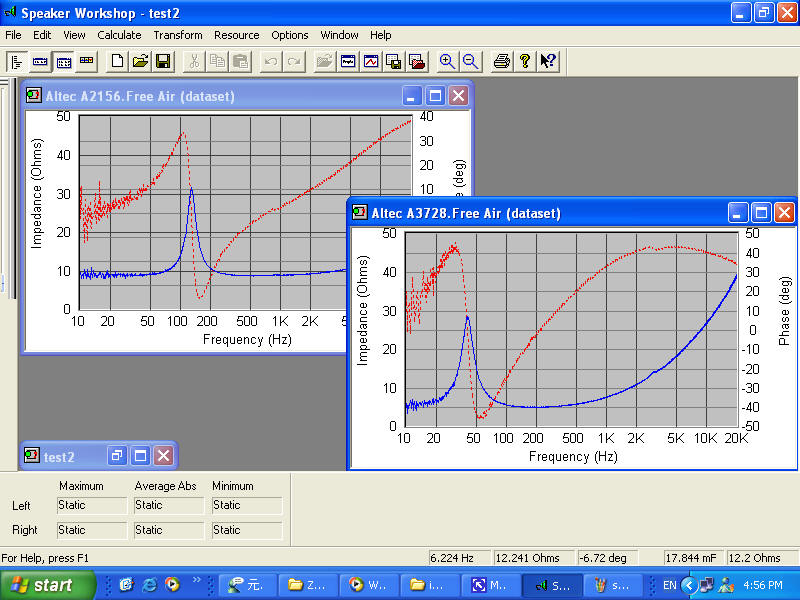
As measured, the A2156 has a resonance (Fs) of about 131hz and a Qts of 0.43. The A3728 has a Fs of 41hz and Qts of 0.49. Keep in mind that these are cheapo drivers, but at least they are made to usable specifications. Not going into further details, I then did an Added Mass test to determine the Vas. I thus had most of the useful Thele/Small parameters, enough for me to proceed.
The first thing I did was to predict the response of the original design, in order for me to make choices. First is the satellite response:
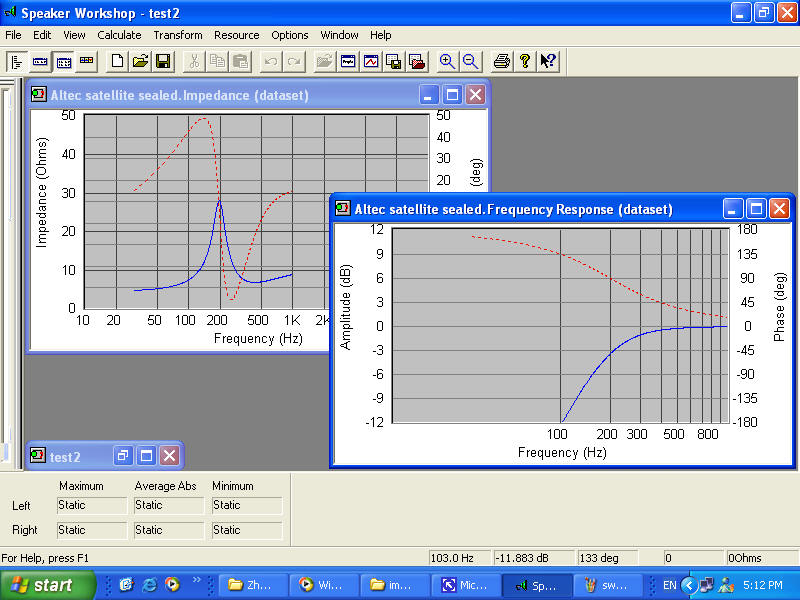
The original satellite enclosure has a internal volume of about 0.025 cu ft. This pushes the resonant frequency up to about 208hz. The driver has a compliance (Vas) of 0.032 cu ft, this results in a total Qtc of 0.68, a pretty reasonable compromise for a sealed design. The tradeoff is slightly better transient response for maximum low frequency extention. I have to get the frequency response measurements for further analysis. Later.
Next, for the original woofer enclosure:
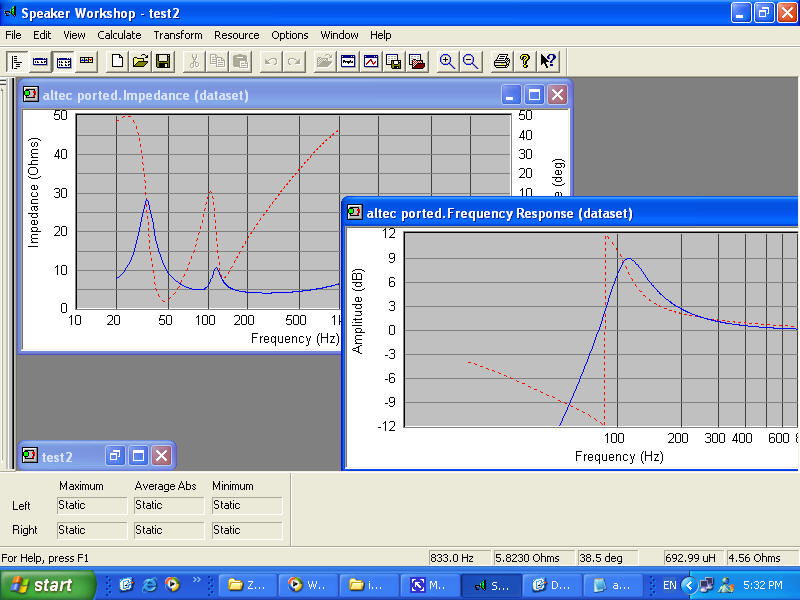
The box volume is about 0.352 cu ft. The double impedance peak shows the port resonance tuned at about 34hz while the woofer's resonance has been pushed up to 115hz (from 41hz free air). The 3db cutoff (F3) is 75hz. The port as designed has a length of 8" and dia of 2" approx. The frequency response shows a nasty peak of 9db centered around 115hz. A Qtc of >1 is expected, which results in greatly compromised transient response and group delay, the graph which i will not show here. The subjective performance of this design is a louder bass, albiet boomier. Perhaps sealing the box will help:
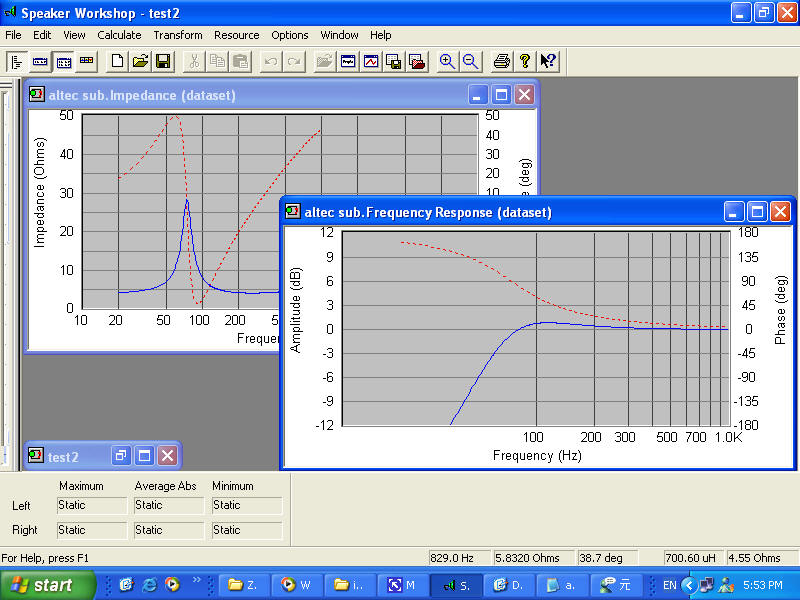
Sealing the box lowers the F3 to 60hz. The resonance (Fs) of the woofer in the box is about 75hz. Keeping the same box volume as before, the frequency response shows a slight peak of 0.8db, as predicted by a Qts of slightly greater than maximally flat Qts of 0.707 (0.773). The subjective effect of this mod is a smoother (and faster) bass response, less of the "one-note bass" effect. I even sensed a better extention, but note now we have lost more than 8db of loudness, at least at 115hz. The group delay compared to the ported design is cut by more than 6 times, and is much more linear, which produces a much better behaved transient response. That said, it's unlikely many people would prefer the change in quality, modern speakers are engineered to sound pleasant with electronic music. Well, different strokes for different folks, I prefer real hifi to boom boxes.
The application of the Linkwitz Transform will be used to lower the F3 to 30hz and Qtc to 0.6, at the cost of greater amplifier power and stress on the woofer. This and other mods in the following sections.