![[Under Construction]](images/undercon.gif)
LM3875 mini-amp a.k.a Gainclone

INTRODUCTION
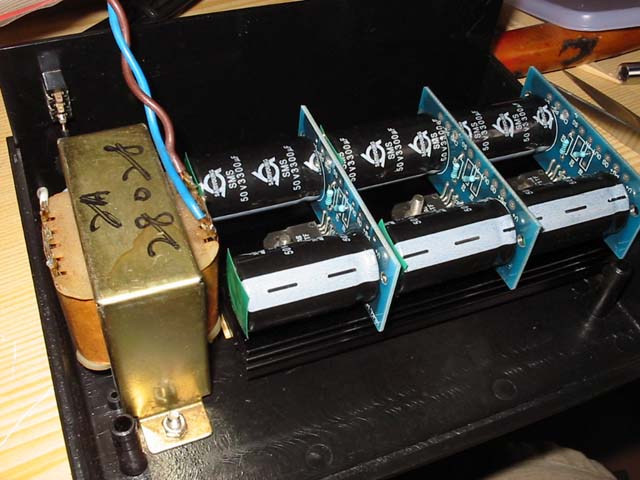
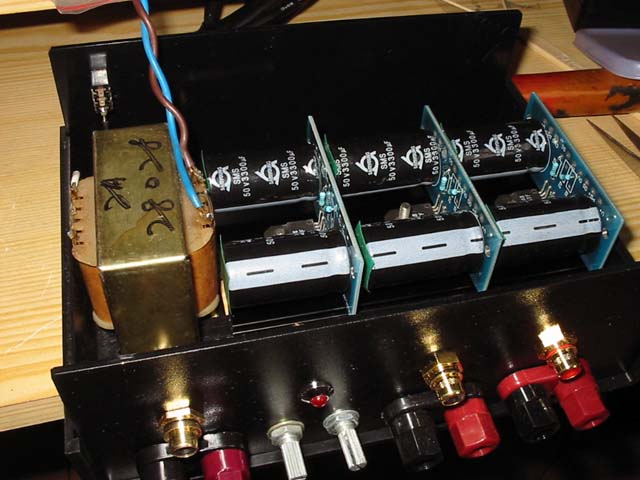
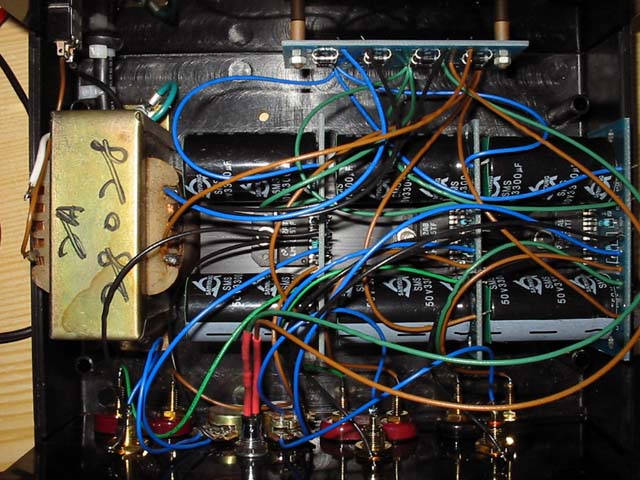
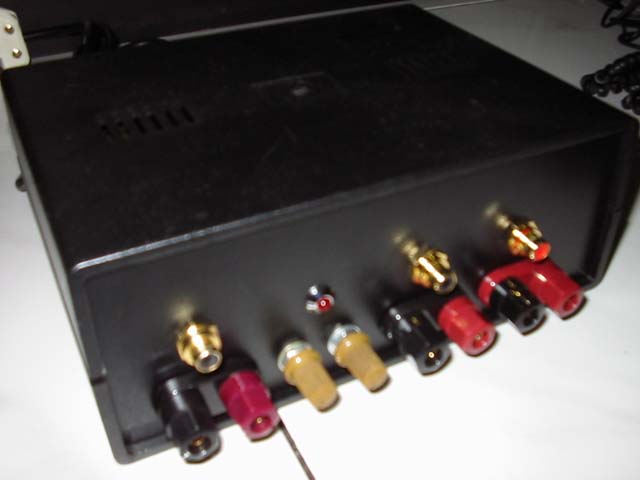
This amplifier was built for my testing purposes. It is small and portable, and easy to construct while giving decent performance (when used within its limits, of course). I made 3 channels (1 stereo, 1mono) with seperate gain controls, and squeezed everything into a small plastic box.
I chose this chip simply because I was curious about the buzz surrounding the 47 Labs Gaincard amp based on it. After the amp was dissected by a reviewer, many people got curious about the prospect of building their own version of this $5k amp which used this $5 chip. This was affectionately dubbed the "Gainclone".
DESCRIPTION
True to most op-amps, it uses a simple voltage-divider feedback to set gain. Other than the usual gain-bandwidth product typical of voltage feedback op-amps, it has a flat response with no coupling devices to cause phase shifting. This is very important as I have to take measurements of the speaker's response, not the amplifier. If the datasheets are correct, the bandwidth is approx. 500kHz at my set gain of 20. Phase response is relatively flat at this passband as well.
The pcbs I have are wired for dual rectifiers. Unfortunately this caused a short in my transformer. Later I realised it requires 2 independent secondary coils, while mine is centre-tapped but not isolated. Elsewhere the schematic is similar as given in the application note, with 3*3300uF capacitance per rail (total 19800uF). That's pretty decent for such a small amp!
The 3 chips are mounted on 1 heatsink measuring 14W*6D*1.5H cm. I didn't bother to check the thermal rating, but it measures about 60°C at idle. Alas, hooking up my Maggies and only 5 minutes on moderate volume caused the temperature to surge to 80°C. Though this chip claims to have SPIKe (?) protection, I didn't want to stretch it any further. After all, this amp was not meant to drive power-hungry speakers like mine.
|
Side Note : A few amplifiers I tried to use on my Maggies also displayed thermal problems. An amp such as the NAD3240, a budget 50w amp, also showed distress after a few minutes. It did not display any problems with normal bookshelf speakers. This means the 3875 amp can probably do its work in a normal, possibly active speaker. |
The unloaded voltage rails measure about +/-35v. According to the datasheet it translates to about 50w rms (100w peak). Numbers can be misleading however, listening impressions resemble more like 20w.
SOUND QUALITY
In short, it sucks. But that is probably only because it is unsuitable to drive my Maggies. The sound has a thin & harsh high end with a veiled midrange coupled to a weak bottom end. Overall I would describe the sound as distant & lifeless, as if a blanket had been pulled over the speakers.
If you're asking: Isn't it any good at all? Well, it has a low noise floor and decent size soundstage, but the left and right halves sound somewhat disjointed.
All said, this amp was built on compromises of budget & portability. It is meant for testing purposes, the sound in this case is immaterial.
|
Here's a tongue-in cheek stab at 47 Labs' claims:
|

PICTURES