Oct. 17-18
Our flight was with Malaysia Airlines via Manchester (what a quiet place to transfer compared to Heathrow) to Kuala Lumpur and then on to Bangkok. Luckily we already had a visa which avoided having to wait for an hour at the visa on arrival section.
The taxi (outside at the counter) took us via the toll way in less than an hour to the center for 290 B.
We took a room at the Taewez guesthouse at 300 B (aircon/private bathroom). We walked across a market (one of the as we soon found out many markets) to the boat pier to catch the Chao Phraya River Express (which at max 10 B is a bargain). This allows for sightseeing without effort (at 32 degrees and a very high humidity the climate takes a bit of getting used to - drinking 2 liters per day is no effort at all).
We got off at Tha Chang pier, had a quick bite at the food stalls and went to the Amulet market. Across the street is Wat Mahathat where the gathering of nuns and monks for prayer was quite an impressive sight. We had dinner at the riverside (S&P) and finally a tuk-tuk ride back to the guesthouse. As for the (in)famous traffic in Bangkok, it's pretty OK so far, we had expected much worse...
Oct. 19
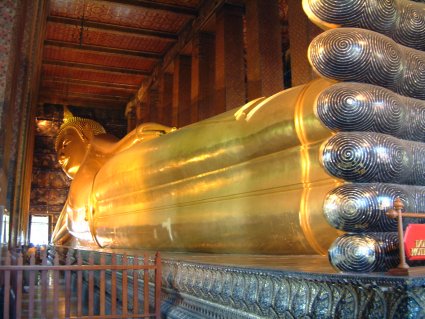
Boat ride to Tha Chang again. The rainy season is apparently not yet over since we waited for 10 min for a tropical shower to stop before heading to Wat Pho. The large reclining buddha is indeed very large. I love the little Buddha statues surrounding it with bits of gold leaf stuck in a haphazard way on to them so they are quite deformed. There apparently is also a Buddha statue for every day of the week.
The Wat Pho is a very large complex with beautiful chedis and a large prayer hall. There is also a Thai massage school, which we tried at 250B per hour. It is relaxing but still I think it'll leave a few bruises... And the constant ringing of cell phones is as much of a nuisance here as in Europe.
From Wat Pho we took a taxi to the Chatuchak weekend market which is absolutely huge. You can buy just about everything here, from genuine fake North Face, Lowe Alpine and Jack Wolfskin backpacks and Teva sandals to Thai handicrafts and all the clothes you can dream of. T-shirts start at 40B so it's really not worth bringing lots of T-shirts to Bangkok. We also tried out several food stalls (among which the cheapest Japanese I've ever seen) - one of the striking things so far is that there is food absolutely everywhere in Bangkok. But mai phet (not spicy) certainly is a phrase to remember.
In the evening we went to another riverside restaurant near the guesthouse (Silver Spoon) specialized in seafood. There was still evidence of the floodings from 10 days ago: the ground floor was still flooded so we had to walk across wooden boards to the stairs to get to the terrace upstairs.
Oct. 20
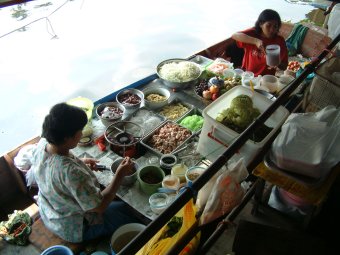
We chartered a long-tail boat to cruise the khlongs. The khlongs are to Bangkok what the canals are to Amsterdam. On the way we stopped to visit the museum of the Royal Barges (enormous decorated royal row boats which only come out once a year or so), the Taling Cha floating market (mostly floating restaurant in my opinion) and Wat Arun (very photogenic wat decorated with beautiful ceramic tiles).
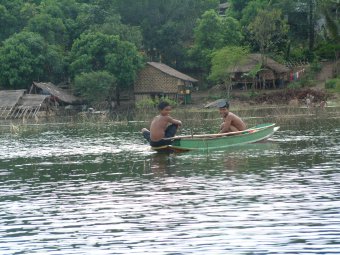
The khlongs (among others khlong Bangkok noi and khlong Mon) are very worthwhile: suddenly you're very far from the skyscrapers of Bangkok in the middle of wooden houses on stilts with kitchens opening up on the water, laundry drying.... in a lush tropical setting.
After our private boat ride we went with the river express all the way to Nonthaburi (terminus of the river express) where we again stumbled onto a market.
In the afternoon we visited the Wat Traimit which contains a 3 m high, 5 ton massive golden Buddha. On the way there we took a tuk-tuk. Tuk-tuks apparently come in 2 types: either the first quoted fare is 100 B or so and then if you bargain it down to half, the tuk-tuk will bring you without problems where you want to be. If the quoted fare is absurdly low like 10 B you can be sure that you will be dropped of first at a shop where the driver has a commission. One trick: say that you don't want to go to shops, then at least they'll tell you which shop they would bring you to, and if it's interesting, you can always go with a cheap ride as a plus. We ended up like this at a tailor for a quarter of an hour because we were interested to see what these had to offer as Bangkok is so well known for tailormade clothes.
The temple of Wat Traimit is next to Chinatown, where we wandered over the Chinese open air food market (and had dinner there).
Oct. 21
We first went to the embassy of Myanmar in order to apply for the visum for our trip in November, but we found the embassy closed due to a Myanmar holiday. So we went by taxi to the Grand Palace and Wat Phra Keow, which was scorchingly hot and overcrowded with tourists. This said, it is stunning. Especially the murals in the galleries surrounding the temple complex are very beautiful and very detailed.
At the end of the visit I traded in my borrowed sarong. As the royal family is extremely respected in Thailand you have to dress accordingly when visiting royal property: no shorts, no rolled up sleeves, no open-heeled shoes... Luckily you can borrow sarongs, shoes etc for free.
After the visit of the Palace we strolled over Sanam Luan, the grassy square next to the Palace with a lot of activity on-going: kites, market, food stalls...
Next stop was the Golden Mountain, which contains relics of Buddha and offers a great view of Bangkok. Another tropical shower kept us on the top a bit longer than planned.
In the evening we went to Suang Lum night bazaar which in my opinion is the polished, touristy and judging by the number of empty stalls not very successful attempt of the Bangkok city council to copy Chatuchak weekend market in the center on a daily basis. The big event was the Oktoberfest - somehow it is strange to see Thai girls in the Thai version of a dirndl dress serving liters of beer in a temperature of 30 degrees...
Oct. 22
First stop again the embassy of Myanmar where we waited 3 and a half hours to get our application in (810 B)- and if we had played by the rules we would have had to come back after lunch break (where we would be first in line, but small consolation in an area of Bangkok where there's nothing to do). Now we simply waited patiently till everyone had left and apparently they appreciated the stoic attitude of the falang (foreigners). I must say it's an experience, but paying 300 B more to a travel agent and thus avoiding having to go there and having to wait suddenly seems an attractive alternative.
We then went on the skytrain (elevated subway) to Jim Thompson's house, a collection of original traditional Thai teak houses beautifully decorated. We had lunch at the cafe while watching a huge thunder storm.
Jim Thompson is the man who revived the traditional art of silk weaving in Thailand and the museum shop has very beautiful silk items. We bought 2 cushion covers and a scarf.
Back on main street we saw that the thunderstorm had flooded several streets - the rain season is definitely not over...
In the evening we took a bus to the Khao San area which is reputedly the center for backpackers in Bangkok. And yes, it is the most kitsch touristy spot I have seen so far here, incl fake Akha hilltribe street vendors- this is Benidorm in Bangkok! Am I glad that we're not staying here...
Oct. 23
We caught a bus (once you get the hang of the bus system, it's incredible, you get everywhere for 5 B or so where tuk-tuk and taxi are easily 50 B) to the Suan Pakkard Palace, another collection of traditional Thai houses which were once royal property. They are very beautiful and filled with historical artifacts such as finds from Ban Chiang, the main prehistorical site in Thailand. Also the garden with ponds is very nice.
Afterwards we went to the Pratunam market which is THE textile market of Bangkok. Again loads of Polo, Diesel, Hilfiger, Camel T-shirts, trousers and so on. One advice for everyone going to Thailand: bring nothing except money and if you take the time to spend the first days shopping you could buy a large backpack and daypack of North Face (resp. 700 and 200B) or such and fill it with unzippable trousers, shirts and T shirts you buy here. T-shirts are around 100 B, shirts and trousers 200 to 300 B... And if the trousers are not OK, tailoring them to the right length costs 30 B.
Things like padlocks, binoculars, photo accessories, moneybelts... are much much cheaper. We continued our shopping expedition into the big shopping malls like WTC, Siam Square and MBK. At MBK there is a camping shop where things like mosquito nets, insect repellant, sleeping bag liner, headlights and so on are 30 % of what you'd pay in Europe. But we bought only a mosquito net at 800B.
After a taxi ride back and a shower (the average number of showers you take here is about 3 per day) we went to Ton Po restaurant which is described both in LP and Insight guide as authentic Thai cuisine in an unspoiled setting - LP even says it has no Roman script sign outside, just a Thai one. Well, it has now and it says "the authentic Thai taste"- you see what a guide book can do for a place. And until now we have eaten at stalls practically as good as in restaurants...
Oct. 24
In the morning we visited the Vimanmek mansion, the largest teak wooden building in the world, which belonged to king Rama V (the actual king is Rama IX). Again it's royal property so the sarong-over-shorts routine is again necessary. The mansion is "western style" i.e. there are chairs (introduced by the king after a visit to Europe in the beginning of 1900), there is the first shower in Thailand and there are plenty of photographs of e.g. the Thai queen in Victorian-style clothing and of Rama VI (son of Rama V) with his classmates at Oxford... Another thing the king introduced was cutlery, before the Thai ate with their hands, and then they started using fork and spoon (still no knives in use today).
There is also a performance of Thai traditional dancing which is a bit of a tourist trap since you're invited to join in and afterwards you can have your picture taken with the dancers. But, still, worth seeing.
Afterwards we picked up our visa for Myanmar and took a bus with our backpacks to the southern bus terminal. There we got on the AC bus to Damnoen Sadoeak, famous for its floating market (80 km from BKK for the incredible sum of 52 B), where we checked in at the Nok Noi hotel. The guys from the hotel offer a 2 hour tour per private boat to the floating market for 400 B, which we booked. Damnoen Sadoeak is a very small town but when we walked around at night we counted 5 ATM?s, 4 Internet cafes (mostly used by local children to play computer games) and 2 mobile phone shops- who said anything about primitive..?
Oct. 25
Up at 6.30 so we could leave at 7 for the market (no use spending the night here to see the market without tourists from BKK if you can't get up in time). I liked the market very much: we tried several things like fried bananas and mini coconut pancakes that are sold from the boats, we said no to all the souvenir sellers and we took heaps of pictures. The setting is again very beautiful with coconut groves, tropical plants everywhere...And yes, it still is truly also a market for locals but you have to get there before the tourists or it's Disneyworld... We even got a request from Thai tourists to pose with us, falang, for a photo - talk about roles being reversed.
At 10 we took the bus to Kanchanaburi where we got a room on a raft overlooking the river Kwai in the Sugar Cane Guest house. There are 4 rooms on such a raft, it has a wide veranda and it overlooks the river with its jungle setting- it can't get much better than this. In town we visited the war cemetery with English, American, Australian and Dutch graves, and also the JEATH museum which is a replica of a bamboo hut the prisoners of war used to sleep in when working on the bridge and the Thailand Burma railway.
The waterfront of Kanchanaburi center looks like a promenade in Greece somewhere with nice benches, street lighting... and loads of floating restaurants for tour buses.
We had dinner at Apple's guest house, heavily recommended in LP for the restaurant, and yes, it was so good that we booked for a Thai cooking course (700B per person) on Sunday.
Oct. 26
Today we rented a car (600 B without gas) to visit Erawan national park and especially the waterfalls.
The falls have 7 steps and it's a bit of a climb in and out of the water to get to the upper level (3 hrs round trip). But it's very cool and refreshing diving into the pools afterwards. The hike is well worth the effort. Clearly Erawan is also popular with Thai because on a Saturday like this you see whole families dragging cooling boxes to the falls in order to spend the day there. I only regret that Thai pay 20B entry and falang 200B.
We also visited Hellfire pass, a cutting through 15 meters of rock as part of the construction of the Thailand Burma railway. Thousands of POWs (European and Asian) died here under the slave regime imposed by the Japanese in order to finish the railway in time.
On the way back we stopped at the Sai Yok Noi falls, which is apparently another favourite Thai weekend outing.
We drove back to Kanchanaburi in the pouring rain so we decided to stick with dinner in the guest house.
Oct. 27
We were preparing to head off for our cooking lesson when the guy from the agency came to see us and told us that the teacher had been taken ill to the hospital (I hope it wasn't food poisoning). Of course the class was cancelled and since it was raining we decided to pack our bags and go to Sangkhlaburi in the hope of finding batter weather there. Sangkhlaburi is a town east of Kachanaburi near the border with Myanmar and it is supposed to be off the beaten track. We chartered the hotel taxi who took us first to the famous River Kwai bridge (we couldn't very well leave without having seen it) and then to the bus station. The first bus was full, which gave us time to have 2 sets of glasses repaired at the local optician, read our mail and have lunch. On the bus we were the only falang headed for Sangkhlaburi (a 220 km 4 hr trip costing about 150 B). The scenery is supposed to be very beautiful, especially the last stretch because the road offers views of the Khon Laem lake with raft houses, but we really didn't see very much as it kept pouring the whole time. In Sangkhlaburi we took a bungalow (with teak wooden beds) with view of the lake at the Burmese Inn for 400 B per night.
Oct. 28
At breakfast we discovered that we could follow cooking lessons here too, and even split up in different sessions - so we planned this for the afternoon.
We went first on a trip with the local transport (pick-up truck) to 3 Pagoda Pass, which is the border with Myanmar. Apparently this has always been quite a smuggler's nest and judging from the quantities of teak wooden furniture sold here (in Thailand there is a ban on teak logging so it all comes from Myanmar) this still is the case. We couldn't resist buying 2 small teak wooden dragons for 30 B each. We saw also cigarettes and alcohol being sold. The population here is partly Thai, partly Burmese, partly Karen and partly Mon. The Karen and Mon are ethnic minorities with totally different languages and culture from either Thailand or Myanmar, which have fled Myanmar in the past years. You can distinguish the Burmese very easily because the men wear a kind of sarong and the women put a white paste on their face to protect themselves from the sun. I find the Burmese I have seen here to be very beautiful people with almond shaped eyes and high cheek bones (the advantage of sitting half an hour in a pick up with locals is that you get the chance to observe them in detail).
I particularly liked the atmosphere here, it is a border town in a distant outpost of Thailand where very few foreigners come (we were the bigger attraction walking around) and the people therefore still smile at you, greet you and with 3 words of English try to talk to you without trying to sell you anything. It is very refreshing to be here and relax for a few days.
We had the same impression when walking first over the wooden bridge to and then in the Mon village near Sangkhla when we got back. When you walk around people are more amazed to see you than you are. But they remain extremely friendly...
We also found out that learning numbers in Thai is a great help when bargaining. We were walking among the rafthouses when suddenly a boat turned up that wanted to bring us to our guest house for 50 B. When we replied yisip (twenty) the amazement was such that they didn't bargain any further.
And then it was time for our cooking lesson with the owner of the guest house. We prepared chicken with cashew nuts, green curry with coconut and sweet and sour pork- and then we ate it all. Clearly everything is made with fresh ingredients and herbs and now we also know what it is that can make the food so spicy (tiny green and red peppers).
Oct. 29
While walking to the village we passed a shop where the local Karen women operate a weaving cooperation Weaving for Women. We bought a sarong for 180 B which is considering the fact that the money goes directly to the producers money well spent.
With the saangthaew (pick-up) we went to a Karen village Huay Malai near Sangkhlaburi, where simply walking around and watching the village life is an attraction in itself.
Coming back we took a motorcycle taxi to 2 nearby temples (20 B). One of these has a handicraft market nearby, where they have an even bigger choice in teak objects, weavings and jade than at the 3 Pagodas Pass. But you really wonder who they sell it to. Yesterday at the pass we were the only foreigners and at Huay Malai and here at the market we were again the only ones...There are a few foreigners staying at the guest house but it's far from full.
At lunchtime we continued our cooking lesson with Tom Yam (spicy sour fish soup) and chicken with ginger.
Later in the afternoon we went on a boat trip on the lake (the sun was finally showing) to take a look at the wooden bridge from the water and cross the spot where the old town of Sangkhla use to be before the dam was built which formed the Khon Laem lake and thus flooded the old town. The top of the temple still sticks out from the water and we hit for a moment even the temple roof (you can also see it under water when boating over it).
We concluded our cooking sessions with Burmese curry (with potatoes) and fried noodles with egg (pad thai). When we got the bill a day later we saw that for all the cooking for the 2 of us they charged 500 B - which was really a bargain compared to the course we had planned to take in Kanchanaburi.
Oct. 30
With a chartered songthaew we got ot the bus station where we took the minivan back to Kanchanaburi. This time the trip lasted only 3 hours. We changed buses in Kanchanaburi to Suphanburi (2.5 hrs in non-airco - as long as the bus is in motion it's OK, but when it stops you get the idea that you're glued to the seats). In Suphanburi we changed buses once more to Ayutthaya (another 1.5 hrs in non-airco). Clearly we're out of the jungle and back in the central plain with a landscape of rice paddies (and hence water) as far as you can see. And it's a hell of a lot hotter here than in Sangkhlaburi.
A bit groggy we stepped off the bus in Auttaya and checked in at Phaesritong guest house (500B per night aircon/bathroom). After a very refreshing shower we had dinner in one of the floating restaurants Phae Krung Kao. I am getting the hang of the Roman script version of Thai, once you figure out that when they put an r in this is either not pronounced or it's pronounced as an l (sri is thus si and farang is thus falang). Why they bother with putting the r in I don't know, it only creates confusion...
Moreover since Thai has a 44-letter alphabet, it is rare to see the name of a town spelled in the same way twice.
Oct. 31
After breakfast at the market (rice with omelette) a minibus (no airco, 12 B pp) took us in 1 hr to Bang Pa-In, the summer palace of the Thai monarchs. As in the other royal properties the grounds and buildings are in perfect shape. The buildings are a bit of a mixture of different styles - there's a Thai pavilion, a Chinese mansion, an art nouveau house, neo-classical houses... and on the other side of the river there's even a wat that looks just like a gothic church.
We didn't really look forward to spending again one hour on a bumpy ride with a non-airco bus, so we headed for the river to see if there was no way to get back to Ayuttaya by boat.
We came across a building with lots of Thai lettering, where the only words in English were Tourist Services Center. So we went inside and found out that we had actually stumbled in to the tourist police office. They wouldn't let us go back out again before we told them what we were looking for. First they didn't know of any boats going to Ayuttaya until a policeman caught up on us (we were back outside already) who said that he knew of way (Thai only but sign language goes a long way). So he took us in his car to a pier where there were indeed longtailboats for hire. And for 600 B and with the help of the police we got a very scenic, quiet, refreshing boat ride back to Ayuttaya.
We had lunch in the floating restaurant again, then took siesta in our aircon room (there was a thunderstorm going on anyway so there wasn't much else we could do).
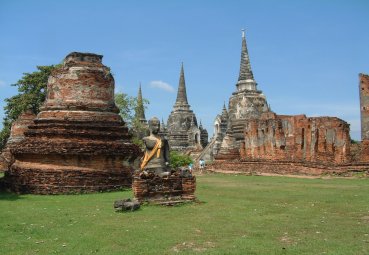
At 3 pm we boarded another boat arranged by the guest house to visit some of Ayuttaya's ruins on the other side of the river (the city lies in fact on an island - the trip cost 250 B pp). Ayuttaya was the capital of Thailand for more than 400 years until it was invaded and destroyed by the Burmese and the capital moved to Bangkok. It must have been a magnificent city in its time, as is also clear from reports of foreign settlers (Portuguese, Dutch, English, Japanese...) that lived here at the time, but now what remains are ruins of bricks scattered throughout the city.
We visited Wat Phutthaisatwan and Wat Phanan Choeng, and came by Wat Chai Wattanaram and the chedi of queen Suriyothai.
In the evening we went to the night market to eat seafood at one of the stalls next to the river.
Nov. 1
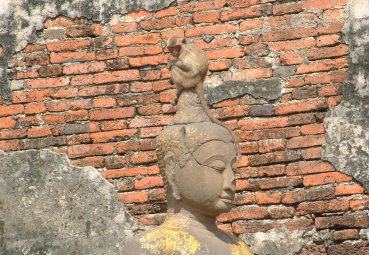
With the bicycles rented from the guest house (50 B a day but the bikes are a bit ramshackle) we set out for a day of exploring Ayuttaya?s ruins. We visited in the morning Wat Ratchaburana, Wat Mahathat, Wat Phra Ram, Wat Phra Si Sanphet, Wat Mongkon Bophit and Wat Thammikarat. Some of the ruins are very impressive, with chedis and phrangs in relatively good condition, but what touched me most is that even one-armed, headless buddhas (the Burmese destroyed nearly all Buddha images) carry yellow ribbons and are kept in respect with flowers and offerings.
After a much needed break in an aircon restaurant we had another unforeseen break (another thunderstorm - apparently the weather in Ayuttaya follows the same pattern of very hot in the morning and a thunderstorm in the afternoon) which had us running to an Internet caf� - so we had all the time we wanted to read and write mails.
Later we visited Wat Na Phra Meru (with a rare Buddha image in the sense that it is seated as if on a chair) and we also went to the tourist information center because we had seen a banner on the road saying Boat Races at Bang Sai and we wanted to know if this was a traditional longboat race (this is traditionally the time for this type of races). The people here are undoubtedly very sweet but their English really is limited so it took a while before we understood that there was a free bus service the day after to the races and that if we wanted to come we were welcome...
Later we tried again the night market for seafood at one of the stalls.
Nov. 2
The first thing we did was pack our bags and change hotels. Now we checked in at the Wiangfa hotel which is altogether a cozier, friendlier and less rip-off place than Phaesritong.
We had our cheapest breakfast so far (omelette on rice with water for two at 40 B total) and walked to the tourist information center. And yes, there was a bus waiting and as we gradually saw people arriving it seemed that we had landed on the bus of the Ayuttaya rowing team fan club. Of course we were the only tourist which seemed very funny to the Thai also going on the bus, but we were assured by the girl from the tourist office that we would be taken care of...
When we got to Ban Sai it turned out that we were at the 15th Thailand International boat races with teams from USA, Canada, Japan... Especially the big dragon boats with 22 paddlers are an impressive sight.
We also had time to visit the Royal Arts and Crafts Center at Ban Sai, set up by Queen Sirikit to preserve and teach traditional handicrafts such as silk weaving, mask making... It is a huge complex with several ateliers where you can see the artists at work, a huge shop where you can buy everything, and a kind of Bokrijk, i.e. a collection of traditional Thai houses from the different parts of the country with exhibitions on the top floors and shops on the ground floor.
For the last time we went that evening to the night market to eat at the stalls.
Nov. 3
Our destination for today was Lopburi, north of Ayuttaya and once, at the time Ayuttaya was threatened by a Dutch naval blockade, the capital of Siam. As such there are also different ruins, of which the most known is that of the palace of King Narai the great.
Another thing Lopburi is well known for are the monkeys. Several of the ruins are besieged by monkeys to the great amusement of the tourists who feed them. Also the Thai are very well aware that the monkeys contribute a lot to Lopburi's popularity with tourists (once a year as a sign of gratitude a buffet is laid out by the city of Lopburi for the monkeys with fruits and nuts to thank them for their contribution to the local economy).
At one of the temples we let a monk (normally living in The Hague so he spoke a few words of Dutch and French) convince us to try another massage. We chose a 1 hr foot massage this time (130 B), which supposedly is good for your health (I wouldn't say it's very relaxing because Thai massage is a pressure massage and it sometimes gets close to the pain limit).
We went back to Ayuttaya by train (it is only 60 km but by bus it had taken us well over 2 hours to get here as the bus stops literally every 100 meters). Well, the train was half an hour late so in the end it took as long as with the bus, but traveling by train is in itself an experience. In 3d class there is no airco so the windows are open, which makes you pay much more attention to the landscape.
Nov. 4
After waiting for an hour for our train to Pak Chong to arrive (which gave us time to experience the national anthem being played at 8 am - all the Thais stand up - and this happens every day at 8 am and 6 pm), we realized we had seats in the very last car, which had us struggling to get on the train with our backpacks. Moreover some monks had taken up our seats and as apparently they can get away with a lot in Thailand, we were assigned other seats. But even in 2nd class (no airco) you have plenty of leg room, so that's definitely an advantage.
Pak Chong is the departure point for excursions to Khao Yai, Thailands oldest national park with the biggest concentration of wild elephant and even tigers. Since both LP and Insight guide heavily recommended Khao Yi Garden Lodge and associated tours, we took a room in a bungalow there (1000B). There's free transportation to and from the lodge (and if you're alone a request stop at the ATM to withdraw money is also possible - speaking of ATM's, what a luxury to withdraw money with a Belgian bank card at very favourable conditions).The lodge is run by a German, which becomes very clear when you look e.g. at the menu. The lodge itself has a very big garden with lots of orchids and a pool with waterfall.
We quickly had lunch before heading off to the first part of our 1.5 day excursion to the park: a visit to a volcanic cave, a trip to a bat cave and night game drive in the park. The volcanic cave is in fact not only a cave but also a very important sacred place that has been known to people since centuries. You descend into the cave via steep stairs , and immediately you see Buddha images and meditating monks. Further down the cave there are fertility statues which are held in high regard. All over the cave there are huge chunks of iron ore visible and also jade arteries. And there's also a few bats and apparently a cobra (didn't see it though). All in all a spiritual place with a very special atmosphere. Next visit went to the bat caves. There are 1.5 mio bats living inside a cave up a mountain in the park and at dusk these all fly out to search for food. We didn't exactly see 1.5 mio bats I think but still it's a strange sight to see first a very thin line of bats flying out which then gradually becomes a big stream of bats. The last part of our trip today consisted of a night game drive in the park where we saw elephant, deer and a snake. For the drive I even had to dig up my fleece from the very bottom of my backpack, since it really cools off here at night.
At the restaurant of the lodge we ordered a Thai hotpot which is a bit a do-it-yourself grill on charcoal while you make soup at the same time. This attracted much attention from the Thai staff, which resulted in us having a private cook since one of the waiters explained us from a to z what to do with all the vegetables etc. It was, in his words "very delicious". We also tried for the first time a bottle of Thai red wine which was- interesting.
Nov. 5
After a stop at the visitor center (we saw a huge lizard and a water dragon here), we did a three hour guided walk in the forest, with lots of explanations about medicinal use of plants - not many spectacular animals though. After the walk we drove through the park (lots of monkeys underway) to the Huat Seaw waterfalls (which featured apparently in The Beach with L. DiCaprio). Finally we watched the sunset from 2 viewpoints.
Khao Yai seems to be a hub for long-term travelers: we met here an American couple traveling SE Asia for 6 months, a Dutch couple traveling for 8 months (they'd already been in China and Mongolia) and a Belgian couple on time credit planning to travel for 3 years(!).
Our spectacular dish for tonight, again attracting a lot of attention, was a complete filled pineapple served with burning candles around it.
Nov. 6
Today = relax day. We just went to Pak Chong to figure out the quickest way to get from Pak Chong to Kamphaeng Phet and to read our mail (at 2B/min that's a real rip-off at the lodge since tariffs normally vary between 20 and 40 B/hr).
And in the afternoon we sat at the pool, read and worked on this report.
Our last spectacular dish here was a steamed fish served in ceramic fish-shaped bowl on burning charcoal. You definitely have to give these people points for presenting food nicely...
Nov. 7
We were dropped off by someone form the lodge at the bus station in order to get the 1st class bus to Bangkok (2 hrs., 110 B pp - backtracking to Bangkok and from there a direct bus to Kamphaeng Phet apparently is the easiest way to get there). In the northern bus terminal we bought our tickets and had lunch, only to discover that on the 1st class bus on long stretches you get a meal box like in a plane... we also got served consecutively a green, orange and red soft drink, and in the middle of the trip we stopped and got a free meal with our bus tickets. After 4 hrs. we arrived in Kamphaeng Phet where a songthaew took us with our luggage to the Phet hotel (600 B /room w. aircon). The Phet hotel is a typical hotel for tour groups (the first hotel of this type we've been in in Thailand).
After an odyssey to find an Internet caf� with a computer with CD-player to put an update of the website on-line, we had dinner at the hotel restaurant - after 3 weeks of breakfast, lunch and dinner with either rice or noodles in everything from stalls till floating restaurants, we went for European food this time (French fries with ketchup!).
Nov. 8
The ruins of Kamphaeng Phet are much less known and visited than Ayuttaya or Sukhotai, but this definitely adds to the charm. The first part of the Kamphang Phet Historical Park is surrounded by the original city walls and consists of the ruins of 2 wat with beautiful Buddha images.
For the visit of the second part of the park we chartered a motorized tricycle to tour the ruins. The second part of the park is very special because the ruins of the different wats are situated in a wood. Some of the ruins have even trees growing in the middle of the buildings... All in all the park is very well kept and because it's not so touristy like Ayuttaya it breathes a special atmosphere.
We picked up our luggage in the hotel to go to the bus station in order to get on the bus to Mae Sot, another border town close to Myanmar. Supposedly the bus left at 1 pm, but in the end we left almost an hour late so we got to Mae Sot around 4 pm. The Mae Sot guest house (280 B /room w. aircon) is the cheapest we've been in so far but it's also pretty basic (Thai toilets). When walking around town you see again lots of Burmese people on the streets and also shop signs are in Thai, Burmese and Chinese. Mae Sot has less of the "remote outpost" feeling Sangkhlaburi had, but you feel that this town is thriving and growing on trade (including a lot of smuggling).
Nov. 9
By songthaw we first went to the border and the border market. The Thai-Myanmar friendship bridge spans the river Moei which forms the physical boundary between the 2 countries. At the market again lots of Burmese products such as jade, teak and weavings.
After our visit to the border we took another songthaew to got to Waley, which is supposed to be a smuggler's nest. The landscape around Mae Sot is a big plain surrounded by mountains. On the plain there is a lot of agriculture, especially rice (November is the harvesting season so everywhere you see people harvesting). Our songthaw driver apparently didn't feel much like taking us to Waley because he dropped us at Pho Phra, a village before Waley and refused to go further. We had to wait for another songthaw carrying local passengers going to the village to finally get there. Along the way again several police and military control posts (relations with Burma are not always friendly and a lot of illegal immigrants stay in Thailand). In Waley there's also a Karen refugee camp but we were not allowed to go in, so we started walking back to Pho Phra. We got a lift from a policeman (I nearly stepped on his gun getting into the car), just in time to catch a songthaw back to Mae Sat.
We had dinner in the Bai Fern restaurant (cordon bleu with gratin dauphinois).
Nov. 10
The waiter we had asked at the restaurant yesterday if he didn't know anyone who could drive us to Mae Sariang met us at the guest house and went with us to the bus station to discuss with the songthaw driver if he didn?t want to drive just the 2 of us for the whole way. So in the end we chartered the regular 9 am songthaw (amazing that they just can do this but apparently songthaws are privately owned so the drivers do as they like) for the trip (220 km - normal fare 160 B pp, charter 1500B).
It is a very beautiful drive through hills with thick forest (also teak forest). For a large part the road follows the river Moei which forms the border with Myanmar. Along the way we passed a huge Karen refugee village (100000 people) - the village goes on for kilometers. Our driver/guide stopped along the way to do some shopping with the local people by the side of the road (Karen and Shan). He bought among others wild boar meat (hunted in the mountains) and a huge live frog (2 kg) which must be a real delicacy because he paid 120 B for it (hunted at night). We stopped also several times to pick up school children and drop them off at their school (with a wai to thank us).
We arrived at 3 pm in Mae Sariang, where we checked in at the Mitaree hotel first (400B/aircon), but after walking around in the village we changed rooms to the Riverhouse hotel (700B/aircon). This is undoubtedly one of the most beautiful guest houses I have seen so far in Thailand. It is completely made of teak wood even bed, lamps, bathroom, coat hangers... and the rooms have a balcony overlooking the river. The rest of the day we simply sat on our balcony to read and enjoy the riverside landscape.
Nov. 11
Since we didn?t feel much like leaving just yet, we decided to do something typical Thai and rent motorcycles for the day (200 B) - for both of us a first. It does take a bit of getting used to but in fact these things are very easy to drive - in Thailand simply everyone can drive one. Through beautiful forested hills we drove to Mae Sam Lab, a village near the Salawin river. There we took a 1 hr boat trip, and headed back to Mae Sariang. When we left in the morning the sky was completely clouded, se we hadn't bothered with sunblock, but since at 10 am all the clouds were gone we felt in the evening a bit like boiled lobsters...
Nov. 12
The first bus to Mae Hong Son is at 7 am and it was full of soldiers. The drive takes also about 4 hours through a beautiful, winding, albeit nauseating, road. In Mae Hong Son we encountered for the first time this trip full guest houses, so we finally found a room in the Romtai huest house (300B).
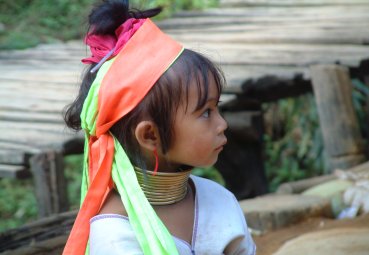
We booked a half-day trip to the biggest village of the Padaung, the long-neck Karen (where also the long-ear Karen live). There is a bit of a controversy about whether you should visit these villages because some people consider it a "human zoo". Personally I'd rather pay 250 B entry fee to these people who are refugees from Myanmar and since they're in Thailand as refugees have tourism as their only source of income than pay twice or three the amount to Queen Elisabeth to visit Buckingham palace or to the pope to visit the Vatican museum, since these two are already rich enough. Besides I don't really see the difference between paying here and paying a Latin American Indian for a photo (which is frankly more tiresome since you have to discuss when you simply point a camera at someone than here where you pay only once).
So we visited the village and of course there are souvenir stalls and of course people pose for you but it is still a village where people actually live (another difference with e.g. the Uros reed islands on Titicaca lake where the souvenir sellers row over every morning to the islands).
In the evening we wandered around Mae Hong Son, had dinner in an Italian restaurant and booked another tour for the 2 of us with a guy called Dam of Namrim tours. We only booked a 1-day trip with bamboo rafting, elephant riding and visit to 2 hilltribe villages for 1000 B pp, but he listens very well and I think he's to be recommended for longer trekkings as well.
Nov. 13
Up early to get some breakfast and meet our guide at 8 am to start our day. The bamboo-rafting is exactly what the name says: you sit with 2 on a bamboo raft (with your feet practically in the water) and you float gently along the riverside landscape. We saw several Burmese refugees (who apparently number in the thousands in Mae Hong Son, collecting sand and grid form the river in order to make some money). All in all, it's a very relaxing experience...
Next we drove to an elephant camp to take a 1 hr ride on an elephant through the forest. This is also quite slow but not so relaxing since the movements of the elephant are not really streamlined.
Afterwards we drove up to a White Karen village (Karen is the largest hilltribe in Thailand and White Karen are a subgroup- the women wear white before marriage, after marriage this changes to red and black). We visited several of the bamboo houses and got a demonstration of different homemade utensils such as a rat trap.
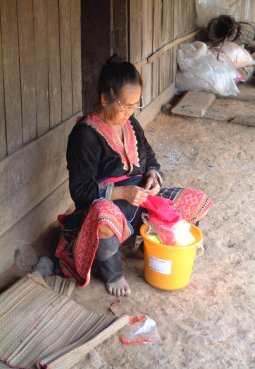
We visited another village, this one of the Hmong (originally from China which is reflected in their dress and physionomy). The Hmong houses are a lot bigger and not made of bamboo. Where the specialty of the Karen is weaving it is for the Hmong embroidery in geometrical patterns. We bought from the lady who made it a handicraft tissue for 400 B.
In the evening we had dinner in the best Thai restaurant in town (according to our guide), the Fern restaurant, and I must say, it was among the best Thai food I've eaten here so far.
Nov.14
We got on the 8.30 am non-airco bus together with among others Lisu hilltribe women for the drive to Pai. The road goes through mountainous territory so there's a lot of hair pin curves - no wonder the 100 km trip takes 4 hours...In Pai we stayed in Rimpai guest house, a very beautiful property with wooden bungalows with private sitting areas in a very nice garden next to the river (500B).
Pai consists literally of one guest house, restaurant, laundry, massage shop, souvenir shop and internet caf� alternating one another. According to our guide from yesterday Pai is a place for falang hippies with cheap drugs, tattoo shops and cooking schools... It is also the first place where there is such a big choice of falang food like sandwiches, burgers...Well I don't know about the drugs but there sure are a lot of alternative-looking falang here. In Pai itself there's not really that much to see (it's mostly used as departure point for trekking and rafting), so we spent the afternoon on our balcony reading. Luckily all these guest houses have free book exchange, it ensures a continuous supply of new books to read...
Nov. 15
We stepped on the bus to Chiang Mai, the capital of the whole of Northern Thailand and the second most important city in the country, where we arrived around noon. After looking at the Top North guest house (a dump) and Gap's guest house (full) we finally ended up in Lai Thai guest house which is big but is nicely decorated and has a pool (590 B).
In the afternoon we first went to the travel agency where we had booked our tickets to Myanmar for the 24th to pick them up. In Chiang Mai it's again a lot hotter than in the mountainous area north west of it, so a dive in the pool was a nice refreshment.
In the evening we went to the famous Night Bazaar and my God, what a shopping Walhalla this is... in Bangkok, you have sometimes the impression of stalls being simply more of the same, but the choice Chiang Mai has to offer is amazing... we still stuck with utilitarian buys (fake Burberry's, Polo, Lacoste polo's and a Swiss Army watch) that we could use for the rest of the trip (we still have 6 months to go so there is a limit to what you can buy)...
Nov. 16
We first discovered that the mobile phone we were carrying was missing - probably lost or stolen yesterday at the Night Bazaar. So we had to go to the tourist police to report this. And then we had to call Belgium to make sure the SIM card was blocked, all in all, there are nice ways of spending your day in Chiang Mai. Still, we did some sightseeing of the old temples Chiang Mai is famous for: Wat Chiang Man, Wat Phra Singh, Wat Chedi Luang and Wat Phan Tao. We also arranged for a rental car at Queen Bee agency (650 B per day) for a week for our trip to Sukhotai.
Later followed a refreshing swim and another trip to the Night Bazaar (and yes, we bought some more clothing).
Nov. 17
We set out with our car (a 4WD jeep) to Bo Sang, the famous umbrella village. There are a lot of other handicraft companies in and around Bo Sang apart from umbrella making - we visited among others a paper making factory. The process of umbrella making was also quite interesting - what a lot of manual labour that goes into it... I must say however that I like the finished product with all the little fringes and the shouting colours less than the semi-finished product (pure bamboo and wood). So we didn't buy one.
Next we attempted to find a scenic drive through the national park of Mae Takrang but we ended up doing quite a bit of untarred road with our jeep (we took a wrong turn.
After we'd found the right road again, we passed a village where a temple feast was being celebrated. Apparently all the temples are preparing themselves for the big Loy Kratong festival of the 19th with all kinds of decorations and celebrations.
In Lamphun, a small provincial capital we visited 2 wats: Wat Chama Thewi and Wat Hariphunchai, but apart from the wats it is a very small town with not that much to do, so we drove on to Lampang, another provincial capital, known because it is the only city in Thailand where you can ride in horse carts. There we got the very last room in a super guest house, the Riverside Guest House. The room was actually a suite with a large living room in a traditional Thai teak building decorated with Thai furniture...and all for 600B. There are also rooms with a beautiful balcony overlooking the river - I strongly the suspect the Italian owner has much to do with the style and taste this guest house demonstrates.
We had dinner at the Riverside Restaurant (same owner) and also this was great (huge choice of Thai dishes).
Nov. 18
Because the guest house was so nice we decided to spend our day around Lampang and only continue the day after to Sukhotai for the festival.
The Thai Elephant Conservation Center is the only government run center dedicated to the preservation of elephant. Since the ban on logging in Thailand all the working elephants lost their job and the issue of what to do with them and the preservation of training methods for mahouts are the main purposes of the center. There is an elephant show with demonstrations of how elephant are used in logging activities, and afterwards you get to feed them... We also went to the elephant hospital - one of the elephants was from Burma and had stepped on a landmine and had its foot amputated. A visit to the center is really worthwhile.
Close to the TECC is the market of Thung Kwian where every Wednesday a jungle market is held with flora and fauna from the jungle. There is also a permanent market but that's not really worth the stop.
The temple of Wat Phra That Lampang Luang boasts the oldest existing wooden building in Thailand, and I must say, it is an impressive temple.
In the city of Lampang itself we visited the Baan Sao Nak, another huge traditional Thai building filled with Thai and Burmese antiques, and the temple of Wat Phra Kaew Don Tao (we must have seen until now at least 100 temples and thousands of Buddha statues ... and apparently Myanmar has even more temples...).
Nov. 19
The 19th of November was full moon and as such the date for the Loy Kratong festival, when all the Thai put little floating boats decorated with flowers and candles (called kratong) in the rivers at night to celebrate the end of the rain season. It is a festival that started in Sukhotai (old capital of Thailand) hundreds of years ago and therefore Sukhotai still is the prime location to be. Of course, one disadvantage of traveling without booking anything in advance is that when you get at noon in Sukhotai on the most important day of the year, chances of easily finding somewhere to sleep are quite slim. We did the tour of the hotels and guest houses, and finally ended up in Yupa guest house, a really very basic place (room was 100B per night).
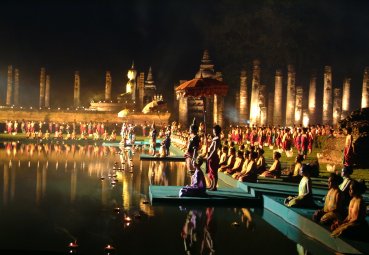
The festival takes place in the old city among the ruins so the setting is quite something. It is mainly a Thai affair, there are of course tourists, but that's definitely not the target public. In the afternoon we saw first the procession of the royal Kratongs (of course bigger than the kratongs of the ordinary people), with a lot of Misses being carried and a lot of traditional dancing in between.
At 6 we got in for the traditional dinner with another show of traditional music and dance, on the lawn in front of Wat Mahathat, the main temple, beautifully illuminated. The dinner was really fun, but we clearly didn't get the opportunity to ask for mai phet (not spicy). After the dinner we bought 2 kratongs that we put in the pond - which earned us some strange looks from Thai why falang would do such a thing... In between the ruins of Sukhotai there are quite a few ponds, and all the floating candles with the illuminated ruins in the background make for a beautiful sight.
We also had tickets for the light and sound presentation, again in the d�cor of the old Sukhotai ruins, and I must say it was magnificent. At times there were 200 people on stage to tell the story of the origin of Loy Kratong (pity it was all in Thai), and with the light effects, candles, fireworks... this alone makes the trip to Sukhotai worthwhile.
Finally there was a huge firework over the main pond, which was really the splendid end of a great festival.
Nov. 20
We only got back at the guest house at 2 am, so we slept until 10 am. Then, without even taking a shower due to not inviting bathroom, we picked up our stuff and set out for a guest house that we'd seen on our odyssey of yesterday, the "Orchid Hibiscus guest house" near the ruins, consisting of Thai pavillons in a nice garden with a superb pool (800 B incl. breakfast). We took a shower, had breakfast, and felt reborn.
The Sukhotai ruins complex offered a totally different sight from the day before. Everywhere people were collecting capsized kratongs from the ponds and cleaning up garbage. But all in all it was a much more quiet visit than yesterday. We visited the main wats inside the old city walls like Wat Mahathat, and the main ones outside the walls like Wat Si Chum. The Buddha images of Sukhotai do have a very striking style: they are androgyn and boneless-like.
We spent the late afternoon swimming and relaxing, but before sunset we visited a couple of other temples.
Back in the guest house we were invited by the Italian owner, who had invited Thai friends from Bangkok for a Loy Kratong dinner, to join in. It turned out to be a very agreeable evening with spicy Thai food, local whisky, live music and interesting conversations with Paulo's Thai friends (not always easy due to limited English skill).
Nov. 21
After filling in his guestbook (and I do recommend him highly) we got from Paulo a ceramic stand for a candle (supposedly 700 years old and found among the ruins) as a present.
We drove off to Si Satchanalai, another old capital now in ruins. It is also situated in a huge park but it attracts only a handful of visitors, so it's nice to wander around in the shade under the trees between the ruins without many other tourists in sight.
After our visit we continued to Phrae, a small provincial capital where we stopped and visited Vongburi house (Phrae used to be a big teak trade center and the house is made of teak and filled with documents and objects of that period). Next to the house we saw silversmiths working on hammering silver bowls.
We decided to push further northeast to visit Nan province, which is a very rural area with very little tourism so far. It is a fact that there aren't many guesthouses in Nan, so we checked in at the Dheravaj hotel (800B) and had dinner there.
Nov. 22
In the morning we did some sightseeing in Nan (and what do you know, the biggest sights are wats): Wat Phumin with wall paintings (among others of farang), Wat Phra That Chang Kham and Wat Phra That Chae Hing. Then we drove on to Ban Nong Bua, a village of a special ethnic group the Thai Lue who are famous for their handwoven fabrics. The village is small and consists of wooden houses on stilts. Underneath the houses you find the looms. We saw several women working on their looms - since they use very fine threads it is a painstakingly slow process.
The next village we visited was Ban Pa Klang, a Yao/ Mien hilltribe village. The Yao are famous for embroidery and silverwork. In the village there are several silver ateliers and shops. We bought a bracelet for 780 B so it's not very expensive...
The Yao women typically dress with embroidered trousers and jackets with fur-like collars. We saw along the very very scenic road towards Chang Khan several more of them.
Nan province seems to be a quiet, beautiful rural area without much industry and mass-tourism, so it's a nice getaway- we only spent a day but I think you could spend a day or three here.
As we'd spent our last bahts on the bracelet, we had to drive to Chang Khlam to find an ATM and a hotel. We stayed at the Chang Khlam garden resort (350 B) - we had dinner across the street and since we got for the very first time in a restaurant an all-Thai menu, we had a bit of fun with LP and LP phrase book in ordering .
Nov. 23
We left early for our drive back to Chiang Mai. On the market in Phayao we had breakfast and then we continued via another very scenic road to Chiang Mai where we got around noon. The Lai Thai guest house was pretty OK so we went back there.
We spent the rest of the afternoon arranging laundry (40 B per kg for wash, dry and iron), emailing, swimming and packing our bags for Myanmar (we left a bag in storage in the hotel which must have weighed at least 10 kg: guide books, excess clothing...).
For dinner we splurged at the Riverside restaurant (which as the name says is next to the river) with a bottle of Australian wine- but the food was also very good...
Nov. 24
This was the day we departed for Myanmar, but since the plane (Air Mandalay) only left at 14.35 we still had the morning to spend in Chiang Mai. We first brought back the car to the rental agency (Queen Bee), then picked up our laundry and finally took a songthaew to the Warorot market. This market is known for textile but it's a lot bigger than that. It is however compared to the Night Bazaar a rather non-touristy affair. The streets surrounding the market are apparently the center for retail and wholesale handicraft shops.
We took a taxi from the hotel to the airport. Apparently there's a 500 airport tax that you still have to pay...
And for the rest of the story see the Myanmar chapter...