| Laos |
| LAOS FYI 1B= 250 kip Jan. 3 In Chiang Khong we dumped our bags in a tuk-tuk to go to the ferry crossing across the Mekong to Laos. Immigration out of Thailand, the boat crossing (20 B) and immigration into Laos in Huay Xai went very smooth. We also changed money: LP says that the highest bank note is 5000 kip but recently the government has also introduced 10000 and 20000 kip notes. We found out later that Laos really works with 3 different currencies: kip (for everyday purchases, budget hotels and food), baht and dollar (both for more expensive hotels and restaurants and charters). But it's best to carry all three of them and ask every time what the price in each currency is - the differences can be huge and it's best if you got the choice in what to pay. The exchange rates used by hotels and restaurants can be really arbitrary depending on what their preferred currency is. Finding a boat to Chieng Kok, north along the Mekong was not so simple. After touring around with a tuk-tuk we finally chartered a speedboat at the Luang Prabang landing for 3000 B but the guy didn't want to leave from there for one reason or another. So it was back in a tuk-tuk again to a village near Huay Xai from where we finally left. For the speedboat ride you're equipped with life jacket and a helmet. It turned out to be one of the most spectacular boat rides we'd done so far. The first stretch passes through forested hills with rocks sticking out of the water, bordering Thailand. We passed again the Golden Triangle area where we'd been only last week (and which is, frankly, the least spectacular part of the trip). The part of the trip bordering Myanmar is at times quite sporty because you really pass through some very choppy stretches where the rocks create currents and rapids. But what a ride it is! Along the way you pass Chinese cargo boats, water buffaloes (also pale ones, almost albino like), and the occasional villages but for the rest it's navigating between the forested hills. Chieng Kok is a port village along the Mekong. We tried to push on till Muang Sing, but since we could find hardly anyone who spoke English (or French) to find out if there was still a bus going (we were offered a taxi for 1500 B but considered that too much) we decided to spend the night here. The Xieng Kok resort lies on a hill with magnificent views over the Mekong. The little bungalows have attached bathroom, and at 200 B this is a bargain. Walking in the village we ran into hill tribe people we hadn't seen until now (later it turned out that they were a subgroup of the Akha, called Ikho in Laos) with silver headdresses, silver shoulder belts and, remarkably, bare breasts. A closer look at the coins on their outfit revealed use of among others Australian coins and "Republique francaise" coins (piastres) of 1899, 1902 and 1904... There is no electricity in the village and the few private generators work from 6 pm to 9 pm. For walking around in the village after dark a flashlight is handy ... electricity and TV are the gathering points for the villagers. In the restaurant where we went we saw by coincidence the next episode of a soap starring a beauty queen and a Muai Thai boxer that we'd also seen the week before - luckily for this type of entertainment you don't need much language skills as the overacting speaks for itself. It was fun however watching the people supportering and enjoying themselves- Lao people watch Thai TV a lot ... they can understand it because the languages are in fact very similar (there are actually more ethnic Lao speaking people in Thailand than in Laos). But in general you can say the influence of Thailand in Laos is considerable. Jan. 4 Today we did find a songthaew truck to Muang Sing and luckily we could sit in the cabin because it was raining quite hard (it's not supposed to rain now, but then it wasn't supposed to be so cloudy in Thailand last week). The road is unpaved but very smooth and passes through beautiful forest. You get the impression from this stretch of road that northern Laos is one big forested mountainous area with rivers intersecting inhabited by hill tribes. After a stop underway to repair something our driver however refused to go any further than Muang Long, a village one third of the way. Luckily there was another truck going further so we weren't stuck for long. We drove through several Akha villages (all Akha women do still wear the traditional head dress ... as opposed to Thailand where you only see the occasional Akha on the road, but here there are so many of them). We also saw people from another hill tribe dressed in blue, green and black pants (also the women) and their hair tied in a knot on their forehead. These later turned out to be Hmong but again a different kind Hmong than we'd seen in Thailand. In any case here in this part of Laos you don't really have to go looking for hill tribes, you can simply not look past them. In Muang Sing, a backpacker's favourite and trade centre for the hill tribe villagers we saw again many Akha and Tai Dam (they wear bright coloured small vests with coins and 1 big coin/hairpin in their hair). The guesthouse we stayed in was Dan Neua GH (120 B attached bathroom). There is one information office/trekking service in the center where we arranged for a tuk-tuk plus guide to visit several villages in the afternoon (25 USD for 2). We first stopped off at Ban Nong Bua, a Tai Dam village. The Tai Dam are known for their weaving (both cotton and silk). We saw looms in action and also silk worms. In the village we bought a hairpin consisting of a French silver piaster of 1890 (18000 kip or 72B). Next we visited a Tai Lue village (they don't wear a distinctive dress) and then an Akha village, again not comparable with the ones in Thailand (mainly, there are no souvenir stalls). Our final visit was to a Hmong village (these ones did not wear distinctive clothing but we did get invited to some kind of spirit ceremony involving a complete Hmong family with a feast meal of pork and rice and rice alcohol). Jan. 5 At night it started raining heavily and it kept pouring the whole day. So we visited the market, famous for the many hill tribe people that normally attend, but it was a very muddy affair. We then walked the Muang Sing hospital to see if we could leave behind all the medication that we'd brought (samples from pharmaceutical companies). They were very welcome so we left everything there. At the handicraft market we bought some Hmong bags (5000 kip each) and some silk scarves (45000 kip) each. As it was too wet to do anything else we took the truck to Luang Nam Tha (luckily with front seats, 60 km, 10000 kip) and what a bad road it is ... without 4WD you wouldn't get through... In Luang Nam Tha we checked in at the Vila GH. The rate was 10 USD which is about 4 times more as LP (edition 2002) says - we found out later that the Lonely Planetisation (= "being recommended in the Lonely Planet" and thus boosting falang traffic) of Luang Nam Tha had caused some guest houses to quadruple their prices. LP says also that boat trips down the Nam Tha are cheapest in this direction but that you have to negotiate ... now the boatmen have formed an association, thus creating a monopoly and there is no negotiating whatsoever on the prices (which have also considerably gone up). In the afternoon we went to the Lao herbal sauna (more a Turkish steam bath with herbs in a bamboo hut) and had a Lao massage (much softer and more relaxing than in Thailand) and at 10000 kip for the sauna and 20000 kip for the massage you're not exactly ruined. Jan. 6 We first went to the market but saw only a few Akha people. Next we chartered a tuk tuk to take us to the boat landing where we wanted to start the 2 -day trip down towards Pak Tha. The fare for a whole boat is 90 USD whether you're 2 or 4 people on the boat. As we were looking to share we first discussed with a group of 4 falangs who finally refused to share. Next we were told that we could share with 2 other people who would arrive a bit later, but when they got there they didn't want to share either... Falangs are more difficult than Lao ... We then decided to rent then the boat for the 2 of us but got stuck on the negotiation of how much discount we would get when we were to take Lao people with us on the boat (we found out later also in other places that even when you've chartered a boat or a car they still try to get Lao passengers on). And finally when we were told that our boatman was having lunch and would only be there at 1pm (it was then 11.30 am and we'd been there since 9 am) we were fed up, signed on our names for the next day and walked off. This time we went to the Pheng Thavy GH (8 USD but a much bigger room and hot shower). We had lunch in town, a baguette with La vache qui rit - I must say, apart from French signs on banks and the post office and the presence of baguettes and La vache qui rit, there is not much left of the French period...In school also English is taught instead of French, so we haven't even met anyone who speaks French so far... In the afternoon we visited 2 villages in the surrounding area: Ban Jong Thai and Ban Hat Yao). The first is a Tai Dam weaving village (where we bought a cotton scarf), the second is a Hmong village. They happened to be celebrating Hmong New Year, so there were many people in traditional dress (and judging from the differences in dress there are several subgroups of Hmong). Typical for the Hmong New Year festivities is game playing: one of the games is ball throwing between 2 lines of participants (the meaning of this is still not very clear to us), another is a kind of volleyball with a hollow rattan ball that you can't touch with the hands. Jan. 7 This time we did get started on our 2-day boat trip, with, incredible but true, 2 Belgians as companions. The weather could have been less cloudy and thus a bit warmer but it was a very nice trip along hills with rainforest (which had, however, at quite a number of places been cut down so there was just shrub left on the hillside). We stopped in a few villages along the way where they definitely hadn't seen that many foreigners before (first, they didn't want to sell anything, second, when you lifted a camera the children ran away scared). The first stretch is also at times more a rafting trip than a motorboat trip: there are 2 guys on the bow who have to paddle very hard at times to get through the rapids. The river is really used for goods transportation ...we saw a goat, pigs and even water buffaloes being transported in these slow boats. We spent the night at the village of the boatman, in his house (mats and blankets rolled out on the lower floor with balcony of his house). For the first time this trip we used our sleeping bag liners and mosquito net. We first walked around in his village, and it's also a place where practically every house has a loom. The people are really very friendly, "sabaaidie"- ing all the time and smiling ...it's a pity the communication barrier is so big. One guy invited us up in his house to share sticky rice in banana leaves. We also bought from his daughter a home grown freshly cut pineapple that they cut into pieces a la minute, and bought from his wife a weaving that is actually a mix between weaving and embroidery and involves lots of different threads being inserted manually to form the pattern. Jan. 8 For once we didn't wake up from the sound of the roosters, but from the cassette player of our host family that started to play at 5. 30 or so...Also the Lao live in a daylight regime and this means early to rise and early to bed. By 1 pm we had cruised down the Nam Tha to where it flows in the Mekong at Pak Tha. When we got there a speedboat stopped alongside to offer its services, and we chartered it for the 4 of us to bring us to Pak Beng (2000B for the boat). After a quick lunch at one of the floating sheds where they also serve food we stepped in the speedboat, insisted that we did not want to take another Lao passenger with us (another attempt to load a Lao on) and set off. This speedboat ride was quite a lot more uncomfortable than the one to Chieng Kok. Apparently the degree of safety and comfort you experience on a speedboat is very much dependent on the pilot. Where the one to Chieng Kok was excellent, this one was a cowboy, really going very fast and very hard over the choppy waves. Not long after we'd left he stopped at some sheds along the river (we thought to buy petrol) but he bought 2 animals, apparently destined for eating as he weighed them. They looked like family of the armadillo and I'm pretty sure they were a protected species, because he next stopped each time he saw people along the Mekong to try and sell them... And just before arriving in Pakbeng he hid them under some gear in the boat... So we were quite glad to have made it in one piece to Pakbeng. We checked in at the Sarika GH, where we got for 500 B the room with the best view in town, looking out on two sides over the Mekong...We spent the rest of the afternoon walking around in the village and doing some shopping for our boat trip the next day, a full day trip by slow boat on the Mekong to Luang Prabang. Jan. 9 As we were quite late in buying tickets, we found ourselves on a small slow boat with only 6 other falangs -which made it an all the more interesting ride because the boat stopped at several villages along the river to let people on or off, so it's at times a very picturesque spectacle, and the Lao look as much at the falangs as we look at them. The slow boat gives you more time to relax, read and enjoy the landscape and it's also cheap (55000 kip pp from Pakbeng to Luang Prabang), but of course it's really much slower than the speedboat. When we sailed past the entrance of the Pak Ou caves we knew we were not far anymore from the town. However, the only thing you see of Luang Prabang when you arrive by river is steps leading down to the Mekong, for the rest you only see palm trees... When we got off the boat, we climbed up to the street, turned a corner and took a room at the Sayo guest house. It's a French colonial building that could just as well sit somewhere in a little town in the Provence, with a symmetrical fa�ade and wood shutters. The room (at 30 USD) was without doubt the most characterful and charming room we'd had so far. It is huge with a separate sitting area, 5 m high ceilings, polished wooden floor, colonial furniture ... absolutely beautiful. Luang Prabang is really unlike any other city I've ever seen ... it's supposedly the best preserved city in South East Asia. This means that it has retained the original build up of small villages around their own temple, clustering together to form a town. Hence you see a lot of temples (very well preserved), and the city feels very relaxed and easy going, more like a small town in southern France somewhere. There are a lot of trees, unpaved sidestreets, wooden and bamboo huts, terraces along the Mekong... We had dinner in l'Elephant, a French owned restaurant with indeed, delicious food (venison, wild boar, nougat glace)... The food is one of the big attractions of Luang Prabang, you can eat very well, drink reasonably priced wine, really an oasis in the middle or rice, noodle and Beerlao country (which in itself is not bad but you do tire of it). Jan. 10 We went first to the Lao aviation office to book tickets to Phonsavan to visit the Plain of Jars. In the office the rate is cheaper (36.5 USD pp) and you can pay with Visa without getting charged 3 % or more extra like the other travel agencies do... And then we toured around LP on foot, visiting the wats (not polished and restored for the nth time like the ones in Thailand, which makes that there you don't see the difference between what's old and what's new) and enjoying the atmosphere. We also did a comparative investigation of other colonial guesthouses and found that for once we'd hit the jackpot with our room. We had dinner in Le Potiron (pizza and steak), again excellent. Jan. 11 For our morning exercise we climbed Phu Si, the hill overlooking Luang Prabang and providing excellent views o the town. We next visited the Royal Palace and continued our discovery on foot of LP. We walked all the way to the Pansea hotel - as we'd enjoyed the one in Yangon so much we wanted to see what this one looked like. It's also very stylish and nice but doesn't have the atmosphere of the one in Yangon. LP is really a very charming city: it's small, laid back, you can sit at the riverside and just watch the Mekong flow by... That evening we went to a spectacle at the Royal Theatre, which was Lao style. Baci welcoming ceremony with distribution of coke, rice crackers and bananas, folk songs, extracts from the Ramayana and Hmong and Phu Noi minorities dances. Afterwards we had dinner at the Souvannapoum hotel, once the residence of a royal prince. Jan. 12 Our flight to Phonsavan was with a small 17-seater of Lao Aviation. We took off and landed exactly on time. Phonsavan is located on a plateau much higher than LP, with little trees and more dried shrubs and grass. The airport is a really small place with the cows and chickens walking around the runway. We' chosen the Maly hotel from LP and as they were waiting at the airport we got a free ride and a chance to meet a British and an Australian couple that'd come on the same flight. We arranged with them to rent the hotel minivan for the afternoon to visit the Plain of Jars sites (80 USD for the van, 20 USD for the room). The first site is the biggest in number of jars and it also contains the biggest jars. Why and by whom these jars were made is still much of a mystery ... the stories told by the local guide that came with us and what LP and Insight Guide tell are diametrically opposite: age ranges from 2000 BC to 100 BC, according to the one they were made with stone tools from quarries far away, according to the other they were made with iron tools on site...who's to tell what's the truth? When walking between the jars you also see quite a few bomb craters. During the Vietnam war Laos was very heavily bombed both by the US and Vietnam (although Laos was in fact neutral territory). Per capita about half a ton of explosives were used... a lot of this is still unexploded and causes regular accidents (UXO or unexploded ordnance). The bomb shells are used for various purposes: decoration, plant pots, steps, supports for fences or sheds... The restaurant of the Maly hotel is also decorated with quite a few of these finds. The second and third jar sites are smaller -the second is located over 2 hill tops between trees, and for the third you have to walk between rice paddies for 2 km before you get there. All in all I had expected the sites to be on a bigger scale than they actually are. Jan. 13 At 7.30 we got to the bus station to get the bus to Sam Nua in the extreme north east of Laos. At the bus station everyone was wearing thick winter clothes with scarves and hats because it really was quite chilly. On top of that the bus was the open side truck type, so we pulled out jackets, scarves, socks etc out of our backpacks to keep at least a little warm. The first stretch of the road takes you to Nam Neun, where we got around 1.30, and we were immediately offloaded there and loaded onto another truck heading Sam Nua. The second stretch is quite winding up the mountains. About halfway a strange sound started in the engine and the driver decided to try and solve this on site, so we waited in the middle of nowhere for an hour and a half... In the conversations between the driver and the would-be mechanics among the passengers we heard the word "soupape" returning regularly, so I guess that's one more influence of the French that remains...The driver didn't solve the problem so he decided to continue to Sam Nua driving very slowly - which meant that we got there only at 8 pm, again in the dark and in the cold (it was even colder here than in Phonsavan). I had no idea it could be so cold in Laos. The guest house we wanted to check into was full, so we ended up in the Phu Lao hotel, a communist era relic with the plaster falling off the walls (40000 kip). There was however a lukewarm shower and 2 blankets so that did help in getting warm. Jan. 14 We first walked around the market of Sam Nua where among others the famous silk textiles are sold. We saw also some Hmong people dressed in green and black, which is remarkable because the ones we'd seen so far were all dressed in blue and black. At the tourist office we next rented a car and driver (30 USD) to take us to Vieng Xai, a valley with karst formations in which the historical Pathet Lao caves are situated. During the war in Vietnam the communist party in Laos took up residence in these caves to be protected from bombings. After they took over power in 1975 they of course moved to Vientiane, but the caves are treated as historical monuments. Inside there are meeting rooms, bed rooms, a hospital, with wooden separation walls. We visited the 2 most important ones, the caves occupied by Kaysone and by the Red Prince. The setting of the caves and the karst formations are beautiful but somehow the caves are not that spectacular in itself. Around Vieng Xai there are several minorities.... villages such as Yao, Hmong... We also visited a Tai Daeng village where weaving is done. Weaving is really the national occupation of the Lao. At this village a scrap iron buyer was looking at what the villagers were offering, and among the stuff was a hand grenade -they really do live with the memories of the war on a daily basis. Getting back to Sam Nua we asked the guy in the tourist office to write down the names of the weaving villages surrounding Sam Nua so we could visit them (if I would have to give a prize of the area with the least language skills so far it would definitely go to Sam Nua - the guy in the tourist office was the only one in town who spoke a few words of English). So with sign language and a few Thai numbers we negotiated with a tuk tuk driver to take us to 2 of the 3 villages to see the weaving. The strange thing is that at the biggest "factory" we went they did not want to sell us anything ... I assume it all goes off to Vientiane immediately and the weavers are simply paid per piece. At another house (a family business) we were able to buy a piece of silk normally destined for a sarong - they cut it straight from the loom... Jan. 15 We got to the bus station at 6.30 to get the bus to Nong Khiaw (40000kip). The first stretch of the trip wasn't that bad with quite a lot of leg room, but gradually the bus began to fill up more and more until people were sitting in the gangway on plastic stools and on bags of rice ... getting out of the bus at one of the rare stops involved walking over the arm rests to get out...Moreover the road was the worst we'd seen so far in Laos ... It's called Route 1 but I assume the last maintenance must've been quite a while ago... The landscape is again mountains and forests, of which again already a lot has been cut - there clearly is not yet a logging ban here as there is in Thailand. When we finally got to Nong Khiaw at 9 pm there was such a scramble for our seats that for a moment we couldn't get back or forth in the bus. Finally after a lot of stepping on people's hands and the like we managed to get out in one piece. Of course in Nong Khiaw all restaurants and guesthouses were already closed, so we had to bang at the door to get in Phayboun GH ... and of course only the very basic rooms were still available but at least they were cheap (20000 kip). Dead tired we stumbled into bed and fell asleep instantly. The bus that we were on normally continues all the way to Vientiane which was at least another 12-hour drive from where we left... I think these drivers must take pills of some kind to be able to manage this. Jan. 16 Nong Khiaw is a pleasant riverside village located on the Nam Ou river. From there it's 4 hrs by bus to Luang Prabang, but as we were quite fed up with bus travel we went to the boat landing to see what possibilities there were there. We finally chartered a speedboat to take us first upriver to Muang Ngoi, and then take us all the way to Luang Prabang (2800B). The scenery upriver along the Nam Ou is very spectacular with steep cliffs and mountains on both sides. Muang Ngoi is a very charming little village along the river where there are no cars or motorcycles. The sand streets and palm trees make it a very relaxed place (which has also been discovered by the backpackers since there are 20 guesthouses or so in Muang Ngoi). But then again, the whole way of life of the Lao is not exactly likely to give you a heart attack (the French say "the Vietnamese plant the rice, the Cambodians watch them planting but the Lao listen to the rice grow"). Also in business this becomes clear :where in other countries as a tourist you're offered when walking on the street anything from boat trips, taxi rides to handicrafts, in Laos you have to go looking for it yourself. After soaking up the atmosphere in Muang Ngoi we boarded again the speedboat to Luang Prabang. The good thing is that speedboats (as they do make a hell of a lot of noise) are banned from coming too near the town, but the disadvantage is that as you disembark so far from the city you're at the mercy then of the tuk-tuk drivers who can charge practically what they want- moreover our tuk-tuk seemed to have serious engine problems because the engine stopped at least a half a dozen times before we got to the center. So we didn't leave on a very friendly note with the driver. Unfortunately both Sayo GH and its neighbour (another colonial place) were full, so we took a room in Senesouk GH (25 USD) which is also a restored colonial shophouse but without the charm of the other 2 (on the ground floor the floors are modern tiles). We spent the afternoon sitting on a terrace near the Mekong and nursing the heavy cold caught on the bus ride to Sam Nua. That evening we went again to l'Elephant for dinner. Jan. 17 After breakfast at the Healthy and Fresh bakery (croissants!) we decided to charter a boat to see the Pak Ou caves and some villages along the way (100000 kip). The first village we stopped at was a village with a lot of handicrafts, especially sa paper (made from the bark of the sa tree). There was also a big silk weaving shop where you can see the silk worms, cocoons, spinning of thread and finally weaving... The Pak Ou caves consist of 2 caves one on top of the other. They are both filled with lots and lost of little Buddha statues (definitely not so big as the ones in the Pindaya cave in Myanmar). On our way out we crossed a big group of Finnish scouts, probably traveling further on after the World Scout Jamboree in Bangkok. We had lunch at the Pak Ou village across the river and then headed leisurely back to Luang Prabang. As we'd switched rooms and now occupied a room on the second floor with a wooden balcony with rattan chairs, we lingered there a bit before heading out again to buy tickets for the minibus to Vang Vieng the next day (8 USD). These minibuses are privately owned and if you feel like a bit more comfort compared to the crowded public transport, it's an alternative. And they pick you up at your GH, and drop you off at one of your choice. For dinner we tried the Couleur Caf� restaurant, another French owned place. Jan. 18 The minibus picked us up at 8.30 and with 3 Americans and a Lao-American we left Luang Prabang. The road to Vang Vieng is a very, very winding mountainous road but the scenery is quite beautiful. A while before you get to Vang Vieng you see karst formations appearing. Vang Vieng is a traditional stop over place between Vientiane and Luang Prabang. It's located on a river, and on the other side of the river are some really beautiful karst formations with a lot of caves (so there's plenty of caving, kayaking and the like to do for the active falang). We stayed in a bamboo bungalow at the Thavonsouk bungalows located right on the river (18 USD). Vang Vieng is not yet Pai (in Thailand) but it does harbour the largest concentration of falang we've seen in Laos. We watched the sunset on the river and it was quite a contrast to see the kayakers coming back with their outdoor gear and Teva sandals, paddling between the Lao women and girls who were busy washing their hair and brushing their teeth in the river (of course fully dressed in sarong - they very skillfully manage to dress and undress while wearing a sarong). Jan. 19 We took again the minibus for the second stretch to Vientiane. This time the road was luckily not a winding mountain road. In Vientiane the first 3 GH we'd picked in LP were full, so we decided to spend our first night in a very straightforward place (Lovan GH, 10 USD) and return to Villa Manoly GH to book for the next 2 nights. Villa Manoly is a very big villa built in the 1950's with a small pool and a beautiful garden -at 25 USD it's a good deal. We walked around in the center of town in the afternoon, and took a look at the Mekong here (it's much wider here than in LP). There's quite a few colonial buildings left but overall the city doesn't come close to being as charming as Luang Prabang. There are a lot of French and Italian restaurants here -we tried Le Provencal. As the King of Cambodia used to say "I am against being colonized but if it has to be than it's better to be colonized by gourmets"- and the cuisine is most definitely one legacy of the French that will live on. Jan. 20 In the morning we went visa hunting, and we first tried the embassy of Vietnam. All countries we've been so far apply the rule that you get a visa that allows you to enter within a period of 3 months and once you're in you can stay 4 weeks - this allows flexibility in entry date. Of course Vietnam has to be different: they require the exact entry date and from then you can stay one month. But as we had no idea when we would enter exactly we decided to skip Vietnam for the moment and try the Cambodian embassy. There it went like a breeze: we paid 20 USD and could pick up the visa (with 3 months validity) on Wednesday. Next we went shopping. Vientiane has a big morning market with different sections for textiles, fresh goods etc. One section is a "department store"and it's a supermarket for counterfeit clothes, watches...In Thailand it's bad but here they have things I haven't even seen there. In the jewelry section we saw heaps and heaps of the French silver piastres, with every imaginable year inscribed on them, ranging from 0000 over 1200 to 1799... Undoubtedly there must be a little factory stashed away somewhere that produces these counterfeit coins in big quantities - only they have no idea of the historical dates that are possible (of course in Buddhist countries we are in the year 2446, so they have to be aware already that the western world lives in 2003). We also spent a lot of time in the textile section: the kilometers silk that are for sale here defy imagination. We went hunting for a Sam Nua type wall hanging (the most sought after), and after comparing offerings and prices also on the tribal market (across the street from the morning market) we bought one with naga (sea serpent) design for 3000B - for 3m handwoven silk with very complex designs... After a sandwich lunch we decided to take it easy for the rest of the day and enjoy the pool. Before sunset we walked over to the Mekong to see the sunset and then had dinner at Le cote d'Azur, still French owned, and really good. It was also clear that the French chef really managed things - we have found that a lot of these restaurants with French names may originally have been started by entrepreneurial falangs, but then they are taken over by Lao who do manage to copy the food very well. The absence of western management however is betrayed by the fact that the new people sometimes barely understand what's on the English menu, generally speak very little English, bring appetizers and main courses at the same time, or bring main courses for the different people of one party at long intervals... The falang way of eating is so contrary to the Asian way where you put everything together on the table to be shared that if you're not in a falang-owned restaurant eating the falang way will not work out well. Jan. 21 We did some more sightseeing today: the Pha Keo museum and the Si Saket temple. Pha Keo contains a lot of beautiful bronze Buddha images, but Si Saket exudes the most charm (it's the oldest temple in Vientiane). After an afternoon at the pool we went again to Le cote d'Azur for dinner. Jan. 22 By tuk-tuk we went to Pha That Luang, Laos' main Buddhist sanctuary. It's completely gilded but it's not really that impressive. The impression you get regarding Buddhism is that where Myanmar people are really orthodox and that in Thailand it's also very alive, in Laos it's all a bit more relax and much less prominent. The wats in Vientiane sometimes resemble more a garbage dump than a temple (in Luang Prabang this is not the case but there I guess there are more tourists and there is more awareness). And that's both in Myanmar and Laos terrible: people just throw everything on the street: plastic, paper, kitchen garbage... We picked up our visa at the Cambodian embassy. We also wandered into a minimart, which turned out to be a supermarket exclusively oriented towards expatriates, selling French cheeses, Swiss and Belgian chocolates, and lots of other typical specialties of western countries. In the evening we were picked up by the travel agent where we'd bought the tickets for the night bus to Pakse who dropped us off at the VIP bus station. It was a very nice bus with wide, very far reclining seats, lots of leg room (more than in an airplane), a blanket, food and drink, and even a video. Jan. 23 We arrived in Pakse at 6 am, put our luggage in the Salachampa guest house, went for breakfast in the Champassak Palace hotel and started exploring the town to see what possibilities there were regarding excursions to the Bolaven plateau. But the few travel agents there were either didn't speak English or were very expensive (70 USD per day). As we wandered around a bit aimlessly the tuk-tuk driver who'd picked us up at the bus station that morning stopped to ask where we were going, and after some discussion we agreed that he would make a 2-day trip with us to the Bolaven plateau for 550000 kip (around 50 USD). The Bolaven plateau is due to its altitude very good for growing coffee, so we first drove through the coffee plantations. At one of them we saw people from the Lao UXO demining service working with metal detectors to clear the site of war debris. When a car came from the other direction it turned out to be a jeep of the "Belgian Bomb Disposal", driven by Rudy, a Belgian military demining expert. We talked with him for a while. Apparently the Lao government has a contract with the Belgian government to hire the services of the DOVO demining experts. Part of their job in Laos is giving talks in villages about the different types of explosives and the dangers involved. They then interview each villager personally to find out about any UXO and then go in with a clearance team. His estimation is that they have for at least 100 more years demining to do (based on the WWI experiences in Flanders). Their last report on an accident in a village with UXO was 2 months ago which he considered very good. We then went to the Tatfane resort built on the spot of a view point over the Thatfane Falls. The falls are actually twin falls coming together cascading down over the steep cliffs of the plateau. After a short visit to the market in Paksong (it was the middle of the day so there wasn't much activity left) we continued in the direction of the Tatlo Falls over a dusty dirt road. On the plateau live different ethnic Mon-Khmer minorities with their own culture, such as the Katu, Alak and Laven. We visited a Katu village along the way -easily recognizable as Katu because of their habit of carving wooden caskets for every member of the family and storing them below rice sheds until use. So if you spot coffins under a shed along the way it's a Katu village. With our driver we walked around the village to see the traditional build up of the village (with a central square), people smoking big bamboo pipes with tobacco, in short rural life at its best. The Tatlo falls are not very high but very wide and you can swim in the pools above and below the falls. It's a really charming and relaxing spot where you can easily decompress for a few days. We rented a bungalow at the Green house resort (15 USD), huge, completely in wood, with a balcony overlooking the top of the falls...The sound of the rustling water certainly has a very quieting effect. We swam in the pools at the top of the falls and had dinner next to the river. Jan. 24 We slept late, had pancakes for breakfast and then walked to the Tadlo resort, the upscale resort on the site. This resort has two elephants that you can ride - for 50000 kip pp you get a one and a half hour trip through the forest, twice wading through the river and walking through a village with the elephant (it certainly makes for a different vantage point). It was not as spectacular as in Myanmar, but definitely worthwhile. We also walked through the village at the bottom of the falls (they'd captured a turtle in the river and this was carried in triumph through the streets) before getting in our tuk-tuk again. We stopped at a village along the way where they sold the typical weavings with small beads made on foot looms - they were pretty expensive though. The market at Lao Ngam was again a very sleepy affair. On the way back to Pakse we stopped at another set of falls which were very beautiful also. There we decided to make a detour via Ban Saphai, a local silk weaving village where the typical southern patterns are made (mostly stylized animals like elephants) and also the tie dye technique is used. In Pakse we slept in the Salachampa hotel (15 USD), a French colonial villa. The owner speaks fluent French, one of very few such people we've met in Laos - later it turned out that she had lived in France for a very long time... We had dinner in an Indian place, the Jasmin restaurant, which was excellent. Jan. 25 We stepped on the slow boat to Si Phan Don or the Four Thousand Islands region, an area in the Mekong where the river is very wide with lots and lots of islands. The trip (50000 kip pp) takes some 8 hours and is a very relaxed affair: you sit on straw mats on the bottom of the boat (no seats) but this gives plenty of space to lie down, sleep, read or watch the spectacle each time the boat stops at a village ...all sorts of cargo is loaded upon the roof and the passengers (men only) sometimes sit on the roof too. We arrived on Don Khong island at Muang Saen, and took a tuk tuk to Muang Khong, a village on the other side of the island where most of the accommodation is. We had the last room in Villa Kang Khong (60000kip), a wood-concrete house with concrete rooms downstairs and teak rooms upstairs. The islands are really a place to relax: there are lots of hammocks and they are definitely well used...We walked through the village and had dinner at Pon's restaurant, with a terrace overlooking the Mekong. Jan. 26 We'd booked via the guesthouse a day trip (80000 kip) to the big waterfalls that make that the Mekong cannot be navigated from source till the delta. Different sets of huge rapids block the Mekong in the Si Phan Don area. So we first set out to Don Khon island, where the remains of the French-built railway (with a very rusty locomotive and a railway bridge with no tracks left) are visible. This railway is the only one ever built in Laos. Cargo that came by boat from Cambodia and Vietnam was off-loaded from the boats, transported via the railway to the area behind the rapids and then loaded onto another boat. Sometimes complete boats were loaded on the trains. When you walk on the island and come to the "small" rapids (which are pretty impressive), you do see why the French decided to build this railway. Next we went by boat to the mainland, boarded a tuk-tuk and drove to the "big" falls at Kon Papaeng. The falls are very wide and when you climb the rocks near them they're quite huge. We had lunch there and then drove on the Lao border post with Cambodia, where we stepped on a boat to see if we could spot any (very rare) freshwater Irrawady dolphins. These dolphins are endangered, mainly by fishing with grenades on the Cambodian side, but I do hope the Cambodians have learned in the mean time that there is more money to be made with live dolphins for tourists than dead fish for locals. As we were actually in Cambodian waters, we had to stop at a Cambodian police post (more a shack with some policemen in hammocks) and pay 5000 kip. We did get to see the dolphins (7 or 8 in total) - they don't exactly jump out of the water but when they come up for air you see the back fins appearing and disappearing again. All in all it's a day trip that would be hard to do on your own (at least if you wanted to do everything in one day). Jan. 27 We rented bicycles for the day and decided to explore the island. We did not cycle on the main road but next to the river beneath the bamboo trees. Along the way you really see village life in action (noodle making, gardening on the slopes of the Mekong, fishing, weaving...) We took ourselves also a dive in the Mekong as you see the Lao do- the water's very muddy but it's still refreshing. Jan. 28 Today we wanted to visit the Wat Phou temple (built by the Khmers and one of the main cities next to Angkor) in Champassak and then head on to Pakse. After the bus had dropped us off along the main road we took a songthaew to the river and crossed by "catamaran" (2 canoes with some wooden planks between them) to Champassak. At the place where we had lunch, we deposited our backpacks and then chartered a motorcycle tuk-tuk to the temple (30000 kip). The temple is a very impressive complex, clinging to a hill, with a walkway and different sets of (steep) stairs leading up to the main sanctuary. The view from the top is really good. On top there's also a wat and if you continue beyond that you come to some huge carved boulders such as a crocodile and an elephant rock, but there are also quite a few that make you wonder whatever they were going to be used for. After our visit our tuk tuk driver got us to the ferry, so we crossed again on catamaran. On the other side there was another tuk-tuk driver apparently anxious to get back to Pakse, because for 20000 kip for the 2 of us we were off. At Salachampa we got again one of the upstairs colonial rooms. When we went out for dinner we passed by a basketry shop (rare by all means in Pakse where there's only 1 so-called handicraft shop but where judging from the cobwebs it' been a long time since they sold anything). We bought 4 of them which we stashed in our backpacks -now there was no escaping anymore sending another package to Belgium. We bought also a Lao T-shirt in a minimart - Pakse really does very little concessions to tourists. Jan. 29 After a last baguette for breakfast we took a tuk-tuk to the market, from where the songthaews to the border leave (6000 kip pp). Near the border we passed truckloads and truckloads of teak wood ... Thailand may have banished logging but this doubles the rates at which forest in its neighboring countries are cut. At this border is also a large border market, so it's a good place for some last minute shopping to get rid of the remaining kips - we bought another T-shirt... Be careful not to lose the immigration form that you get upon entering or it's 10 USD fine when you exit (as happened to a German who crossed the border together with us). |
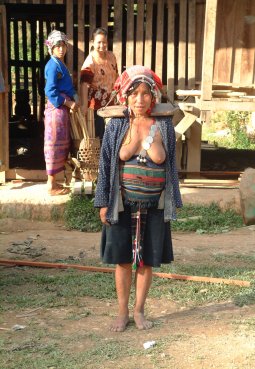 |
| Akha woman in Chieng Kok |
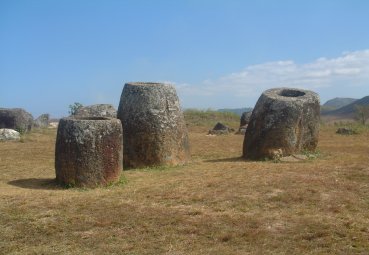 |
| Plain of Jars |
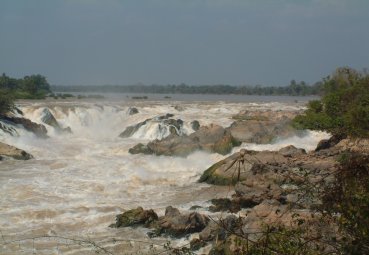 |
| Rapids on the Mekong |
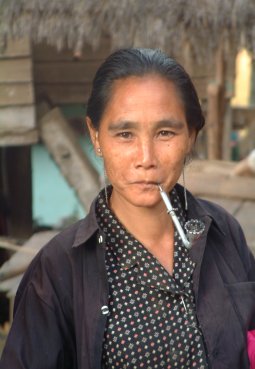 |
| Village woman during Nam Tha boat trip |
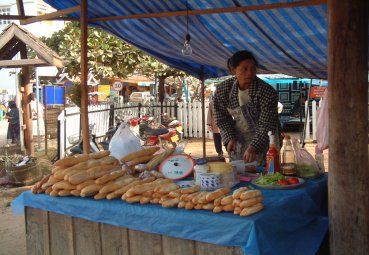 |
| Baguettes |
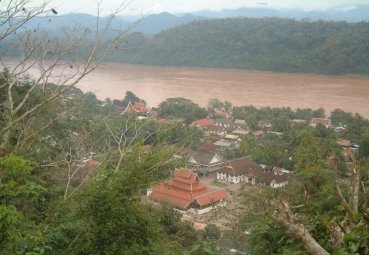 |
| Luang Prabang |
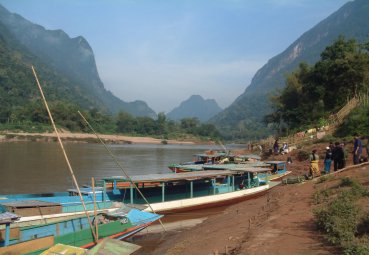 |
| Nam Ou river |
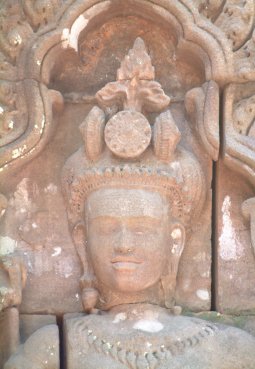 |
| Wat Phu |