Nov. 24 (continued)
The Air Mandalay flight was quite correct regarding timing and service. At the Yangon airport the only other planes I saw were from Yangon Airways and China Airlines - it is not exactly the busiest airport I have ever seen. Immigration and customs went quite easy and also the FEC changing (200 USD pp but if you don't stay long by means of a "present" you can arrange for 200 USD for 2). We had expected to land in sunshine but it was raining quite a lot - later it turned out that this abnormal weather with heavy rain was due to a cyclone (it would haunt us for a few more days).
We got a taxi for 5 USD at the taxi service counter which took us first to the Green hill hotel (only 15 USD but what a dump! Plus the staff doesn't give a very trustworthy impression, not to say that they lie in our face). Our second choice, Liberty hotel, turned out a whole lot better. It's a colonial mansion with a new wing added (22 USD).For dinner we picked from LP the Green Elephant, which is not only a restaurant but also a shop. It has a very colonial atmosphere in a covered garden setting with rattan and teak furniture, ceiling fans... In the shop all sorts of rattan accessories and lacquer ware are sold (all very nice but pricey- and all to be paid in USD of course: inflation is such that USD is preferred over the local kyat). We tried some Bamar dishes and already one striking difference with Thailand certainly is that the food is not spicy at all (curry here simply means stew).
Nov. 25
The cyclone was still in full force because it poured the whole day. So instead of sightseeing we wandered around downtown Yangon visiting all the travel agencies listed in the LP to see if we could hire a car with driver for several days to explore Myanmar. It turned out to be not so easy. The first one, Free Bird, quoted 40 USD per day incl. driver cost and fuel. The other ones either didn't offer car rental service, were more expensive or had no car available...
So we went back to Free Bird and bluffed about us having an offer for 32 USD, which brought the price down to 400 USD for 12 days and 30 USD for each supplementary day.
Changing money also turned out to be quite an odyssey. The official rate is 1 USD= 6 kyat (pronounced chat), but the black market rate is over 1000 kyat. The Bogyoke Aung San market, the best known market in Yangon is reputedly the best place to change money, but either all the money changers stayed inside because of the rain or we didn't look very appealing because we only got a few offers at not more than what Free Bird was offering, 1050 kyats. So we finally changed 200 USD in kyats at Free Bird (changing money on the street always involves a risk of being tricked). The highest note in Myanmar is 1000 kyat, so about 1 USD. Consequently for 200 USD you get about 3 cm of paper money...
For dinner we chose the (Chinese) Royal Garden restaurant, situated on the Kandagwyi lake next to a kitsch marvel of Yangon, Karaweik restaurant, a huge glittering restaurant in the shape of a mythical bird. Food is incredibly cheap in Myanmar (much chaper than in Thailand): for lunch in a Bamar restaurant we paid 1400 kyats and for dinner we paid 7000 kyats for 2. Taxi rides are also cheaper than in Thailand: the maximum we paid in Yangon was 1000 kyat. Hotels on the contrary tend to be more expensive.
Nov. 26
Today the weather was not too bad so we did some sightseeing. The must do attraction in Yangon is the Shwe Dagon pagoda (5 USD entry), a huge and very impressive complex. It is one of the most sacred sites of Myanmar, and as the Burmese are much more strict on shoe wearing than the Thai, we had to take off our shoes already at the bottom of the stairs (the Shwe Dagon is located on a hill).
On top you come onto the main platform with in the middle the huge golden/gilded Shwe Dagon pagoda itself (over 100 m high) with lots and lots of little pagodas, pavilions, Buddha images etc surrounding it. Striking were the planetary posts (the Burmese week has 8 days, with Wednesday AM and PM counting as 2 days because of Buddha being born on a Wednesday): the people born on that day pray at that post, pour water over the Buddha and over the sign animal related to that day. Another very impressive sight were the huge bells (one of which the British tried to take but let fall in the river, after which the Burmese raised it by tying lots of bamboo rods on it). And everywhere you see people praying, offering, meditating, all in all a very mystical and magical atmosphere.
We then took a taxi to downtown where we walked past the street market to Sule pagoda. As in Thailand all sorts of fried or baked goodies and fruits are sold on the streets, so it's a very lively scene.
The colonial buildings (of which there are quite a few in downtown Yangon) that you pass in the street are generally very run down (broken windows, plants growing on them) and give the impression that once the British left the Burmese simply squatted them. If one day Myanmar comes out of its isolation and is discovered for tourism, the potential of Yangon is enormous because you still can imagine very vividly what it used to be like in colonial days. But now it is only a shade of its former self.
The only well renovated building in the downtown area is the Strand hotel, which is at about 400 USD per night not exactly for the average Burmese (or the average western tourist for that matter). In the Strand caf� we enjoyed an English high tea with smoked salmon sandwiches, scones... You find yourself in an airconditioned oasis of quietness and British style while you can see through the windows the heat and dust and hustle and bustle of Yangon street life- this is definitely as close as you can get to experiencing the colonial days.
After high tea we moved to the Strand Bar for happy hour.
Later in the hotel we found out that you can email (via the hotel's email address, but not via Internet email - Internet is still non-existent in Myanmar), but it's pricey: 1 message is 1 USD.
Nov. 27
Our driver picked us up at the hotel at 8 am for the start of our trip, via Bago to Mt. Kyaiktio, the site of the famous Golden Rock (one of the most sacred sites in Myanmar).
On the way to Bago we stopped at the Allied War cemetery where about 27000 mainly Indian and British soldiers are buried. The grounds are in perfect condition (maintenance is by the War Graves Commission).
In Bago we visited the huge reclining Buddha, bigger than the one in Wat Po in Bangkok. The Burmese style of buddhas is totally different than in Thailand: where in Thailand they are monocolour and very streamlined, in Myanmar they are painted and how a certain na�ve-primitive style.
Bago's Shwemawdaw pagoda looks like a brother of the Shwe Dagon, except there aren't so many pavilions surrounding it.
Driving through Myanmar shows clearly that pagodas are to Myanmar what the wats are to Thailand. Along the way you pass very regularly donation posts for the pagodas that happen to be around that area. Another thing you pass very regularly are toll gates: apparently every village or so has the right to levy toll for use of the roads.
The road from Bago to Mt. Kyaiktio is simply terrible: there are so many pits in the road that the average speed lies around 20-30 km/h. You do see a lot of road works but this involves heaps of rocks next to the road which are sorted manually by size, then laid out basket per basket on the road, mostly by young women, and finally tarred by means of a pierced oil can that is swung above it...
The scenery along the way is very beautiful with rice fields, water buffaloes; palm trees... and it's very flat. In fact the river plain that stretches to well above Taungoo is so wide and flat that if not for the palm trees, water buffaloes and temperature you'd think you were in Holland.
Because of the terrible road we got to Kyaiktio only at 5 pm. There we had to step onto a truck (with wooden benches) to drive up the mountain. The Burmese definition of "full" is definitely not the western one: everyone is loaded onto the truck like sardines in a can with a lot more people hanging on to the sides and back.
On the way up it started pouring - one of the advantages of sitting with so many people in a truck is that if someone opens an umbrella you keep dry also...
At the truck stop you still have to walk up for 40 minutes. Since we had booked Kyaikto hotel on top of the mountain (at 44 USD a night a rip-off but supposedly the only one on the top - actually there is another one, the Mountain Top Inn) we still had to get to the ridge. In the mean time it was pitch dark, misty and raining, so we set our pride aside and paid carriers to get to the top.
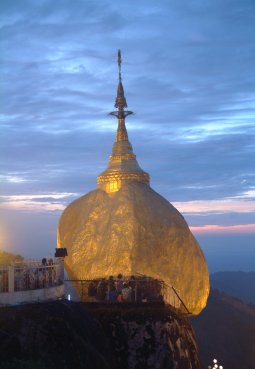
We went to the Golden Rock site at 7 pm and I must say, it's an amazing sight. The completely gilded rock balancing over the cliff with the little pagoda on top, the pilgrims praying, burning candles and incense, men rubbing gold leaves on the rock... (women are not allowed to touch the rock). Gold leaf costs 350 kyats, and small bells to hang near the rock are 400 kyats. The place has a truly a magical atmosphere.
After dinner we went back at 9 pm but by then there was a lot less action- the Burmese are definitely not night owls (most restaurants also close at 9 pm).
Nov. 28
We got up at 5 pm to see the sunrise at the Rock. Again, an extraordinary atmosphere: people buy platters of food to offer to the spirits so there's dozens of platters next to the rock as offering with people again praying. The Golden Rock is definitely one of the most special places I've ever been.
After walking back down we waited almost an hour before our truck-with-benches was full (according to Burmese standards), after which the truck descended the road (bad, steep, with lots of hairpin curves) at full speed - truly a roller coaster ride...
The rest of the day we drove to get to Taungoo, where we only got after dark. The scenery along the way is again very beautiful.
Driving in Myanmar is a chapter in itself. Although it was a British colony there's right hand drive (the switch happened in the 70's on the advice of a fortune teller), but most of the cars come from Thailand where there's left-hand drive. The result is that the driver can see pedestrians and cyclists very well, but for oncoming traffic he needs the help of the car in front. Consequently there is a lot of horn blowing and light flashing involved.
At night it's even worse, since you have to avoid the pits, look out for dogs, cyclists, bicycle taxis (sidecar model with the 2 passengers back to back) and overtake trucks in fronts of you (and the oncoming cars seldom have completely working headlights).
In Taungoo we stayed at the Myanmar Beauty guest house, an all teak 2 storey building with veranda with view of the rice paddies (15/20 USD). For dinner our driver took us to Mother's House restaurant.
Nov. 29
In the morning the owner of the guest house (it's actually owned by a couple of doctors) introduced us to the Myanmar way of eating breakfast with an absolutely huge variety of dishes with lots of different fruits to taste. I have never had such a charming breakfast before.
While we were eating the owner told us about a trip to a camp of working elephants that is possible near Taungoo. Although for 2 it's not cheap (40 USD for the car, 10 USD each for a permit, 15 USD for a guide, 10 USD for the camp) we still decided to do it. For lunch we got all sorts of leftovers from breakfast. It turned out to be quite a Camel Trophy type of adventure. With another chartered car we drove to a village in the hills outside Taungoo. Once there the villagers told us that the road was so bad (the heavy rain again) that the car couldn't go any further. There was a local bus however preparing to leave so we got on that, but then we had to get back off again because, as our guide (the owner's son, also a doctor) told us, the people thought it too dangerous and didn't risk anything happening to us. Then we decided to still drive on with the car as far as possible and walk the rest. Not far outside the village we crossed a jeep (a genuine WW II jeep still functioning), and the driver told us that you needed 4 WD to go further. Our guide discussed with him and because the man was his father's patient, he agreed to drive us in the jeep to the camp (but only one way so we still had to find a way to get back).
After getting out of the jeep we walked for half an hour (well, actually waded through a river) before we saw the real camp site. At this camp there were 7 working elephants, but in the whole area there are about 500 of them (logging an area that would be flooded by a dam).
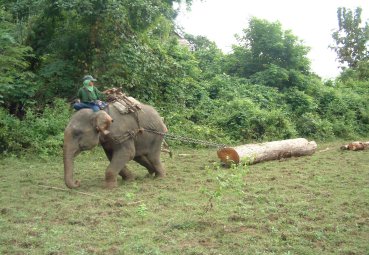
We saw one elephant working near the camp dragging and pushing logs. Meanwhile on the river we saw ironwood (so heavy that it sinks) being transported on bamboo rafts - now I also know where all this bamboo rafting in Thailand comes from, but this is clearly the real thing...
Our guide negotiated with the mahouts of the camp to take us back on elephant back to the car (8 km). For one elephant they had a saddle but without a cushion, the other one you had to ride by sitting in its neck and holding on to the work saddle. We first took a shortcut through the forest in the area where the elephants are normally working, which involved a lot of them stepping over logs - what an experience! Especially when you sit in the neck of the elephant with its ears flapping against your legs and it's going down a steep stretch or stepping on and over logs, it feels quite sporty.
But after sitting 2 to 3 hours alternatively in the saddle and in its neck, it is quite enough...
So we walked the last 3 km back to the car. And after a well-deserved shower we had dinner in the Private Home restaurant.
Nov. 30
At breakfast we continued our tour of Myanmar specialties - these are really incredible friendly people... we took enough food left over from breakfast for lunch and as a goodbye present we also got a teak elephant bell.
For the rest was today another long driving day, but again not boring at all. The river plain with all the rice culture, the water buffaloes, the landscape dotted with pagodas... We got a first puncture at about noon, and stopped in a small village at a tyre repair shop. Since apparently these are tyres with inner tubes we saw the whole process of removing with a hammer the outer tyre from the wheel, checking the inner tyre, replacing it (our driver carried a spare one with him)... All this under the attention of the whole village (and especially the children) since apparently not everyday a car with falangs strands there. A tour of the village and show with the digital camera were part of the entertainment while waiting for the repair, which took about an hour.
To get to Kalaw (an old British hill station) we took a shortcut from the main road towards the hills in which Kalaw is situated. The landscape is absolutely beautiful, and this is where we got our second puncture. This time the driver simply put on the spare tyre and in the next big village we had that one repaired too. While we were waiting we saw a bus with gearbox problems. Four mechanics had removed it and opened it up so you could see the gearwheels, all this under the bored looks of the bus passengers who still had some hours waiting ahead of them...
When we were ready to continue our drive it was already getting dark, and as Kalaw is situated in the hills it promised to be a long and exciting night drive.
Which was exactly how it turned out: the spectacle of big trucks trying to pass each other on narrow and very bad mountain roads or in hairpin curves is worth seeing. It involves people getting out of the trucks, discussion back and forth, signaling, reverse driving... We also passed a bus with its rear wheel stuck in a pit, so that it was on the verge of toppling over - all this again under the resigned looks of the passengers. I do not think many trucks or buses will have passed any more in either direction that night. On the way we also saw an elephant cross the road!
When we finally got to Kalaw we were actually quite relieved to have made it. From LP we had chosen Pine View Inn (20 USD). The Seven Sisters restaurant is a Shan restaurant with very good food. My initial enthusiasm at seeing that some of the clients were drinking Spy wine cooler (my favorite drink in Thailand) was dampened when it turned out that they had bought these in Yangon (they were government officials) - I must have looked quite disappointed because in the end we got one as "present".
Dec. 1
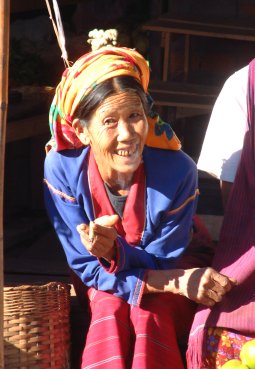
On the way to the famous Pindaya caves we passed in the town of Aungban where that day the five day market was held. So we spent an hour walking on the market taking pictures of all the activity and people. There are many PaO and Palaung hill tribe people living in these hills. This market was another highlight of our trip so far - it is incredible how lovely and honest these people are. People seem to delight in saying hello or smiling at you. And that's another very striking thing: in general the level of English that people speak and understand is amazingly good, especially when you compare it to Thailand.
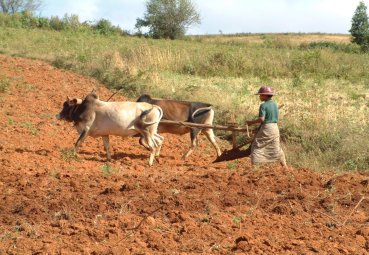
The drive to the Pindaya caves was again very beautiful. Under the way you really feel catapulted back in time when you see people harvesting rice with a sickle, ploughing with oxen or buffaloes, and the transportation on foot, by horse cart or by ox cart. We saw about 10 ox carts laden with cauliflowers, a good vegetable or this height and climate but presumably a heritage of the British - had they been colonized by the French they would probably be producing wine right now.
The Pindaya caves are very famous caves filled with some 8000 Buddha images - they're all located near the entry however in a maze, further down the cave there are only a few images. After the cave we went to an umbrella making shop which was again incomparable to what we'd seen in Thailand. The self-supporting economy Myanmar has developed because of its isolation makes that everything gets done, but in a way that seems primitive and where time does not cost money- of course this is also one of the things that make Myanmar a travel experience that can only be described in superlatives.
The umbrellas are made from bamboo, and the cover is paper made by hand and decorated with natural flower petals and leaves... and they cost the incredible sum of 700 kyat for one (0.7 USD). We bought 2 - we'll figure a way to transport them, these are so unique pieces that we could not resist them.
In the afternoon we went to have tea at the Kalaw hotel, a historical Tudor-like mansion that once housed British officers but that is now also a run-down remnant of the glory days. There are several other very big very English looking mansions in Kalaw.
Dec. 2
We first spent an hour or so walking around Kalaw center before continuing to Lake Inle. In Nyaungshwe on Inle lake we went looking for the MTT office to get more FEC's, but because we couldn't pay with VISA we ended up in the bank to exchange euros for FEC's (at a rate of 1.02 which was better than when we bought dollars before we left). We checked in at the Inle Inn (12 USD) and spent the afternoon walking around in Nyaungshwe, the village situated on the northern shore. At 3.30 pm we left for a canoe trip on through the wetlands left and right of Nyaungshwe and reaching into the lake. It's a very pleasant and relaxing trip - the villagers live in houses on stilts and all transportation is done with canoes so you see everyone from schoolchildren to grandmothers paddling a canoe. With the canoe you see the life along the water: people doing laundry, or the dishes, or washing their children and themselves (dressed in resp. a sarong and longgyi - a longgyi is a sarong like skirt worn by nearly all Burmese men, you have to get used to the sight but actually after a while I found them quite elegant-looking).
On the way we stopped at a cheroot (cigar) factory which was also quite interesting to see. We stopped in an old monastery to see the sunset ?the monks were very friendly and curious about foreigners. For this 2-hr boat trip we paid 500 kyats per person.
In the hotel we had a traditional Shan dinner (just for the 2 of us) followed by a half hour marionette show (again just for the 2 of us - this adds again to the uniqueness and constant amazement you feel when traveling in Myanmar).
Dec. 3
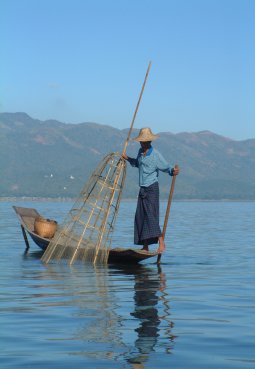
Today we spent a full day on the lake. With a boat (9000 k per day) we first traversed the channel that separates Nyaungshwe from the lake itself. Immediately as we got on the lake we saw the famous leg-rowers (as the name says, one leg is used for rowing standing up in the boat) and fishermen with the large conical traps in their canoes.
The lake is inhabited by the Intha people - on the lake are several villages with houses on stilts and floating gardens surrounding it. The floating gardens are man-made, anchored to the bottom of the lake, and are cultivated by villagers in their canoes. The main crop seems to be tomatoes. One of the most famous villages is Ywama because there is every 5 days a floating market. At Ywama we first visited a silversmith, where we couldn't resist buying a few things.
Then we went on to the market of Intain, situated on the lake shore. Inle is quite touristy, judging from the line of souvenir stalls you have to go through before getting to the market itself. Behind the market we went looking for the "old pagoda" (the Burmese classification of anything with historical value) that supposedly was the main attraction of the village. You come to a very long covered stairway (also lined with stalls), but as you walk on you see left and right literally hundreds of stupas and pagodas scattered - and all in various stages of decay. In the first cluster we walked in, you wander through overgrown, broken pagodas with beautiful stucco decorations. Some of these decorations are also broken off and lie carelessly left and right- this gives you an idea how it must have felt like to discover Angkor Wat or such...
The estimations we got later on of how old this complex was ranged from 500 years old to 200 years old. I think 200 is closer to the truth. I also think a lot of these stucco decorations and Buddha images inside the pagodas were already taken away to be sold in antique shops all over the world
After the market we visited some more craft shops, silk weaving, blacksmithing and a cigar factory. We also visited Phaung Daw U Paya, with Buddha images with so much gold stuck on them that they really resemble balls. Our last stop was at the Nga Phe Kyaung, or the Jumping Cat Monastery. The monks have taught some cats to jump through a hoop, which is, well, not so spectacular, but the monastery itself is a very beautiful old teak building and the monks are again very friendly and curious.
All in all the lake is a very beautiful place -it's touristy of course, but that doesn't have to spoil the fun.
For dinner we had a candlelight Shan supper at the Smiling Moon (there was, once again, no electricity - no wonder most hotels have their own generator).
Dec. 4
We enjoyed Inle so much that we decided to stay another day and go trekking in the hills surrounding the lake (5 USD pp incl. guide, water, lunch).
But first we got up early to go to the market which was today supposed to be held in Nyaungshwe. Since there wasn't really that much activity to be seen we asked around only to hear that "because it was the new moon the market was closed". So much for easy keeping track of the market days in Shan-state. But our early morning walk gave us a chance to see lines of monks barefoot on their alms round. The monks in Myanmar wear burgundy robes, different from the Thai monks who wear orange.
The 23 km trek passes a meditation cave where 2 monks permanently live (and meditate). Then it winds up through the hills through several Pa-O villages (hill tribe) to a monastery with a great view of the lake. We had lunch there before slowly descending back towards the lake. We finally returned by boat to Nyaunghwe.
Inle is a good place to chat and exchange information with other travelers - we talked with Polish, French, Swiss and Israeli people, all in one day.
Dec. 5
Our breakfast was a Shan breakfast with sticky rice with beans, fried vegetables and fried tophu (the first day we'd tried also Shan noodles) - it makes a nice change from the omnipresent toast and eggs you normally get. We also went to the "gas station" first: as gasoline is rationed in Burma you can buy at the official stations per day depending on the area only x gallons at 200 k per gallon. This is all duly noted in a little book that goes with the car. Consequently there?s a flourishing black market where the price is 2000 k per gallon - these unofficial stations use an oil can with a plastic tube attached to it and a funnel to fill up... We left Inle at 8 for the drive to Mandalay. It passes again through mountainous area (with the same scenarios of 2-trucks-trying-to-pass-one-another). We arrived in Mandalay at 3 pm, and after touring some of the hotels we chose the Garden Hotel(12 USD), not because it was so appealing but because in Mandalay there is such a huge jump in price between this class of hotel (10 to 15 USD) and the attractive ones (at least 40 USD).
At the Air Mandalay office we learnt that there was no direct flight from Mandalay to Sittwe so a visit to the ruins of Mrauk U along the west coast would have to be arranged from Yangon, which also meant it would be a lot more expensive (110 USD pp one way)... So this meant a change in plans - we still had to decide what to do the next 2 weeks.
We then rushed to Mandalay Hill just in time to catch the sunset and the beautiful views over the Royal Palace, the hills of Sagaing and Mingun with lots and lots of glistening white and gold stupas...
For dinner we went to Bamar Beer Bar, a bit British Club like with mostly European food.
Dec. 6
Surrounding Mandalay are 4 old capitals, Amarapura, Inwa, Sagaing and Mingun.
Today we visited Amarapura and Inwa. From the royal place of Amarapura only 2 masonry buidings remain - there are in the area surrounding the present village lots of ruins of smaller buildings and stupas, but again overgrown and left to their fate. In the village itself we stopped to see the weaving in action. Many houses have looms on which silk and cotton sarongs and longgyis are woven.
Also in the village is one of the biggest monasteries in the country with 1200 monks, the Mahagandayon Kyaung. These monks eat only once per day and every day the meal for all 1200 is sponsored by another family. It is an impressive sight to see all the monks silently queuing in order to get a few spoonfuls of rice (which has more of a symbolic meaning, they do eat other things than rice but this is already placed on the tables).
Amarapura is most famous for the U-Bein bridge, a 200 year old teak bridge for pedestrians and cyclists only (it's the longest teak span in the world).
After Amarapura we continued to Innwa, which can only be reached by passenger ferry. Once you're across you have to hire a horse cart to visit the sights because they're far spread out. This is again an amazing visit: inside the old city walls there are now small villages and rice paddies. And in between you see the ruins of stupas and pagodas - it is incredible how indifferent the Burmese behave towards these remains. We visited 2 monasteries and the old watch tower. The Bagaya Kyaung is one of the most beautiful monasteries I've seen so far: it's all in old dark weathered teak beautifully carved with huge teak posts supporting it. The monasteries here do feel much more ancient and untouched than the ones in Thailand.
The other monastery is Maha Aungmye Bonzan, a brick-and-stucco construction with a special design.
The old watchtower is also called the leaning tower of Inwa because after an earthquake the building started leaning heavily towards one side. Of course no one prevents you here from climbing it...
After our visit of the 2 cities we returned to Mandalay and stopped by at the MTT office, the (much despised) government travel and tourism agency. Much to our amazement the people who helped us here were of the most friendly and knowledgeable travel agents we'd met so far (e.g. the ones in Inle can only sell tickets from Inle to somewhere else and thus tell you anything to convince you to buy at their agency). We got a lot of info on what areas are now accessible to foreigners and suggestions of how to spend the rest of our trip.
In the evening we had dinner at the very cheap but very good Mann restaurant and then went to the performance of the Mandalay Marionettes and Cultural Show (3 USD) with a live traditional orchestra. It's a very small theatre but it's well worth seeing.
Dec. 7
The first visit of this morning went to Manadalay Palace. In the heart of the city is a huge square area (one side = 2 km) surrounded by huge walls and a moat where the Mandalay Royal Palace used to be. This was completely made of wood and burnt down to the ground during WWII. The government has reconstructed the palace some years ago, and it does give you an idea of what it must have looked like, but it remains an empty shell without a soul. Even worse is that the complete area within the walls has been confiscated by the Burmese army, so you're just allowed to drive to and from the palace, the rest is restricted area. Mandalay could be a beautiful city but with this black hole in the middle there's something to be said for one traveller's description "the name is more beautiful than the city".
After much discussion we had decided to spend the rest of our trip taking a flight to Bhamo and then a river trip down the Ayeyarwaddy, but when we went back to MTT the flight we wanted to take (government Myanmar Airways) had all of a sudden ceased to exist or been taken over by VIPs, which one was not clear but in any case we couldn't fly. While discussing what to do next we saw a brochure of a luxury 3d/2n trip from Mandalay to Bagan on board a colonial ship, the Pandaw (www.pandaw.com). The last minute offer turned out to be less than half the retail price (170 USD pp instead of 365 USD pp) so we booked that cruise instead.
This settled we left for Sagaing, another old capital near Mandalay. Sagaing is still very much alive and is called the center of the faith because the hills are lined with many many monasteries and pagodas. It's really a very beautiful sight from across the river.
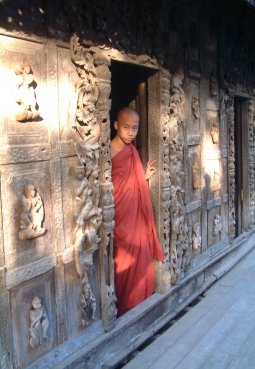
Since this was our last day with the driver we did some further sightseeing with him in Mandalay to Shwenandaw Kyaung (once part of the royal palace and now a very old and exquisitely carved teak monastery), Atumashi Kyaung (once the ruins of a very important monastery but now horribly reconstructed), the Sandamani Paya (a forest of all white equal stupas) and the Kuthodaw Paya (dubbed the world's biggest book because of hundreds of marble slabs which contain the buddhist scriptures).
Dec. 8
We took the 9 am ferry (1000k pp) to Mingun, the last of the ancient capitals that can only be reached by boat. The remains of a huge chedi (that was intended to become the biggest in the world except that in only reached one third of its height and was later partly destroyed by an earthquake) are very impressive. Another impressive sight is the Mingun Bell, supposedly the world's largest working bell.
After coming back we walked from the jetty to the central market which was relocated by force by the government to a new multiple storey building. It must have been OK when it was new but now when you walk on the upper floors the decay and neglect just shout in your face. Only the lower floors are quite lively but I think a big part of the market has again gone outdoors because the open air market surrounding the building is much more lively.
We walked on to the train station to see if we could get any train tickets for Pyin U Lwin, a British hill station about 60 km from Mandalay. We had been warned by Swiss people we'd met that they'd had a very hard time getting tickets, even with the help of their Burmese guide - finally they had to give a "present" to obtain tickets. And, surprise surprise, after we'd found the right counter (all in Burmese) we were told that "they did not know today if the train would have first class the day after tomorrow and that we had to come back tomorrow". Waiting, discussing and even offering a present did not help so we finally gave up.
In the evening we went to the Lashio Lay restaurant, a Shan restaurant of the type with a lot of cooking pots and you simply point at what you'd like (bill was about 3000k for 2).
Dec. 9
Today was the day of confrontation with Burmese bureaucracy. We first tried to change euros in FEC but since our euros got stained in the money belt we were sent from one bank to another. The second bank also refused to change and it even got to the point where the bank manager got very upset (oriental people are supposed never to get angry). We finally changed what he would accept and withdrew some more with Visa.
At the MTT office we paid the rest of the boat trip and then went back to the train station to see if we had more luck today. Again we were told that they were not sure they would be any first class and that we had to come back at 4 pm. After looking for the station master (who was, of course, away for lunch time) and discussing with several other officials, the final version of the story was that the first class coach was already broken for 5 days and they were still repairing it. And as they did not have a spare coach... We finally decided to let it go and go by bus to Pyin U Lwin.
In the afternoon we paid a visit to the gold leaf workshops where thin sheets of gold are stacked into packs and hammered in different stages thinner and thinner until the desired thickness is reached. Next we went to the Mahamuni Paya, containing the Mahamuni image, one of the most sacred images in Myanmar. Originally it's a very old bronze statue, but years of worshippers sticking gold leaves on the image have it now covered in a 15 cm thick layer of gold. The complex is an oasis in the busy city of Mandalay: there are ponds, trees... Around the complex are a lot of handicrafts quarters situated: woodcarvers, stone cutters, and also the pagoda repair shops. There are also a lot of stalls selling all kinds of religious items: from monks' bowls over monks' robes to buddha thrones and pagoda umbrellas.
Dec. 10
We packed only a daypack for our overnight trip to Pyin U Lwin and left the rest of the luggage in the hotel. As soon as we walked into the bus station we saw the dollar signs coming into the eyes of all the Burmese there, so we really had to insist that we did not want a private taxi but wanted to go with the pick-up instead, albeit in the front seats. At 1000k pp (1USD) for 60 km we were probably still ripped off, but foreigners always pay a lot more than Burmese people and if you don't know the language...
The ride to Pyin U Lwin winds up through the hills over the plain of Mandalay, and after a stop halfway to spray the radiator with water, we got after 2.5 hrs to the hill station. It's much bigger than Kalaw, and there's also much more colonial buildings preserved than in Kalaw.
The local taxis are these miniature Wells Fargo stage coaches that look like they've escaped from the Wild West... We hired one to do a tour of the outlying hotels with us. Along the way we passed quite a lot of big brick and wood Victorian mansions with even the original roof tiles intact (instead of the omnipresent corrugated iron).
We decided to stay in the most famous hotel of Pyin U Lwin, the Candacraig hotel (still government owned), a 1904 colonial mansion that once was the "holiday center" of the Bombay Burmah Trading company and looks like a British country home. Compared to the Kalaw hotel in Kalaw you see that effort is put into this hotel to keep it well kept and renovated. There's the big sweeping staircase, the big rooms with fireplace, teak furniture, high ceiling and balcony overlooking the grounds...We immediately fell for it and at 30 USD per night it's not that expensive. In the afternoon we had tea on the balcony and simply enjoyed the peace and quiet and fresh air after the crowdedness of Mandalay... at such a moment it really is very easy to forget that you're in South East Asia and not somewhere in England.
Even the dinner in Candacraig is traditional English: roast beef with potatoes (excellent by the way).
Dec. 11
We walked to town and negotiated there a tour with the horse cart to the Botanical Garden. Much to our surprise the Botanical Gardens are very well kept. There's a pagoda on an island, an aviary, different types of garden... there's also the old clubhouse and tea pavilions. All in all a very quiet and agreeable place to spend the morning.
When heading back to town we gave a ride to a monk who apparently lives 6 months in Canada and 6 months in Myanmar - he'd just arrived to spend the winter here. His specialization is meditation and he does missionary work in Canada. When we got to town he got out the cart with us to help us find the pick-ups back to Mandalay. We took again the front seats at 1000 k and set off for the return. Going down is supposed to be a lot quicker than going up but as our driver apparently wanted to save gas it took us longer than the ride up.
We checked back in at the Garden Hotel, took a shower, and went searching for a place to change money - we finally changed at 1030 which was considering the fact that a few days before the maximum we were offered was 1000 not bad. We then made a last minute trip to one of the monasteries we'd visited where lots of marionettes were sold. We bought 3 in total for 10USD.
Dec. 12
By taxi we went out to jetty where we would set off for our boat trip to Bagan. As we were a bit early we wandered around the riverside, to see life along the river from close by (people living on bamboo rafts, loading and off-loading of ships...).
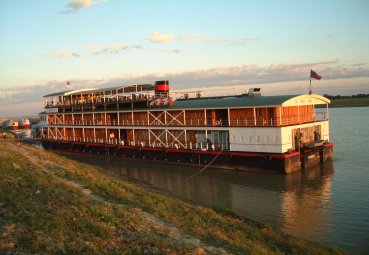
We embarked on our ship, the Pandaw 3 only to discover that we would be just 4 passengers (along with 30 crew members) on this trip, 2 Canadians, Larry ("I'm in real estate"), Rejean (his personal assistant?) and us. So we got the pick of the cabins - we chose to be on the upper deck. Lunch was served in the dining room (table linen, polished cutlery, rattan place mats...). And then we enjoyed the afternoon cruising.
How to even begin to describe the beauty and tranquility of this voyage? Along the river you only see sand banks, fields, palm trees with the occasional bamboo huts and white and gold pagodas - there are no stone houses, factories, cars, roads to be seen. You see people doing laundry, ox carts, little fishing boats, the occasional bigger motor boat... the ship sails very silently so the peace and quiet that you experience are undescribable. What a trip! What a luxurious experience!
The sunset is also amazing: the colours of the twilight over the river, with the little canoes paddling home... photographs can never do this justice.
And the ship is a beauty in itself: all teak and brass cabins and decks, with rattan chairs outside each cabin, chaises longues on the sundeck...
After cocktails we had a candlelight dinner with, for the first time in Myanmar, a bottle of Australian red wine.
Dec. 13
Today we spent a full day cruising. We made 2 stops, one at a pottery village, Yandabo, and one in the afternoon at a much bigger village, Pakokku.
Yandabo is a small village where there are quite a lot of pottery makers - the clay is collected from the riverbed, moulded into water pots, cooking pots, ovens etc and then decorated, dried and fired. To fire the pottery it is stacked on wood in layers so a huge mound is formed which is then set on fire. The fire burns for a few days and then after cooling off the pottery is ready for use. It was a very pleasant visit with thanakka (the white paste used by Burmese women and children as protection against the sun) demonstration and tea and semolina cake tasting. We also went inside the old monastery and the new primary school.
The second visit to Pakokku was a bit more hectic. By trishaw we first went to a factory of blankets (woven by hand) where we really got the impression of being jumped at from all sides to buy something. Even worse, when we left to go and visit a cheroot factory (for us already the third) the women cycled next to us with their blankets, still trying to convince us to buy something. We called this instead of the floating market the cycling market- but they did follow us all the way back to the ship which was a bit too much. A last short stop we made before arriving at the ship was at a market where we got to see in detail the betel nut making process. A leaf is smeared with a paste and betel nut and tobacco is placed inside after which the leaf is folded to form small packets. These packets are chewed by many Burmese, which involves a lot of spitting the red juice on the streets. When they smile at you afterwards, they look like they've just bitten over someone's throat.
But we got back on board in time to catch another beautiful sunset over the Ayeyarwaddy.
Dec. 14
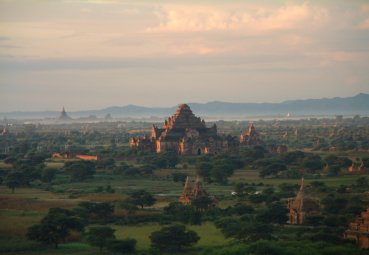
Arriving by boat in Bagan is quite a sight: gradually you see the peaks of temples rising out of the mist over the river... Bagan is a very big plain with, at last count over 2000 temples scattered all over the plain, which were all built in the 11-13th century. They have been abandoned for centuries but are very well preserved. The site is the prime tourist attraction of Myanmar and is easily compared to Angkor Wat in Cambodia. We disembarked from our beautiful ship at 9.30. With a horse cart (standard means of transport in very laid back Bagan) we went in search of a hotel and finally checked in at the Golden Express Hotel (20 USD with a swimming pool). The hotel rents bicycles at 1000k per day so we took off towards Old Bagan, the center of the area.
Since we also wanted to book a balloon flight over Bagan (Ballooning over Bagan, 200 USD per person) we first rode to the Bagan hotel (to pay with Visa) where we ran into our Canadian friends from the Pandaw - we convinced them to go also ballooning.
And then we started our first round of exploration of the many temples : Gawdapolin, Shwuguyi, Thatbennyu... the strange thing is that you ride with your bicycle along sand roads quietly from one ruin to another, which is very agreeable - there are no people living in Old Bagan so it's just trees and temples.
At the more important temples souvenir sellers try to sell everything from lacquer ware (the specialty of Bagan) over fresco paintings (handmade copes of the murals inside the temples) to bronze opium weights, gongs, rattan accessories... But whatever you buy you can be sure it is handmade. This is another thing I had not expected at all in Myanmar: Thailand is always praised for its many handicrafts, but still, every time you visit a shop there you suspect some little factory around the corner where the things are actually made and the workshops tourists visit are for demonstration only... But in Myanmar the variety and quality of handicrafts offered is amazing, at very low prices, and since everything is done manually here you can be dead sure that the handicrafts are indeed actually handicrafts. Everything we have seen: all the agricultural activities but also the real handicrafts such as umbrella making, stone carving, wood carving, silversmithing, weaving, lacquer ware, gold leaf making are only a testimony of how this economy is self supporting and of how people are managing to make and do everything - if ever an atomic bomb falls these people will have no problem whatsoever. We have bought until now marionettes, umbrellas, a gong, silver, silk, rattan, lacquer ware ... it is so hard to resist... In 5 weeks in Thailand we have bought only utilitarian stuff (clothes and watches) and here we have bought truckloads of stuff.
In technological aspects Myanmar is really stuck in the Middle Ages - this makes it so special when compared to Thailand. I still find Thailand a great country with lovely people, but it has simply evolved much more than Myanmar, so there's less of the culture shock you experience here. The Myanmar people may not have material wealth like in the west or even in Thailand, but their Buddhist life philosophy and the fact that they do still live off the land makes that they survive well and enjoy life. The openness, friendliness and curiosity of the people are heart-warming. Astonishing is also that although this country has lived in isolation for so long, e.g. the language skills of tour guides are simply excellent and the level of knowledge about a small country like Belgium is so good.
But anyway, we cycled the afternoon around Bagan and then took a dive in the pool to cool off.
Dec. 15
We were picked up at 5. 45 for our balloon ride. There were enough people for 2 balloons so after morning tea and coffee we took off just in time to see the sun rising over the Bagan plain. And again, how to describe the beauty of it? As far as the eye can see the peaks of the temples rising out of the early morning mist, with only the chanting of monks to be heard, the balloon floating gently very close and over these magnificent big temples... the flight was about 1 hr and 15 minutes and I took 140 photographs (now a digital camera is really a luxury). This is absolutely the best way to see Bagan and get an impression of the size of it all - it is an absolute must-do! After the landing we had a glass of champagne, got our certificates (we already had the caps) and got back to the hotel for breakfast.
We decided to rent a horse cart or the rest of the day (5000k) and first went to Minnanthu village to see the temples furthest from Old Bagan. Several of the temples contain murals, some very well preserved, others faded or heavily damaged. Here again temple looters and early European tourists have caused a lot of damage and stolen a lot of artifacts.
We then went to Sulamani Pahto and Dhammayangyi Pahto (the biggest temple), and then on to Myinkba village where we visited a lacquer ware factory (top items are from 12 USD for a cup to hundreds of dollars of erally big items so top quality is pricy - of course at the temples you can buy lacquer ware from 1 USD ).
We finally went to Shwenandaw Pagoda to see the sunset over the Bagan plain.
Dinner was in a restaurant near the hotel (Queen restaurant).
Dec. 16
We rented again bicycles for the day and set off exploring some more temples, among others Ananda Pahto and Htilominlo. We cycled also to the village of Nyaung U, the main population centre in the Bagan area. In any case they already have Italian restaurants, pancakes and lassi, a sure sign civilization has arrived...
The rest of the day we hung around the pool and headed off to Nanda restaurant, a very stylish open air restaurant with an amazingly good professional puppet show (and since it's the 4th we've seen so far we already can tell the difference).
Dec. 17
In the hotel we chartered a taxi (20 USD) to take us to Mount Popa, about 60 km from Bagan. It is in fact the Mount Olympos of Myanmar: it's the home of the 37 nats or spirits who influence the daily life of the Burmese quite a bit (how this cult rhymes with Buddhism is something we've never quite figured out).
Along the way you pass lots of coconut trees where people earn a living by climbing into them and collecting the palm juice. After fermentation this becomes palm wine or toddy. You can also boil the juice and the residu is called jaggery (brown sugar) which is a frequently used ingredient in Myanmar cuisine. Extracting oil from peanut and sesame by means of an ox driven installation is also part of the way these people earn a living.
Mount Popa has a spectacular setting: it is a remnant of an old volcano and rises like a chimney out of the surrounding plain - on top of the mountain are a series of shrines and pagodas. The climb up is quite steep but you have monkeys to keep you company.
All in all Mt. Popa certainly does not have the mystical quality the Golden Rock has.
As we were back around noon we had lunch at the hotel restaurant and a swim in the pool before climbing at 3.30 pm on the night bus that would deliver us to Yangon the next morning 9 am (5000k pp). It is an airco bus but not the newest one... on the bus we also met a Canadian family (parents with children and 2 grandparents) that we'd met 6 weeks before in Lopburi in Thailand - it's a small world.
Dec. 18
After a reasonably comfortable drive we arrived in the highway bus station of Yangon. We decided to continue straight on to Pathein, a large port city in the delta region. By taxi we got to the Hsimmalaik bus station, bought 2 tickets for the 11 am bus to Pathein (2000k pp) and had brunch in a tea shop.
The bus was fully stacked a la Burmese: there's these little plastic chairs that are set out in the gangways and the bus only leaves when all these seats are taken and a lot of cargo has moved to the roof of the bus.
We got to Pathein around 4 pm - we felt quite groggy because of spending all this time on the bus. There isn't much choice regarding hotels (Paradise hotel, 12 USD) in Pathein and even less regarding restaurants (we went to See Bae Inn which was not so great but became a lot worse when the mother of all cockroaches jumped on the table - so far for a recommendation from LP).
The waterfront of Pathein is nice however- there's even an evening bazaar which is for the early bird Burmese quite exceptional.
Dec. 19
We decided to take the 11 am bus to Chaung Tha, a beach resort at the Gulf of Bengal some 36 km from Pathein. We spent the time until 11 wandering around the waterfront observing the activity of the freight boats and the little row boats acting as ferry. Pathein lies at a bend in the Pathein river and with the palm trees and pagodas sticking out over town it's quite a pleasant sight.
The bus to Chaung Tha (1500 k pp) was the more typical Burmese public transport: it involves climbing over bags of rice and onions and wooden crates, and sitting with your knees up to your chin because every square cm of floor space is occupied - there wasn't even space for the little plastic chairs that are normally put in the gangways to seat passengers. Traveling by public transport in Myanmar is only for the fit, the agile, the good-humored and the lightly packed...and it is tiring and time consuming . I am glad we rented a car the first 12 days because we saw much more than we could've seen with public transport.
We got to Chaung Tha at 2 pm and after careful scrutinizing of the beachside hotels we chose Thiri (15 USD for a bungalow directly on the beach). The beach is very long with white sand and coconut trees, and the water is warm. There were a lot of Burmese tourists from Yangon, recognisable by their big new cars and the fact that the men didn't wear longyis but trousers.
One of the great advantages of spending some time at the beach is the abundancy of sea food: we had grilled lobster (actually langouste) in a restaurant directly on the beach for 4500 kyats pp...
Dec. 20
In the morning we walked the length of the beach, around to a peninsula where there's a fishermen village... the actual bend to the village which is the nicest spot on the beach doesnt have any hotels on it (the rest of the beach is one hotel next to the other) - clearly the western taste in tourism has not yet fully perpetrated the Burmese mind.
We had tiger prawns and cuttle fish for lunch, and after an afternoon of swimming, reading and lazying we went again to the same restaurant as the day before for dinner (again lobster, plus crab).
Dec. 21
At 7 am we were picked up by the "express bus" heading directly for Yangoon (4000k pp). There was a bit more room for legs and luggage, but still, as we got to Yangon only at 3 pm, 8 hours is still a long time for the cramped position you're in...
In Yangon we headed again for the Liberty Hotel, took a shower, and then left to have dinner at the Pansea hotel (www.pansea.com). The description in LP is quite lyrical, but it doesn't do the hotel justice: it is such a magnificent building, situated in an embassy quarter, with a very beautiful garden and swimming pool. The main building is an old restored colonial mansion with again rattan, bamboo, teak, brass, cotton and these big ceramic pots: incredibly refined as decoration is concerned. The restaurant is reputedly one of the best in Yangon - we had dinner in the garden, amidst ponds and huge umbrellas used as garden decoration. The set "menu de degustation" is 35 USD but it was truly excellent (the best food we've eaten in Myanmar).
Dec. 22
As our flight was at 12 am we just had breakfast and then left for the airport. All the jade, teak, silver and other stuff we'd bought (and that you're not really supposed to take out of the country) passed customs unseen, so we quietly flew off towards Chiang Mai, with the memory of an incredible and unique travel experience.