
History
The Japanese archipelago
assumed its present shape around 10,000 years ago. Soon after, the era known
as the Jomon period began and continued for about 8,000 years. Its people
were hunter-gatherers. Gradually, they formed small communities and began
to organize their lives communally. They also began to use earthenware objects.
Rice cultivation reached Japan from the Eurasian continent around 300 BC during
the Yayoi period, and settlements grew larger.
Japan can be said to have taken its first steps to nationhood in the Yamato period, which began at the end of the third century AD. During this period, the ancestors of the present Emperor began to bring a number of small states under unified rule from their bases around what are now Nara and Osaka Prefectures.
In 604 Prince Shotoku laid down Japan's first constitution. Also from this time, Buddhism that was introduced from the Eurasian continent began to take root in Japan. The Nara period began at the beginning of the eighth century with the establishment of the country's first permanent capital in Nara. Toward the end of the century, the capital was transferred to Kyoto, launching the Heian period, during which noble families predominated and a distinct national culture blossomed.
From the Kamakura period, which began at the end of the twelfth century, to the close of the Edo period in the latter half of the nineteenth century, Japan was ruled by samurai, or warrior class. Order broke down around the middle of the fifteenth century, and Japan was torn by civil warfare for nearly 100 years as samurai lords of different domains fought one another. The agent of pacification and national unity was Toyotomi Hideyoshi.
At the beginning of the seventeenth century, Tokugawa Ieyasu set up a government
in Edo (now Tokyo), and the Edo period began. The Tokugawa regime adopted
an isolationist policy that lasted for more than 200 years, cutting off exchange
with all countries except China and the Netherlands. But with the arrival
of American Commodore Matthew Perry in 1853, the nation began to open itself
up to the United States and European powers.
The age of the samurai came to an end with the Meiji Restoration of 1868,
and a new system of government centered on the Emperor was set up. The new
government promoted modernization, adopted Western political, social and economic
systems, and stimulated industrial activity. The Diet was inaugurated, and
the people began to enjoy limited participation in politics.
From around 1920 a democratic movement gained strength. But amid a global economic crisis, the military came to the fore, and Japan eventually marched down the road to war.
With the end of World War II in 1945
Japan put into effect a new Constitution, committed itself to becoming a peace-seeking
democracy, and succeeded in relaunching its economy. In 1956 the nation's
entry into the United Nations was approved. Since then, Japan has contributed
to world peace and prosperity as a member of the international community.
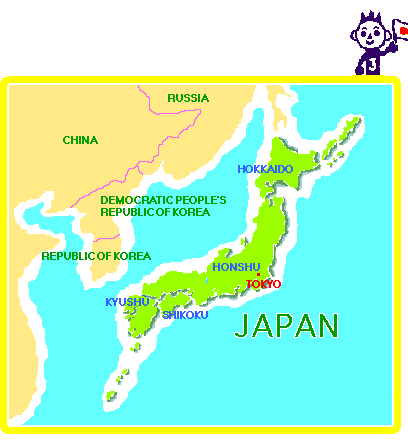
The country's land area is 378,000 square kilometers, which is one twenty-fifth that of the United States, one-twentieth that of Australia, and 1.5 times that of Britain.
It has a population of 125 million, making Japan the world's eighth most populous
nation. Nearly all the Japanese live on the four main islands of Hokkaido,
Honshu, Shikoku, and Kyushu.
Japan also has one of the world's highest population densities; there are
338.4 residents for every square kilometer of land. The figure for the United
States is 28 and that for Britain is 239. Three-quarters of Japan is mountainous,
and two-thirds is forested.
Warm and cold currents wash into the seas around Japan, and many species of fish are caught in abundance. Japan has four distinct seasons, but because the country stretches for 3,000 kilometers along a north-south axis, its extremities, Hokkaido and Okinawa, have very different climates. Around the end of March, you can go sunbathing in the south and skiing in the north.
Japan has 7,087 species of higher-order plants. There are 1,214 species of vertebrates and 35,207 species of invertebrates.
The country often suffers such serious natural disasters
as flooding from typhoons and torrential rain, volcanic eruptions, and earthquakes,
but tornadoes are rare.