|
A Star's Life:
We head now on a journey through the life of a star. Those of you who have already read the section on The
Beginnings already know a little about how stars start their formation. For those who haven't, don't worry, we are about to repeat it here for you as well. If you've read this already in The Beginnings section, feel
free to continue on to the next page or read it again for a review.Planets form from cold clouds of gas and dust. These clouds are called nebula and are mostly made up of hydrogen. For the most part the cloud remains
stable and floats along within the galaxy. It does not take much, however, to turn this inactive cloud into a glowing ball of fire known as a star. All the cloud needs is for some of the atoms that make it up to be
disturbed or agitated. As the first few atoms begin moving they come closer to other atoms. Their proximity to these atoms increases the gravitational attraction between the two atoms. As more atoms become attracted to
each other, their mass increases and their ability to attract even more atoms increases. Soon, you have a giant ball of hydrogen forming in space. As the atoms come closer together, they collide more often, generating
heat. The heat generated from these collisions causes the ball of hydrogen to begin to glow faintly. Whether or not a protostar makes it to a regular star (called a main sequence star) or not has much to do with the
amount of mass that exists in the protostar. In fact, much of a star's life has to do with the mass of the star. Without enough mass, the collapsing protostar will not generate enough heat to start nuclear fusion (which
is the signature of a star.) A star's mass will also determine how long it will live and what form it will take when it dies. Protostars without at least 40% of the mass of our sun (also referred to as a solar mass or
M) would not form into a star. They would become brown dwarfs. Astronomers are still trying to determine the point that separates a brown dwarf from a very large planet like Jupiter. Star's with at least 0.4 M will go
on to form main sequence stars. What characterizes a main sequence star is the nuclear reactions going on in its core. Once the core temperature of a star reaches 15 million degrees Kelvin, nuclear fusion can begin.
Nuclear fusion in main sequence stars involves the fusing of hydrogen atoms into helium atoms. The amount of energy released during this reaction is given by Einstein's equation E=MC^2. The force of these nuclear
reactions is strong enough to withstand the force of gravity and the star is said to be in stable equilibrium. Main sequence is the term used to describe the stage in which a star remains for most of its life. 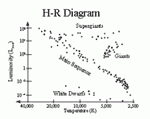
It can clearly be seen in the Hertzprung-Russel (HR) diagram. The HR diagram is a
measure of a star's luminosity vs. surface temperature. As you can see below, main sequence stars run from the upper-left to the lower-right corners of the diagram.
In the lower-left you will find white dwarfs, which are remnants of low-mass stars and in the upper-right are red giants, which are stars in their dying stages.
As mentioned earlier, the lifetime of a star is highly dependent on its mass. The reason a star is able to stay "alive" for any period of time is that the forces of the
nuclear reactions in its core are powerful enough to overcome the force of gravity trying to crush the star. Eventually, the star will run out of fuel and it will
gravitationally collapse. It might make sense then that a high-mass star would live longer than a low-mass star because it has more fuel. Actually, it is the opposite. A
high-mass star does have access to more fuel, but it also needs to burn it much faster. The large amount of mass in a high-mass star also means larger
gravitational forces. In order to remain in stable equilibrium, the star must burn its fuel faster to overcome those gravitational forces.
Low-mass stars, like our own sun, can live for around 10 billion years. High-mass stars can have life spans as short as 3 million years. Table of Mass-Lifetime:
(Solar mass M = mass of our sun) (Luminosity L = luminosity of our sun)
25M |
200000L |
3e6 years |
15M |
30000L |
15e6 years |
3M |
65L |
500e6 years |
1.5M |
5L |
3e9 years |
1M |
1L |
10e9 years |
.08M |
0.4L |
13e9 years |
0.4M |
0.03L |
200e9 years |
A star spends 90% of its life on the main sequence, after this time it runs out of
core hydrogen to burn and gravity begins to cause the star to collapse again. As the core collapses, it rises in temperature. According to Newton's Third Law of
Motion, however, for every action there is an equal and opposite reaction. As the core of the star begins to collapse and heat, the outer layers of the star expand
and cool. As the star cools it turns red in color. This type of star is known as a red giant. Since red giants are very large stars they are also very luminous. Once the
temperature of the core reaches 100 million Kelvin, it is hot enough to begin converting helium into carbon. This reaction is powerful enough to again counteract the force of gravity.
In low-mass stars (less than 8 M), the volatile nature of the helium to carbon reactions causes the star to pulsate. This pulsation is strong enough that the outer
layers of the star are ejected from the core, forming what is known as a planetary nebula. All that is left of the star now is its helium core. The core of the star has
now become a white dwarf. Do to the very condensed nature of the atoms, white dwarfs are incredibly hot, giving them a white color. They are also very small (no
more than a 1000 kilometers across) which is why there are not very luminous and were only just discovered recently. When the star eventually runs out of helium to
burn it simply dies out and becomes a black dwarf, a body in space composed mostly of carbon. High- mass stars go through a much more violent struggle during their death. The
outer layers of a high-mass star do not eject to form a planetary nebula; rather they begin nuclear reactions of their own. As the core burns helium to carbon and
oxygen, the outer layers begin converting hydrogen to helium. Again, the star will eventually run out of helium in its core. The core will begin collapsing again and
rising in temperature. Then, at the next critical temperature, carbon and oxygen will begin fusing together. The next layer above will fuse helium to carbon and
oxygen, the layer above that hydrogen to helium, etc. There is, however, a point at which these high-mass stars run out of fuel. The elements and temperature
necessary to fuse those elements together are listed on the next page..
Element->New Element: |
Necessary Temperature: |
Hydrogen
->
Helium |
10 million k |
Helium
->
Carbon and Oxygen |
100 million k |
Carbon and Oxygen ->
Neon, Magnesium, Silicon, and Sulfur |
1 billion k |
Silicon and Sulfur ->
Iron, Nickel, + similar atomic weight |
10 billion k |
When a star is large enough (about 8 M), the core can begin fusing silicon and
sulfur into iron. Iron's molecular structure does not allow it to be fused to create any new elements. Without any nuclear reactions counteracting the force of
gravity, the star begins a rapid collapse. The force of gravity is so strong that it pushes the electrons out of their orbit and into the nucleus of the iron atoms. The
electrons combine with the protons to form neutrons. The core of the star is now totally composed of neutrons. Gravity, however, is still attempting to crush the star
further. The neutrons reach a point where they cannot be crushed anymore and recoil, like a spring, causing a massive explosion that sends a huge shock wave through the outer layers of the star.
The incredibly high temperatures that result from this explosion (in excess of 100 billion degrees Kelvin) cause reactions with all the elements discussed previously
to make up most of the elements known in the universe. The entire core collapses in less than a second and the resulting explosion is referred to as a supernova.
Supernovae can be brighter than galaxies and sometimes become so bright they can be seen during the day here on Earth. The dust from this explosion will later
be used to form another star, perhaps with planets around it. All that is left of the star is its core of neutrons. For the extremely high-mass stars (greater than 15 M), even the nuclei of the iron
atoms are not strong enough to resist gravity and the collapse of the core continues further. When the force of gravity is great enough to cause a neutron
star to collapse, a black hole is formed. In a black hole, the force of gravity becomes so strong that even light cannot escape it. All the atoms continue
collapsing into a small pinpoint in space called a singularity. A singularity is infinitely small but can contain an infinite amount of mass in it. Black holes consist
of two parts; the singularity and the event horizon. The event horizon is a disc that encircles the singularity and is the point at which light cannot escape the gravitational effects of the black hole.
The event horizon is what gives the black hole its name as it is literally a black circle sitting in space. The event horizon can be calculated by the equation
Rs=2GM/C^2. Once something crosses the event horizon, it is lost forever. According to Einstein's Theory of Relativity, nothing can exceed the speed of
light. Since the force of gravity in a black hole is strong enough to keep even light in it, there is no way anything can escape it. |
|