|
Information
for Parents Page |
|
|
Welcome
to my “Information for Parents” page about my assessment policies and
practices!
Here I will
explain my purpose for assessing students, and provide information about the
assessment tools used in my classroom. |
|
|
|
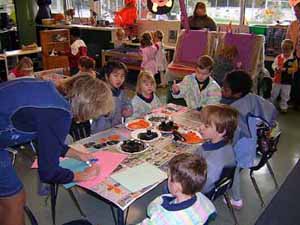
My purpose for assessing students is to provide information about the student’s current level of functioning which will be used to influence my instruction. Grades are not given to students at the pre-kindergarten level and they do not complete any kind of seatwork or pencil-and-paper tests. Instead, students are observed on a daily basis during their work time and these recorded observations provide information that influence instruction. In fact, much of the time, students will not even be aware that they are being assessed. The observations help teachers understand what individual students already know, and what skills each student might need more time with. This information is then used for individualization planning, as well as large and small group activity planning.
|
|
Students in my
class will be assessed in a variety of ways including: ·
Early Screening Inventory (ESI)- The ESI is a standardized screening
instrument designed for children ages 3 through 6. There are 25 items which
can be grouped into three categories: visual motor/adaptive, language and
cognition and gross motor/body awareness. This assessment is done three times
a year at the beginning, middle and end. For each item students are rated
‘proficient’, ‘in progress’, or ‘failed’. Students receive an overall score
of “pass”, “re-screen” or “refer”. Students who score a “re-screen” will be
screened again at a later date and student who score a “refer” will be
evaluated for special education services. |
|
|
· Ages and Stages Questionnaire-Social/Emotional (ASQ-SE)- This is a social/emotional screening inventory used for children ages 6 months to 5 years old. It is conducted during the initial home visit and involves parents responding to questions about their child’s abilities with regards to: self regulation, compliance, communication, adaptive functioning, autonomy, affect, and interaction with people. A score of below 70 is passing, and a score above 70 will lead to further evaluation by the special services team. |
|
|
· Child Observation Record (COR)- In compliance with our federally mandated High Scope Curriculum, each day during “work time” teachers will record their objective observations regarding what students are doing, saying, learning, and working on. These observations are recorded in an observation book and are categorized according to the High Scope Curriculum Content Areas. The 8 HS Content Areas are: Language, Literacy, Mathematics, Science, Creative Arts, Social/Emotional Development, Approaches to Learning, and Physical Health and Development. |
|
|
· Work
Sample Portfolio-
Throughout the course of a school year, samples of student work will be
collected to document progress. Each month a sample of the student writing
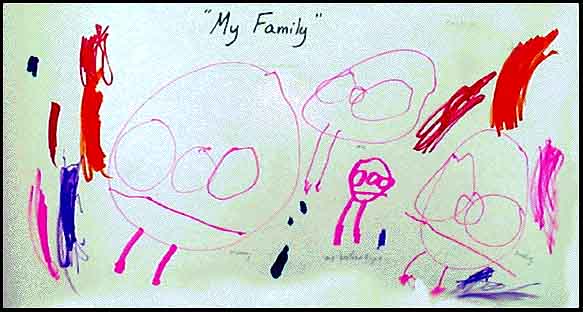
their own name, as well as a drawing of their person will be collected for
the portfolio. Other samples of student work that might be included are:
photographs of student work with materials such as blocks or legos,
art, samples of writing, and photographs of the student participating in an
activity. |
|