

 |
 |
 |
 |
 |


|
|||||||||||
 here
are a few extant fabric armor pieces: here
are a few extant fabric armor pieces: |
|||||||||||
 |
|||||||||||
|
Figure 1
|
|||||||||||
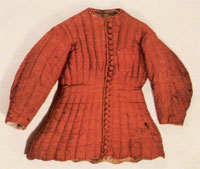
| The arming coat of Charles VI in Chartres Cathedral, France, 14th Century. (Figure 1) It is made of red silk damask with linen liningand is stuffed with cotton "wool". It has a scalloped edge and cloth covered wooden buttons. The buttons are spherical on the upper half of the garment, and flat disks on the lower, a commonly seen feature. The quilting is vertical throughout. The body is hourglass shaped with large "banana" sleeves. Embleton says there are two slits in the left side for suspension straps of a sword scabbard. | |||||||||||
 |
 |
||||||||||
| Figure 2 | Figure 3 | ||||||||||
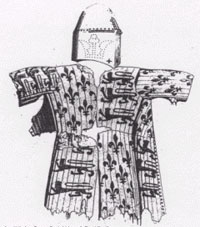
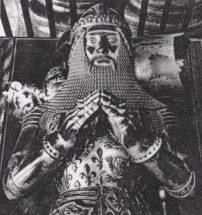
| The Jupon of Edward the Black Prince in Canterbury, England. (Figure 2) It is made of red and blue velvet, with the arms of France and England embroidered on it with gold thread. It is filled with wool stuffing. It is laced up the front and has short elbow length sleeves. The body is cut in 8 sections with a seam at the waist. The sleeves are 2 pieces and shaped. It can be seen on his effigy. (Figure 3) | |||||||||||
 |
|||||||||||
|
Figure 4
|
|||||||||||
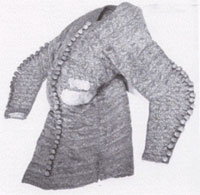
| The Charles de Blois arming coat in Lyon, France. (Figure 4) It is made of ivory and gold silk brocade with linen lining. It is stuffed with cotton "wadding interlining". The body is close fitting with tight sleeves as well. The sleeves are very deeply cut into the body for maximum movement. It is buttoned up the front and also has buttons up the back of the sleeves past the elbow. The quilting is horizontal. | |||||||||||
 |
|||||||||||
|
Figure 5
|
|||||||||||
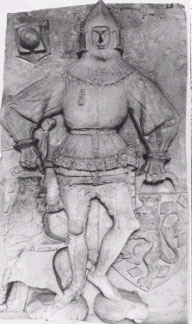
| Another good example of an arming coat is found in the Walter von Hohenklingen effigy, c. 1386. (Figure 5) It shows the owner wearing all his armor, with an arming coat under the breastplate. It has button closure at least from the waist down. It seems fitted, again from the waist down. The large banana sleeves also have buttons on the outer edge to the elbow.Note that this garment is worn over a mail shirt or at least part of one, as the dagged hem is visible below Walter's belt. | |||||||||||
 |
|||||||||||
|
Figure 6
|
|||||||||||
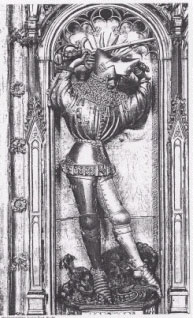
| A very similar example can be seen in the wooden statue of Saint George by Jacques de Baerze in Dijon, France, 14th Century. (Figure 6) The wearer has a very similar silhouette to von Hohenklingen. Unlike von Hohenklingen, there is some discussion as to whether or not he is wearing his breastplate under the garment. This would help to explain the very round chest. The arming coat has a full upper body and a close fitting waist with large sleeves. The front is buttoned from the neck to the waist and laced from the waist down. there is a great fullness of fabric above the waist while the hips are almost tightly covered. Perhaps this snug lower body acted as a foundation to which the legs were attached. Note that the aventail is tied to the gambeson. | |||||||||||