|
|




       

 |
Introduction to SCUBA Diving
Why would you SCUBA dive? What is SCUBA diving? How does it work? Why don't you drown? These are some of the questions many people ask about SCUBA diving, and we hope to provide the answered here. Why Dive? Why not? Diving is exciting, challenging and relaxing - all at the same time. Imagine yourself drifting through aqua-marine water. Beneath you lies a sea floor covered in anenamies waving in the current. Up ahead a small reef looms. As the current carries you over the reef you see star fish, eels, and sea cucumbers. Below you spot a small hole in the rocks with a bunch of broken shells out front. You let a small amount of air out of your BC, and slowly descend towards the opening. Just before you crash into the small opening you add in a bit of air, and effortlessly come to a stop a few feet from the hole. Unfortunately, the pacific octopus who's home you've just spotted isn't there - but a few seconds later your on your way, this time chasing after an elusive wolf eel... Or imagine yourself descending through the bitingly cold water of a mountain lake. The water is stained deep green with silt, and you can't see anything more then 20' away. As you descend you start to see what looks like some lines in the water. As you move deeper the lines turn into an old dam and pumphouse, buried under the lake for over 80 years. You slowly descend into the pumphouse through a skylight, and pass down a ladder into it's lower levels. At the bottom you find a water outlet - you swim through and come out at the base of the dam. Slowly you make your way over the dam, and follow the remnants of a road to the foundations of an old house. Somewhere out there lies a few other foundations, and you're determined that you'll find another one today... You're on a white sand beach. All around you lie tourists, sunning their bone-white bodies and drinking pina-coladas. As you walk by a few of them glance in your direction, wondering why you're lugging 60 pounds of equipment to the beach. Little do they know you're about to enter a world of brightly colored coral, and even brighter fish. Moray eels, ray's, turtles, and hundreds of fish will be your company on this dive. As you descend through the blue-tinted waters you silently hope that you'll find an elusive manta ray, or maybe even a sea turtle... Diving has something for everyone. You can drift through the warm waters of the tropics, looking at coral reefs and the fish that inhabit them. You can dive the current-swept coast of western Canada, rich in cold water life. You can explore the lakes which dot the maps - many have hidden treasures you'd never expect to find. You can dive on ships, or through caves. Dive at night, look for lost treasure, or spear fish. Diving is an exciting sport that anyone can enjoy.
What is SCUBA Diving? SCUBA stands for Self Contained Underwater Breathing Apparatus, which is a pretty good explanation of what SCUBA equipment does:
How Does It Work? SCUBA equipment has been around for over a century - but it wasn't until after the second world war that the equipment became reliable enough for recreational use. SCUBA divers enter a world where we were not intended to live - so we must carry everything we need to survive. The main purpose of SCUBA gear is to provide you with breathable air. Now you wouldn't think this is very hard - couldn't you just use a long hose? Unfortunately this doesn't work - pressure increases as you go deeper into the ocean. As a result, if you were in just 3m (10') of water and tried to breath through a hose you would have great difficulty. At 4.5m (15') you would be unable to inhale at all. Seeing as divers often go below 30m (100') there is no way a simple hose could be used to provide air. To counter act this effect SCUBA gear is designed to provide the diver with air at the same pressure as the surrounding water. In it's simplest form this requires three parts - an air reservoir, a pressure reducing valve, and an on-demand valve - or in diver lingo a tank, first stage and second stage respectively. The SCUBA Tank: SCUBA tanks come in many sizes and materials. Usually we describe a SCUBA tank by the material it is made of and it's air capacity. For example, an "Aluminium 80" tank would be an aluminium tank that can hold the equivalent of 80 cubic-feet of air at atmospheric pressure. Luckily this air is under pressure so the tank itself isn't 80 cubic feet in size - the tank itself is much smaller, and air is pressurized into the tank. Tanks come in al sizes, from small (20 cubic feet or less) "emergency" cylinders to mammoth tanks with greater then 100 cubic feet capacity for long-duration diving. Besides aluminium, SCUBA tanks are also made of steel. The main difference between these tanks is that a steel tank will sink when empty, whereas an aluminium tank will float. So a diver who finds that they need a lot of weight to go under water may pick a steel tank so they don't need as much weight elsewhere. The First Stage: The first stage is a valve which attaches directly to the tank. This valve system contains either a piston or diaphragm which takes the high pressure air of a tank (1000 - 3000 PSI) and lowers the pressure to the same pressure as the water (generally less then 60 PSI). This air is released into several hoses which can connect to regulators (which you breath through), buoyancy compensators (more on these later), and dry suits (also more later in the article). In addition the first stage will contain one or more high pressure ports which the diver can connect to a pressure gauge to determine how much air he/she has left. The Regulator (Second Stage): The second stage, usually called a regulator, has a very important job. Technically it is called an "on-demand valve", or in other words it provides air only when you need it. Without this the diver would have a continuous stream of air from the first stage. Inside of the second stage is a small valve which blocks air flow from the first stage. When the diver inhales this valve opens, providing the diver with air from the first stage. When the diver exhales this valve closes, cutting off the air flow from the first stage. This way the equipment minimizes wasted air by only providing air when the diver inhales. That's it - but SCUBA divers need a lot of other gear to dive! Gear: The Octopus: The octopus is the name given to the combination of the first stage, second stage, pressure gauge, and hoses. Depending on the divers set-up there will be four to six hoses leaving the first stage. But if all you need is a first and second stage then why would you need more then one hose? To start with, all divers carry two regulators. The first regulator, called the primary, is the one the diver uses during his/her dive. The second reg (secondary or backup regulator) is there for emergencies - if your primary reg fails you can switch to the secondary. If your buddy runs out of air you can give them your secondary to breath from. So that's two hoses, but what about the other two? One hose connects to your buoyancy compensator device (BCD), and is used to add air to the BCD. The second hose carries high pressure air from the tank to a submersible pressure gauge (SPG). This gauge tells the diver how much air is left in the tank. Usually attached to this gauge is a depth gauge and a compass. Some divers use a dive computer in place of one or both gauges. Additional hoses may be attached to the first stage. The main use for these "extra" hoses is to provide air to dry suits.
The octopus. On the left is the SPG/depth gauge/compass consol. This consol is connected to the high pressure port on the first stage (top). The red thing is the secondary regulator, the black is the primary regulator. The lone hose is the air supply for your BCD. The last three hoses are connected to low-pressure ports.
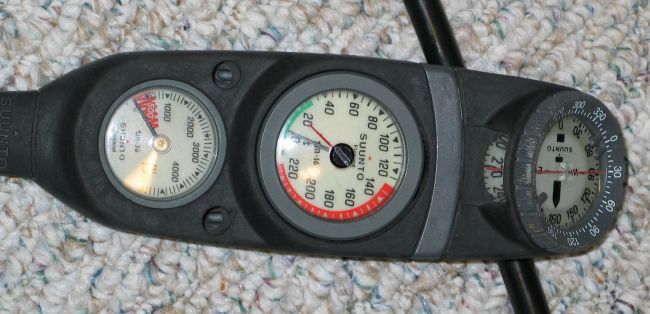
Close-up of the consol - left = SPG, middle = depth gauge, right = submersible compass. The Buoyancy Compensator Device: This device (usually called a BCD) is used by divers to adjust their buoyancy - or in plain English is used to allow a diver to sink, float upwards, or stay at one depth. Almost every diver on earth will float when you throw them in the water - most people float anyways, and most SCUBA gear also floats. This is especially true of wet and dry suits, both of which contain a lot of trapped air. So in order to sink divers add weight (usually to a weight belt) so they will sink lightly. The only problem is that as the diver goes deeper the trapped air in their wet suits and other equipment is compressed, and the diver will become less buoyant - in other words will start to sink really fast. To make things even more complicated a diver's tank becomes more buoyant as air is used up. So to account for these changes in buoyancy divers wear a BCD - a device which can be filled with air and emptied to adjust the divers buoyancy. Today there are two main styles of BCD's. The most common is the "jacket" type, which is essentially an inflatable vest. Most divers learn to dive in these type of BCD's, and they are the most common type rented by dive shops. These BCD's are the easiest to use. Their main downside is that the air in them tends to move around as you dive, often making it hard to trim yourself properly. In addition, these BCD's can limit the mobility of your arms. The second type of BCD is a "winged' BCD. These BCD's contain "wings" which you fill with air. These wings are located on either side of the SCUBA tank. The main advantage of this system is that the air remains in one place, thus giving you better trim. In addition, these systems maximise the mobility of your arms. The main downside is that they require more experience to use, and some older systems had a tendency to flip a diver onto their face when floating on the surface. In both cases the BCD contains a back plate which the tank is mounted onto. Weight System: As mentioned above divers float, and as such carry weight to make them sink. There are a variety of ways this is done, but one thing common with all weight systems is that they have a way of "ditching" enough weight that a diver will float. This way a diver can make an emergency accent by releasing their weights. Most commonly used is a weight belt that is worn around the waist. Although inexpensive this system is not very good - when walking the belt cuts into your waist, and underwater the belt can shift, throwing you off balance. Various suspender systems have been developed which can improve this, but recently weight integrated BCD's have been invented. These system carry your weight in pockets built into the BCD. This gets weight off of your hips, and places it in a location where it does not shift. Many divers also attach a small amount of weight elsewhere. For example, a diver who tends to float head-down may put small weights on his/her ankles. To reduce the amount of weight on their hips some divers attach weights to their tank, or use a BCD with a metal back plate. Regardless of where this extra weight is carried, all divers have enough "ditchable" weight to ensure that they will float if this weight is dropped. Mask: If you open your eyes under water everything you see will be blurred. To see clearly divers wear a mask which covers their eyes and nose. This allows the diver to see underwater, and keeps water out of their nose. There are many styles of masks, but they all serve the same function. Fins: If you were to dive without fins you would not be able to move underwater! To fix this divers wear fins on their feet. There are two main types of fins - traditional and "split" fins. Traditional fins look like a frog or ducks foot. These fins allow a diver to "push" on more water when they kick, thus allowing the diver to move faster. Splits look a lot like traditional fins, but have a slit down the middle. These fins act more like an airplane propeller. Generally speaking splits require less strength to use, and have a higher top speed then do traditional. The downside is that splits are very poor at developing "spontaneous power" - if you suddenly kick hard they will deliver little power. This can be an issue in emergency situations, or while boarding a boat. In addition, some divers find that splits work poorly in high current situations. Snorkel: Snorkels are used by divers swimming on the surface. They allow divers to swim to a dive site without wasting air. Many divers do not use a snorkel as swimming on the surface is inefficient, and the snorkel can get in the way under water. Protection: The sea if full of things which can hurt divers - cold water, sharp corals, fish with teeth, and so on. To protect themselves from these dangers divers wear protective suits. there are three types - "skins", wetsuits and dry suits. All three provide protection against things in the environment, but skins provide minimal warmth, wet suits provide medium warmth, and dry suits provide the most warmth. Skins: Dive skins are used in the tropics. These can range from a thin lycra (spandex) suit to a thin 1-2mm wet suit. Often these are so-called "shorty suits" - suits which only cover your truck, upper arms and upper legs. Wet Suits: Wet suits are made of neoprene - a rubber full of small air bubbles. These air bubbles act like the insulation of your house and insulate your body from the cold water. Wet suits allow a thin layer of water between you and the suit. This layer of water provides no warmth, and if your suit fits poorly this water can leak from the suit and carry away valuable warmth. Wet suits are available in many thicknesses, ranging from thin 3mm suits made for the tropics to cumbersome suits over 10mm thick! Most wet suits are between 3mm and 7mm thick. If properly fitted a 7mm wetsuit can keep you warm at close-to-freezing temperatures. The biggest drawback of a wet suit is that as you descend the air bubbles in the neoprene are compressed. This creates two problems - first, the suit looses warmth. Secoondly, the suit becomes less buoyant, so the diver must add air to his/her BCD to compensate. Dry Suits: Dry suits are the ultimate protection against cold water. These suits are one-piece, and contain seals around the wrists and neck to keep water out. Under a dry suit the diver can wear warm clothing. The air inside of a dry suit is also compressed as the diver descends. To counteract this dry suits are connected to the first stage of the divers octopus. This allows the diver to inject air into their suit as they descend. A valve on the suit allows air to be released as needed. Besides keeping you warm dry suits have the advantage that you don't need to change after a dive - you peel off the suit and instead of being clad only in a bathing suit, you are wearing a full outfit, ready for a night on the town! Other Protection: Divers wear other insulting/protective gear when they dive. Gloves and boots protect and insulate your hands and feet. A hood is worn to protect your head. Some divers even wear chain mail to protect themselves when diving waters with man-eating sharks!
Some more gear. Left = snorkel. Middle top = fin with a dive knife and sheath sitting on it. Middle bottom = Fin with medium sized dive light sitting on it. Right = Cold water gloves, boots and a dive mask. Other Gear: The gear described above is "essential" gear - diving without it would be dangerous at best - deadly at worst. Other gear can be taken, usually if the diver thinks they'll need it: Knife: Many divers carry a knife. Although rarely used knives can be useful for freeing yourself from kelp or fishing line. A good knife will have a line cutter, serrated and smooth edge, and a blunt tip. The line cutter allows easy cutting of fishing line, whereas the serrated edge allows you to saw through thick kelp. The blunt tip is particularly useful - it can be used as a screw driver, pry-barr, and keeps you from accidentally poking holes into important things.
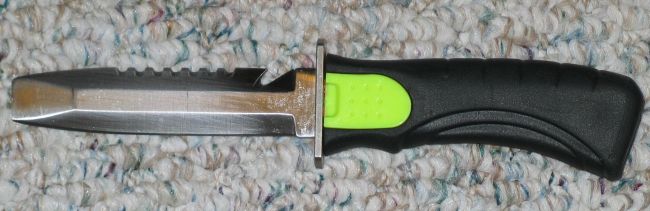
A good knife. Blade is made of stainless steel and is oiled to protect it form the water. Serrated edge and line cutter are visible on top, straight edge on bottom, and blunt tip on left. The blade is approximately 4" long. The brown colour is a reflection off of a bookcase. Camera: A broad variety of underwater camera's are available. Some people dive just so they can take pictures, while others carry a camera to so they have something to remember the dive by. Underwater cameras range from $30 for simple disposables to over $2000 for professional digital cameras. Compass: A compass is a very useful tool underwater - it allows you to determine what directionn you're moving in, swim specific patterns, map an underwater site, and navigate through the underwater world. Special dive compasses must be used - normal land compasses will be crushed by the water pressure. Lift Bag: Many divers carry a lift bag - a specially designed bag used to lift object from the bottom of the sea. These bags have many uses, ranging from recovery of items form the sea floor to supporting a line so a diver can rest mid-water. Safety Sausage: These should fall into the mandatory equipment list, but unfortunately many divers do not use these. A safety sausage is simply a brightly coloured rubber tube you carry in a pocket. If you surface far away from your dive boat or shore exit site, you can inflate this tube. This makes you easier to find, either by your dive boat or by search-and-rescue. Whistle: Like the safety sausage this item should be mandatory equipment for all divers, but it isn't. Like a safety sausage, whistles provide you with a way of signalling to your dive boat or rescuers. Whistles are especially useful in low-visibility conditions (i.e. fog or rain), or at night. Dive Light: Specialized dive flashlights are made for divers. These allow divers to dive after dark, enter caves and ship wreaks (something you should NEVER do without proper training), and are even carried during the day so divers can peer into dark crevices. These lights can range from small mask mounted lights to massive spot-light like lights which can illuminate the water for hundreds of meters. Dive Slates: Divers usually communicate with a series of hand signals. However, if more complex messages need to be passed divers use a writing slate. These can range from a ruff piece of plastic and a pencil, to magnetic slates, to specialized underwater paper and pens. These have many uses, including communicating with other divers, writing down information as you dive, or recording navigational information. Dive Computers: Dive computers have almost become standard equipment for all divers. These computers keep track of how deep you go, how long you stay under water, calculate how long you can safely stay under water, and some can even calculate how long the air in your tank will last! Some divers are using these computers to replace their SPG and depth gauge. Although this is tempting it may not be entirely safe - computers are electronic, ad if yours developed a leak you would be in trouble. As such most divers still carry mechanical SPG's and depth gauges along with their computers. |
This Page, and all other pages in the http://www.geocities.com/k_o_dionysus/ directory copyright (2004), Bryan Heit & the Knights of Dionysus