Birds Photographed in the UK in 2000
(January - March)
Jonathan Wasse
London, UK
|
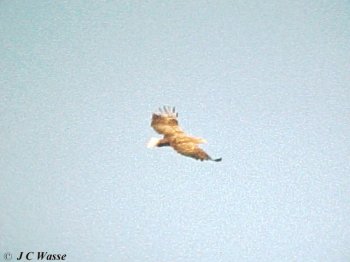
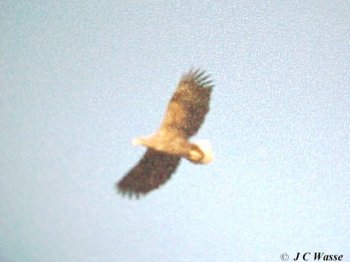
White-tailed Eagle Haliaeetus
albicilla
Docking, Norfolk, January 2000.
This elusive adult
was located in a tree on farmland
to the north west of Docking. It had
eluded birders
all morning, many of whom had gathered 5 miles
west
at Brancaster. One hour later it flew low southwards
and
appeared to land in a nearby copse. After a quick
drive to the back of this
copse the bird flew out from
the trees and slowly gained height
as it again drifted
southwards. As it flew towards me I quickly
changed
from 'scope to camera. I was very lucky to get a
couple of
decent flight shots.
|
|
Following a relatively barren spell with ony a
couple
of brief sightings of this Eagle in the UK over the
last
nine year, at least 3 twitchable birds were
present in eastern
England during winter 99/00.
|
|
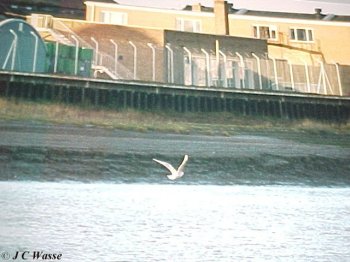
Glaucous Gull Larus
hyperboreus
King's Lynn, Norfolk, January 2000.
A nice 2nd
winter bird frequenting the rivermouth.
A milky coffee coloured bird
showing the typical
pale iris and a small pale tip to the bill,
characteristic
of this plumage.
|
|
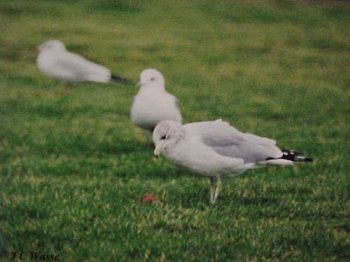
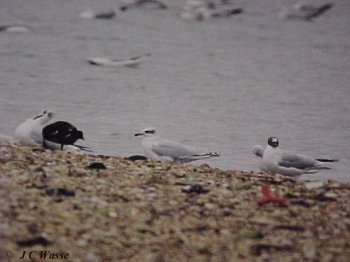
Ring-billed Gull Larus
delawarensis
Shoebury, Essex, January 2000.
This 3rd
winter-adult bird that came to bread proved
to be surprisingly
elusive.
|
|
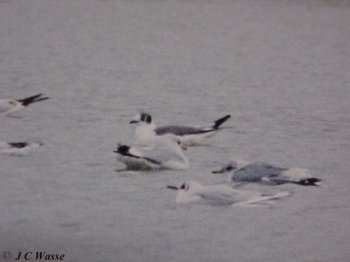
Mediterranean Gull Larus
melanocephalus
Radipole Lake, Weymouth, Dorset, February 2000.
This 2nd winter plumaged bird was one of 3 birds
present on the shingle
island near to the visitors
centre. The others being an adult in nearly
full
summer pluamge and a 1st winter bird.
|
|
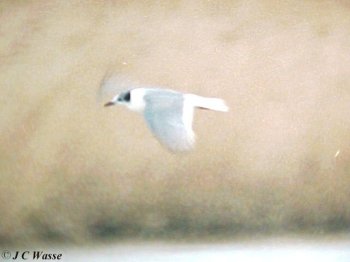
Franklin's Gull Larus
pipixcan
Radipole Lake, Weymouth, Dorset, February 2000.
This
2nd winter plumaged individual had a routine of
flying into Radipole
Lake to bathe with the other gulls
one hour before dark. Later it
would fly off to roost
nearby in Weymouth Bay. I was lucky to get a
nice
selection of photos despite the windy and overcast
conditions
in the late afternoon.
|
|
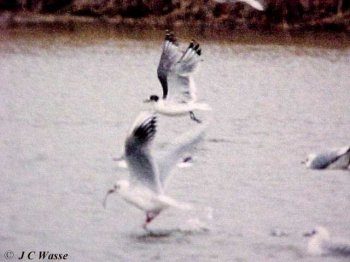
Ageing the bird as a 2nd winter as opposed to
an
adult is clear from this photograph. This is seen with
the
extensive amount of black in the primaries, with
a clear lack of white
just before the black primary tips.
|
|
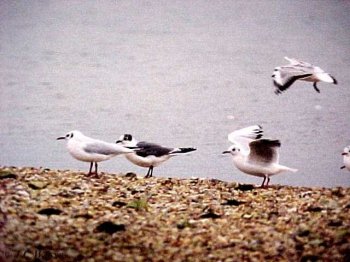
A striking feature of this bird is the dark
grey
colour of the wings when compared to the slightly
larger
Black-headed Gull Larus ridibundus. Also,
note the large amount of
black on the head and small
white crescents around the eye. The
legs appeared
blackish.
|
|
A very nice bird indeed. It was a shame that
it spent
only a short amount of time, about 10 mins., at this
site
before moving on to roost in the Bay.
|
|
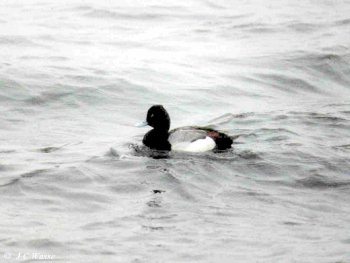
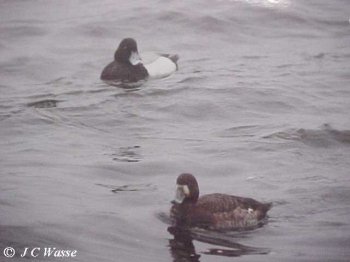
Lesser Scaup Aythya
affinis
Drift Reservoir, Cornwall, March 2000.
This 1st summer
drake arrived from North America
the previous autumn.
|
|
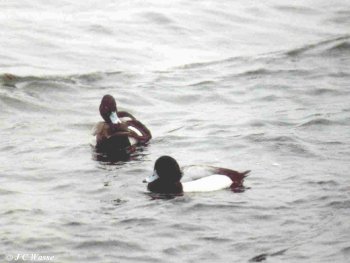
A nice comparison with Greater Scaup Aythya
marila
(lower). The black restricted to the nail of the bill
of
the Lesser Scaup is clearly visible. | .
|
|
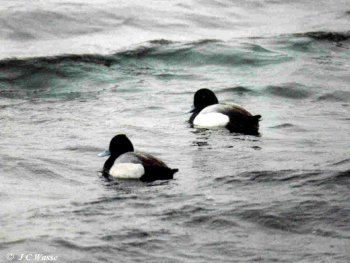
You cannot ask for a better comparison than
this
side-by-side shot. The thick fog cloaking Cornwall
that morning
allowed for excellent close views of
these two species. The darker
vermiculations of
the Lesser Scaup (left) are visible, as is the
bulkier
size of the drake Greater Scaup (right).
|
|
Greater Scaup Aythya
marila
Drift Reservoir, Cornwall, March 2000.
Two pairs of
Greater Scaup accompanied the
Lesser at this site. Did the Greater
Scaup
originate from the USA?.
|
|
Sora Rail Porzana
carolina
Stover Country Park, Newton Abbot, Devon, March 2000.
A
record shot of this long staying bird (ca. 3 months).
|
|
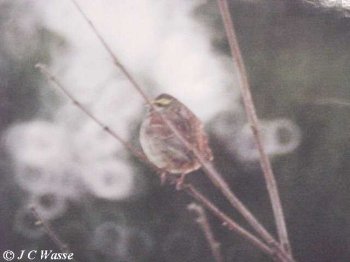
Cirl Bunting Emberiza
cirlus
Exminster, Devon, March 2000.
One of the few remaining
strongholds of this species
are along the country lanes around
Exminster,
Devon. At least five singing males were watched
during
this brief visit.
|
| Back to Top
| Forward to UK Birds 2000 April
- July
Bird index
Home Page
|