
C'arn the Hawks!
Scroll through Hawthorn's proud Honour Roll! C'arn the Hawks!
C'arn the Hawks!
"Which team is the most successful in the AFL?"
"Which team is the most unsuccessful in the AFL?"
Premiers, Wooden Spooners and Brownlow Medallists of yesteryear
Eddie, Sam, Trev and a lotta laughs!

"Can we count you in to be a PROUD, Passionate and Paid Up Member?"

Become a fellow Hawthorn member today! Join Now!
Comments please!
Constructive or abusive comments appreciated at:
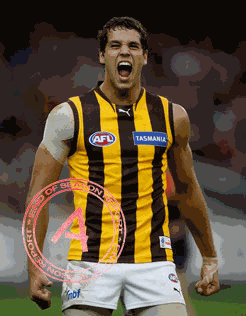
2008: The Hawks began the season under high expectations and didn't disappoint…

Hawthorn Hawks
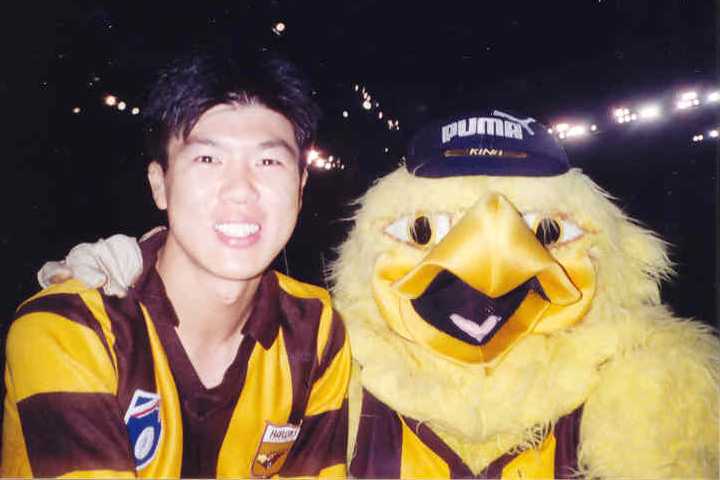
Hawka et moi, Colonial Stadium (Docklands), 2001
2008: Season In Review
(extract from "End of Season Report: Hawthorn" - Luke Holmesby)
Season in a nutshell: People expected big things from the Hawks this year and they didn't fail. While they still have a relatively young list, Hawthorn stepped up to be one of the genuine forces of the competition, winning the first nine games of the season and going on to win the flag. The Hawks dropped a few games in the second half of the year but still finished comfortably in second position thanks largely to stars Sam Mitchell, Luke Hodge, Brad Sewell and of course Lance Franklin - who emerged as a genuine superstar. The one thing standing in the Hawks' way was the all-conquering Geelong, and while the Hawks were not the best side for the season, they were the best when it counted. The test for the Hawks will be if they can continue to be a force after Geelong has peaked and before the next talented young team emerges.
Defining moment: It was established early that Hawthorn would finish second and face the Western Bulldogs in the first week of the finals. What they did to their opponents in that qualifying final made the football world take notice and had some experts predicting Franklin to be the greatest player of all time. He booted eight against a formidable Bulldogs defence and it was clearly established which team was the biggest threat to Geelong's throne.
What went right:
Forwards. You very rarely get a poor game from all three of Lance Franklin, Jarryd Roughead and Mark Williams. The fact there would always be at least one star forward in good form was the key to Hawthorn's forward line dominance.
Hitting peak form at the right time. In a season where the Hawks clearly seemed to be the No. 2 side they prepared extraordinarily well to peak at the perfect time. Players such as Luke Hodge, Brent Guerra, Brad Sewell, Xavier Ellis and Clinton Young all were playing the best football of their careers right at the end of September.
Hardness in the middle. No team wins a flag without true leadership in its midfield. Skipper Sam Mitchell was one of the best on-ballers in the game this year and was ably supported by Jordan Lewis, Sewell and the evergreen Shane Crawford.
What went wrong:
Continuing knee problems for youngsters Beau Muston and Max Bailey were lowlights in what was otherwise an impressive season. Bailey has only played four games and Muston none since they were drafted within seconds of each other at the 2005 national draft. They are still both young and highly-rated but their careers could be over before they have a chance to properly start.
Tribunal worries. Hawthorn's ferocity has frequently seen them before the tribunal. Hodge, Franklin, Lewis, Mitchell, Crawford and Campbell Brown are all crucial parts of the side but all have plenty of carry-over points against their names for various incidents over the past 18 months.
Salary cap. We are sure to get the usual spiel from premiership teams that all the players will take pay cuts to stay together. But the fact of the matter is being a flag winner adds to a player's worth and with most of Hawthorn's side in their early 20s, they have to consider the case of more premierships versus financial security.
The coach: The critics were out for Alastair Clarkson early in his career but in 2008 he well and truly silenced them. Clarkson played his cards close to his chest with the media and fans, but the results spoke for themselves. The Hawthorn coach established the now famous rolling zone that had opposition clubs baffled and ensured a successful season for his team.
Most Valuable Player: The coach might have constantly stressed there was more to his side than Lance Franklin, but there was no one more important. This was the first year we saw Franklin as one of the elites of the game. His blistering pace, strong marking and kicking for goal brought fans through the gates and was a major reason the Hawks won the flag.
Coach's award for one-percenters: Sewell is fast becoming the game's most highly-rated underrated player. Sewell has performed shutdown jobs with distinction, while also doing a bit of damage with the ball himself. He had more tackles than any other Hawthorn player. While he doesn't have the flashiness or profile of star teammates Luke Hodge or Lance Franklin, his worth to the team was shown with 16 votes in this year's Brownlow Medal.
Needs a big pre-season: Not so much because he needs to lift his performance, but it couldn't hurt Stewart Dew to shed a few more kilos before 2009 begins. Dew has lost a fair bit of weight since the Hawks drafted him last year but he will be even more valuable to Hawthorn if those powerful thighs weren't quite so thunderous.
Next big thing: It's not hard to see that Hawthorn has got something special in Cyril Rioli. He had no problems slotting in to one of the best teams in the AFL and played a significant role. His pace, skills and bravery added an extra element to the Hawthorn forward line. Rioli didn't miss a game and was unlucky not to be awarded the NAB Rising Star. Far from simply being a flashy forward-pocket player, Rioli showed that he has the all-round skills capable of making him a star of the competition.
Trading places: Ruckman Simon Taylor may want to seek a new home after losing his place in the pecking order to Brent Renouf for the finals. If fellow big man Max Bailey can recover from his latest knee reconstruction, Taylor will find himself the No. 4 ruckman and will have to look elsewhere. But early indications are that he wants to stay at the club. Forwards Tim Boyle, Beau Dowler and Mitch Thorp will also struggle to get a game with Franklin and Roughead entrenched up forward for the next decade and would have a bit of currency on the trade market, particularly for clubs like the Bulldogs, Adelaide and Sydney Swans who will be on the hunt for a key forward.
Overall grade: A
2007: Season In Review
(extract from "End of Season Review: Rebuilding Bears Fruit" - Jason Phelan)
Season in a nutshell: An inglorious start to the season in Brisbane left the Hawks on the bottom of the ladder, but it proved to be one of the few low points in a season where the club’s bold rebuilding plan began to bear fruit.
A win in round two vaulted them up the ladder into eighth and they didn’t drop out of the top eight for the rest of a season that culminated in the club’s first finals appearance since 2001.
Defining moment: The sight of Buddy Franklin’s match-winning, long-range bomb slicing gracefully between the goal posts in the dying seconds of Hawthorn’s elimination final against Adelaide was a defining moment for him and the team.
The young Hawk side’s ability to dispatch the finals-hardened Crows officially moved it out of the development phase and into genuine flag contender territory.
What went right: The Hawks’ burgeoning stocks of talented youngsters generally made good progress in their development this season which was the key factor behind the team’s success. Players like Jarryd Roughead, Clinton Young, Ben McGlynn, Grant Birchall, Stephen Gilham and Franklin further cemented their places in the senior side and helped maintain the drive to the finals.
Along with their development came a more attractive brand of football based on hard running and which gave an exciting and unpredictable forward structure plenty of opportunities.
Hawthorn’s home-and-away season of 2007 yielded 263 more points than the previous year’s with the high mark a 100-point thumping of the Blues that sent their season into freefall.
The veteran of the group, Shane Crawford, kept his body sound and was a consistent contributor throughout the season, with his game against Adelaide in the elimination final a highlight.
What went wrong: One of the more concerning aspects of the 2007 season was the manner in which the Hawks bowed out of the race for the flag. Alastair Clarkson lamented his side’s inability to perform under the bright lights of the semi-final against the Kangaroos. His players must learn to cope with playing when considered the favourite.
Shane Crawford, Luke Hodge and Jordan Lewis will all miss the start of the 2008 campaign after copping suspensions for undisciplined acts during that match.
Richie Vandenberg, Mark Williams, Max Bailey, Danny Jacobs and Tim Clarke spent most or all of the season injured on the sidelines.
Campbell Brown attracted unwanted attention as the business end of the season neared when he publicly admitted to lying to the AFL Tribunal in order to get Chris Judd off a rough conduct charge earlier in the year.
The club says: "We're not comfortable at all with being happy to just to play finals footy. We've set about every year since I've been here to play finals, and two of the years we've missed the mark and this is the first year we've been able to get there.
"We just need to understand just how difficult it is to get into a position to play in these types of games.
"Our guys will benefit enormously from it, but I hope the disappointment of [the semi-final loss] will fuel a pretty hungry desire to have a strong pre-season and a strong home-and-away series next year so we can give ourselves a chance to play in these types of games again." - coach Alastair Clarkson
Coach's award: Brad Sewell is a firm favourite of the coaches thanks to the selfless, team-oriented way he attacks each and every task he is given. A worthy winner of the Peter Crimmins Medal, Sewell led the club in tackling, averaged 21 possessions and won plenty of admirers for the way he was able to curb opposition playmakers while still getting plenty of the ball himself.
An honourable mention goes to Ben McGlynn, who impressed regularly with his impeccable work ethic.
Next big thing: Mitch Thorp’s progress was hampered by a hip complaint but big things are expected of the 194cm forward down the track.
Taken at No. 6 in the 2006 NAB AFL National Draft, Thorp managed to make his debut in round 15 and didn’t look out of place. Depending on his pre-season, the exciting Tasmanian could slide into the spot vacated by Ben Dixon.
2006: Season In Review
(extract from "2006 Report Card: Hawthorn" - Matt Burgan)
What went right: The Hawks were too one-dimensional when going forward in 2005 and a stated aim this year was to discover other avenues to goal, other than just Mark Williams. This was achieved, with Ben Dixon booting 39 goals and Lance Franklin 31 majors from just 14 matches. Jarryd Roughead spent much of the year in the backline, but moved forward with promise late in the year. Yet Williams still booted 60 goals for the year - an outstanding achievement from a small forward - which included two bags of eight. Coach Alastair Clarkson would be delighted with the form of his forwards.
Hawthorn tinkered with its game-plan for much of the year. The Hawks won four of their first five games, but with a game-plan that featured lots of numbers behind the ball. A few mid-year thrashings convinced the coaching staff to change things and instead more pace and run was injected. Not only did the Hawks finish the year with four straight wins, but they featured an impressive and entertaining attacking style that supporters would like to see repeated from round one, 2007.
What went wrong: For 13 matches (rounds six to 18) Hawthorn achieved just one win - a 41-point win over Richmond in round 12 - which was a far cry from its fine start and finish to the 2006 season. The Hawks had an average losing margin of 45.25 points during those 13 matches, with several drubbings coming along the way. This drop in form resulted in Hawthorn falling from fourth on the ladder after round four to 14th in round 14. It remained in that position until the last two rounds when it bounced back with some impressive late season form.
Although not decimated by injury to the extent of some other clubs, Hawthorn did have its own injury problems during 2006. The Hawks could not afford to be without key players during the year, particularly in their rebuilding phase. Shane Crawford missed seven matches for the season, Trent Croad (four), Peter Everitt (eight), Danny Jacobs (13), Richie Vandenberg (six), Brent Guerra (six), Michael Osborne (18), Tim Clarke (four), Tom Murphy (six), while Lance Franklin's start to the season was hindered by injury and form.
Most improved players: Robert Campbell played just one match in 2005 - the opening round of the season - yet missed the rest of the year with a knee injury. But in 2006, Campbell bounced back to play every match, while he started the season as the club's first ruckman, due to the limited pre-season suffered by Peter Everitt. Campbell also spent time in key defensive posts as the season progressed and displayed some encouraging signs. The 24-year-old should continue to blossom over the next few seasons, given that he has rebounded strongly from his knee injury. He now has 54 matches under his belt. Mention must also be made to Rick Ladson, who played all 22 matches for the season, after four injury-riddled seasons. Like Campbell, Ladson cracked the half-century - he has now played 52 matches - and should only continue to forge on from this point. Brad Sewell is also an underrated, yet integral part of the Hawthorn team. Either in defensive jobs or run-with assignments in the midfield, Sewell continues to improve and impress.
Most disappointing players: Ruckman Peter Everitt is one of the finest ruckman of his era - and should continue to be in 2007 barring any mishap - but it won't be at the Hawks. Everitt parted ways with the club just two days after Hawthorn's season concluded, after both parties were unable to see eye-to-eye on a new deal. His future has been strongly linked with Sydney. It was a disappointing end to a four-season union with the Hawks, as 'Spida' won the club's best-and-fairest award in 2004, finished second in 2005 and was also All-Australian last year. But a interrupted pre-season entering 2006 and just 14 matches for the year - his second half of the season was ruined by an ankle injury - was not the note that all concerned with the brown and gold was hoping for when Everitt joined the club, after 180 matches with St Kilda from 1992-2002. Also, midfielder Nick Ries could only add nine matches to his 81-game career - his sixth listed season at the club - as others were clearly favoured ahead of him. He was an emergency on nine occasions. Forward/midfielder Harry Miller was only able to add four matches, after playing 14 matches in his debut season in 2005. And despite regularly being named among Box Hill's best, Matthew Ball, did not crack anymore than three matches in 2006.
Rising Star: Hawthorn had two NAB AFL Rising Star nominations in 2006. Emerging wingman Clinton Young received a gong in round 12, yet it was the nomination in round 14 that the Hawks are really licking their lips about - Grant Birchall. The Taswegian made his AFL debut in the opening round of the season and by the conclusion of Hawthorn's year, Birchall had 16 matches under his belt. Yet it was his last four matches that made the football community take note. He notched up 110 disposals in his final four rounds, which included a stunning 36-disposal performance against Geelong in Hawthorn's last home-and-away match of the year. He can play in a number of positions and standing at 192cm, his versatility is an enormous asset to the club. Birchall is one of the most promising youngsters in the game.
Best win: Hawthorn's round three win over Geelong at Skilled Stadium was one of the initial upsets of the season. The Cats had not dropped a match at that point of the year, after winning the pre-season competition and smashing the Brisbane Lions and the Kangaroos in the opening two rounds of 2006. Yet the Hawks produced a stunning performance against the Cats - winning by 52 points - which was also the start of Geelong's slide in 2006. Luke Hodge, Sam Mitchell and Brent Guerra shone for the Hawks, while Campbell Brown and Mark Williams booted three goals each. Interestingly, Hawthorn's greatest winning margin of the season was against Geelong in the final round of the home-and-away season, when it thrashed the Cats again by 61 points at Telstra Dome.
Worst defeat: Hawthorn suffered several thrashings throughout 2006. Statistically, its worst loss was against Port Adelaide in round 11, when the Power won by 96 points. But the one loss that really hurt the Hawks was against St Kilda in round 13. Hawthorn went down by 70 points to the Saints, yet they had come off a 41-point win against Richmond at Aurora Stadium. Hawks fans went into the match expecting a much more competitive showing, yet the match failed to live up to expectation.
Shopping list: The Hawks could make up to 10 list changes, with several fringe players contracted before the Alastair Clarkson-era likely to be under the pump. Hawthorn will continue to inject exciting young talent into the club - as it has done in its past two seasons - and this trend will again be a priority in October/November. The Hawks are sure to be heavily involved in the trade period, particularly with the talents of list manager Chris Pelchen at the club, who was instrumental in the club gaining five selections in the top 22 of last year's draft, after some shrewd trading. Pelchen will again be one of the leading trade strategists in October. But with the likes of John Barker retiring and Peter Everitt moving on, the Hawks could opt for a mature age player in the exchange period. A mature ruckman from another club could come into consideration, with 'Spida' moving on. It's a cliché around draft time, but Hawthorn may well opt for the 'best available player' come November, as the past two years has addressed a number of key areas and it will only look to build on that.
What the coach says: "We'll go through a pretty extensive review, but you guys (the media) will do that better than me probably - we won a few early, disappointing in the middle and won a few late - it's pretty basic really," Hawthorn coach Alastair Clarkson said after round 22.
"No we didn't (set a number of wins for 2006) and I'm not sure that we'll have it next year either, because that then ties you in … and 'Bomber' (Geelong coach Mark Thompson) probably in the same situation that 'Schwabby' (former Hawthorn coach Peter Schwab) was in three or four years ago," Clarkson said.
"You build expectation by stating that you're going to win premierships and finals and it's just too much in its infancy, our whole growth as a footy club and back to being a competitor at finals level again, to put a tally of wins on it.
"But we did want to make sure that the worm was curved in the right way in terms of progression and that didn't necessarily always mean win/loss - it could mean getting more game-time into our young players."
What we say: Hawthorn's list will again make another significant transformation over the summer and in the long run - and all things being equal - the club will give itself the best opportunity of achieving ultimate success down the track. But first the club must remain patient. Stability is the key. The fact is these players drafted over the past two seasons are still only going to be 20 years old or younger and patience is a must. Although there is a chance that Hawthorn could push for a top eight berth next year, it's unlikely that that Hawks will be a genuine contender for at least the next three to five years. In today's football environment, that's light years away. The Hawthorn board and key executives must remain united and not be swayed into 'Band-Aid' pressures. If the club is serious about becoming a force again, it must give coach Alastair Clarkson and his charges the best possible chance of achieving success. That means backing him all the way. There are still going to be tough times for the brown and gold, but progress has been made in 2006 and the signs are there that improvement will again continue in 2007. The plan is in place - now see it through.
2005: Season In Review
(extract from "2005 Report Card: Hawthorn" - Ashley Browne)
What went right: The Hawks blooded 11 first year players and just about all of them showed something. After some early struggles, No. 2 draft pick Jarryd Roughead moved to the backline and proved most adept, while Lance Franklin dazzled Hawk fans with some of his work close to goal. This kid could be anything. Jordan Lewis played 19 games in the midfield and impressed with his skill and his toughness. Clinton Young, Harry Miller, Josh Thurgood and Simon Taylor also showed signs through the season they could have long careers ahead of them in brown and gold.
The Hawks also rediscovered their competitiveness and were only blown away once for the year, by 117 points to Port Adelaide in Round 13. They were competitive most weeks and played an attacking brand of footy that placed a premium on keeping possession of the ball. In Mark Williams, the Hawks nearly had the Coleman Medallist and if not for a knee injury that kept him out of the last few weeks, he might well have won it. He finished with 63 goals in what was an outstanding season.
Another bonus was that Jonathan Hay got through the season relatively unscathed. While Hawk fans often covered their eyes when he disposed of the footy, the plan at Glenferrie all along was that he get through 2005 unscathed after three injury-interrupted seasons. That he did, which means that next year will be about getting back to something approaching his All-Australian form.
What went wrong: The Hawks became the masters of snatching defeat from the jaws of victory, and lost eight games by four goals or less. The Round three loss to Essendon, Round six loss to Carlton and Round 21 to Richmond by a point were particularly disappointing because the Hawks controlled large chunks of each match. The Hawks also controlled the Round 15 clash against Adelaide for all but 10 minutes in the third term when the Crows piled on six unanswered goals.
Injuries didn't help the Hawks, nor did their skills errors. It may have been a young side, but some of the skill and decision-making errors by Hawthorn in 2005 were comical.
Who stepped up: Just as Hawk fans were starting to despair that Luke Hodge would never be as good as fellow 2001 draft standouts Chris Judd and Luke Ball, Hodge turned in a brilliant season and emerged as the club's best player. He formed a fearsome midfield tandem with Mitchell, but also won plenty of touches as a defensive sweeper and as a damaging forward. Hodge, for whom 30-plus possession games became the norm, would appear a natural leader but did let himself down by missing a mid-season training session, which culminated in a one-match suspension imposed by the club.
Williams put the shotgun away in 2005 and as noted kicked goals - lots of them. He was great on the lead, surprisingly good overhead and dangerous when crumbing, which confirmed the thoughts of most observers that he will be at his best in years to come as a second or third forward when the Hawks develop a true tall marking key forward.
Chance Bateman, Campbell Brown and Peter Everitt were all great for the Hawks - Everitt would be genuinely stiff not to be named All-Australian ruckman - but the other player to really step up was Trent Croad, who was the best centre half-back in the AFL for the first half of the season and one of the best key forwards in the caper later in the season, when injuries and match-ups forced him to move up the ground.
Missing in action: Injuries cruelled the Hawks this year with key players such as John Barker, Sam Mitchell, Chance Bateman, Campbell Brown and Nick Holland not playing enough senior footy for the year. The one bonus was that the soft-tissue injuries that have plagued the club in recent years more or less disappeared, replaced by collision injuries that are simply a case of bad luck.
The Hawks were also without experienced midfielder Angelo Lekkas for most of the season because of a minor stroke suffered after a practice match late in February. His return against Geelong in Round 13 was inspiring for the Hawks and one of the highlights of the season.
Rising Star: Franklin, Lewis and Roughead were all worthy nominees for the NAB AFL Rising Star and when assessing Hawthorn's season, it is difficult to separate the three, so let's not. But according to leading commentator Garry Lyon, Roughead and Franklin could well be the next Nick Riewoldt and Justin Koschitzke, while Lewis already appears a ready-made midfielder, who can mix it with anyone. That'll do quite nicely for the Hawks, and with the third and sixth draft selections overall still to come this November, the Hawks will get more opportunities to add to an impressive list of quality youngsters.
Best win: The heart says Essendon (of course!) in Round 20, but the head says the 54-point belting of Fremantle at Subiaco in Round nine. The Hawks hadn't won outside Victoria (not including Tasmania) since 2001 and nobody gave them a sniff of beating the Dockers, whose previous home game resulted in a 20-goal win over Collingwood. But the young Hawks ran the Dockers into submission, with Williams booting five goals and Mitchell, Everitt and Crawford dominating the stoppages. On the home front, the roars that greeted the wins over Brisbane and Melbourne at the MCG suggested that they also scored high marks with the Hawk faithful.
Worst defeat: Again, the heart says Essendon in Round three given that if not for an incorrect goal paid to Dean Solomon in the final quarter, the Hawks would have won. But really, Port Adelaide humiliated Hawthorn in Round 12, rattling off 16 goals on the trot in the second half. New coach Alastair Clarkson deserved praise for his all-out attacking approach to most of the season, but if ever there was a time to push players back, this was it, especially in front of a national TV audience. And when you look at the AFL ladder in totality, losing to Collingwood in Round 10 was pretty poor. The Hawks were a better team than the Pies for most of that day, and the season.
Shopping list: The appointment of Chris Pelchen to the club's football staff is fascinating. Port Adelaide's 2004 premiership team contained players such as Damien Hardwick and Byron Pickett that he brought to the club, expressly filling the directive handed from the coach. His job at Hawthorn is to scour rival clubs for players who are undervalued or deserving of more game time and we wait with interest for early October to see the results. As for the draft, the Hawks will look for at least one more tall with an early pick and have already made it quite clear that whoever they bring into the club will be reasonably skilled.
What the coach says: "Our club made no secret of its desire to give younger players and indeed younger coaches an opportunity to strut their stuff and start building for the future of this footy club. We've played more youngsters - I think we're equal with Brisbane in terms of playing more youngsters than any other club - and we've played those youngsters in more games than any other club if you add all their games together collectively.
"We've met a lot of our expectations in terms of what we believe is now a healthier and better-conditioned list. We've had issues in the past where we've had a lot of soft tissue and stress-related injury to our playing group and we've been able to overcome those - whether that's sustainable remains to be seen," - senior coach Alastair Clarkson.
What we say: Rarely have a group of supporters enjoyed a five-win season as much as this and already be so excited about next season. 2005 was a development season; the club never shied away from this and the foundations have been laid for what could be an exciting time down the track. But 2006 will be about building up their bodies and teaching them more about how to play with the aim of moving further away from the bottom.
Fit and firing, this team could threaten for a lowly finals berth next year but the more realistic aim would be to win between eight and 10 games. But the Hawks have the trade and draft periods to look forward to, as well as the start of Jeff Kennett's rein as president and the move to Waverley Park. Hold on to your hats, Hawk fans, because you're in for a hell of a ride even before the first ball is bounced in 2006.
2004: Season In Review
(extract from "2004 Report Card: Hawthorn" - Ashley Browne)
What went right: In terms of hit-outs, Peter Everitt was the clear leader in the AFL with 628, 119 ahead of Jeff White. Yet it was White who earned All Australian selection, much to the disappointment of the Hawks. In such a wretched season, Everitt's ruckwork shone like a beacon and he also showed tremendous leadership traits - a quality that appeared beyond him during his time at St Kilda. After appearing absolute certainties for the wooden spoon with six games to go, the Hawks regained some pride under stand-in coach Donald McDonald and won two of their last six games with a more committed and direct brand of football.
What went wrong: Where do you start? And do you have all day? Sadly, it was that sort of year for the Hawks. Injuries cruelled the side yet again, with Shane Crawford (back, arm) and Jonathan Hay (knee) each missing half a season and Luke Hodge missing a critical chunk of the early part of the season with stress fractures. Danny Jacobs and Lance Picioane were embroiled in a drink-driving episode, an old end-of-season trip reared its head, Nathan Thompson lost form and then admitted to a battle with depression, a brawl against Essendon incurred the wrath of the football community and in particular the AFL tribunal, and then Peter Schwab was sacked as coach. The merits of the decision were quickly overshadowed by the shabby way in which it was handled. It was inevitable that a battle for the boardroom would emerge after such a sorry season and at the time of writing, premiership skipper, club saviour and former board member Don Scott is marshalling the troops for a proposed November Extraordinary General Meeting.
Who stepped up: The aforementioned Everitt was great, but the surprise packet at Glenferrie in 2004 was Trent Croad. He started slowly at centre half-back, but as his confidence grew, he started backing himself and adding some attacking flair to his game. By season's end, Croad was playing some of his best footy at Hawthorn since 1999. Luke Hodge returned from injury and rarely played a poor game thereafter, showing great leadership, toughness and genuine class. He's not captaincy material yet, but is not far off it. Richard Vandenberg was a damaging midfielder for much of the season, while Sam Mitchell, Mark Graham, Chance Bateman and Mark Williams (in patches) probably deserve passing grades for the season. Tim Clarke deserves some praise for his application.
Missing in action: Joel Smith ran hot and cold, Angelo Lekkas appeared disinterested, Nathan Thompson was inconsistent, Danny Jacobs never recovered from an early-season hamstring strain, Michael Osborne regressed, Nick Ries and Campbell Brown battled but let themselves down with skill errors and in Brown's case, discipline, Ben Dixon, John Barker, Kris Barlow and Nick Holland suffered with injuries and form, Jonathan Hay only played well fleetingly after his knee injury, Steven Greene's skills let him down and like Rick Ladson was too skinny.
Rising Star: 2004 marked the first time there was no nominee from Glenferrie in the 11-year history of the National's AFL Rising Star Award. Matthew Ball emerged in midseason as a promising run-with option through the midfield and probably should have received more game time. The club's first selection from last year, Harry Miller spent the year at Box Hill and made some progress, while the first pick from 2002, Luke Brennan finally made his debut and played three games across half-back. He should become a regular player in 2005. The Hawks were also stiff to lose emerging key position prospect Tim Boyle for the year with a badly-broken leg in the pre-season. From all reports, he was on track to play senior football early in the season.
Best win: Clearly the 49-point win over Melbourne in the opening round was the pick of the four. Everitt was dominant in the ruck, the midfield enjoyed a field day and the Hawks dominated in the key positions at both ends of the ground.
Worst loss: Heaps of bad ones but the 86-point loss to Adelaide at the MCG in round 10 was too bad to be true. The Hawks were insipid that day and the defeat was magnified by the season-ending broken arm suffered by skipper Shane Crawford.
Shopping List: The Hawks have needs everywhere but desperately need another key forward and need more skill and toughness in the clinches. It would also appear there is no great faith in back-up ruckman Robert Campbell, meaning a ruckman may be drafted in November.
What the coach says: "From my observation there are some holes in the club that need to be fixed. We need to make sure we bring in a team of people that are vibrant, they’re young, knowledgeable and committed," - new coach Alastair Clarkson.
What we say: The Hawks should simply erase 2004 from the memory bank. It never happened.
Goals for 2005: Get things right off the field. Work out the boardroom situation, get the new coach out on the hustings and then sell the virtues of the new Waverley Park facility. Create a feel-good vibe about the club among the supporters and the media to insulate against what will probably be another bottom-four finish in 2005 as the team sets about rebuilding.
2003: Season In Review
(extract from "From Ridicule to Respect" - Brent Diamond)
One could only imagine the glory that might have been if the Hawks had been able to match the first half of the season - which garnered a paltry three wins - with their pulsating second half, when they steamrolled through the competition with nine wins from their last 12 games.
The team's treacherous start to the season sent fans into a frenzy. In the mad month of May injuries to key players put Peter Schwab and Shane Crawford under the increasing pressure to perform and our young guns were labelled Mummy's Boys.
Some may say it was a season of lost opportunities for the Hawks, with nine matches decided by less than two goals. The side's confidence was shattered in Round 5 against Richmond, when the Tigers turned a nine-goal deficit into a 20-point win. It was a tumultuous period for the club with injuries again playing a part. Peter Everitt's influence on team fortunes was apparent when the talented ruckman broke a cheekbone in the second quarter. The Hawks never recovered and relinquished a match-winning lead.
The Hawks were subjected to a gut-wrenching defeat against undermanned Essendon in Round 8. Crawford said it was the worst defeat he had ever experienced. "It was embarrassing, insulting … the thing that killed me was that I knew we were good enough," Crawford wrote in his book Shane Crawford: EXPOSED. Crawford and his coach were notably the most criticised duo in the AFL during May. Schwab showed exceptional courage and belief throughout the period.
Crawford faced the most difficult period of his career with increasing speculation about his commitment to football and to Hawthorn. The media was spouting the argument of football versus his acting aspiration and involvement in The Footy Show's The House of Bulger.
However, the Hawks found renewed confidence. What was the turning point? Was it a new approach from the coaching staff to play the players in their best positions? Or was it the courageous act from Campbell Brown, who suffered a season-ending shoulder injury after blocking the path of an oncoming Nigel Smart, inspiring his teammates to new heights?
Whatever the reason, the team began to play smarter and with more belief in themselves and one another. They played inspired football; they shouldered greater responsibilities and took more risks. And more importantly - they played for each other and they played to win.
After the break, the Hawks went from a team in turmoil to a team playing with a vengeance, and resurrected a season that many believed was already over. There was still a mathematical chance of making the finals, yet despite winning the final three games of the season, the Hawks narrowly missed out for the second successive season and finished ninth.
Crawford lead from the front and ended the season with a fourth Club Champion award and equal runners-up in the Brownlow Medal. Sam Mitchell continued his rise to stardom, winning the AFL National Rising Star award and becoming one of the league's centre-clearance maestros. Angelo Lekkas achieved his best season and finished second in the Club Champion and a goal behind the club's leading goalkicker Nathan Thompson who booted 38 goals.
Joel Smith continued his resurgence as a top league defender and was named in the All-Australian team for a second time. Peter Everitt proved himself a pivotal player to the Hawthorn line-up with his outstanding ruck displays and was sorely missed when injuries and suspension hampered him throughout the season.
The Hawks' young guns continued to improve and consolidate places in the senior team. Michael Osborne was outstanding in defence, Nick Ries and Tim Clarke worked tirelessly in the midfield, while Luke Hodge and Mark Williams were impressive.
2003 may have been the season of lost opportunities but 2004 should see the Hawks make the most of their chances and embark on the road to success.
2002: Season In Review
In a year that began with high expectations, 2002 was a wasteful season of missed opportunity. At a loss for words to describe an abysmal 2002, I shall re-cite the wisdom of Robert Walls (The Age, 09/08/2002) prior to the end of a forgettable season:
"The Hawks are teasers. They lack substance. They get you excited about their prospects and then they fail to deliver. After an encouraging season in 2001, plenty of us selected them to be a top-four team the following year. But it didn't happen. They finished 10th on the ladder with a woeful percentage.
Twice this season, they have won blocks of four games in a row to tantalise. But after each burst they have disappointed. "Show ponies", say some of their keenest fans.
For a club that prides itself on its grunts and growl, the class of 2002 have been disappointing. There are too many frontrunners in this team. Blokes who look good when the game's opened up and the ball flows freely. But when it's tight and tough, too many don't deliver.
A champion in every sense this year has been the skipper, Shane Crawford. Week in, week out, he has carried the team. He has been ably assisted by Richie Vandenberg, Simon Cox, Angelo Lekkas and Mark Graham, but then it slips away. Too many talented players have failed to deliver on a regular basis.
In 2001, the Hawks had two All-Australian players in Joel Smith and Jonathan Hay. Smith, the best-and-fairest winner last year, had the most kicks, most defensive rebounds and most handball receives in what was a stellar season. He was the creative playmaker in the back half. This season, with suspect and strained hamstrings, he has done nothing.
Hay has missed only three matches but has looked out of sorts at full-back. At times, he looks uninterested, plays too loose and really struggles in the body-on-body contests. In the space of twelve months, the two All-Australians have gone from chocolates to boiled lollies.
Completely missing from action has been John Barker. Barker was in the top-four value players a year ago, kicking the most goals and taking the most marks for his Hawks. This season, there's no go in him at all. The running has stopped, and the desperation to go for marks has departed.
We marvel at Daniel Chick's toughness, desperation and tackling. His repeat efforts are superb, but it's frustrating at game's end to see that his disposals too often don't reach double figures. Ben Dixon teases, too. His best is brilliant but there are too many games where he goes missing for entire quarters and halves.
And so it goes with the Hawks. Hot one minute, cold the next. You can see the frustration and strain showing on coach Peter Schwab's face. The coach is a measured, reasonable man, but his patience must be wearing thin with a group that seems happy with its lot in life, a group that seems to think that near enough is good enough."
However, it was not all doom and gloom at Glenferrie this season. As Robert Walls alluded to, Richard Vandenberg was the Hawks' most-improved player, conjuring inspiring goals from his breaking bursts of pace. Given a lifeline by the Hawks, draftee Simon Cox re-paid Hawthorn's faith and was also a solid contributor throughout the season. 2001's #1 draft-selection Luke Hodge and rising stars Nick Ries and Campbell Brown shone in an otherwise dark season, showing their capabilities in performing at the highest stage. However, they were expected to do too much in their debut season, as too often the more senior Hawks did not show the hunger or desire to succeed.
I'm proud, passionate and paid-up to be a part of Hawthorn in 2003, but can the same be said about the players???
2001: Season In Review
Season 2001 was a roller-coaster ride for Hawks fans, full of dramatic highs and monumentous lows, but ultimately, one worth every minute of the journey. After starting with eight successive wins, the best season-opening winning streak in Hawthorn's proud history, the Hawk machine stalled and struggled to gain momentum thereafter, winning only five of their last 14 home-and-away games.
Peter Schwab's ticker was given a testing this season, literally, as he was diagnosed with a cardiac arrhythmia that forced him to be hospitalised while his team was battling Carlton to consolidate a position in the top eight. In Chris Connolly's debut as head coach, the Hawks snatched a "heart-stopping" victory from the clutches of defeat. In a dramatic finale, Ben Dixon fulfilled every kid's backyard dream of kicking the winning goal after the final siren.
The euphoria of the win was short-lived however, as the previously winless Fremantle caused the upset of the season by humbling the Hawks upon Schwab's return. From chocolates to boiled lollies, a week is a long time in football. For those conspiracy theorists out there, Fremantle's victory may have portended the farcical trading of Trent Croad to Fremantle for the #1 national draft pick, and the subsequent appointment of Chris Connolly as the Dockers' new coach.
Hawthorn's mid-season slump coincided with untimely injuries to key players, severely depleting the Hawks and testing the depth of the team, particularly in the midfield, where Shane Crawford's on-ball pace and drive was sorely missed. Eventually, the Hawks limped to another Finals Series with many experts doubting the Hawks' survival beyond the first week.
Plagued with a shoulder injury for much of the season, Nick Holland's return to the line-up for the Final Series inspired the Hawks into rediscovering the form they had displayed during the first half of the season. Hawthorn comfortably defeated Sydney in the 2nd Elimination Final, and a trip to Adelaide via cargo plane for the 2nd Semi-Final against Port Adelaide loomed.
In a match where Hawthorn failed to convert countless attacking forays, enter John Barker for a cameo appearance right at the death. Battling a debilitating migraine attack throughout the match, Barker's trusty right foot yielded two final quarter goals, one from the "impossible" angle and one that booted the Hawks into a 2nd Preliminary Final showdown against the minor premiers, Essendon.
Controversial umpiring decisions by Darren "white maggot" Goldspink bewildered Hawthorn fans, which certainly ruined any chance of a famous Hawthorn victory. Incensed Hawks fans saw the match degenerate from a spectacle into a complete debacle after every umpiring blunder. Goldspink's inept umpiring and incompetence was duly noticed by the AFL, with Goldspink promptly dropped from officiating in the Grand Final the following week. In a harsh reality, there is some justice after all…
After trailing by six goals at half-time, a revitalised Hawthorn staged a monumentous fight back in the second half against the rapidly fatiguing Essendon. Hawthorn came within a kick of snatching the lead in the final quarter, but Trent Croad's booming 60-metre drop punt cannoned onto the goal post. Those few inches condemned the Hawks to a gallant loss and possibly Croad's fate at Hawthorn.
Jonathan Hay and Joel Smith earned All-Australian honours after stellar seasons in defence. On the verge of being de-listed after a disappointing season 2000, it has been a remarkable year for Smith, who has transformed himself into a solid, running defender. John Barker, Daniel Chick, Jade Rawlings and Nathan Thompson continued their brilliant season 2000 form to dominate their respective positions. Rookies Nathan Lonie and Steven Greene also emerged as rising stars to support Shane Crawford and Daniel Harford in the midfield.
After a tremendous start to the season that promised so much, a Preliminary Final defeat was a bitter pill to swallow for Hawks fans. However, with a young list hungry to succeed, the future is full of optimism for the Hawks. Sixth in 2000, fourth in 2001 - a Grand Final appearance in 2002?
2000: Season In Review
In Peter Schwab's first year at the helm of the Hawthorn Football Club, he guided his young, raw Hawks into their first Finals Series since 1996. His attacking style and tactical nous was just the right combination needed for the Hawks to continue their surge from the "football wilderness" of past seasons. Season 2000 provided many highlights for the club, including the celebration of one of the game's legends and perhaps the discovery of future champions of the game. Hawthorn fans look forward to next year full of optimism that our team can once again be a real threat for the premiership race.
Led by the inspirational Shane Crawford, several players stepped up this season to play an important part of the Hawks' resurgence, notably the courage of Daniel Chick around the packs, the aerial-dominance of Jade Rawlings across half back, the brash talent of Glen Bowyer in the midfield, the "cult hero" status of John Barker in the forward line, and the experience of Tony Woods in the midfield.
Nick Holland starred across half forward, kicking over 50 goals this season and regularly taking a bagful of contested marks each game. Jonathan Hay led the back line with assurance, with many Hawthorn attacks starting from his deadly accurate passes. Nathan Thompson's ability to dominate at full forward or in the ruck proved influential in Hawthorn's second half of the season. Trent Croad's versatility with dashing runs from half back and strong, marking power up forward provided many headaches for the forwards and backs of every team.
Hawthorn farewelled one of our adopted sons, Paul Salmon. The "Fish" played his 300th AFL match this season and his last, his 100th game in the brown and gold was in the 1st Semi-Final against the Kangaroos. In a fitting farewell, the crowd saluted a true champion as his teammates carried him off the MCG at the end of the game.
But as one champion exits the main stage, the Hawks may have unearthed a new, rising star. Brett Johnson, playing his first final against the Kangaroos, was nerveless in his debut final and showed that he could stand up against the pressure of AFL football.
Time to put the Hawks guernsey back into the closet for another year. But the smell of mothballs will be a little sweeter, knowing that sixth position in 2000 are signs of better times ahead for the mighty Hawks.