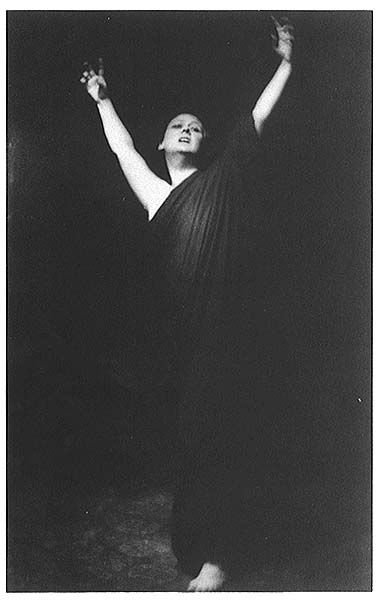
Modern was developed in the 1920s and 30s, by American dancers Martha Graham and Doris Humphrey and a German dancer Mary Wigman. It derived from ballet but with a more expressive movement style. It is an abstract style of dance which experiments with sound, lighting, scenery and costume.
Martha Graham was inspired by an American dancer Isadora Duncan who disliked the disipline of ballet. She liked free, spontaneous and natural movement and danced barefoot. Martha Graham's choreography was derived from ideas of myths, dreams and ancient Greece. Her technique, one of many, uses the idea of using the torso and breathing in contracting and releasing, 'angular' twisted body shapes, floor movements (in a class floor-work is the equivalent to barre work in ballet), and uses dance to convey emotion rather than a story.
Doris Humphrey's choreography responds to the idea of fall and recovery. She challenges the idea of social organization, often by placing groups at different levels within the stage space, using the whole stage area and not just the stage floor.
Merce Cunningham was a dancer in Martha Graham's company. He redefined modern dance, he required not to convey either emotion or an individuals relationship to society but believed that the content is found by the audience and not communicated by the artist, enabling him to experimented with time, space, movement and stillness. |