Proof:
Warnings
Green House Effect
Effects:
Heat
Ice
Sea Level
Climate
Nature
Animals
Bibliography:
Works Cited
|
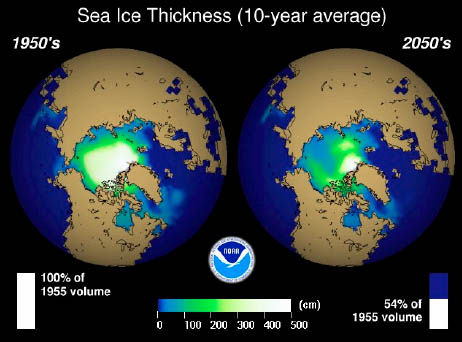
Glaciers are already melting away rapidly on 6 continents, and global warming will speed up this melting and cause the sea level to rise. The Bering Glacier, North America’s largest glacier, is losing 20% - 25% of parts of the glacier. The Arctic Sea ice’s average thickness is losing 4 inches a year, out of 6 ft., and is shrinking by 14,000 square miles out of 1.5 million square miles in the summer. But by 2050 at least 20% of the annual sea ice will be gone, and there might not be any summer ice. Though the ice is already floating in water and will not affect the sea level, it will however cause the Earth to lose some of its ability to reflect heat into space, and thereby leading to more global warming. Glaciers in Uganda, Kenya, Antarctica, and India and around the world have lost a large percentage of their glacier, and are their massive retreat is expected to hasten (Threat). For instance the Qori Kalis glacier in Peru is melting 9 times faster than it was 20 years ago (Tropical). Even worse Mt. Kilimanjaro in Africa has lost 33% of its ice fields, and is expected to lose the rest by 2015, and Glacier National Park will be expected to change its name by 2030 if global warming continues (Threat). The ice caps in alpine regions in the tropics and subtropics are melting at a phenomenal rate (Tropical).

Ice Recession in Glacier National Park from 1911 to 2000.
All glaciers in the park will be gone by 2070 if retreat continues at its current rate.
|