the film
the diary
photos
reviews and awards
the director
credits
contact
links
the diary
The following is Ms. Kaftan's diary of the making of her film.
-
DIARY OF FAULTLINES
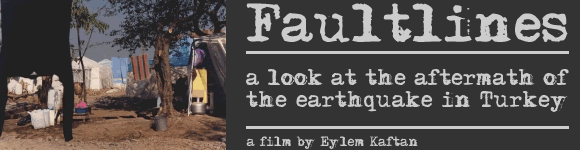
Two years ago, I was planning to make a film in Eastern Turkey. The day I was about to leave Ankara for this project, one of the biggest earthquakes hit Western Turkey where my hometown was. All the railroads were closed, bus trips were cancelled. I had to make a decision though to go west, to my hometown. The film Faultlines, came out long after I volunteered in the earthquake zones. It is about the aftermath of the 1999 Earthquake in Turkey. It is a personal and political story of the earthquake victims who were left alone not only during the quake, also in the aftermath when they needed proper shelter, food, healthcare and moral support. The film consists of interviews of the victims, the footage of their day to day lives in tentcities, political demonstrations, meetings as well as many archival footage. It starts by the victims chronicling the night of the quake, the rescue process, and their desperate attempts to find their lost ones. Then it covers issues of housing problem in the cold winters, health problems, and the resistance organizing against the government and finally the change both the victims and the volunteers went through. Its main characters are Bora and Aslan family who lost many family members. Huseyin appears as another character who quit his school to volunteer in the aftermath. He saved many lives, one of them being a 17 year old girl who was abducted from the tentcity and raped and shot by men who wanted to take advantage of the chaotic conditions of the aftermath. The film is shot on digital.
August 17, 1999
3.15 am the deafening howling of dogs wakes me. It feels like there are thousands of them. I am sleeping on the floor in a friend's place in Ankara, the capital city of Turkey. The bed shakes like a cradle for what feels like an eternity. I know that it is an earthquake. It is pitch dark. The dogs keep howling. In those 47 seconds, I think about many things: our helplessness before nature, our closeness to nature, our solitude and togetherness.
August 18, 1999
At least one hundred people died so far. I leap from the bed in tears. I am far from home. My little sister is alone in Istanbul. My parents are staying at our summer residence.
We are in the middle of a film shoot in Ankara. I am the main actor. The film is put on hold. I keep calling Istanbul. All the electricity and telephone lines are down. The only device that works is the radio. I learn that the epicenter is my hometown. My family has fortunately survived. The death toll increases to 4500.
August 19, 1999
Turkey is shaken by constant aftershocks. Thousands of people are stranded under the rubble. The government is literally dysfunctional. There is lack of sufficient equipment, manpower. Later I learn that for Istanbul, a city of 15 million people, the number of rescue workers is only 36.
August 20, 1999
All the roads are closed. The bridges are collapsed. I reach my hometown after a long journey. I realize my family wears the same expression on their faces as I have seen on everyone: the expression of survival, of being alive. Everyone talks to each other in the earthquake zones. Everyone feels the sentiment of brotherhood and sisterhood. Everyone wants to share his or her stories.
August 21, 1999
There are still people stranded under the rubble. The death toll is said to range between 17 and 45 thousand. Everyone wants to help. We join the rescue efforts, collecting blankets and food, and help rescue workers. I sleep in tent cities and speak with victims.
August 22, 1999
An 11 story building in my hometown right behind our own collapses, killing a family friend, and killing 28 members of a family. A 19-year-old is the only family member who survives. My father mentions his name, Bora. He later becomes the main character of my film.
August 31, 1999
I have to leave Turkey because my school will start soon in Toronto. I am saddened to leave my hometown. I feel like I am leaving my roots there. I feel that I am part of a kind of a revolution and by leaving I am abandoning it. Volunteer support from all over Turkey successfully helps victims build tentcities, receive food, rebuild their infrastructure and help them deal with their trauma.
September 1999
I am back in Toronto. I tell my stories to my Canadian friends and show them the pictures. I made many friends during volunteering. They are still volunteering in tent cities. I miss them. One night, I am having drinks with some friends in a bar. Something clicks. I want to go back, be a part of this memory. I start looking for funding. We call all airline companies frantically. Tickets are expensive. We don't have much luck. In the end, my volunteer friends from Turkey collect money and provide the flight ticket. This year, I am teaching at York University. My supervisor allows me to leave for one week. Camera is provided from Turkey. A professional cinematographer from national Turkish TV agrees to be the cinematographer for free.
We shoot for one week. We stay in the zones. Nothing seems to have changed since the quake. There is a frantic rubble removal everywhere. Everyone we meet in the zones seems to have lost someone. They all accuse the government and contractors. Some blame the quake on homosexuals, prostitutes and transvestites. God punished them for being so "immoral". Yet their prejudices are defied by the support they receive from those "immoral"s. Longhaired young men with piercing and urban transvestites volunteer for the victims.
Children impress me very much. They seem to have gone through an enormous change. They lost their friends, their teachers. Most schools are closed. Many people are leaving their towns, loading their belonging into trucks and immigrating to new places.
There are constant aftershocks. People are in constant fear. The tent cities are chaotic. People seem to trust volunteers more than the government. Everywhere there are long line-ups for food, toilet, rental aid etc. I return but I can't help but feel that nothing can adequately represent what I saw in those days.
October 1999
I return to Toronto. I am robbed in Chicago airport. I lose all my money, my purse with my tickets and passport. I am stranded in Chicago for two days. Somehow I managed to switch my tapes to another bag just before losing everything else. I feel I have survived one more time in saving my film in the last second. They could have been gone with my purse; tiny little digital tapes where the memory of a special one-week is registered forever.
One block or a stepping stone maybe is gone, namely shooting the film. Now another struggle starts. I shot on pal; I have to transfer them to NTSC. It costs close to 1000 dollars. A Turkish Canadian filmmaker living in Montreal covers the expenses. He lets me use his Avid studio. Then my constant journey between Montreal and Toronto starts.
February 2000
I examine my footage. I follow the news. Earthquake victims are still homeless, living in bad conditions. I want to take a break from the film and fly back to Turkey again, to follow up the aftermath.
August 2000
Financial circumstances and my job at York won't allow me to go to Turkey before now. My boyfriend Craig comes with me. This time he is the cinematographer. I arrange my ticket so that I will be there at the anniversary of the earthquake.
August 17, 2000
People gather in squares to commemorate the victims of the quake. They want to remember the solidarity they felt during the quake. They want to feel like brothers and sisters again. There is a campaign running all over the country, organized by a somewhat leftist newspaper, which says, "We did not forget, We won't forget". People turn on their house lights at 3 am to remember! At urban centers far from the earthquake zones I realize there is certain apathy. Survivors tell me they feel really hurt that they are being forgotten. I learn that more than 10 thousand people are still living in tent cities.
August 18, 2000
In the earthquake zones, there are meetings and demonstrations. At the epicenter, over 5000 people, angry and disappointed, gather in the squares. Craig and I go up to the top of a wrecked building to film the meeting from above. We speak to people whose children were lost during the quake. People suspect the medical Mafia; stealing injured children from the hospitals and selling their organs but the parents don't want to think the worst.
August 2000
I visit Bora and others who are still living in prefabricated houses. There is a government campaign all over the country boasting that they have accomplished a lot since the quake. The victims disagree. I visit homeless people in the zones. I learn the government is forcing the inhabitants of tentcities to pay for the electricity. Unemployment raised to 150 000 people since the quake.
I speak to government officials. They are in complete denial of their failure. I interview a man who lost his family who is suing the government for the highest single compensation in Turkey.
I meet a girl who was abducted from the tent city and raped by four men and shot. A volunteer group provides her treatment. She is going through an enormous awakening.
Winter 2000
I am anxious to finish the film, but cannot use the studio as often as I would like. I also face a lot of technical problems. Initially I was hoping to finish the film in a few months, now it has been almost a year and a half.
The other problem I am facing is the film is made in Turkish, I need feedback but I don't know many Turkish people. It all takes time. I make a few rough-cuts. Since I am the only one looking at the project, it is really difficult to step back. To come up with a structure that I am totally satisfied took such a long time. After all, the first time I shot I wasn't thinking about any structure. I like to listen to people's testimonies; I like an improvised way of shooting. But in the editing suit, I feel like I am creating a whole another film. It is so difficult to cut a lot of stuff. You attach so much meaning to them. But you need a sledgehammer sometimes and be cruel about your work. There are infinite numbers of options but somehow I have to follow my intuitions.
I work with musicians. We complete an original soundtrack.
The studio I have been working is starting three new productions. Right before I finish I have to leave that studio. It is finished in my mind. Mental image has to be transformed into a publicly visible image. I read Sculpting in Time a lot by Tarkovski. I know that I have to sculpt a lot. The more I put work, the better it is going to be.
I look for an editing studio to finish up my film. I call up film companies and ask them if I can use their studio in exchange for volunteering for them since I have no money to offer to them. After a frustrating month, upon hearing the story of the film, Malcolm Guy from Multimonde productions says I can use their Avid studio. I end up having one month of free editing. It is one of the most sleepless and happiest month of this year. The last day of July, as the day breaks for August, the month of the quake, I finish the on-line cut with an on-line editor and my husband Craig. I go home with the beta copies I make. I wonder if my feeling is close to a mother's feelings as she goes home with her baby after she gives birth. Coincidentally, my favorite part in the film is when the little girl in the tentcity introduces her new-born sister as "a baby who came to life to replace a dead person." This scene is followed by Bora pointing at the graves where his entire family lies.
I learned a few important things. Independent filmmaking requires rigorous determination; it needs courage to make people believe in your project. It is a lot of asking for help. More than that, it needs a lot of patience. It is not for impatient people. It is certain patience that you have a dream, it is a film, and you need to carry that dream vibrantly all the way along. Until the mountain top...