


Julian Owens
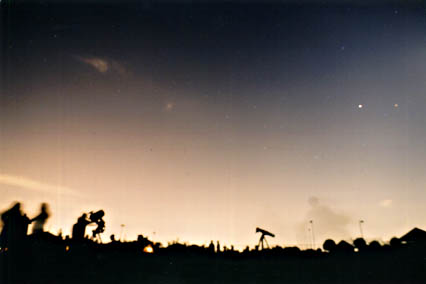
We will be meeting at Harmony park for the viewing of mars and other sites. Come on by bring your scope, binoculars, eyes and a lawnchair. General public is invited and its free. Meet at Harmony park at sunset. Dress for a warm night. I will be bringing water in a cooler for people sharing scopes. Of course we all know mars will be bloser then it has been for the next few hundred years. So lets all make for a good showing.
orbit:
227,940,000 km (1.52 AU) from Sun
diameter: 6,794 km
mass: 6.4219e23 kg
Take a look at mars.

In the year 2003, Mars will come as close to Earth as it didn't come in millennia, not to speak of lifetimes. Mars opposition will occur on August 28, 2003, less than two days befor the planet passes its perihelion on August 30. The closest approach of the two planets will already occur one day earlier, on August 27; distance will be as close as 55.758 million km (more acurately, 55,758,006 km or 34,646,418 miles). At this distance, it will appear larger than at any historic time to now: 25.11 arc seconds in diameter.
This is the closest approach since a time of 59,619 years, when in 57617 B.C., the planet came still a very little bit closer, 55.718 million km, and exhibited an apparent diameter of 25.13 seconds of arc. The next enclounter closer than the current 2003 one will occur on August 28, 2287, when Mars will be observable at an apparent diameter of 25.14".
At such a close distance, the planet will brighten up to visual magnitude -2.9, and appear under an apparent diameter of 25.11 arc seconds; it will outshine Jupiter notably (would even if that planet were in favorable opposition), and only be second to planet Venus.
Mars (Greek: Ares) is the god of War. The planet probably got this name due to its red color; Mars is sometimes referred to as the Red Planet. (An interesting side note: the Roman god Mars was a god of agriculture before becoming associated with the Greek Ares; those in favor of colonizing and terraforming Mars may prefer this symbolism.) The name of the month March derives from Mars.
Though Mars is much smaller than Earth, its surface area is about the same as the land surface area of Earth.
Except for Earth, Mars has the most highly varied and interesting terrain of any of the terrestrial planets, some of it quite spectacular:
- Olympus Mons: the largest mountain in the Solar System rising 24 km (78,000 ft.) above the surrounding plain. Its base is more than 500 km in diameter and is rimmed by a cliff 6 km (20,000 ft) high (right).
- Tharsis: a huge bulge on the Martian surface that is about 4000 km across and 10 km high.
- Valles Marineris: a system of canyons 4000 km long and from 2 to 7 km deep (top of page);
- Hellas Planitia: an impact crater in the southern hemisphere over 6 km deep and 2000 km in diameter.
Much of the Martian surface is very old and cratered, but there are also much younger rift valleys, ridges, hills and plains
