On orthography and pronunciation of a contact language:
the case of HKU
linguistics majors learning Mauritian Creole
2. Sound system of Mauritian Creole
3. Decoding pronunciation from orthography
4. Mispronunciation and causes
5. Conclusion �V objective, limitation and further research
2. Sound system of Mauritian Creole
|
The purpose of this chapter is to present the sound system of Mauritian Creole in a more linguistic fashion, as Frew��s book (our Mauritian Creole textbook in the field trip preparatory class) does not provide a clear one. The pronunciation guide in the book (pp 9-10) is unsystematic, denoting sounds by crossing English and French spellings in an inconsistent way. This is comprehensible since probably the intended readers of his book are laymen rather than people who know linguistics. There is a need, I believe, of a linguistic description of the sound system of Mauritian Creole for linguistics students. To offer a deeper understanding of how phonemes in Mauritian Creole are like, some notes of the differences between the sound system of Mauritian Creole and those of English and French will follow. |
2.1 Vowels and consonants in Mauritian Creole
|
To present the charts of vowels and consonants of Mauritian
Creole, I will base my work on Baker (1972: 40-44) with modifications
justified later. Unlike Baker��s work, I will compile the charts of vowels and
consonants in a more modern style, that of IPA for showing phoneme inventory
of a language. A number of uncertainties about particular phonemes will be
noted below, and hopefully some answers can be found out in the |
2.1.1 Vowels in
Mauritian Creole
|
Here is the articulatory-auditory vowel diagram of Mauritian Creole. There are 5 oral vowels, and 3 nasal vowels. |
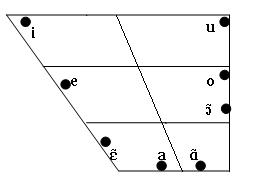
Figure 1 Articulatory-auditory vowel diagram of Mauritian Creole
|
For the nasal vowel /ɛ̃/, it is /æ̃/ in Baker (1972: 40) and /ẽ/ in Pudaruth (1972: 20), but Carpooran��s (2005) dictionary uses /ɛ̃/, which is also the symbol of the original French nasal vowel in IPA (1999). For the reason of authority, I have chosen /ɛ̃/ instead of those from older works. |
2.1.2 Consonants in
Mauritian Creole
|
Here is the table showing the consonant inventory of Mauritian Creole. There are 18 consonants. |
Table 1 Consonant table of Mauritian Creole
|
|
Bilabial |
Labio-dental |
Dental |
Alveolar |
Palatal |
Velar |
Uvular |
|
Plosive |
p b |
|
t d |
|
|
k g |
|
|
Fricative |
|
f v |
s z |
|
|
|
ʁ |
|
Nasal |
m |
|
n |
|
ɲ |
ŋ |
|
|
Lateral |
|
|
|
l |
|
|
|
|
Approximant |
w |
|
|
|
j |
|
|
|
The phonetic symbol of the palatal nasal /ɲ/, which is used by Carpooran (2005)
and I have selected, is problematic. This consonant symbol denotes a
consonant with no oral release, but the symbols used in older works (Baker,
1972: 43; Pudaruth, 1972: 45) are /j̃/
or /ỹ/ which imply oral
quality (since /j/ and /y/ themselves are oral sounds and
the tilde ˜ above only
indicates nasalization). The case can be either that the palatal nasal has
undergone a change (with orality being gradually lost) or that there is
imprecise use of phonetic symbols in the works mentioned. Since these authors
have not provided explanation, the answer should be sought in my trip to I have also chosen /ʁ/ to mean the sound represented by ��r�� in orthography �V instead of /r/ from other works. Since in the present-day standard of IPA (1999), /r/ denotes an alveolar trill which is not the ��r�� in Mauritian Creole. Choosing /ʁ/ is to avoid confusion and indicate its nature (a velar fricative). |
2.2 Sound system of Mauritian Creole compared to those
in English and French
|
Here are some points to note concerning the differences between the sound system of Mauritian Creole and those in English and French: 1) Loss of rounded front vowels In Mauritian Creole, all front vowels are unrounded but back vowels are rounded; the same case applies to English. In French, however, front vowels exist in unrounded-rounded pairs but back vowels are rounded. 2) Loss of distinction of mid-low and mid-high vowels Mid-low and mid-high vowels contrast with each other in French (/e/ vs /ɛ/; /o/ vs /ɔ/), but such distinction is neutralized in Mauritian Creole. The resultant vowels tend to be the mid-high versions (i.e. /e/ and /o/). 3) Use of nasal vowels Mauritian Creole has retained the use of nasal vowels as in its lexifier language French. In both languages, nasal vowels and their non-nasal (i.e. oral) counterparts are phonemes, a change of which triggers a change in meaning. On the contrary, nasal vowels exist only as allophones in English �V phonetically they do exist, but not phonemically. Vowels, say /ɪ/ in /sɪn/ (��sin��), are nasalized in reality to anticipate the following nasal. Nasal vowels in Mauritian Creoles (and in French) require English speakers to make an effort in colouring a vowel with nasality quality in contrast to a vowel without such quality. 4) The glottal fricative /h/ As in French but unlike English, Mauritian Creole does not have /h/ in its consonant inventory. 5) Loss of certain more ��marked�� consonants from French in Mauritian
Creole /ʃ/ and /ʒ/ in French are reduced respectively to /s/ and /z/ in Mauritian Creole. As a result of the loss of rounded vowels, the French rounded approximant /ɥ/ (the reduced version of the French rounded front vowel /y/) is also lost. |
2. Sound system of Mauritian Creole
3. Decoding pronunciation from orthography
4. Mispronunciation and causes
5. Conclusion �V objective, limitation and further research