This theatrical Australian hard rock band was
formed in November 1973 by Malcolm Young (b. 6 January 1953, Glasgow,
Scotland; rhythm
guitar) after the demise of his previous outfit, the Velvet Underground
(no
relation to the US group). Young, whose elder brother George had
already achieved
stardom in Australia as a member of the Easybeats, also enlisted his
younger
brother, Angus Young (b. 31 March 1955, Glasgow, Scotland; guitar).
Their
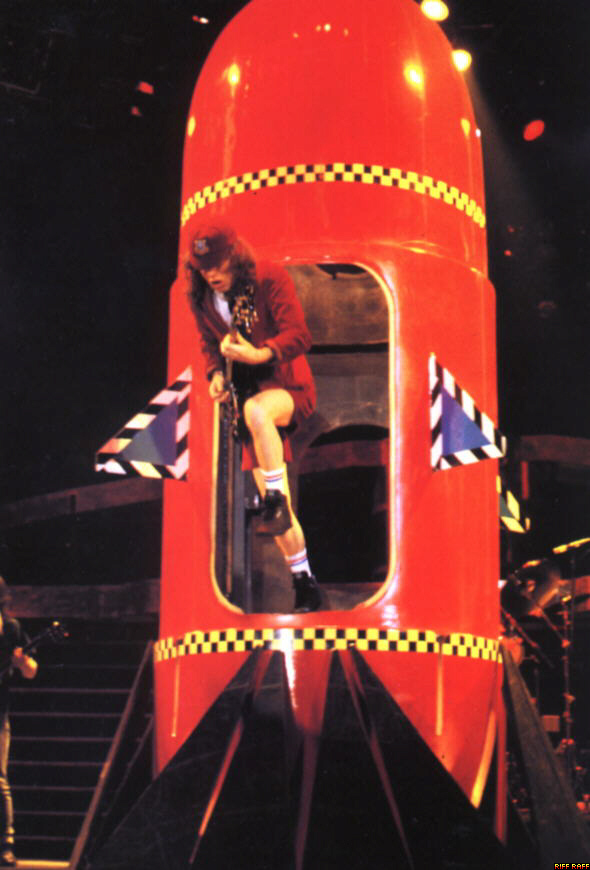
sister later suggested that Angus wear his school uniform on stage, a
gimmick
that rapidly became their trademark. The two brothers made their debut
appearance
in a bar in Sydney on 31 December 1973, along with Dave Evans (vocals),
Larry
Van Kriedt (bass) and Colin Burgess (drums). In late 1974, the Young
brothers
and Evans moved to Melbourne. Another immigrant from the UK, Bon Scott
(b.
Ronald Belford Scott, 9 July 1946, Forfar, Scotland, d. 19 February
1980,
London, England; vocals), graduated from being the band's chauffeur to
becoming
their vocalist when Dave Evans refused to go on stage one night. (Evans
went
on to form Rabbit, releasing two albums for CBS Records in Australia,
before
joining Hot Cockerel in 1984 and releasing David Evans And Thunder Down
Under
in 1986.) Scott had previously recorded with two Australian outfits,
pop
group the Valentines (1966-68) and rockers Fraternity (1970-74).
Indeed,
after he emigrated from Scotland in 1951, he had also spent five
consecutive
years as drum champion (under-17 section) with the Perth Pipe Band.
After
such a wholesome start, a prison conviction for assault and battery
indicated
a more volatile side to his nature, and resulted in him being refused
admission
to the army. In 1965, he joined the Spectors, before the aforementioned
periods
with the Valentines and Fraternity.
|
|
|
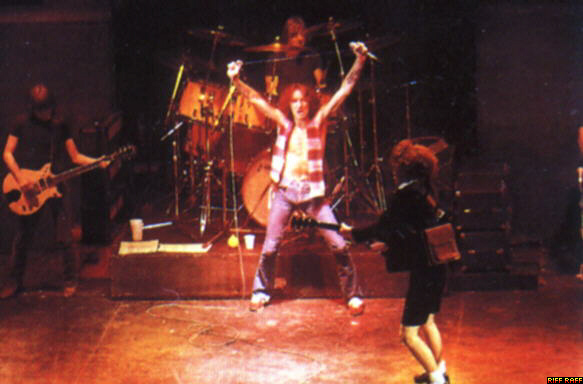
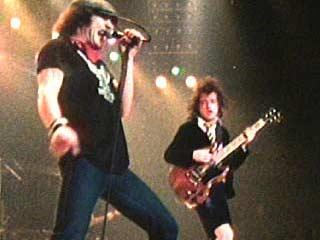
The AC/DC line-up that welcomed Scott had
already recorded a solitary single, "Can I Sit Next To You Girl", but
it was his voice
that graced their first two albums, High Voltage and T.N.T.. The latter
album
also introduced two new members, Mark Evans (b. 2 March 1956,
Melbourne, Australia;
bass) and Phil Rudd (b. Phillip Hugh Norman Witschke, 19 May 1954,
Melbourne,
Australia; drums). Both sets were produced by George Young and his
writing
partner, another former Easybeat, Harry Vanda. Neither set was issued
outside
Australia, though Atlantic Records in Britain did offer a selection of
material
from both records under the title High Voltage in 1976. These albums
established
AC/DC as a major draw in their native territory, and brought them to
the
attention of Atlantic, who promptly relocated the band to London in
January
1976. However, Evans was replaced by Cliff Williams (b. 14 December
1949,
Romford, Essex, England; ex-Home) in June 1977 after the former tired
of
touring. He went on to Finch/Contraband, then a variety of bands
including
Swanee, Heaven, Best and Party Boys.
|
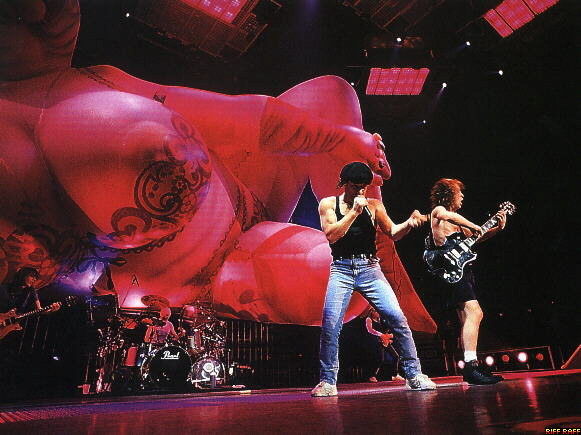
Once AC/DC began to tour outside Australia, the
band quickly amassed a cult following, as much for the unashamed
gimmickry of its
live show as for its furious, frequently risqué brand of hard
rock.
Let There Be Rock broke them as a chart act in the UK, with its
contents including
the perennial crowd-pleaser, "Whole Lotta Rosie'. The live If You Want
Blood
You've Got It consolidated their position, but 1979"s Highway To Hell
established
them as international stars. This, the band's first album with producer
Mutt
Lange, also proved to be their last with Bon Scott. On 19 February
1980,
after a night of heavy drinking, he was left unconscious in a friend's
car,
and was later found to be dead, having choked on his own vomit. The
coroner
recorded a verdict of death by misadventure.
|
|
|
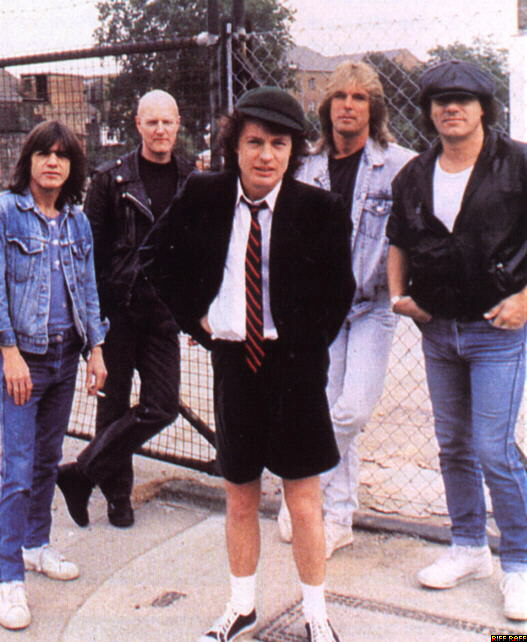
Scott's death threatened the band's future, but
his replacement, former Geordie lead singer Brian Johnson (b. 5 October
1947, Dunston, England), proved more than equal to the task. His first
album with the band, Back In Black, reached number 1 in the UK and
Australia, number 4 in the USA, and spawned the UK number 15 single
"Rock 'n' Roll Ain't Noise Pollution". The album was certified as
having sold 12 million copies in the USA by March 1996. In 1981, For
Those About To Rock (We Salute You) topped the American charts for
three weeks, the band headlined at the Donington Festival
and also achieved two Top 20 UK singles ("Let's Get It Up" and "For
Those
About To Rock (We Salute You)"). After Flick Of The Switch in 1983,
drummer
Phil Rudd left the band to become a helicopter pilot in New Zealand,
and
was replaced by Simon Wright (b. 19 June 1963; ex-A II Z and Tytan) -
who
in turn departed to join Dio in 1989. His replacement was Chris Slade
(b.
30 October 1946; ex-Manfred Mann's Earth Band).
|
In keeping with their superstar status, AC/DC
maintained an increasingly relaxed schedule through the 80s, touring to
support each carefully spaced album release. Two UK Top 20 singles,
"Who Made Who" (1986) and "Heatseeker" (1988), confirmed their enduring
popularity. There were further
"casualties", however. When Malcolm Young was unfit to tour in 1988 his
cousin,
Stevie Young (ex-Starfighters), temporarily deputized. Paul Greg also
stepped
in for Cliff Williams on the US leg of their 1991 tour. A year earlier,
The
Razors Edge had been one of the more successful albums of their later
career,
producing a Top 20 UK hit, "Thunderstruck" and reaching number 2 on the
album
chart in America. In 1992, they issued a live album, while the
attendant
single, "Highway To Hell", made the UK Top 20. With Brian Johnson long
having
buried the ghost of Bon Scott, the band showed no signs of varying its
winning
musical formula, and in 1994 were buoyed by the return of Rudd to the
line-up.
The following year's Ballbreaker marked a powerful return after a
lengthy
break from recording. The ensuing Bonfire box set, meanwhile, served as
a
fitting memorial to Bon Scott. The band greeted the new millennium in
typical
style with the "business as usual" recording, Stiff Upper Lip. They
were
deservedly inducted into the Rock And Roll Hall Of Fame in March 2003.
|
|