Responses to Assisted Suicide
Hippocrates and the Origins of Medical Ethics

Hippocrates, a Greek scientist, is widely known as the father of modern medicine. Hippocrates established a school of medicine in Greece and the founding of the study of medicine. In modern times, doctors take the Hippocratic Oath before entering into the practice. The Hippocratic Oath is the foundation of medical ethics. By taking this oath, physicians swear to adhere to two primary duties: to prolong life and to relieve suffering. Although both duties are honorable, at times they seem to contrdict each other, specifically in the case of a terminally ill patient. Many physicians, such as Dr. Kevorkian, believe that is s a right for a patient to choose and immediate and basically painless death. Other doctors however, view physician-assisted suicide to be a violation of the Hippocratic Oath as it does not prolong life.
Catholic Moral Response to Assisted Suicide
The Catechism of the Catholic Church on Euthanasia
2277: Whatever its motives and means, direct euthanasia consists in putting an end to the lives of handicapped, sick, or dying persons.
It is morally unacceptable.
Thus an act or omission which, of itself
or by intention, causes death in order to
eliminate suffering constitutes a murder
gravely contrary to the dignity of the human
person and to the respect due to the living God,
his Creator. The error of judgment into which
one can fall in good faith does not change the
nature of this murderous act, which must
always be forbidden and excluded.
2279: Even if death is thought imminent,
the ordinary care owed to a sick person cannot
be legitimately interrupted. The use of painkillers
to alleviate the sufferings of the dying, even at
the risk of shortening their days, can be morally
in conformity with human dignity if death is not
willed as either an end or a means, but only
foreseen and tolerated as inevitable. Pallative
care is a special form of disinterested charity.
As such it should be encouraged.
The Catechism of the Catholic Church on Suicide
2280: Everyone is responsible for his life before
God who has given it to him. It is God who remains
the sovereign Master of life. We are obliged to accept
life gratefully and preserve it for his honor and the
salvation of our souls. We are stewards, not owners,
of the life God has entrusted to us. It is not ours to dispose of.
2281: Suicide contradicts the natural inclination of
the human being to preserve and perpetuate his life.
It is gravely contrary to the just love of self.
It likewise offends love of neighbor because it unjustly
breaks the ties of solidarity with family, nation, and
other human societies to which we continue to have obligations.
Suicide is contrary to love for the living God.
Other Views on Assisted Suicide and Euthanasia
Legal Views
Currently in the United States, there is a right known as the "right to die," which refers to a patient's right to refuse unwanted medical treatment or to have ongoing care ended even though the patient will die if treatment stops.1 This right to die has been recognized in many U.S. courts under a variety of situations, including terminally ill or not terminally ill, mentally competent or mentally incompetent, and in the hospital or in the home.2 However, very few courts have decided definitively whether the right to die extends to cases of physician-assisted suicide, such as the procedures performed by Dr. Kevorkian.3
Suicide is not a crime in any state.4
Although only Oregon has recognized the legality of physician-assisted suicide, current right to die law emphasizes a patient's right of self-determination in receiving or ending treatment from their physicians.5 While patients do have a right to self-determination in medical matters, the state has a duty to protect both "the value of an individual's life and the value of life to society as a whole."6
Citations
1.�Physician-Assisted Suicide and the Right to Die with Assistance.� Harvard Law Review, Vol. 105, No. 8. (June , 1992), pp. 2021.
Taken From: http:// links.jstor.org/ sici? sici= 0017811X%28199206%29105%3A8%3C2021%3APSATRT%3E2.0.CO
2.�Physician-Assisted Suicide and the Right to Die with Assistance.� Harvard Law Review, Vol. 105, No. 8. (June , 1992), pp. 2022.
Taken From: http:// links.jstor.org/ sici? sici= 0017811X%28199206%29105%3A8%3C2021%3APSATRT%3E2.0.CO
3.�Physician-Assisted Suicide and the Right to Die with Assistance.� Harvard Law Review, Vol. 105, No. 8. (June , 1992), pp. 2022.
Taken From: http:// links.jstor.org/ sici? sici= 0017811X%28199206%29105%3A8%3C2021%3APSATRT%3E2.0.CO
4.�Physician-Assisted Suicide and the Right to Die with Assistance.� Harvard Law Review, Vol. 105, No. 8. (June , 1992), pp. 2024.
Taken From: http:// links.jstor.org/ sici? sici= 0017811X%28199206%29105%3A8%3C2021%3APSATRT%3E2.0.CO
5.�Physician-Assisted Suicide and the Right to Die with Assistance.� Harvard Law Review, Vol. 105, No. 8. (June , 1992), pp. 2024.
Taken From: http:// links.jstor.org/ sici? sici= 0017811X%28199206%29105%3A8%3C2021%3APSATRT%3E2.0.CO
6.�Physician-Assisted Suicide and the Right to Die with Assistance.� Harvard Law Review, Vol. 105, No. 8. (June , 1992), pp. 2033.
Taken From: http:// links.jstor.org/ sici? sici= 0017811X%28199206%29105%3A8%3C2021%3APSATRT%3E2.0.CO
Views Presented by Dr. Timothy E. Quill
Dr. Timothy E. Quill was a hospice medical director who assisted in the suicide of a leukemia patient. He wrote an article regarding this event which was published in the New England Journal of Medicine in 1991. Dr. Quill is one of many doctors in the world who have admitted to assisting a patient's death. Dr. Quill outlines what he views is the necessary criteria for physician assisted suicide:
1. The patient must, of his own free will and at his own initiative, clearly and repeatedly request to die rather than continue suffering.
2. The patient's judgment must not be distorted.
3. The patient must have a condition that is incurable and associated with severe, unrelenting, intolerable suffering.
4. The physician must ensure that the patient's suffering and the request are not the result of inadequate comfort care.
5. Physician-Assisted suicide whould only be carried out in the context of a meaningful doctor-patient relationship.
6. Consultation with another experienced physician is required.
7. Clear documentation to support each condition above is required.1
If each of these conditions is met, then Dr. Quill would argue that the euthanasia is justified and is by no means immoral. However, as pointed out by M. Scott Peck M.D., there is one consitent error in his argument. Nowhere in his book nor in these seven books does Dr. Quill define his terms, such as what he means by suffering and the degree of this suffering. With this being the case, these seven points lose some of their value, yet still provide a reasonable justification of euthanasia to many people.2
Citations
1. Peck, M. Scott. Denial of the Soul. New York: Harmony Books, 1997. Pg 224.
2. Peck, M. Scott. Denial of the Soul. New York: Harmony Books, 1997. Pg 224.
M. Scott Peck's views on Euthanasia
M. Scott Peck, author of The Road Less Traveled, also wrote The Denial of the Soul, a book dedicated to the complex topic of euthanasia and human mortality. M. Scott Peck, along with many Christians and physicians, believe that there is an important distinction between suicide, in which man has control over life, and a natural death, in which God is the only influence in determining life or death. This belief, although very Christian, provides a strong secular argument as well, since this belief agrees with the conditions of the Hippocratic Oath.1 A doctor's job is to promote life, not end it, and to do so while mainting the patient's dignity.
In response to Dr. Quill's seven conditions of justified euthanasia, M. Scott Peck points out that these points are only one side of the story. If a patient is in the state of considering suicide, they need guidance from a spiritual and psychological source, not just a doctor or two.2 The human person is incredibly complex and multi-faceted, and so a patient requires advice from a variety of sources, not just one. It is M. Scott Peck's belief that with proper guidance from proper sources, a patient contemplating suicide would choose to die a natural death.
M. Scott Peck also cites the principle of double effect3 in determining the moral value in assisted suicide and euthanasia. The principle of double effect has four main parts in deciding the morality of an action:
1. The action must be a good action, or at least indifferent.
2. There must be good intentions for the action.
3. The action cannot be intrinsically evil.
4. The good effects must balance out the evil effects.
Assisted suicide does not comply with these four conditions. Although in most cases of assisted suicied the physician has good intentions (i.e. to end the suffering of the patient), according to M. Scott Peck, it is an evil action, and evil means never justify good ends.
Although he is generally against euthanasia, M. Scott Peck includes an important caveat in his book: there may always be extreme cases requiring exceptions to a general rule.4 In fact, M. Scott Peck himself says, "The fact that I would vote against physician assistance in the suicide of [suffering] patients should not be taken to mean I am against euthanasia under any circumstances whatsoever."5 That is not to say that the issue of euthanasia is completely subjective, but rather that life is extremely complicated. There are no definite answers to any question as difficult to answer as this question of euthanasia, and so in searching for answers to any of life's moral questions, it is important to keep an open mind and know that the answer won't be as clear-cut as we would often like it to be.
Citations
1. Peck, M. Scott. Denial of the Soul. New York: Harmony Books, 1997. Pg 207.
2. Peck, M. Scott. Denial of the Soul. New York: Harmony Books, 1997. Pg 210.
3. Peck, M. Scott. Denial of the Soul. New York: Harmony Books, 1997. Pg 214.
4. Peck, M. Scott. Denial of the Soul. New York: Harmony Books, 1997. Pg 218.
5. Peck, M. Scott. Denial of the Soul. New York: Harmony Books, 1997. Pg 218.
Sources
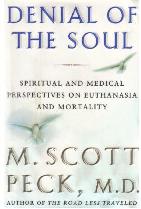
Peck, M. Scott. Denial of the Soul. New York: Harmony Books, 1997. Pages 207-228.
Catechism of the Catholic Church
�Physician-Assisted Suicide and the Right to Die with Assistance.� Harvard Law Review, Vol. 105, No. 8. (June , 1992), pp. 2021-2040.
Taken From: http:// links.jstor.org/ sici? sici= 0017811X%28199206%29105%3A8%3C2021%3APSATRT%3E2.0.CO
Kevorkian Biography
Kevorkian Home Page
Kevorkian's Patients, Trials, and Conviction
The Thanatron
Timeline
Kevorkian's Views