
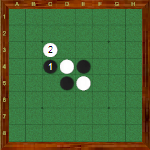
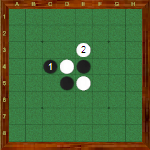
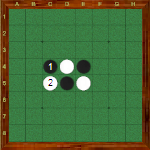
Openings are grouped to three different types - Diagonal, Perpendicular & Parallel. Most players prefer to start with Diagonal or Perpendicular openings. If you are a beginner in reversi (like myself), you can choose to play with these two opening types. As for those who are not beginners, they might choose Parallel opening just to get a feel of it. As stated in Rules section of my website, if you can play small, play grouped and play inside well enough, you could try focusing on any of the opening type, one at a time. Most important is to find an opening that suits you in the best way, meaning that whenever you choose either black or white, you'll see more advantages to yourself rather than to your opponent. Is this too confused for you to understand? Well, below are the 3 basic openings:
|
|
|
|
 |
 |
 |
|
|
|
|
If you're wondering why most players choose diagonal or perpendicular in their openings, well...I think it is because they're used to it & 2nd of all, the chosen opening gives them more advantages & gives their opponent more disadvantages in their game play. Since almost everyone starts with a diagonal or perpendicular opening, you can assume that almost everyone knows how to counter them as well...meaning, if you choose to start with a parallel opening, your opponent might get confuse on how to play & also how to counter it. This doesn't occur everytime though, because you can never assume that your opponent(s) has no previous experience with parallel opening. As for me, I'm used to perpendicular openings at first, but now I don't choose to play any particular ones, in order to minimize my own vulnerabilities in my own game play.
Perpendicular opening gives players more choice to move around, meaning that you can choose this opening as a start & slowly, make small change(s) in your move(s) in order to learn which move(s) gives you more advantage in your game play. Well, that's how I learned using this opening in the first place, until one day, my reversi teacher mentioned about diagonal opening. He told me that I shouldn't restrict myself to only one type of opening, because with this restriction, it is very hard for me to move on to a higher level. I dare not say that I'm an expert, because currently, I'm still considering myself as a learner (beginner) \(^o^)/ in reversi. Diagonal opening gives players less choice of movements in the beginning, but more move(s) to choose during later in the game. Parallel opening, in the other hand, gives you opening disadvantage if you're using white. Knowing which opening to use, is not enough. You must also know which would be your best following openings. I will share with you all the openings, so that you can decide for yourself, which one is the best for you.
Actually, any reversi games consists of either 20-20-20 or 15-30-15. What is the meaning of these numbers?? These numbers represents the sections of a reversi game: Opening-Midgame-Endgame. Above each pictures, I'll include the name of each openings & below each pictures, I'll include the opening type of that opening. I hope I didn't bored you so much...hehe, here are all the openings:-
|
|
|
|
|
|
|
|
|
|
|
|
|
|
|
|
|
|
|
|
|
|
|
|
|
|
|
|
|
|
|
|
|
|
|
|
|
|
|
|
|
|
|
|
|
|
|
|
|
|
|
|
|
|
|
|
|
|
|
|
Hmm...after I looked at this page again, I realized that all these openings are too crammed together in one page, so I decided to split it up into 5 pages, 15 openings per page...so that it will look better & the pages will load faster. The links to other openings can be found here:-