

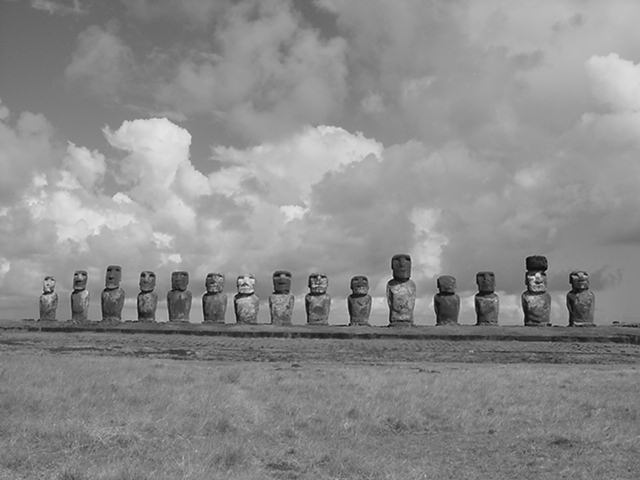

Between 1000 and 1500 AD these statues were carved by a workforce entirely made up of the short-eared tribe and erected as representations of the ancestors of the powerful long-eared clans. They average 4 meters in height and almost 14 tons in weight. Placed on top of stone altars (ahus) along the coast to face and protect the interior of the island, they were worshipped as protective funerary monuments.
The moai are round-bellied, failing at any attempt to conceal their love handles with the palms of their hands. The way they were transported from the quarry down to the coast remains a mystery. The Rapa Nui didn�t have knowledge of the wheel and the volcanic stone that the moai are made of is so brittle that the theory about them being transported on top of wooden rolls seems unrealistic. The statues would have been eroded by the time they arrived to the sea. We�re definitely in favor of the teleportation theory; as always, it must have been the aliens. For a much better explanation, check out the archaeological studies by PBS's Science Unit.
In line with the alien theory, we made a pilgrimage to �the navel of the world�, a perfectly round stone with magnetic powers which is said to emit positive and healing energies. Guillaume tried it on his pancreas and sinuses. We'll get back to you on that one.
Although such esoteric practices remain, ancient and mystic religions have given way to Christianity. Small catholic shrines are now located next to the ahus, featuring local materials, such as lava and bones; both the Christian and the ancestors� cult iconographies are combined in a peculiar baroque style. In 150 years the inhabitants have become fervent Catholics. Surrounded by Virgens de la Merced and San Pedros, we felt very strongly that the Muslim, Hindu, Buddhist and Anglo-Saxon cultures were behind us and that we were now back to the latin world. Our return home was imminent.
Despite being so far away, there were telltale signs that we were approaching familiar waters. When our guest house owner, Do�a Teresa picked us up at the airport her peering eyes wanted to know more when she half-jokingly said: "Oh, I thought that you were a couple when you phoned, so I made up a room with a double bed...(?)" Her mother, Do�a Maria stuffed the money in her bra and asked too many questions. We realized that from now on it would be hard to keep our lives private. Because of the island's tiny community, Teresa and Maria recommended that we do a guided island tour with Uncle Patricio and why not rent a car from their cousin? Very easy, no paperwork. Besides, the island is so small that there is no law about having car insurance. Apparently the risk is up to you: "Tranquilo - no problema."
Easter Island is the remotest inhabited spot on Earth, that is to say 4.100 km from Tahiti and 3.700 from the Chilean coast. We understood that pizza is not always available, especially if the boat that delivers flour hasn�t arrived, nor is ice-cream, delivered twice weekly by plane. This place now ranks as second on the list of the most fascinating regions of the world we have visited on our trip, following immediately after Cambodia.
photos from
Easter Island


