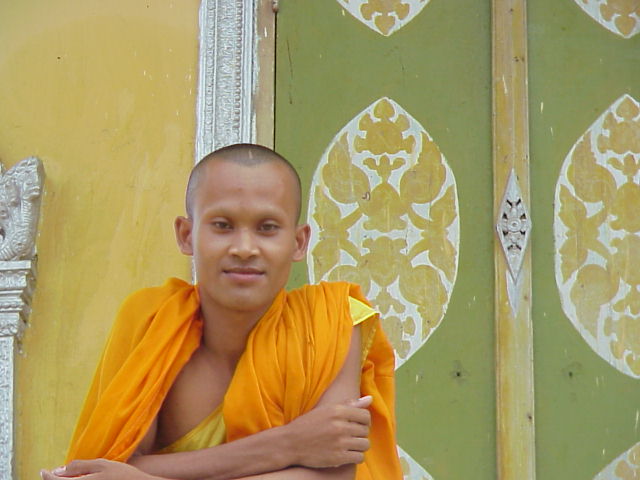
The selection of the 'best pictures' from each country is getting more relative as we move along. What makes a good photo? Jonas likes to capture movement, street life, and kids. Guillaume is obsessed with detail, colors and shrines. The selection process is quite subjective and sitting down to look at the photos we took in Cambodia, we just couldn't agree or arrive at a mutual final selection. Cambodia was the strongest emotional experience on our travels so far. Although we shared many emotions, it became a very personal journey. These are the reasons why we opted to present our favorite pictures separately this time. They might not be the best ones, but they represent our experiences and special moments.
One of the first impressions upon arrival was the extreme physical beauty of the Khmer people. It was in stark contrast to the somewhat two-dimensional features of the Vietnamese on the other side of the border. We realized we didn't know that much about this culture. In our history classes back in the 70's and 80's, the greatness of Cambodia's past had been obscured by its more recent situation. We were surprised to find a strong Indian influence as we reencountered the familiar gods Ganesh, Vishnu, and Hanuman, as well as lingam representations in temples, interior decoration and garden sculptures.
Around the 12th century Cambodia was a great Southeast Asian empire. One million people lived in Angkor Thom, then the largest city of the world. To maintain and attend to the Buddhist temple Ta Prohm close to the capital, almost 80.000 workers were required, including 615 apsara dancers. In contrast to these numbers, today you find a Cambodia where 1 person out of 250 is an amputee thanks to landmines placed all over the country during its thirty years of civil war. Infant mortality is the highest in Southeast Asia.
We only stayed for a week, moving from Phnom Penh, the capital, to Siem Reap, gateway to the famous Angkor temples. In this short time we went through deep joy and profound despair, swinging from one emotion to the other and not always able to separate the two.
Cambodia is one of the poorest countries in Asia. We made it a ritual to bring any leftovers from our meals out on to the streets and share with the countless starving people in Phnom Penh. At the Russian market, we bought apples for a couple of kids. After a few moments, they came back with a dozen friends, all calling out "pomme, pomme, pomme" (apple in French tourist vocabulary). We then ran into a group of amputees also begging for food. There was a short moment of embarrassment when Guillaume tried to figure out how to hand an apple to someone who doesn't have arms. The armless man burst into giggles while his friends helped him grab the fruit. That moment became representative of the Khmer attitude toward life. In the midst of despair we found lots of humor and ringing laughter.
There is however something much darker lurking underneath their generosity of spirit. We tried to understand this duality, but found it hard to match their physical beauty and smoothness, sensitivity and huge smiles with that of a people capable of violence, destruction and absolute madness. Apocalypse Now, the movie based on Joseph Conrad's book Heart of Darkness, well illustrates the spell Cambodia can cast on the human mind. |