Sad to say, the suffering of the Cambodian people is not over. We met several people from our generation who were orphaned in the war; they are still mourning their parents and siblings. The country is also under economic abuse; both from its own corrupt politicians and foreign investors. Angkor Wat and the other temples in Siem Reap are the jewels of the kingdom, but concession to the temples was granted to Apsara, a Korean company that charges admission ranging from 20 to 60 US$ per visitor. Investors from Malaysia and Singapore are expanding their five-star hotels in the area to accommodate the rising numbers of wealthy tourists. Unnecessary to say, very little money stays in the Cambodian economy. As a result of the concession, the temples are surrounded by beautiful parks and accessed by the best roads in the country. But just around the corner, out of sight from the transfer buses, the locals still step on landmines and loose their limbs. Cambodia depends mainly on foreign financial aid, which is paid in US dollars. The dollar has become the country's new money. Trying to pay for anything in riel, the official national currency is a joke. Shop keepers stared perplexed at the national bank notes and answered: "Oh, not possible. We haven't received the exchange rate to the dollar yet."
And, worst of all, Cambodia is a country where some ex-pats proudly describe, in loud voices and in detail, their sexual adventures with pre-pubescent girls.
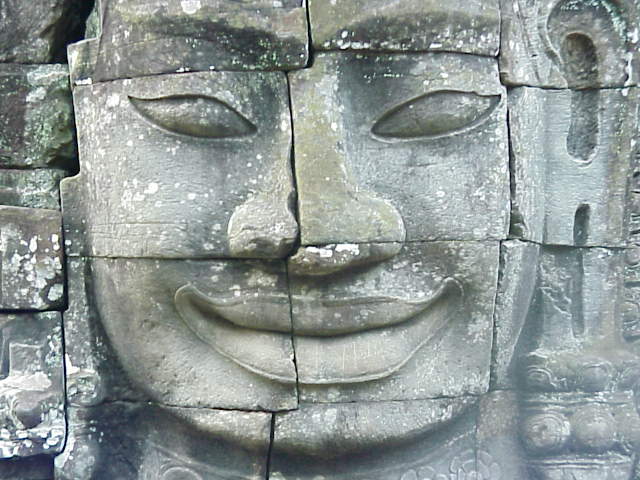
We're writing this in December, one month after having left the country for Thailand. The peaceful images of Buddha have followed us all throughout Southeast Asia, but his presence was particularly strong in Cambodia. We got the feeling of being in a lawless society, protected by a divine and obscure force. Buddha's calm smile floated above an often-confusing world and looking at that smile now, we remember some of the more uplifting moments. Of course there was our three day intensive exploration of the temples in Angkor and the exceptional beauty of Khmer sculpture as featured in the National Museum in Phnom Penh. There was the spontaneous English lesson in Siem Reap. There was our guide at the Tool Seng Museum, who managed to smile and communicate human warmth although she has worked, for twelve years, in the very building where her entire family was tortured and killed by the Khmer Rouge. There was our thirty year-old motorbike driver in Phnom Penh, himself an orphan, who talked at joy about his wife and children over an Angkor beer at sunset. There was the image of arriving in the capital on the last day of the annual Water Festival, held to celebrate the end of the monsoon. Thousands of people from the countryside had gathered in the city to support their favorite rowing team on the Tonle Sap River.
Life goes on. |