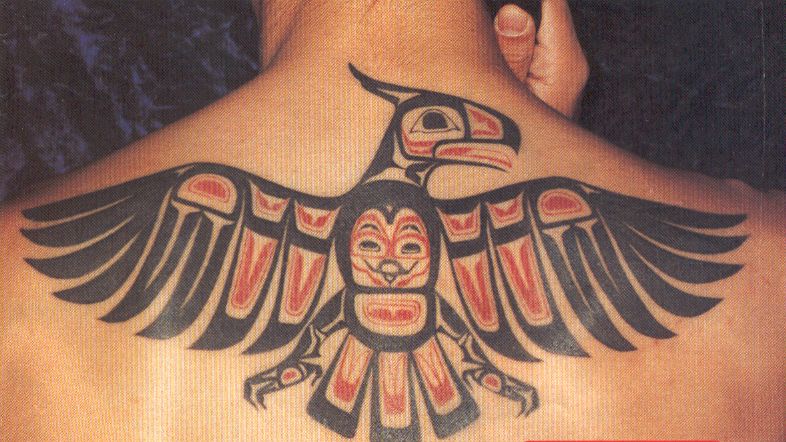
TRIBAL Along with "traditional", one of the most confusing tattoo
terms around. Most indigenous people have their own tattoo heritage - and if
not, often suitable imagery from their other art mediums are adopted into tattoo
designs, which are representative of their culture. Celtic, Marquesan,
Traditional Japanese, Maori, Haida or Northwest American Indian - all of these
tattoo styles could be considered Tribal. Living in a "Global
Village", we're constantly exposed to different customs and societies - and
we often think nothing of extracting elements from our cultures and adapting
them into our own. This is especially true with tattooing. Human beings are
obsessed with symbolism and iconography, so things are seldom what they seem on
the surface. While a person of Celtic descent probably doesn't mind a
non-European covering their body in the ancient knotwork of their heritage,
perhaps the wearer needs to think about the meaning of the work before making a
lifetime commitment to it. Authentic Celtic knotwork may look like a jumble of
interlacing lines to you, but it often hides sacred inscriptions and imagery
within its web.
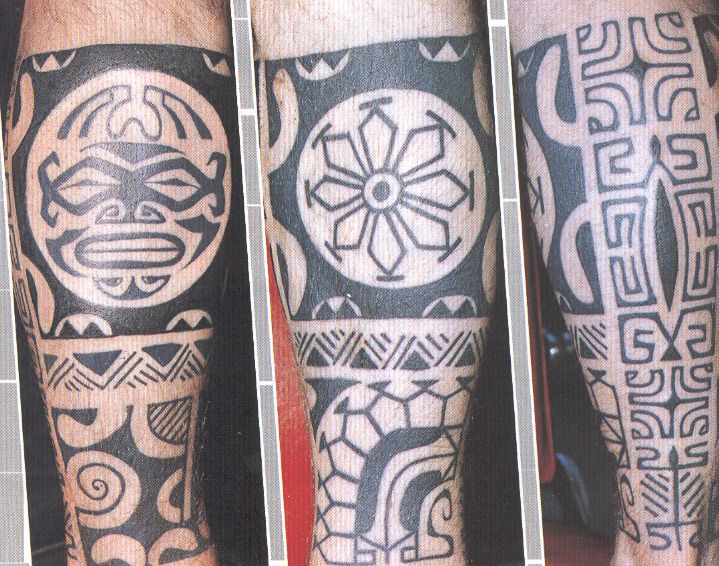
The curvy, abstract, flat black tattoos most commonly
referred to as "Tribal" is more appropriately called
"Neo-Tribal". Combining the aesthetic of various indigenous tattoo
styles with a modern minimalist sensibility, the tattooist creates strikingly
original skin art in which placement and design are interdependent. It's a
Tribal tattooist's attention to creating a tattoo, which compliments and follows
the contours of the body, which gets lost on lesser artists. To have a
successful Neo-Tribal piece, you must go to someone who not only knows how to
tattoo, but who understands how the ink must relate to musculature and bone
structure as well.
FINE
LINE
Work with a lot of detail and thin outlines, delicate and involved. Fineline has
its roots in the jailhouse tattooing, where the artists were limited to one
color, so they flaunted their artistry in the detail of the piece. The subtly of
this work has opened the craft to endless design possibilities, but it's very
important that you go to a reputable and experienced Fineline tattooist.
A tempered hand is important because the skin that's
not tattooed - the "negative space" - is just as important as the skin
that is tattooed (a good rule for any tattoos). An unskilled or overeager
inkslinger might be tempted to cram too much information into a tattoo, which
could make it hard to see the design. The tattoo is overworked because the
tattooist didn't even know when to stop. Even if it looks great for the moment,
an extremely detailed Fineline piece could turn into mush a few years down the
line. The best Fineline tattooist uses detailing sparingly, with an eye towards
how it will hold up in the future.
NEW
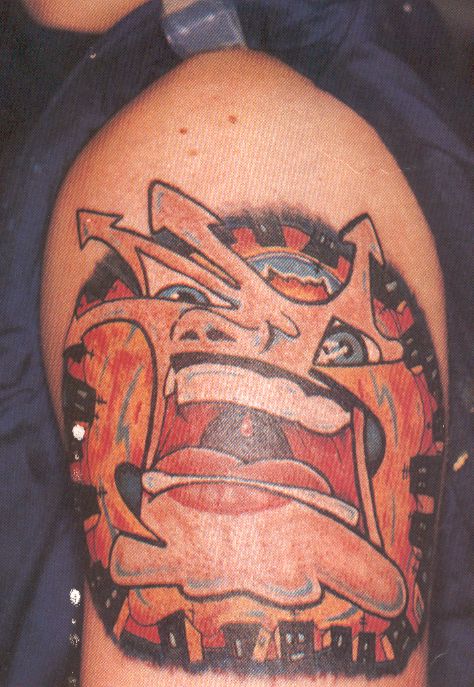
SCHOOL Diversity and inclusion, the two things that some segments of the
tattoo world have been adverse to for many years. That is what "New
School" tattooing is all about. New School, much more than a style, is a
different approach to the essence of tattoo. From techniques and tools, to the
way a tattooist does business - a group of young, innovative artists breathed
new life into the ancient art.
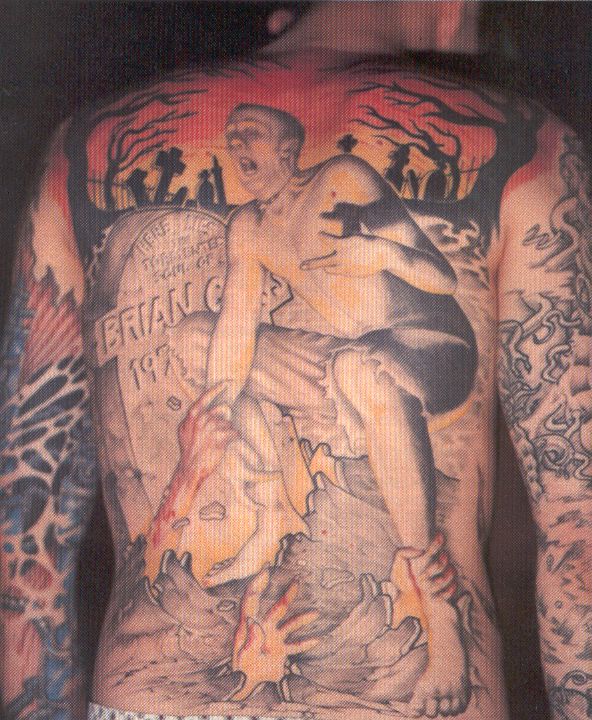
Most of these New Schoolers came from fine arts
backgrounds and brought "fresh eyes" to the craft. Since they were
trained in schools rather than parlors, they had few pre-conceived notions of
what could or couldn't be a tattoo - suddenly anything could be translated into
skin art. New Schoolers pulled the best from other tattoo traditions, coupled it
with pop culture visuals (low brow art, graffiti, underground comics, horror /
fantasy illustrations) and rendered these images in styles that previously been
seen only on paper, canvas and film. Along with the cartoony, color saturated
tattoos generally associated with New School, styles such as neo-traditonal,
Bio-Mechanical, Wild Style and "painterly" tattoos all emanate from
the New School philisophy.
BLACK AND
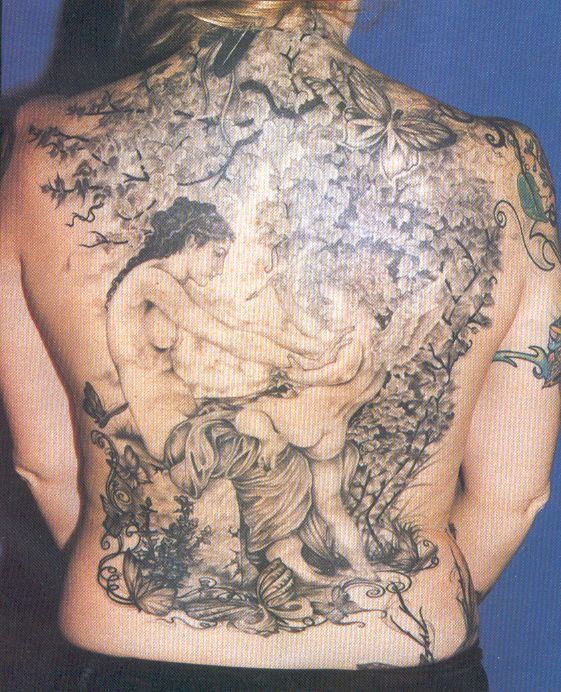
GRAY Tattoos done only in black ink, which, when used for shading or as a
wash, appears gray. Black and Gray is also referred to as "Joint
Style" or "Jailhouse" because the technique originated in
penitentiaries. Incarcerated tattooist would jury-rig home made tattoo machines
powered by any small, available motor. Since colored tattoo inks weren't
available and cigarette ash made an acceptable, easily emulsified pigment, the
tattoos were invariably Black and Gray.
The advancement of this underground technique was
refined in the 70s, turning Joint Style into a mainstay of modern tattooing.
Black and Gray is customary used for portraits or for achieving a very realistic
effect. The artist's concentration is focused on the line and shading of the
piece.