The Middle East Connection


Search My Site:


Tau Gamma Phi Fraternity - Founded October 4, 1968

Tau Gamma Phi
is Triskelion Grand Fraternity, My Fraternity is the Supreme Fraternity

History
Chapters
Seal


Filipino Community in Dubai, U.A.E.


  Traveler's Guide:
Philippines
U. A. E.

Jokes

Quotes
words of wisdom, and inspiration

Funny Thoughts


TXTing
getting the most out of your mobile


Ring Tones


Tattoos
Think before you Ink

Music Guide
music history from the 50s to 90s

 You are Guest No. 
Hit Counter
 Since April 15, 2001

100% Trusted Filipino Owned
Rate Our Site


Send an Internet Greeting Card

Enter Card ID Number to Pickup Your Greeting Card

Hopefully to Win Some More Awards!!!

Remeber the famous comic strip???

Vote for Meeh!!!

Back to My Homepage!!!

HITS4PAY!
Earn extra money for reading Emails


     1980s                                             1990s

BRIT-POP
The 1990s witnessed a further fragmentation of popular music into an ever-increasing confusion of subcategories that defied anyone over 30 to classify them. The decade began with the continuing dominance of anonymous dance music in the singles chart fortified by a new intake of identi-kit "boy bands" and "girl power" pop puppets manufactured and marketed to please the pre-teens. Then as if to challenge this sad state of affairs, a new wave of guitar bands swept in the first from Seattle and then from Britain to signal the return of what the bands and their fans saw as "real Music". The American variety, epitomized by Nirvana, was harder and owed more to punk than pop, while the British contingent led by Suede, Blur and Oasis revived the pop sensibilities of the 1960s and 1970s. Some of the more cynical observers called this return to past values "Retro Rock", but in "cool Britannia", as it was known, it felt more like a renaissance. Brit-Pop is simply a revival of 1960s-stlyed guitar-dominated pop which came to dominate the UK music scene in the 1990s.


GRUNGE
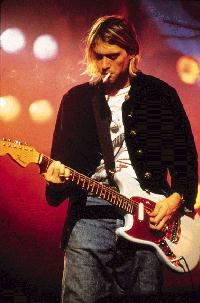
In the bleak, bitter winter of 1991, the smouldering intensity of Nirvana's first global hit lit a fire in the hearts of many who feared that rock music had become a corporate conveyer belt commodity. It was one of those rare songs that stopped you in your tracks and kept you glued to the television or the radio until the last note had faded. What makes it even more poignant is the knowledge that its creator, Kurt Cobain, was to commit suicide only three years later at the height of his fame, aged 27.

Kurt CobainNirvana, were prime purveyors of what became known as Grunge, a thick wedge of sound that married garage rock, hardcore punk and heavy metal. Although, ironically by the time Nirvana broke through, other prime exponents of the Seattle sound, including Mudhoney, Dinosaur Jr., Soundgarden, Sonic Youth, Husker Du, the Meat Puppets and the Pixies, were getting restless to move on before Grunge became a fashion accessory.

However, for the unsuspecting rock fan "Smells Like Teen Spirit" was little short of a revelation. The focus of the track is a mesmerizing mantra-like chorus wedged between a wall of heavily distorted "fuzz" guitars and a spacious bass and drum figure over which Cobain's raw, throaty vocal vainly attempts to express crippling alienation and disillusionment. Unlike conventional rock songs, it doesn't build or ride on a riff, but adopts the scissors-and-paste method of punk visuals with an all out trash  intro, falling back for a vocal verse with subdued backing from bass, drums and spacious flanged guitar.


WORLD FUSION
The most exciting development in pop during the 1990s besides Brit-pop has been the emergence of the dance form "world fusion" - an invigorating and exotic blend of world music (traditional folk music) and rock usually combining ethnic and rock instrumentation to create dance music with cross-cultural appeal. It's a mix of multi ethnic influences, rap and techno nurtured by young, mainly Asian artists in the cultish atmosphere of the British club circuit. 

Bands such as Trans-Global Underground believe that most people are missing out on what world music has to offer and they want to introduce a wider audience to it by feeding them little snatches sweetened by a dance beat.

Musical nomads Loop Guru have the largest library of world music in the west and have been integrating it into their own music for the last ten years. Fun^Da^Mental have been described as the Asian Public Enemy, while TGU tend to mix Afro-Arabic and Asian influences with acid house.

Originally formed by four young Asians, Fun^Da^Mental added West Indian DJ and raga rapper Bad-Sha Lallaman, who raps and toast in Punjabi and English; Indian tabla player, percussionist and co-vocalist Goldfinger Man-Tharoo; turntable techno-wizard DJ Blacka Dee and founder Propa-Gandhi (aka Aki Nawaz). Their intention was, and continues to be, the highlighting of traditional Asian elements incorporated into hardcore rap and raga, whilst promoting the beauty of Islam, Sikhism and Hinduism as well as an anti-west (sic) political oration. To achieve the latter, they utilize excerpts from the speeches of Malcolm X, Nelson Mandela and Mahatma Gandhi among others.

Loop Guru had no political ambitions, however, preferring to weave a soft-focus, trance-including mantra to call the faithful to worship at the temple of the dance. For Jamud and Salman, sampling is not stealing but recycling. Everything they use, they use with respect. While Loop Guru distanced themselves from the dance floor ethos, Trans-Global Underground embraced it enthusiastically, believing that they could put cultural barriers into meltdown through the medium of dance. It was Trans-Global's "Temple Head" single which first brought World Fusion to the attention of the media, and inevitably, the major record companies.

TGU are a loose collective of Arabic and Asian vocalists, keyboard maestros and sample freaks, plus rapper Neil Sparkes throw in for good measure. In performance they sport exotic tribal masks, with the exception of Indian singer and belly dancer Natasha Atlas, and offer an exotic hybrid of dub, house, rap and roots. "Temple Head" peppered Tahitian chants with Burundi drums, while other tracks on their debut album "Dream of 100 Nations" added zenana drones and Indian harmoniums, fermented in an intoxicating cocktail of cross-cultural styles.

Admittedly, this fusion of East and West has its critics - those who would like to see traditional roots music preserved behind glass like a precious cultural icon. But world fusion cannot be fossilized like folk music. It could well be the future of pop for its potential is endless.


About Me   |    Interest   |   Photo Gallery    |   Cool Links   |   Classified Ads   |   Chat    
Forum   |   Links for All   |   Guest Book   |   What's New   |   Disclaimer   |   Site Map

Hosted by www.Geocities.ws

1