Granada and Consul
Body Styles: 4 Door saloon, 5 door estate (station wagon), 2 Door saloon, and 2 door coupe (Granada badge only).
: 1972 to 1977
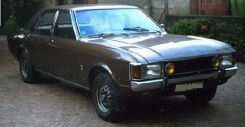
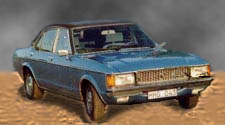
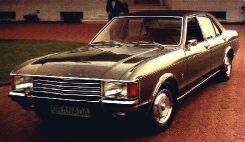
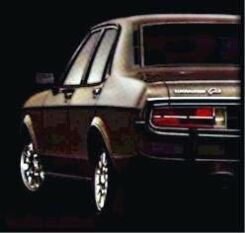
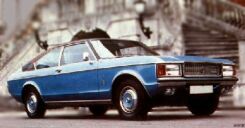
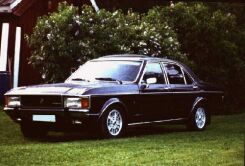
| First introduced in 1972, the Ford Granada, and its lower spec counterpart the Consul represented Fords European flagship models. With a completely new, sleek Americanised body design it replaced Fords very successful Zephyr and Zodiac range of cars . |
|
| Early engines were a carryover from the Zephyr/Zodiac range. However, a new range of engines was soon to be introduced. The 2000cc OHC (Over Head Cam) American based Pinto inline 4 unit, with its increase in power and economy replaced the ageing 2000cc V4 Essex unit. The 2500cc Zephyr/Zodiac was retained, however, a more powerful 3000cc version and C4 automatic Transmission became standard on the top of the range models. | |
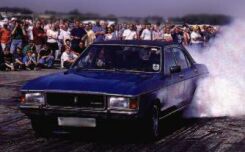
| A 3000cc GT version of the Consul became available with a 4 Speed manual transmission. Police versions of the Consul GT. (favoured because of its lower weight) were purported to be capable of speeds in access of 135mph: although up until recently, Police forces denied the charge that these cars were modified. |
|
|
|
Throughout its life, Ford enjoyed a level of success that many other manufacturers could only dream of. The Consul and Granada range had a model for just about everyone. |
| 1975 saw the Consul badge dropped from the range, leaving only the Granada name. Now with a revised base model, the Granada 'L' was born. Further up the range, the re-badging continued, with the demise of one of Fords oldest badges, the GXL. |
|
|
|
Ghia, was the new badge to adorn the Granada. With Fords take-over of the Turin based design company responsible for many of Europe's most desirable models of the fifties, sixties and seventies Ford joined the ranks of many other European car manufactures to utilised the unique design talents at the Ghia studios. Names including VW's Carmen Ghia, (which was probably one of the companies most recognisable names), and other manufacturers such as Mercedes, BMW, Porsche, Lancia, DeTomasa, Fiat and a whole host of other. |
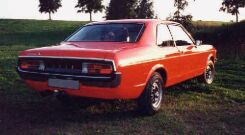
| Ghia first turned there attention to the Granada's interior, with improved fabrics and sound deadening it was recognised as one of the quietest cars of its day. They next turned their attentions to the bodywork, and with it came the birth of the Ghia Coupe. An American styled two door fastback brought the Granada into the realm of the sports Tourer. Aimed directly at a new and growing sector of the market, the young executive. A market that Ford its self was the first to recognize. However, sales of the Ghia Coupe never reached its potential as buyers of all ages flocked to the ever successful Cortina. The model was therefore dropped within two years of its launch. | |
|
|
Other improvement brought by Ghia across the range included revised spring setting for the top end models, a change from the American design C4 transmission to the Lighter European C3 (no relation to the American C3). The addition of alloy wheels and a front anti-role-bar all added to the cars appeal. |
| Outside of Europe various unique models were produced. These included the fearsome Piranha (for the South African market). This high-performance model sported either Fords American base 4200cc straight Six or the superb 5000cc V8 engine found in the Ford Mustang producing over 300bhp. With a performance that could easily match the best of European market such as BMW, Mercedes, Jaguar and Porsche this car was a force to be reckoned with. |
|
| Although few examples have made it over to Europe, however the are rare. Some were imported into the UK through specialist dealers, you wouldn't normal see one of these beasts on your local Ford forecourt. | |
|
|
However, the Piranha did spawn a number of clones, ironically, it wasn't until the 1990's that we would see a rebirth in the V8 interest. Various people carried out conversion on the 3000cc model. This has lead to problems in Identifying original cars as they holds a much higher value than a conversion. Furthermore, the fact that Ford reproduced a number of the components in the 1980's has had a further impacted on identification although careful examination of the vehicle and any document including original import certificates should help. |
|
The Ford Consul and Granada range was one of Europe's first model ranges to offer large car comfort and performance at a price many could afford. An attitude adopted by Ford that would remain with the range throughout its life. After the war Ford built a reputation in Europe for producing cars for all at an affordable price. There Consul's Zephyr's and Zodiac's had long since proven themselves as large affordable, but equally important, desirable and modern cars. Ford played heavily on this when they introduced the MK1 Granada and Consul. Whilst many European manufactures retain dated looks in otherwise good cars, Ford took the bold step and introduced and very new and stylish shape. (Unfortunately, in years to come, this approach would also spell the end for the large rear wheel drive Ford). Coupled with Fords styling houses and marketing techniques, buyers were safe in the knowledge they were joining a family which said, I am successful and forward looking. The appeal of the new shape soon cut deep into the traditional old English markets held by Rover. Not only were they cheaper, but the big Ford were more reliable and 3 litre models were as fast as cars costing twice as much. This lead to a great deal of interest from various Police forces around the UK. The Consul 3000 GT soon became the car of choice. It was fast, could carry several people yet was reliable and cheaper to maintain than many rivals. Coupled with Ford performance development programs with companies such as Cosworth engineering many Police Consul's could easily match the performance from the likes of Jaguar. After the acquisition the Ghia design studio, Ford put them to work in redesigning the MK1. The Consul badge disappeared, as did the range topping GXL to be replaced by the Granada 'L' as the base model and the Ghia for the top end. By this time, the V4 had gone, along with the American C4 automatic. Alloy wheels appeared and with various tweaks to the suspension. 1977 saw the release of the Squarer MK2. It shared its basic shape with the MK4 Cortina, which was, introduced the previous year. Floor, suspension etc. were all carried over from the MK1; however, tightening emission regulations forced Ford to replace the Essex V6 line-up. |
|
 |
 |
 |
 |