
Mt Cook Aorangi
Sea to summit
FOR YEARS I�d been sending Christmas letters to Graham trying to induce him to forsake a few weeks of the Scottish winter climbing season to come out to New Zealand for the Mount Cook sea to summit trip. Then out of the blue an e-mail arrived in April announcing that he had booked his flight for a few days before New Year and was on for it. The flight had not been cheap but then he was travelling to the first country in the world to see the New Year on what most people were dubbing the millennium.
Two days after arriving, a jetlagged and hayfevered Graham was just getting his bearings again as we drove over to the West Coast on a road which would have been a dodgy B-road back in Britain but over here passed muster as a state highway. For someone from England�s green and crowded land, the concept of highways involving one-lane bridges on which the traffic took turns to cross was something of a shock, even more so when we encountered the bridge over the Arahura near Hokitika on which both directions of traffic also share it with the train.
Around midnight we arrived at Fox Glacier and slept in the dubious comforts of our small Suzuki four wheel drive�s front seats, emerging at 8am tired and stiff and aching for a decent cup of coffee.We were fortunate indeed to find ourselves less than a minute�s walk from the best cafe on the Coast, Cafe Neve, which featured Beth Orton music, a kick-back atmosphere, kick-arse coffee, fabulous food, and an accommodating staff.
I had sold our itinerary to a duboius Graham as being a series of ``easy days�� until such time as he was acclimatised to Kiwi hours. This first day was to cover about 10km from the Copland track car park down to the mouth of the Karangarua River to start the sea to summit journey and then back up to the car and back to Fox. �Four hours,� I enthused. �Maybe five. And no packs.�
At the time the Coast was coming to the end of a five-day spell of fine weather, which is about as close as they come to a drought in these damp parts, and we wandered down through riverside paddocks down to a wee bluff, where we came across a wee tributary and convinced ourselves to take our shoes off, wade through, and then continue with dry feet in the bush for a few hundred metres before the cruisy riverside walk would recommence. This was a flashback to my first tramping trip in New Zealand, where we unwordly Australians had made a rod for our backs by strenuously keeping dry feet for as long as possible. Soon after arriving here to live, I realised that a day in the hills almost invariably involved wet feet and you may as well dive straight in at the first crossing.
The untracked Westland bush - and if nobody else has ever done Mount Cook from sea to summit, we could hardly expect a track, could we? - gave us an empathy for how meatballs feel when immersed in spaghetti. It was slow slow progress around the bluff and then even slower when we realised that the braided river flowed along the bank for the next wee while. Over an hour later, we finally realised that the river flowed along the bank all the way to the mouth, plunged into the river and then enjoyed a quadrupling of speed along the boulders of the riverbed. We later tried tbe bank again but came across an unyielding bastion of flax which we had push through before arriving at a couple of fishing huts not far from the beach.
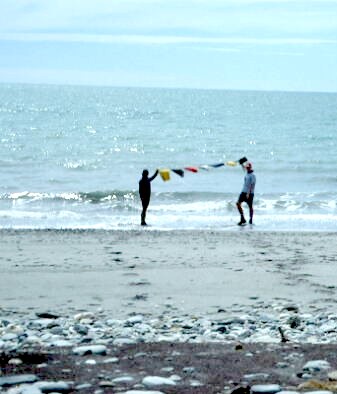
A few minutes walk and we were at the shingled beach, embarrassedly knackered after our ``rest day�� walk. This was not good. It had taken five hours, so we�d have to turn straight around to get back to the road before dark, and our rest day would be a 10-hour epic. Sobered, we took some start-of-trip photos, dispensed with the swim and headed back. Some Kiwi tramping sense finally reinstituted itself here and I suggested we just go up the riverbed since the Karangarua was unseasonally low after its mini drought. We did this and after a few cruisy knee-deep crossings, arrived back at the cars in less than three hours. Better still, our route had involved following the riverbed under the highway bridge so, technically at least, we had not crosssed any roads (nor were we going to, from that point) from sea to summit. This was something of a change from the Aconcagua road bash and obviously augered well.
A short drive later and we were once again enjoying the ambience of Cafe Neve, after which even the wailing of appalling music near our backpackers was unable to prevent me nodding off.
After another session of Neve coffee, food and ambience the next morning, we headed up the Copland Valley, loaded this time with packs comprising 10 days food, climbing gear, and an added burden of good food, wine and whiskey for New Year�s Eve that night. Tortoise mode served us well as we toiled slowly along the track, gradually passing most of the 40-odd people who were heading in for the night, finally arriving at the huge and luxurious (by Kiwi tramping standards) Welcome Flat hut five hours later.
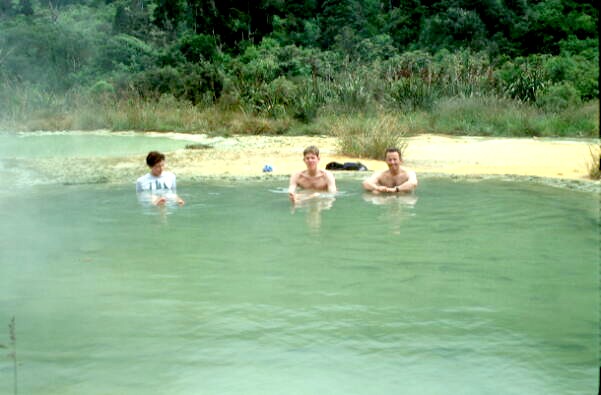
The packs were dumped and we went straight to the sumptuous hot springs less than a minute�s walk away. When we arrived, there was nobody about so, in local style, stripped off completely and dived into the water. Inevitably a few minutes later everyone began to arrive, right down to Sonya and Ilse, a couple of women we�d chatted to on the track in, who sat beside us.
After half an hour or so, a break in the conversation was filled with Sonya�s pronouncement that she thought it was appalling that some people just take off everything and jump into the pools.The cloudy water hid our status on that front but Graham and I faced each other with a ``We could be in here for a while, eh?�� look. Fifteen minutes or so later, the penny dropped for Sonya who announced that although others might think nudity appalling, she personally was totally comfortable with it. No, we didn�t believe her either.
The evening followed in a fantastic environment of about 40 people, all of whom had had the motivation to head into a bush hut and were a great mix of all the demographic factors of gender, nationality and age. I even ran into Matt, a friend from Australia who I hadn�t seen since a cross country skiing trip to Cross Cut Saw 11 years before. Life was pretty sweet.
There was, understandably, a late start the next day. Well, 4pm actually, since we only had to go up to Douglas Rock Hut a couple of hours up the valley. Ilse, who by then had picked up the nickname Madame Lash for reasons which she had best explain to you herself, came along for the walk. The late start did nothing to mitigate the heat and humidity, which was unrelenting, and despite drinking water like fish we were unable to keep up with the sweat being put out.
By the time the hut arrived, our clothes were wringing with sweat and we arrived to find in situ two Australian climbers who were trying to have a go at Mount Sefton. One of them had a dodgy knee and his companion had bravely and selflessly left him alone in the hut on New Years Eve and travelled down to spend it with us carousing at Welcome Flat.
The radio sched�s weather forecast - rain and snow to 1200m by mid-afternoon - made them give up on their plans in favour of heading back over the Copland Pass and back to Mount Cook Village to try something there. They left at a pre-dawn hour, one of them keeping up to his army roots by shaving before he left, with the explanation that one ``must keep up standards in the field��.
We rose at dawn, a rather more sensible hour, then headed off an hour later. Once again the humidity was overpowering and when it started to rain, we didn�t bother putting our rain jackets on because we could not have conceivably become any wetter. I was less than enthused by the prospect of heading over because of the navigational difficulties if there was a white out but Graham was keen, possibly because he still foolishly thought I knew the way from my crossing the pass in the other direction 11 years earlier. It is just possible he gained that impression because I had said pointedly that I knew the way.
It soon transpired that I didn�t remember much of it all, particularly when after a few hours in crawler gear up towards the pass, we emerged to find a 50 metre cliff of tottering choss between us and the Copland Shelter, our intended destination. I knew at least that that was not the pass and so we headed back down, tried another gully to our left and, after some remarkably acrobatic rockclimbing moves in plastic boots and with a climbing pack, found a pass with a mere 25 metre cliff. Back down again and the third gully showed us the correct pass another 20 metres further across. We were in no mood to go back and head up that gully and some more acrobatic moves had us jumping over the bergshrund then following the tracks down to the shelter, which offered accommodation only slightly more luxurious than the Suzuki.
After another early night, we found an overnight blizzard had left snow banked up against the windows, prompting our first rest day during which we each read the book Graham had with him, tried playing checkers (until I gave up in a hissy fit of failure) and finally I even resorted to the only book in the shelter - a Gideon�s bible. After reading the whole of Matthew, I had experienced no revelations (for want of a better term) but had had my quota of smoting, begating and gnashing of teeth. The social event of the evening was the 7pm radio sched and we even looked forward to my home-made dehydrated dinner, which is as good a proof of boredom as there exists.
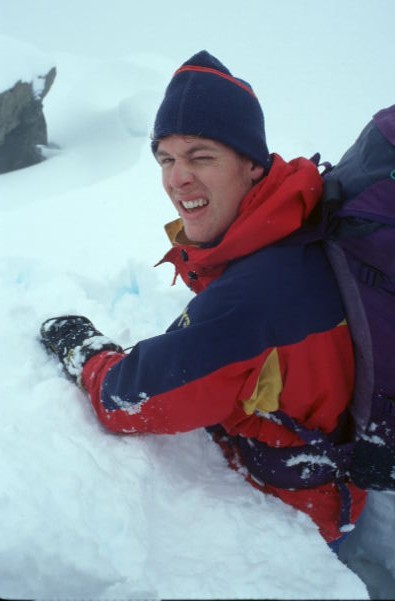
The forecast again was not cheery news but we hoped at least to get across to Ball Shelter the following day. We set off in the cloud the next morning, based on my memory that the route was straightforward (which it had been, on the way up and in perfect weather in 1989!) and after an hour of tricky ground and snowdrifts up to chest deep, we found ourselves bluffed and had to retreat back to the shelter. After a short time there, the weather cleared and we headed out again, this time spotting an alternative route which took us down warily to the moraine of the Hooker Glacier.
Ball Pass was directly across the valley from us but we were concerned about finding our way on the high altitude traverse if the weather closed in again. A direct ascent seemed promising, despite a bit in the middle which we couldn�t quite see but assumed would ``go��. We headed across the moraine and up the other side only to find that it clearly didn�t ``go��(or at least, if it went, I wasn�t going) and so had yet another trudge back over the rocks of the lower Hooker glacier to the moraine wall standing between us and the Hooker Hut.
We had bypassed this hut because a washout a few years before had made access to it rather desperate. Graham spotted what he thought was a likely route up a moraine wall, which to me served only to provide flashbacks of our attempt to climb the chalk cliffs near Dover back in 1995 which ended in a 20 metre lob onto an ice screw (for him) and a fervent belief that the last few seconds of life were about to flash by (for me). He headed up while I bravely hid under a rock at the bottom.
He eventually got to the point, balancing on boulders protruding from the mud, where he could put his hand over the moraine shelf onto the grass above but had no way of completing the move.
At this point the Hand Of God appeared, or so it seemed, although the limb in question actually belonged to someone in the hut just above who was somewhat surprised to see Graham�s hand appear. Graham got to safe ground and they then pointed the way for me to follow a rather easier route around the side.
After a convivial night in the hut, the clouds cleared to provide a view of Mount Cook, the first sight of the objective and one looking straight up the South Face which made it look Pretty Bloody Difficult.
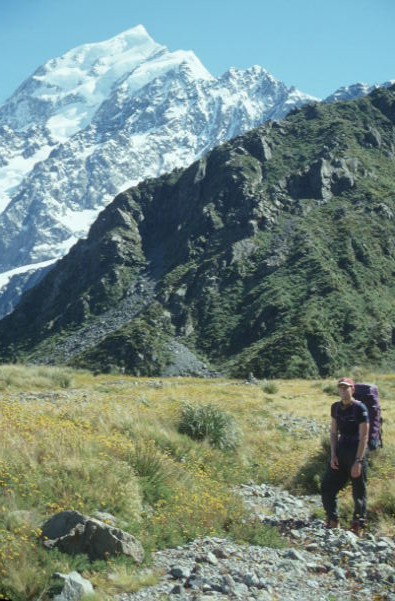
The following morning we headed off again across the glacier, this time following the normal route uneventfully over snowy Ball Pass and down to the Ball Shelter. By this point, we were beginning to get quite fit, our packs were getting smaller and hills were becoming fun. After another convivial night with others in the shelter, we took on the famous grind up the lower Tasman Glacier.
Unlike most things in these mountains, this had improved out of sight in recent years thanks to the decision of the top 18 metres of Mount Cook in 1991 to relocate itself on the glacier. Even nine years later, the millions of tonnes of debris had produced what appeared to be the perfect flat and easily traversed ring road around the outflow of the Hochstetter Icefall to the bottom of the Haast Ridge. We could quite legitimately have stopped our walk here since, after all, this was the summit but some misguided sense of work ethic saw us heading up the endless screes of the lower Haast Ridge, a particularly dodgy transition zone between scree and grass, and finally the vague track heading upwards.
In the old days this was the normal route up Cook before the days of skiplanes and helicopters. They must have been hard buggers because the route was hard work, being alternately loose or airy and occasionally both.
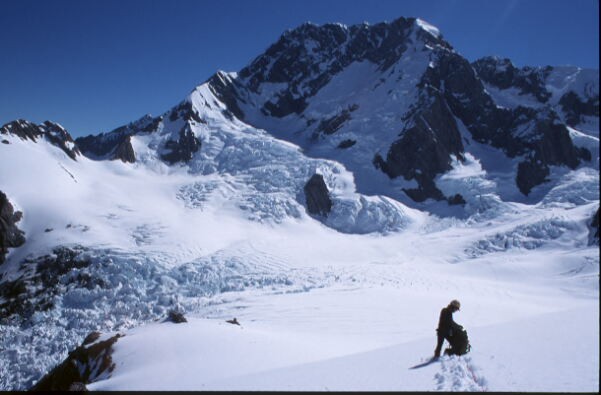
We made our way up to the scenic but musty Haast hut, near the Bivouac site from which the early ascents of Mount Cook were made, then followed a chamois track over Glacier Dome, stopping to pitch one awkward section, and then down to the crowds at Plateau Hut. Amazingly enough, Gavin and Steve arrived around 11pm.
The forecast was good but a quick vote resulted in a rest day being called for the next day, which was spent indolently reading, chatting and explaining to Gavin and Steve how to tie into the rope for glacier travel, which might prove to be quite a useful skill the next day. We even lent them our second rope, a piece of philanthropy which helped distract ourselves from the realisation that we had yet another bland but worthy dehydrated meal while everyone else had flown in and had real food.
For a mountain which is a bit of a tiddler in world terms, summit day on Mount Cook is big - 1600 metres height gain and a lot of horizontal work on the glacier thrown in for good measure. The starting time follows suit, with most people getting up around midnight and then heading off by 1am. It was one of life�s ironies that just as Graham�s body clock had attuned itself to New Zealand time, we were faced with a day when English time would have been a great advantage.
The radio sched had provided a mixed forecast suggesting the weather would be a bit manky by 11am but in one of those unexplained aspects of climbing we both felt the psych was right and prepared to head up that morning. We had originally hoped to do the peak via Zurbriggen�s Ridge, an appropriately aesthetic route heading straight up the mountain and named after the Swiss guide who came out to New Zealand with Fitzgerald, an English Alpine Club member, to make the first ascent of Mount Cook at the end of the 19th Century. After a journey of many months, the pair arrived at the foothills to be told that three Kiwis had climbed beaten them to it by a couple of days. They were, understandably, not that impressed.
Over a century later, we were not that impressed either by Zurbriggen�s Ridge, which in current condition involved going under two icefalls and then through a rockfall zone. We had opted instead for the Linda Glacier, the easiest way up the mountain which was reportedly in very good condition. This proved a good call because by the time we headed out at about 12.50am, there was no moon at all, the cloud was down, ice crystals danced in front of our head torches and visibility on the glacier was next to nil. Fortunately for us, the need for navigation was obviated by a very clear path cut through the Linda�s crevasses by previous climbers but we were left in no doubt that even finding the bottom of Zurbriggen�s Ridge would have been a real drama.
One trouble with leaving at 1am is climbers often head off before the snow has frozen, which makes progress rather slower. So it proved for us and we played that enjoyable game of will-it-hold-my-weight on the snowpack for the next few hours before finally getting above the freezing level.
Throughout the night we had been listening to the sound of distant serac fall, which is something of a regular thing in New Zealand alpinism. Then the tracks headed under an obviously very fresh and very big serac fall, involving television-sized blocks of ice spread a metre deep over a span a couple of hundred metres wide. We silently trudged around the outside of the fall zone then rejoined the path further on and soon came to another serac-fall zone, albeit this one had a huge crevasse at the bottom so that the only method of mitigating risk was to run across and hope nothing came down. As is obvious by the existence of this website, we did and it didn�t but we certainly gained an understanding of why, in the black humour of climbers, this feature of the mountain had been dubbed the ``gunbarrels��.
By the time the sky lightened with dawn, we emerged above the clouds and arrived at the bottom of the summit rocks, the only technical part of the climb. Dawn also brought with it a large black cloud advancing on us from the West Coast which was as threatening as it was unforecast. Once again, the psych still felt right and we continued upwards, hoping to be able to move together to save time but finding instead that the ground was sufficiently difficult to justify pitching it.
Graham, who it should be said is a rather superior climber to me, took on the first pitch up some loose and steep rock as the black cloud slowly arrived, snowed on us then dissipated. I climbed through, made all of 10 metres before coming across a chockstone which I judged too difficult and belayed so Graham could do it. Naturally as soon as I tied off and began taking Graham�s rope in, I spotted an alternative and easier-looking chimney which I should have gone up. For his part, Graham didn�t say a word of criticism.
The climbing had been awkward rather than difficult but after that it eased off and we emerged onto the ice cap at the top of the mountain. By that point we were in brilliant sunshine, although down at Mount Cook Village the locals would be moaning about the awful weather which socked in the valley and immersed everything except us and Mount Tasman, New Zealand�s second highest peak. The ice cap was straightforward, although manky ice quality kept us on our toes until we arrived at the serac zone a little way from the top.
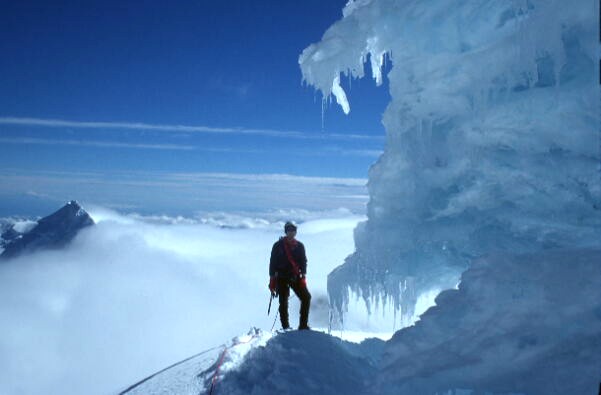
Before the summit fell off in 1991, the top was a broad snowy hummock which was a comfortable and commodious spot to rest and enjoy the view. Not any more. Now it�s a precarious spike of rock and ice known as ``the chandelier�� and which gives every impression of wanting to join its erstwhile colleagues 3000 metres further down on the Tasman Glacier. Good thing there is a topuni, or a Maori custom, that climbers should not stand on the very summit of the peak which they call Aorangi. We were happy to observe this and stopped five metres short of the actual summit, took a series of photographs and were joined by the arrival of a sightseeing helicopter from the West Coast.
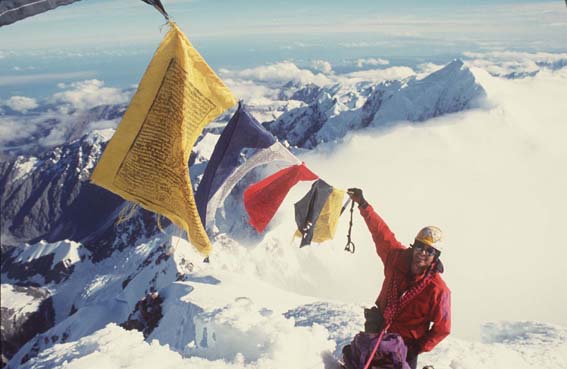
By now it was 9am but we were painfully aware we were only half way. Still, we had plenty of time and took our care with the descent to the summit rocks and then the series of abseils through them. Even so, the situation was brought home when the rope went over the edge of a rock and sliced through the sheaf of the rope. It�d get us down to the hut but would be history after that.
Once out of the summit rocks, we headed back into the snow and, after a quick second sprint across the gunbarrels, began the long trudge back to the hut in ankle-deep soft snow. We were very grateful for the track since navigating through the cloud on the virtually flat and featureless Grand Plateau would otherwise have been a real nightmare. I�d begun to suspect we were lost when that most welcome of sights - the twin toilets of the hut - emerged out of the mist, and indicated that the hut was only a few metres further on.
Even better news was in store - two other Kiwi climbers in the hut had brought a menu of meat, meat and more meat which was all very nice but not much good in providing the high-carbohydrate diet you need for the hills. ``Would you be interested,�� they asked, ``in swapping some of your dehydrated meals for two huge garlic steaks?�� Life does not get much sweeter than that.
The following morning we arranged a flight out to Mount Cook Village and headed from the airport to the NZ Alpine Club hut for a glorious hot shower to wash off the preceding 10 days of exertion.
We then repaired to the buffet at the Hermitage hotel, where we shocked the German tourists sitting next to us by devouring nine plates full of real food, before driving back to Christchurch and home. Floating ethereally on the horizon over Lake Pukaki, Mount Cook was living up to its Maori name, which translates as ``Cloud piercer��.
Since the climb had taken a week less than we had estimated, I realised that returning to work immediately would give me enough holidays to do the Kosciuszko sea to summit that winter. I rang work and they were happy enough for me to come back early but, once I arrived, I discovered that after I hung up the chief reporter had told everyone in the office that I ``had no life��, assuming I must have got bored sitting around at home on holiday and decided to go back to work early! There�s no pleasing some people.
Go to Mont Blanc Go to Aconcagua
Go to Kosciuszko Go back to the home page