
Aconcagua
Sea to summit
The walk
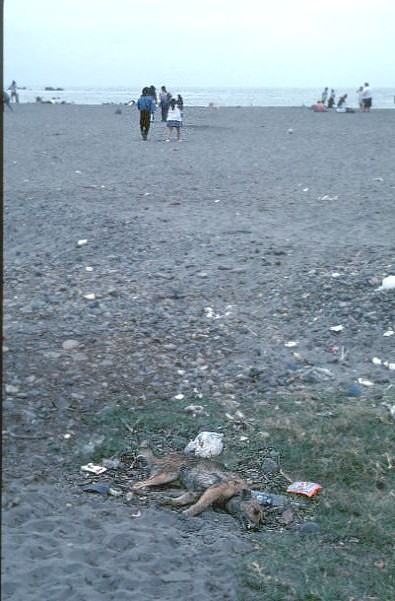
IN FRANCE the walk began at Mentone, in the heart of the Beau Monde of the Riviera. In Chile, the beach at Con Con was more low monde than beau monde, a point driven home by the olfactorially obvious presence of a very dead dog which was lying next to the empty spirits bottle!
At Mentone I'd gone for a quick swim and ducked my head underwater to avert anyone accusing me of failing to go the full distance but plans to do so here were quickly abandoned because of the quality of the water. I dipped my toe in the surf, had a quick empanada at one of the dodgy restaurants and began walking along the railway line beside the Rio Aconcagua to get away from Con Con as quickly as I could.
After a few hours of trying to co-ordinate my pace with the railway sleepers and then pounding the tarmac of the road, my feet began to ache and I was beginning to dread the thought of going through 200km of this to get to the roadhead at Punta de Vacas.
This mood was lifted when I went to a roadside farm to get permission to camp in one of their paddocks. Sure, no problem, and by the time my tent was set up, the couple living there had brought out some peaches and some bread rolls for me. As ever, it was the people who had the least who gave the most and they probably to this day don't realise the lift their simple gift generated in my spirits
The next few days were spent following the Rio Aconcagua as it threaded its way between towering hills and it was a bit sobering to suddenly realise during my meditative walking trance that they were only about 2000m (6000ft) high and that Aconcagua was the equivalent of three and a half of them stacked on on top of the other. My eyes went skyward to where the imaginary summit of this composite mountain would be and it really brought home just how big Aconcagua is.
The days settled into a routine of walking for a few hours after breakfast then having a siesta at some convenient coffee house or restaurant then pounding the tarmac again until dusk. The topography was nothing special and the food was usually the truly terrible churrasco (Recipe: search highways for roadkill. Boil to death with limp vegetables. Serve.) but the people who I tortured with my fractured Spanish each day provided the highlight. At first I received nothing but confused looks when I explained I was walking from "nivel del mar a la cima de Aconcagua" (my Spanglish version of "From sea level to the top of Aconcagua") - until I realised that the region on the Chilean side of the border is called Aconcagua. I realised my mistake at a cafe in the market at San Felipe and added the "Cerro" in front of Aconcagua. The proprietor looked truly shocked and, as I left, shook my hand and looked deep into my eyes with a look of abject concern. Perhaps he thought he might be the last person to see me alive?
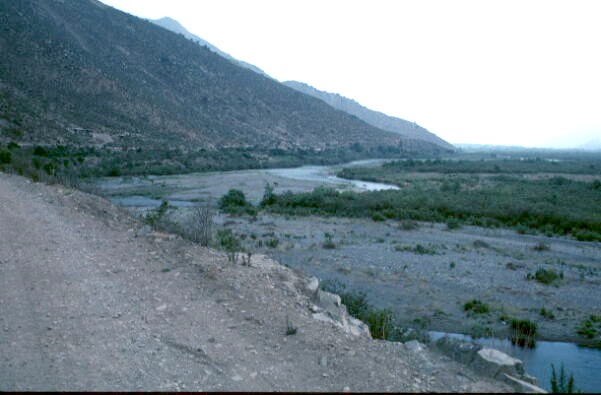
On the fourth day, just past Los Andes, the valley closed in as I entered the mountains. The only way forward was to join the diesel-spewing trucks and buses on the main highway to Argentina. There were no backroads to save me now and my aim of seeing the real Chile was changing into seeing the entire trans-Andean vehicular fleet.
Even this had its advantages, however scant, in a familiarisation with the local car types. It was no surprise to find that the ubiquitous Ford known throughout England, Australia, New Zealand and other commonwealth countries as the Cortina was known here by its European name, the Taurus. After all, no self-respecting Chilean would want to be seen driving around in a car named after the Spanish word for Curtain. Similarly there were no Chevy Novas to be seen either, but then that might be a case of life imitating art because nova is a Spanish phrase for ``It doesn't go''. However the biggest relief of all was to realise that the Mitsubishi four-wheel-drive known at home as the Pajero is redubbed here as either the Montero or the Galloper. That was a relief, since pajero is the Spanish collective noun for the sort of man whose active sex life doesn't require the, er, participation of anyone else!
Even these mind games wore pretty thin and I was beginning instead to focus on the the stupidity of doing Aconconcagua from sea to summit. And then I walked into the roadside cafe of Fernando Quiroga. He was a mountain guide, an award-winning poet, an eco-warrior and the solution to my road-bashing blues! I stopped in for what was planned as a quick cup of tea but then had a long chat about climbing Aconcagua (he'd done the ferociously difficult south face) which led on to other climbs around the globe and then about New Zealand, a venue he'd wanted to visit but had never managed. He'd even met Kiwi icon Sir Ed Hillary at a Club Andinismo de las Andes meeting in Santiago a few years back.
I wrote in his visitors book with English and Spanish versions of the sea to summit plan, which ended with "Todos Andar - Todos Loco" (which was supposed to mean: totally by foot, totally crazy). He saw it and pointed out that the world relies on crazy people. Without crazy people, everyone would work in a bank and Europeans would never have discovered America, man would never have walked on the moon and nobody would ever have climbing a mountain. That was just the tonic I needed to revive my flagging spirits.
The next stop was the Hotel Portillo, a huge concrete monstrosity based at Chile's premier and eponymously-named ski resort. The rooms were a little out of my price range (one night cost twice what my entire trip in Chile had cost so far) but I settled for a Portillo burger at the restaurant to celebrate reaching the frontier with Argentina. The waiter had me pegged as scummy riff raff from the start. Did I want a drink, he asked knowing full well that the burger on its own was stretching my ability to pay. No, I said. Coke? No. Fanta? No. Te? No. Cafe? And so on through the entire drinks list. He stopped, furrowed his brow, then came up with another drink which was not even on the list. I said no, he smiled and retired. Round one to the waiter!
I struck up a conversation with some people sitting nearby, clearly among the "have"s of Chile, who were here overseeing an Outward Bound style camp for the rich youngsters of Santiago. They introduced me to one of the people taking the course. Had he done much climbing, I said after explaining my sea-to-summit trip. "Yes," he said. "I've climbed Everest and K2." And he'd even taken a tiny flask of Chilean red wine to toast on the summit!
The next day, it was a short walk of a few kilometres to the Chilean border post where I had to line up with the cars to get through customs and immigration. It took a bit of explaining before I convinced them that I truly was on foot but they eventually let me through. Another few kilometres up the road were the tunnels which go through to Argentina, where I had to turn off and head up the abandoned road zigzagging up through the scree to Cristo del Rentedor (Christ the redemptor - statue made from recast Argentine armaments) at 3800m. This was the highest I'd been on the trip and I could feel the altitude, and again was sobered to realise I was only just over half the height of Aconcagua. A huge sign proclaiming the height to be 4200m showed the local tourist organisers were not averse to a wee bit of embellishment.
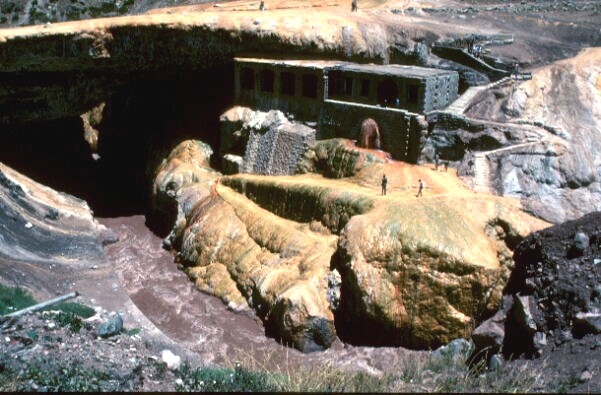
This was also my first sight of the actual mountain, which was supposed to be visible from Santiago but which had always been hidden by the smog haze. Another mountain in the way hid most of it but the summit of Aconcagua was poking out, looking much whiter than it had been in the photos I'd seen of it and featuring a huge plume of windblown snow. I headed on down to Puente del Inca, where most climbers begin their ascent of Aconcagua.
The Crowds
At Puente del Inca, there was a stream of Andinistas coming down off the mountain telling tales of two-metre snowdrifts left by the worst summer storm in 10 years. Climbers at the third camp on the mountain, Nido de Condores (Condor's nest) had been trapped there for days by the storm and deep snow.
Eventually someone was able to force a trail back down to base camp. A little later I met some particularly hard-looking Slovaks who had reached the summit via the Polish Glacier in snow between knee and thigh deep.They looked exhausted and were the only ones to have topped out in recent days. The news, in short, was not good.
I canned my original plan, which was to walk up the Vacas valley and try to find someone to rope up with to do the Polish Glacier route. My failsafe - a high level traverse over to Nido de Condores if the Polish Glacier was untenable _ was no longer going to be an option, so I plumped for the normal route instead. From what everyone was saying, that was going to be quite difficult enough.
The benefit of this was I avoided the boring 17km walk to Punta de Vacas the next day and had the opportunity to savour the hot pools at Puenta del Inca! These mineral hot springs are the furthest south the Inca empire reached and modern-day travellers who use them to wash off the grime and sweat of the dry Andean uplands will instantly know why the Incas felt no urge to go further. The lower pools have wild mineral formations, a natural spa-jet effect and a truly convivial atmosphere, while the shallow pool above the ruined spa building was perfect to sit in pre-dawn and watch the sun rise over the Andes between your toes as they stick out of the water. Bliss.
With my route changed, I tried to get down to Mendoza to jump all the bureaucratic hurdles needed to get onto the mountain. After failing to flag down a couple of buses, I stuck my thumb out and was soon picked up by a young Mendoza couple coming back from a holiday at Vina del Mar. They had covered in four hours in their car a distance which had taken me a week on foot! They were both law students, spoke excellent English and so were spared from the bleeding ears caused by my fractured Spanish. They were also definitely from the "have" side of the Have/Have-Not divide and seemed shocked when I balked at paying US$60 for a night at a two-star hotel and instead asked to be dropped off at the scummy dives known as hotels around the bus station.
The administrative hurdles the next day were fairly straightforward and following morning, I arrived at the bus station loaded down with 21 days of food ready to wait for the snow to subside. I shared the bus with Eric, a climber who was diagnosed with multiple sclerosis a few years back and who was being sponsored by a pharmaceuticals company which manufactures an MS-inhibiting drug to do the ascent of Aconcagua. He and his climbing partner were also happy to share mules with me to take our equipment to base camp, which brought the price down from a hefty US$120 charge down to half that. After not seeing a single foreigner on my walk up the Rio Aconcagua, there was no shortage in Puente del Inca.
Another guy heading up was Truls, who unbelieveably spurned the use of mules because he wanted to do the mountain "unsupported". His resolve wavered a little when I offered him the other half of my mule for free but he stuck to his guns and the next day shouldered a 40kg pack for the walk to Confluencia. I thought he was mad to do that, but then he thought I was mad to have walked from the coast!
The track to Confluencia was straightforward, although every Andinista coming down was greeted with "La cumbre?" (The summit?) instead of the usual "Hola". One benefit of walking from the coast was I was already fit before I reached the mountain and so I reached camp in a little under two hours, which gave me plenty of time to watch as the Argentinian workers living there practised the local sport of rolling boulders down the hill towards the camp! There were some worried faces among the owners of tents underneath (including my own) but the boulder disintergrated harmlessly before destroying anything. The haul up to base camp should have taken a little over four hours except the track split in two just before the steep pinch up the terminal moraine and I took the wrong (left) track and ended up at the refugio instead and faced a 30-minute walk over to where I should have been.
Everyone there fell instantly into one of two categories. There were the Andinistas, the fresh faced bunch who were still keen and enthusiastic, and then there were the ones whose faces showed they had done the hard yards on the mountain. We dubbed them Pandanistas, after the tell-tale white circles around their eyes where their sunglasses sat. I collected my gear from the muleteers and pitched my tent, which I rarely left for the next 36 hours because the sudden rise to 4300m had finally caught up with me.
It's a very convivial place though, complete with a main road through the centre of camp. Everyone there has a common aim and everyone's very friendly. On my third day at base camp, I hauled seven days of food and all my climbing gear for the upper mountain up to Nido de Condores and was back at base camp after about five and a half hours. The altitude headache didn't arrive until after I was down but then it stayed all night. My planned "last big feed" before moving my camp up the mountain took about three hours to eat - a real struggle.
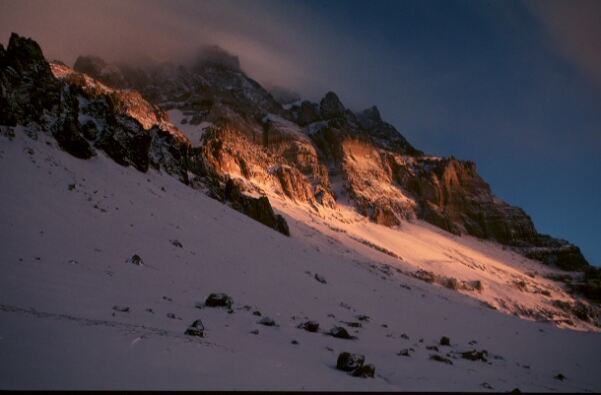
The weather became progressively mankier the next day but I did the haul up to Camp Canada after lunch when it seemed to be getting a little better. It got worse, of course, and I ended up pitching my tent in a howling blizzard, which stopped soon after I was safely inside. There was a pretty impressive sunset and everyone emerged from their tents for a Kodakfest. Lots of clicking, oohing and ahhing and comments about how privileged we were to be there.
Jonathan, Ian and I ended up playing cards until about 3pm, when I ran out of excuses to remain in their tent. I headed outside, rolled up what was left of my tent and headed down to base camp.It turned out we were the lucky ones.
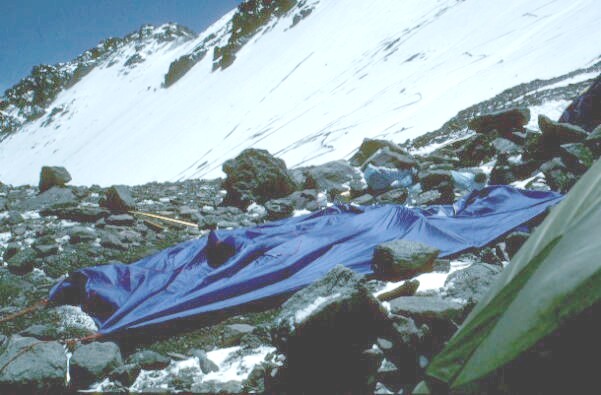
Nobody felt very privileged at 2am when a hooley of a storm arrived. The gentler gusts would loosen the frost which had condensated on the inside of the tent from my breath, which would then drift gently down on to my sleeping bag and freeze on the outside. The big gusts would lift the tent off the ground. The Macpac tent I'd picked up new on the way to the airport some 17 days earlier is one of the strongest and best built anywhere. It was up to the abuse being meted out... until about 8am when one of the upwind guyropes attached to a hefty rock broke through being abraded by the force of the storm. The other one couldn't handle the load on its own and before I could kit up to go outside and repair it, a huge blast came through and flattened the tent, breaking both poles in the process.
Annoyance changed to survival, and I stuffed everything I could into my pack and legged it to the nearby tent. Inside were Ian and Jonathan, two brothers from greater London who I'd met down in base camp. They were remarkably hospitable to the frost-covered intruder who burst into their tent! When the lulls between gusts began to get longer, everyone at camp began yelling from one tent to another to assess the damage. The result: about half the 10 tents damaged, with only a couple totally flattened.
Nido de Condores had three destroyed tents and all but one at Camp Alaska, a truly stupid place to have a camp in the middle of a featureless screefield, were history. Tents at base camp had been damaged by winds variously estimated to be between 100 and 160kmh, and Rolando, one of the guides, was doing a fine trade in retelling how he saw one of his permanent mess tents flying away, grabbed hold of it and ended up getting an unscheduled flying less. At the refugio, a flagpole which had withstood a decade of Andean storms had fallen victim to the winds.
Without a tent my summit hopes seemed dead in the water but there was not a tent to be had in base camp for love nor money when I arrived there. Worse still my sleeping bag was soaked after the previous night's events and so I trudged over to the refugio to spend the night there. In keeping with my luck that day, there were no dorm beds left and I ended up paying US$25 for a twin-share with a man I subsequently discovered to be the captain of the Norwegian freestyle snoring team! It became so bad, I had to take my bed out into the corridor and sleep there, hankering back to the halcyon days with the dead dog at la playa de la Con Con.
The tent problem was still as intractable the next morning as I unabashedly felt sorry for myself and dried out my sleeping bag on the balcony of the refugio. Rolando tried to convince me I could do the summit in one day from base camp - a mere 2700m height gain. "Yeah, right!" I thought but the next day found myself heading up to Berlin camp to test Rolando's claim that if I could make it there in seven hours, I could reach the summit in 12. I convinced myself to take my sleeping bag, mat and stove on the truly spurious pretence that they would be "ballast" to prepare me for the big day...
I reached Nido de Condores in three and a half hours and, out of a sense of hospitability, thought it would be rude not to do the rounds of the people I knew who were based there. These included Jonathan and Ian, who had just moved up from Camp Canada that day, and mentioned that there was a guy in the next tent on his own who used to be in the Alpine Club in England.
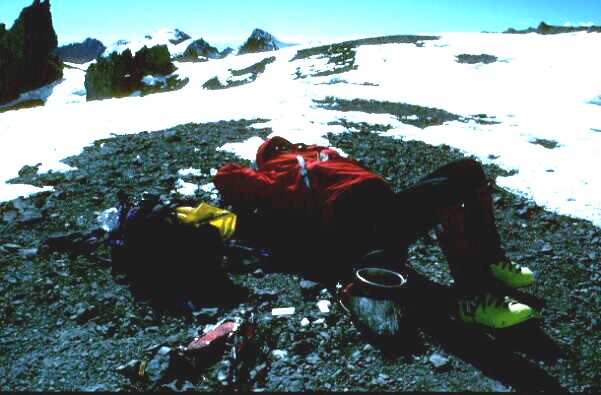
Norm was a former CEO of a Californian computer company (he was bought out by his partners after he failed to convince them that the PC was likely to be quite important in the future) who was spending the week before his 70th birthday trying to climb Aconcagua.
We were both former members of the Alpine Club in Britain - he had emigrated to America from Scotland in the 1950s - and so we inevitably had some people we knew in common, who we chatted about until I summoned the courage to ask if I could share his tent. With a generosity I hope I'd be able to show if our situations had been reversed, he said yes.
It turned out he had been in Camp Canada too on the night the storm hit, had to abandon his tent after the poles broke around dawn and raced down to base camp, getting blown over by the winds several times in the process. Escape had come at a price and he had sustained frost damage on his fingers. Norm was nothing if not determined, though, and frost damage or no, he managed to buy the only mountain tent for sale in base camp for a mere US$500 - more than it cost new! Since he didn't have that much cash on him, he then had to convince the vendor that he was good for the money, which is an ususual situation for someone in his station in life.
From then I was not fully in control of my destiny because I had to go wherever the tent went and Norm was heading up to Camp Berlin the next day. A little earlier than my acclimatisation schedule would have preferred but then beggars can't be choosers. As a weight saving gesture, we opted to only take one day of food since the weather seemed settled and we wanted to preserve our strength. That day, Norm and I were joined at Berlin by Jonathan and Ian. Truls turned up as well. His tent had been at Nido during the storm and was being battered so much he decided to take it down but in doing so suffered serious frostnip to one finger and, in any event, broke a pole in the process. He had managed to hook up with another climber, Nick, whose partner had fallen sick. We arranged to head for the summit at dawn - 7am - and went to bed.
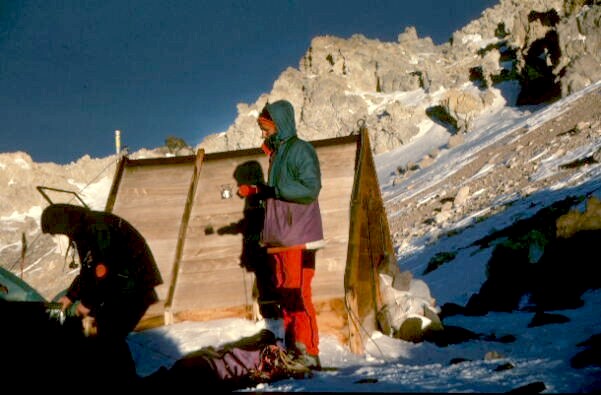
At 2am, I was lying in bed pretending to be asleep when I heard a very familiar noise on the outside of the tent. Peering outside confirmed my worst fears: snow! When was this mountain going to give us a break?! Even more confusing was the fact that my altimeter needle hadn't budged a millimetre. At 7am, there was about 30m visibility and a white hoar frost covered everything.
Even worse, we didn't have the food to wait another day. We pondered this for a minute and then Norm announced: "Let's go through the trash and see if we can find some food." It's not everyday you hear a millionaire say that. But then Norm provided an abject lesson in why he's a millionaire: all around us were the tattered remnants of abandoned tents from the storm a few days earlier and Norm had twigged that the occupants would have abandoned everything except the essentials when they fled. Sure enough, he arrived back from a tour of the tents with freeze-dried food, soup mixes and drink mix.
At 9.30am, Truls announced that the weather was getting better. I told him I was going to wait until tomorrow because I wanted a good day for the summit. "This is a good day," he announced in his unique Norwegian accent. And he was right. The clouds scudded away and there to the east lay that good-luck talisman of anyone climbing Aconcagua - the smog of Santiago.
Truls and I kitted up but Norm didn't think he would be fast enough to head up so late in the day. We set off at about 10.15am, with Truls keeping his frost-damaged finger inside his jacket to avert further problems, a successful tactic but one which came at the cost of being nicknamed Napoleon. One of the sneering derisions of Aconcagua by serious climbers is that it's "just a walk".
Indeed it proved to be, although even walking to the corner shop is hard work when you're down to less than one third of the oxygen to be enjoyed at sea level. The route was straightforward and well stomped down, allowing us to get into the jaunty rythm of two breaths per step to make headway. Within two hours we were at Refugio de la Indepencia, a semi-demolished dogbox which at 6500m above sea level holds the record for the highest building on earth.
From there, a traverse takes summiteers into the canaletta. This is the make or break part of Aconcagua - a steep gully filled with loose scree which leads to the summit. We were lucky and the snow had consolidated a lot of the scree and avoided the two-steps-forward one-step-back scenario so common in reports of the summit day. Even so, it was bloody hard work. Perhaps it was the altitude starting to hit or maybe losing the ability to maintain a steady rythm which makes high altitude climbing much easier. Then again, maybe it was the effect of not enough sleep, food or water in the past few days.
Whatever reason, it was by far the hardest thing I had ever done in my life and I kept thinking that those who deride Aconcagua as "just a walk" should come up and try it before they open their mouths. It was harder than running the marathon, harder than any of the multi-day climbs I'd made in the Alps in Europe and harder than the infamous Coast to Coast race in New Zealand.
The terrain was no more difficult than a scree gully, but it was like heading up a scree gully while trying to breath through a straw. Most people seem to come to grief here. I was bracing myself to come across the two corpses of climbers who had died in the Canaletta in the last month but found out later that the military had come up the day before and removed them. I recalled a conversation back at base camp with a young German climber who had reached the Canaletta, looked up towards the summit and thought "Yes, I have it". He was halfway up when he reached his limit. He took off his backpack and tried to get further but only managed another few metres before turning around and heading down.
I knew how he felt. By now it was up to five huge, deep and gasping breaths for each step forward. In the past I've turned back on lots of mountains because it was too difficult, too slow or too dangerous. There's no shame in it. But here, for the first time, I contemplated about turning back simply because it was too much hard work. I banished the thought because it meant I'd have to go back down the mountain, get more food and then head back up again to get the summit, when all I really wanted to do was to get away and do something more enjoyable. The thought of actually giving up on the summit altogether was never an option.
The Victorians would have called this "manly resolve", although the 1990s version is probably "pig-headedness". Norm later said he'd seen this trait in me, although the actual words he used were "Hard-nosed son of a bitch" - a compliment in his eyes. Either way, it's why 80 per cent of getting up these bigger mountains is mental.
By the time the top of the canaletta was reached, I was on my own and breathing harder than I had ever done in my life. It was almost a shock after picking my way up through a series of rocky steps to suddenly step on to the summit plateau and find it was big enough to hold a game of croquet on.
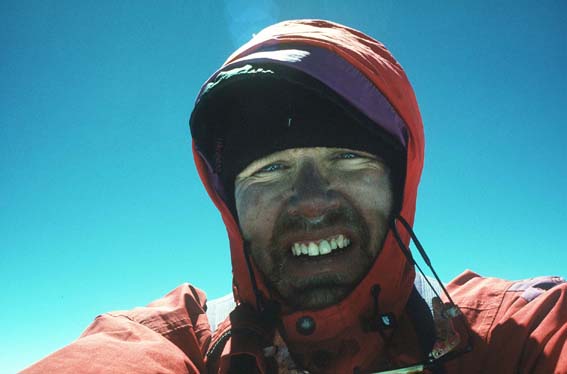
Life was pretty frill-free up here: grab a few rocks as souvenirs for friends then out with the camera to take a photo of the summit cross to show I was here and then some quick self portraits to capture the expression of pain on my face. While doing so I inadvertantly stopped taking the deliberately deep breaths and reverted to my normal sea-level rate. Within a few seconds my autonamous nervous system kicked in and I involuntarily took a huge deep gasping breath. From then I breathed so hard and deep in a bid to recover my oxygen deficit that I began to feel giddy. Not a good state to be in when you're up here on your own and so, after spending three weeks to stand on this spot, I headed down after spending less than a minute on the summit.
Even going down was not easy and I had to rest on the descent. Normally, once I'm off the difficult ground, I bounce down the mountain on the high of reaching the summit. Not here. I had to take seven breaks between the summit and Camp Berlin. Norm, Jonathan and Ian rallied around and made me drinks, which I repaid by psyching them out with tales of how hard I'd found it! I was still so drained the next day when I stumbled down to base camp that everyone assumed I hadn't made the summit and was dejected. One day later, I walked back out to Puente del Inca past the bars, the pensions and the shops and straight to the hot springs.
Go to Mont Blanc Go to Mount Cook
Go to Kosciuszko Back to the home page