| View the home of Roberts brother William |
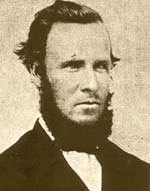
Captain Wilson was grandfather to Duncan C and Norman Wilson Johnson. Click here to view Duncan's picture and their family info.
Among the many vessels he commanded was The Baltic and the Lady Colborne (also referred to as The Lady Colbourne).
Although lesser known as an extension of the Underground Railroad than other towns such as Amherstburg, Buxton, Chatham, Dresden, Hamilton, Kingston, Niagara Falls, Toronto, St. Catharines and Windsor, the Town of Oakville was the gateway to Canada for many African Americans, as early as the 1830s.
William Chisholm purchased the land around Sixteen Mile Creek in 1827 and in 1834 the Town of Oakville became an official Port of Entry into Canada. Ships from Oakville sailed throughout the Great Lakes and beyond, and many slaves were assisted by ship captains to stow away in grain vessels. Stories are told of a tunnel which ran from the 16 mile creek to the Herb Merry House on Trafalgar Road, and there is also some evidence to suggest there may have been a tunnel leading under Navy Street from near the Custom House.
Particularly well remembered is Captain Robert Wilson, who brought many African Americans to Oakville concealed aboard his ships. For years following the American Civil War (1861-1865), African Americans would come to George�s Square in Oakville to celebrate Emancipation Day, and those who had been helped by �Captain Robert� would visit him at his nearby �Mariners Home�, which still stands at 279 Lawson Street.
*photo courtesy of Oakville Historical Society Collection
(The following excerpt, while fiction, contains precise and historically accurate detail based on escape stories found in The Refugee: or The Narratives of Fugitive Slaves in Canada, by Benjamin Drew.)
We lived like that until I was twenty-two, when Adam Smart was thrown from a horse and struck his head on a shovel and went into a coma and died. I can't say I regretted the man's death. But his brother came onto his estate, and started talking about selling me off. He didn't need Ruth, and he got rid of her. She came to see me at night. She didn't come for the loving. She came to tell me my time had come. We had talked about this many times. We wrote out a carefully worded pass.
Please allow this nigger, Langston Cane, who is my property, to pass unhindered. He takes care of my livery business, and is off to purchase new equipment on my behalf.
John Smart
Petersville, Maryland
I waited until the next day, when I knew that John Smart had an appointment with a lawyer about his brother's estate. Ruth then wrote a fake letter to John Smart.
Dear Mr. Smart,
I hope you will excuse me for borrowing your nigger, Langston. Your brother let me take him from time to time, and I will be happy to pay you for his work, as I always paid your brother. I have some things that need delivering, and so the nigger has also come away with your horse. Will pay, too, for the use of the horse. I should have the horse and the nigger back by dark. If not, please come see me.
Sincerely,
Richard Symons
I have always thought this was a stroke of genius on Ruth's part. Richard Symons farmed pigs sixteen miles south of Petersville. If John Smart wanted to check out the story, he would have to travel opposite to the way I was heading.
I took the best halter and the best horse, and fed her and watered her well. I took half of the money hidden in Adam Smart's home, and gave the other half to Ruth. I was banking on the notion that John Smart didn't know that his brother kept a collection of coins and bills in a leather pouch high on a ledge in the cold cellar. I ate four eggs and half a loaf of bread. I drank two cups of milk. I crammed apples, walnuts, bread, and dried strips of beef into a saddle bag. I also packed a carrying bag and, on a whim, two rat traps. Indeed, since my flight from slavery, I've hardly been anywhere without a rat trap in a pocket or fold of my raiment. In leaving, I took a few of Adam Smart's clothes. I wore some of them as I climbed onto Smart's prize mare. She knew me well, that mare. And I knew her well. I knew how hard I could run her, and I knew how long I could run her, and I knew how much rest she would need before she could get up and go again.
I hugged Ruth, then stood back to look at her face. A single tear welled up and streaked down to her jaw. She kissed me and put her finger on my lips, then turned around and walked into the barn. I swung up on Nell and began riding north.
I rode in broad daylight and at a casual speed, all day long. At the end of the afternoon, I paid to have Nell fed and watered in a small town. I stood by her in the shade, and chewed on a few slices of the dried beef. Bless Ruth's soul. I would never have known you could dry out beef and keep it like that, had it not been for her. I had a cup of water. Only one man in town asked me what I was doing with such a fine horse, and who I belonged to. I hung my head, mumbled that massa had written out a pass for me, showed the paper, and was left alone.
I gave Nell two hours of rest. When the sun sank low in the sky, we rode out of town. We rode slowly at first, and cantered when it grew dark. We proceeded as quickly as I could judge safe, given the roads and the darkness. We had a full moon. I thought of my mother, stealing through the night to see me. I thought of Ruth, straddling me with her head thrown back and breasts heaving. I thought of Hilda, whipped senseless, and of Wild Bill, shot dead after saving her.
I rode Nell through most of the night, stopping to water her when I found streams and to feed her when I spotted hay. I wrote myself a new pass in the moonlight. This one was from a fictional master, who was sending me ahead to run an errand for him. I tied up Nell and slept for an hour in the night, while she rested. On the third day, I stopped in another town. Three men asked me to produce papers. I massa'd them this and massa'd them that, and managed to have papers from a town ten or so miles back. But as I was arranging a feeding for Nell, I saw more people looking at me. And I caught a notice of my name and a description of the horse on a piece of paper on a signpost. I ran the poor mare hard until I came to a Negro working outside a barn.
"I'd like to sell you this horse. She's tired, but she's fine."
"Don't want no horse."
"I'll give you a good price."
"Is that horse stolen? If I buy a stolen horse, it's still stolen. And when it's found, I'll be the one they start whipping."
"If you give me a meal and a place to hide, you can have the horse."
"I don't want it, sold or given. I don't want you either. You and your horse both look like trouble. Get on out of here."
I rode Nell a mile up the road. I watered her at a stream. I led her deep into the woods and tied her up to a tree. Then I removed a shoulder bag that carried paper and pencils, what little food I had left, my money, a change of clothes and shoes, and my rat traps. I thanked the stars for small miracles. Adam Smart and I had the same size feet, and the man had two good pairs of shoes.
I hated to kill the horse. But I couldn't have her wandering out onto the road without a rider. She'd give me away for sure. I found a branch that was heavy enough to kill, but light enough to swing hard. I smashed her between her eyes with all the muscle I had. Nell crumpled and rolled over.
It hurt me to do it. But she died a good deal more quickly than some Negroes I have known.
It was the right season to steal back my freedom. Corn grew in the fields. At night, I would steal a few cobs, and light a fire in the woods, and throw the cobs right into it, and run off to hide as far away as I could, while still keeping an eye on the fire. If nobody came before the fire burned out, I would return to eat the cobs. They'd be cooked enough by then.
One night, I stole a young pig, led it into the woods, killed it right off and sliced off its ears and cooked and ate them and kept on moving.
A Quaker in Pennsylvania hid me for two days, and warned me that people had been looking for a runaway with a horse. He fed me, gave me a good bed, and drew me a map. He told me that forty miles north, a Quaker man in a white farmhouse with a big red barn would give me shelter.
I got there, and I stayed for three days. I was coughing and sick from sleeping in wet grass. I got half my strength back, and made it all the way to the hills of northern New York State when I ran into trouble just south of Canandaigua.
A church minister was passing in a horse and wagon, and he looked kindly, so I asked him for directions. He said he'd take me close to the town of Naples, and then show me the way. But he didn't stop out of town. He took me right into the middle of it. I asked where he was going, and he said, Stay right there. I jumped out and ran. He shouted out at me.
I ran as I've never run before. Up one street, down another, across a yard, over a fence, and inside someone's door. A tall man with blue eyes and a great beard stood staring at me.
"Good God, my man, what are you doing? If anyone has seen you, you will have destroyed our work."
"You are a...you are a...."
"I am a Quaker. And you are a fool. Get down in that crawl space. Hurry."
I hid on the Quaker's property for a week. Much of that time, I was sequestered outside the house, near the barn, in a hidden crawl space the size of a coffin. People thought they had seen me run to that house. It was inspected three times by a local sheriff. The Quaker had no choice but to hide me underground. I coughed terribly. I had dust and dirt in my mouth, my eyes, my ears, my rectum. I was filthy everywhere. After a week, when suspicions had faded, the Quaker took me back into his home. He took care of me for two weeks. He wrote out maps and directions, and told me that I was not far from the northern border. When I got to the town of Rochester, I was to go to 20 Lake Street after nightfall. This man's brother lived there. He would put me in touch with a ship captain who could take me across Lake Ontario to Canada.
He took hold of my elbow and led me into his schooner. He had red hair, and a strange, feminine, sing-song accent. His first words, which were mumbled at great haste, I couldn't understand. But his step was quick and sure, his back sturdy, his eyes blue as the lake water, and his hands strong. I could see that this man ate well.
The boat was about a hundred feet long. It had white sails hanging from three masts. He led me down into the hold, which smelled of fresh lumber. But there was none in there. There were saws of all sorts, and bags of nails and horseshoes and hammers, and four fine saddles and saddle bags. There was work going on, where this man came from. That much was clear to me.
He introduced himself as Captain Robert Wilson of Oakville, Canada West. He asked me if I had eaten recently. I had not.
"That's a good thing. I'll feed you when we get across the lake. But it's blowing out there, and I bet you haven't been out in rough water before."
I allowed that I hadn't.
"I'd advise you to see to it that nothing more goes into your stomach for the time being. I'm going to have to ask you to stay down here. Out of sight. Have you heard of the Fugitive Slave Act, my lad?"
I wouldn't have admitted it to a man who stole Negroes. But this man was different. He was saving me. He was about to sail me across Lake Ontario. "I know of it," I said.
Langston Cane did indeed make it to Canada. He had the necessary guile and strength. His co-conspirator, Ruth, who evokes the spirit of Harriet Tubman, knew that his flight to freedom had to be a solo one. This was the safest route.