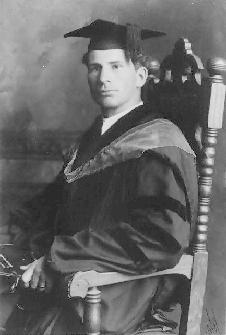
Several biographies have been written on George Francis McEwen including:
Robert S. Arthur, et. al "George Francis McEwen." University of California In Memoriam, July 1975, pp. 91-93.
Mills, Eric L. "Useful in Many Capacities. An Early Career in American Physical Oceanography." Historical Studies in the Physical and Biological Sciences 20:2 (1990), pp. 265-310.
George Francis McEwen was born on June 16, 1882, in Manchester, Iowa, the son of John Freemont McEwen, a jeweler, and Lillian Dodson McEwen. McEwen attended Iowa State College in Ames from 1885 to 1900, and from 1902 to 1905, supporting his studies with occasional work in watch repair. He withdrew after a serious bout of pneumonia. In 1905, McEwen and his mother moved to San Diego, California, hoping to improve their health. McEwen's mother moved with him to Palo Alto where he attended Stanford University from 1906-1908. He received an A.B. degree in 1908 and a doctorate in physics in 1911. McEwen had a teaching fellowship at Stanford while working on his doctorate and served as Instructor in Applied Mathematics at Stanford from 1910-1911. He was appointed Instructor in Mathematics at the University of Illinois in 1911.
McEwen was recruited by William E. Ritter as a physicist for the Marine Biological Association of San Diego in 1908. This was a summer position until 1912, when McEwen was formally appointed hydrographer by the Regents of the University of California. During the same year the Association became the Scripps Institution for Biological Research of the University of California. McEwen's title was changed to Hydrographer and Curator of the Oceanographic Museum in 1916. His title was changed again to Associate Professor of Physical Oceanography in 1926 and he was thereafter listed in University of California publications as Associate Professor of Physical Oceanography and Curator of the Oceanographic Museum until 1928, when he was promoted to Professor of Oceanography and Curator of Physical Oceanography.
McEwen concentrated on hydrographic work during his early years at Scripps. He designed instruments and became interested in the dynamical oceanography of V.W. Ekman and V.F.K. Bjerknes. By 1912, his work was focused on the determination of ocean currents using temperature and long term weather forecasting. McEwen received support for his climatological work from E.W. Scripps during his early years in La Jolla, and from 1925-1933 his research was funded by several southern California power companies. During this period, his long term weather forecasts were distributed broadly to scientists and representatives of the power and agricultural interests. McEwen published many papers and his research was considered promising by Scripps directors William E. Ritter and Thomas Wayland Vaughan.
McEwen married Mae Alice Winner in Hamilton, Missouri, on June 18, 1912. They had two children, Paul Albert McEwen born in 1913 and Dora Ellen McEwen born in 1932.
McEwen taught summer courses in oceanography at Scripps beginning in 1917. During the 1920's McEwen taught courses in physical oceanography (dynamical oceanography) and meteorology at Scripps and lectured frequently at UCLA. He gave a series of lectures on dynamical oceanography at the University of California in Berkeley in April l926. Beginning in 1938 McEwen taught a course in physical oceanography together with Harald Sverdrup and Richard Fleming, and Sverdrup and McEwen together taught a course on meteorology.
From 1936-1939, McEwen supervised a compilation of ships' meteorological observations taken between l904 and 1934. This work was undertaken at Long Beach with WPA labor in cooperation with the U.S. Navy Hydrographic Office.
McEwen gradually abandoned his long term weather forecasts by 1940 when their scientific validity was questioned, and the work of other scientists, principally Ekman and Bjerknes, eclipsed his own. While McEwen spent the decade of the 1930's attempting to refine his temperature-based methods of calculating ocean currents, his efforts were not successful. The methods of the Bergen School were taught at Scripps beginning in 1936 when Nowegian oceanographer Harald Sverdrup became director of the Scripps Institution of Oceanography and began to transform both the research program and curriculum according to European scientific standards.
During World War II, McEwen's work on the dispersion of silt in the ocean attracted the interest of Manhattan Project scientists. In 1944, he left Scripps to join them. He later calculated the dispersion of radioactive material during Operation Crossroads. His mathematical model of dispersion occupied his work until his retirement in 1952.
McEwen was an active member of many scientific organizations. He was a member of the American Committee of Oceanography of the Pacific of the National Research Council. He was a fellow of the American Association for the Advancement of Science and a member of the American Academy of Arts and Sciences. He was a member of the American Meteorological Society, the California Academy of Sciences, the American Geophysical Union, the American Physical Society and the American Mathematical Society. McEwen was a delegate to the Pan-Pacific Science Congress in Honolulu in 1920 and served as a delegate to the Congress when it met in Tokyo in l926. He was vice president of the American Meteorological Society in 1938 and 1939.
McEwen died in La Jolla on March 1, 1972.