Political Influences (Introduction)
Real Revolution - Through Democracy
Alan McCombes supports Independence First
Independence Convention to Launch on St Andrews Day
Taking the lid of Scottish ambition - by Brian Nugent
More Support for Independence First (from Celtic League, Kev Williamson & David Ross)
New Office Bearers for Independence First
Time for Scotland to leave this potential UK police state
Scotland's Republican Voice by Graham Connelly
Scotland has to be taken from the left by Donald Anderson
New SNP Leadership Offers Fresh Start
How can Scots parties move forward to Independence?
Democracy destroyed in the heart of Europe - by Jo Harvie
Why Fiscal Autonomy is not possible without Independence
Losing the Heid by George Rosie
Labour Government using Terrorism as excuse for ID cards
The time to stop the cards is now - by Kevin Williamson
Campbell Martin MSP Suspended from SNP
Labour's Divide and Rule school closure tactics
Time for SNP MSP's to Choose Direction
Scottish Republican Articles (Collected)
Ludicrous Entryist Allegations switch off voters
News Story about Me! - SNP leftist faces party expulsion for News article
Republican Socialist SNP is the way forward
Adopting SSP MSP Salary Policy could Revolutionise SNP financial position!
Deluded Reid Proves Labour don't listen to Scots
Time to Change US policy on the Middle East
News of the World Yellow Ribbon Toilet Tissue Campaign
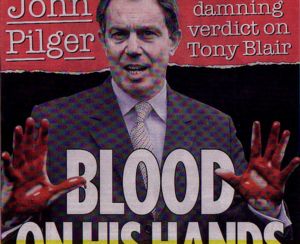
Not In our Name (by award winning journalist John Pilger)
Murdoch Reveals Real Reason for War - Cheap Oil
Support Freedom for the Basque Country!
London Must Let Go of the Remote (by Kevin Pringle)
The Truth about Public Spending
ID Cards Scheme - Attack on Civil Liberties
Poverty Amidst Plenty - By Andrew Lumsden & Alex Neil
Independence - Its a Capital Idea
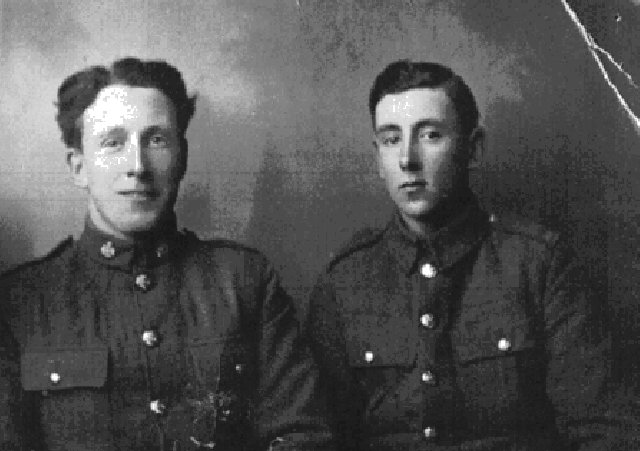
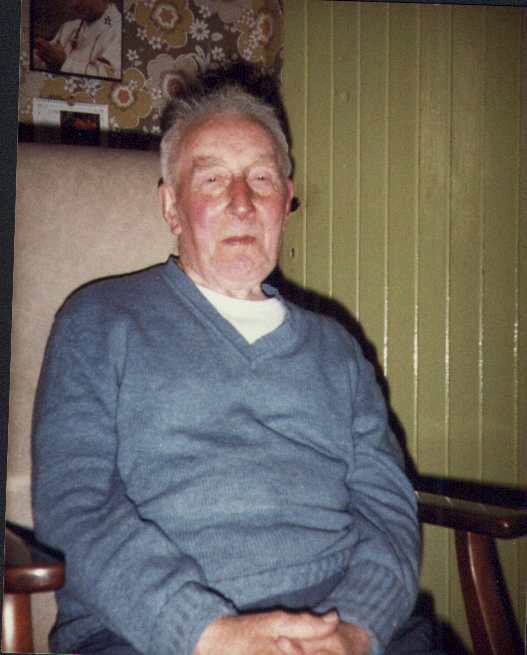
My Uncle Joe as a boy of 15 (on the left) and as I knew him, later in life.
Political Influences
by Joe Middleton
I joined the SNP in 1987 after seeing a party political broadcast. I had, for some time before that, supported both independence and the party. My driving force politically has always been a deep sense of injustice that Scotland has never been treated fairly and while I have Socialist beliefs that have increased the more I have learned, my belief in independence has grown also.
I became a socialist because my great uncle was one. He was also called Joe, Joe Burns, and he had come to believe in socialism after serving, and being wounded 5 times, in world war I as a young man. The suffering he witnessed first hand and the inexplicable reasons for the conflict led him to embark on a process of educating himself, through reading, and as he became more convinced of the worth of Socialism, he joined the Labour party and worked for them for many years.
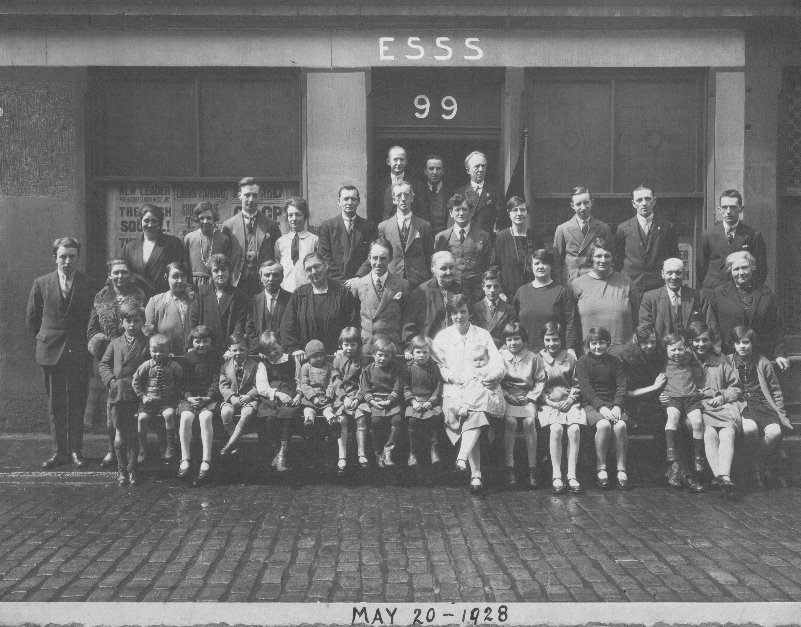
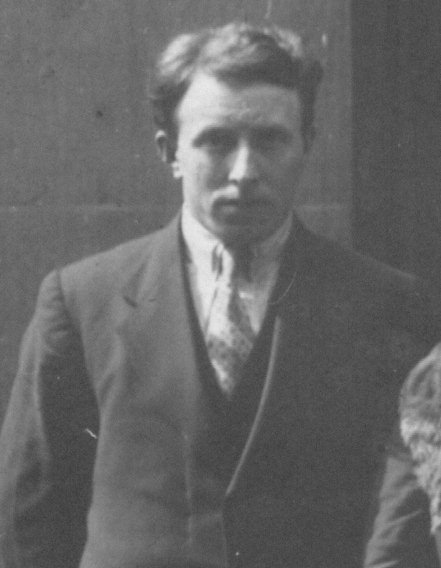
At that time, the Labour party was built around the trade unions and represented the working class. Inspired by the Bolshevik revolution, Labour proposed a near revolutionary program of social change. They were widely respected for their principles and their willingness to stand up for their own class and this was reflected in the ballot box. The Labour party still enjoys enormous support today but, I would contend, does not deserve it.
My Grandfather, Matt Clayton, was a miner at the Lady Victoria pit in Newtongrange. My father was a postman and my family are practicing Roman Catholics. I'm a natural Labour party supporter, statistically, yet I've never voted for them.
For me independence
is a way to change the unjustness in our society but even if it didn't change it
substantially for the better I would still want it. My overall driving ambition
is for our country to be free. I am a Scottish nationalist and I believe the history
of our nations struggles for its freedom are directly relevant to our situation
today. (The story of the 1820
uprising is also an interesting and instructive history lesson.)
William Wallace, Thomas Muir,
John MacLean, their legacy can and must always inspire
us. As for New Labour or New Tories or Rosy Tories, call them what you will, they
are a pale pink shadow of a once proud and principled party. The party where once,
men like my great uncle who was not a nationalist but was nonetheless a great and
principled man, were proud to represent their fellow workers is dead.
New Labour no longer represents our forefathers instead it represents a watered
down form of Thatcherism disguised by muddled middle class values, the terrible
exploitation of the poor and weak in our society began by Thatcher and continued
by Major will not be stopped by Labour.
Labours drastic shift to the right, began by Neil Kinnock to improve their popularity
has went so far that there is little or no difference between Labour and the Tories
on any issue.
It is up to this party to inform the general public in Midlothian, a working class
area, of Labours betrayal of their interests. Andrew Lumsden our PPC in 1992 effectively
informed the public of this in a long and hard working campaign which I, as CA convener
at the time, was proud to play a major part in.
Andrew ran a campaign around public meetings supported by heavyweight speakers like
Jim Sillars and around local issues.
He pre-empted the unpopular closure of Greenhall high school by informing the public
of Labours plans to close it.
He supported the Monktonhall Mineworkers consortium in their successful bid to re-open
Monktonhall, by holding meetings on their behalf, pushing through support for them
at the SNP's national council, lobbied Westminster and even took their case to Europe.
His part in the campaign for Monktonhall was reported at every stage by the Advertiser,
often with Photographs of him, his public meetings were also reported extensively
and statements on every major issue by Andrew and others like myself were
reported each and every week.
The reason for this was because we produced an enormous amount of press
releases.
While Andrew spoke to every area of the constituency and met with local groups,
myself, Davie, Brian and others wrote letters and press releases to the press all
based around the central message that
A) Labour are just like the Tories and
B) Only independence can achieve real change.
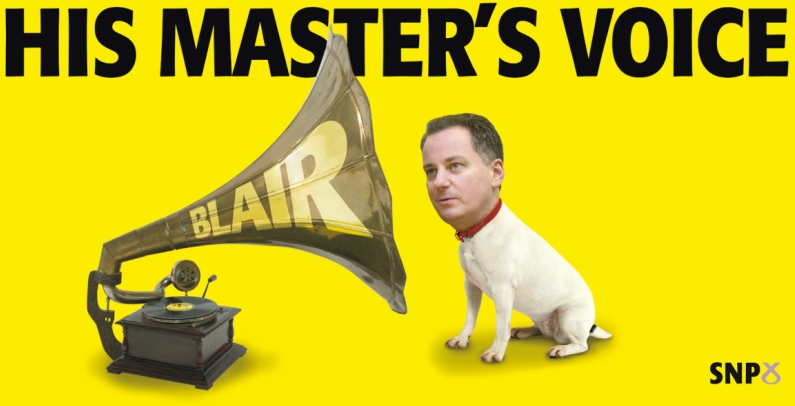
One of the most interesting things on television was the program "the wilderness years" about Labours ongoing process of changing from left to right. While Tony Blair is employing a manic grin and squeakily talking of the great things done by Neil Kinnock, John Prescott smiles wanly like a man who's just had all his teeth pulled out but is trying to put a brave face on things.
Brian Gould and others admitted that their party was wrong to ditch every principle they ever had and that Neil Kinnock was utterly incompetent and a stooge of Peter Mandelson. Tony Benn, who is the only honest and consistent politician Labour have ever produced, hit the nail on the head with his appraisal that Labour are just like the democratic party in the USA and their election to power will make as little difference to Britain as a change of government does in the states.
Since joining the SNP I have met a few individuals who have influenced me strongly. Jim Sillars the party's former deputy leader is a politician of enormous charisma and extraordinary public speaking skills. There are few people who can get a standing ovation at a public meeting in Woodburn community centre but Jim Sillars is one of them.
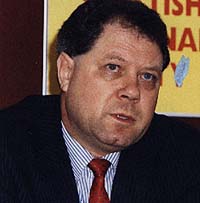
Mr Sillars, Alex Neil and Kenny MacAskill all came through and spoke at public meetings in our campaign from 1990 - 1992 to try and get our candidate for Midlothian elected, Andrew Lumsden. Both Kenny and Alex are now MSP's in the Scottish parliament.
Andrew is a brilliant politician who it was an enormous pleasure to work with. Shortly after his election as PPC myself and a number of other younger activists took over from the previous office bearers who had resigned en masse.
Andrew believed he had a decent chance to win Midlothian (it required a 25% swing or one in four Labour voters to start supporting the SNP). He was proud to call himself a socialist, which fitted in perfectly with my own political philosophy.
Andrew produced his own press releases with photos while myself, Dave Moyes and others like Brian Archibald, tried to fill out the more general picture and create an image of a well run local organisation. We attempted this by a thorough dissemination of SNP policy through the local press via press releases and Letters to the Editor. As I was Convener of the CA for the duration of the campaign I was in a position to be able to publish a lot of stories in my own name.
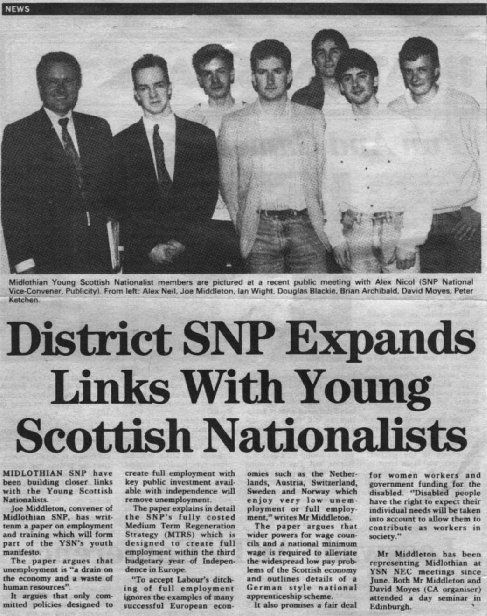
Click on the thumbnail (above) to see the larger picture and click back on your browser to come back to this page.
We were acutely aware that ordinary voters didn't know what the SNP stood for on education, employment and the health service so we tried to put forth as much tangible political information on core issues as possible.
We were lucky in that the Advertiser were willing to publish our efforts. I was lucky to have Dave Moyes to dig up local stories which I could then polish up for publication (most of the press releases we did during that time are on this site excepting Andrews which I don't have in computer file format - I may get them scanned later). Most of all we were lucky to have as enterprising a candidate as Andrew who attended numerous public meetings, made a huge attempt to support the re-open Monktonhall campaign (taking the campaign to firstly our party conference then later Westminster and the European parliament) and who dug up the first news of the local councils plans to close Greenhall High School which was to prove of crucial importance in the council elections which followed subsequently.
We were also of course lucky for many years to have Alex Salmond as party leader. Alex's debating skills made our party's presence seem much larger than it actually was. This was tremendously important in terms of political credibility.
Without the brilliance of Alex Salmond the party would not be in the position it is in today. He was helped enormously having Sillars as deputy while the policy of Independence in Europe (largely attributed to Sillars who formulated it in his old Scottish Labour party) made the party seem much more credible and effectively knocked on the head the 'separatist' taunt which Labour had successfully used against us for many years.
Alex Neil's free by 93 policy was run down in retrospect by some, however it was a tremendously exciting idea which helped the party to believe that we could get close to our goal of national independence. It was exactly the right message at the right time for the party.
Nobody in politics ever got anywhere without believing in what they were saying. Alex Neil, Jim Sillars and Alex Salmond's leadership put us in the position of believing ourselves that independence was just around the corner. That belief was what inspired our jump in support in the 92 election.
Our campaign in Midlothian didn't win but we did put across the party's message effectively reflecting the national strategy a direct attack on Labour outflanking them from the left. A substantial swing in our favour was the result of a hard fought three year campaign. Yes it was exhausting, Sillars was probably right that the Scottish people collectively lost their bottle at the last gasp but it was still the most exciting time I can remember being in the SNP and perhaps our most effective time of campaigning.
Currently we have a hugely different situation largely due to the establishment of the Scottish Parliament and (with PR) a massive increase in representation.
Salmond's leadership had lasted a long time and he eventually stepped aside for John Swinney. In the last two elections our vote has declined and John Swinney was recently challenged for the leadership of the SNP by Dr Bill Wilson, a Glasgow activist.
* We only had a handful of MPs at Westminster because of the FPTP (first past the post) system, unfortunately this system is still in place for both Westminster and council elections.
REAL REVOLUTION - THROUGH DEMOCRACY
In my last post (on my weblog Free Scotland Now!) I mentioned Colin Fox and his absurdist fantasies of the red flag being flown worldwide and wakening up to a new dawn. Unfortunately this dawn might well be accompanied by the boots of dictatorship, if it ever happened at all, which it won't.
It's not the case however that society is set up in a fair or just manner, far from it! However if we want change we must achieve it ourselves in our country, from below through consensus not imposed from above and through the democratic process.
What should we be looking for?
It is important to recognise that it is only in the last half-century that any significant economic improvement has been made in the lives of working people. The hard fought liberties of a free health service and education system are under threat of abolition and have already been significantly undermined by both of the main UK establishment parties, despite the fact that the trade unions still pour millions of pounds into one of them.
There is a minimum wage, but it is set at an embarassingly low rate. There are working time regulations throughout Europe which are completely ignored by Britain and while the amount of public holidays in Europe in general surpasses the USA (an employers paradise and an employees nightmare) there are swathes of temporary workers where their basic rights in this regard have been fundamentally eroded.
It seems clear to me that we need to set our own standards for working conditions and then vote in those who are willing to adopt those standards and vote out all those who won't.
Minimum Wage
�25 per hour would give an effective wage of just under �19 per hour, which is well within most business budgets (if they cut down on the wages of their chief executives and slightly reduce their bonuses for stockholders) companies must put their employees first.
Working Hours
There should be a legal maximum of 24 hours per week ie six hours for four days per week. All employees should have a basic right to flexible working hours
Holidays
50 days off per year (10 public and 40 statutory)
Pensions
Companies should be forced to provide a pension contribution of at least 20% of their employees wages per year
Education and Health Care
Must be completely free at the point of delivery. Education is a right not a privilege. Free health care should be a basic in a civilised society
Independence
Scotland is a rich country with ample resources. With independence we can choose our own destiny. If your local MP opposes independence then he is not interested in your welfare or the welfare of any other Scots. If he works for a London based party, that's where his true loyalty lies.
I suggest we write to our local representatives with this little manifesto. If they reject it then we need to reject them. Print 500 leaflets, put them round your local community centre, hold a public meeting and pick a candidate who does support such measures (yourself if necessary) then vote them in.
Most people are brainwashed into accepting the unacceptable. We need to lift our spirits higher and aim for a genuinely better society today.
NEW MESSAGES OF SUPPORT FOR INDEPENDENCE FIRST
"To build a Scotland that's free from poverty, racism, militarism, nuclear weapons and environmental degradation, we need first to liberate Scotland from the Anglo-British state. The campaign to allow the people of Scotland of decide their own future via a referendum deserves the support of all progressive people, not just in Scotland, but throughout the UK."
Alan McCombes (SSP)
"In an era when politics appears increasingly to be a murky mess of double-dealing, equivocation, trivial but pernicious party-political intrigue, and veiled but nonetheless lickspittle subservience to the interests of the multinational corporations at the expense of the poor, it is refreshing to see such a clear and simple demand, and heartening to view the cross-party support. If the political left is to get anywhere it needs to put aside what are fundamentally petty differences and develop a coherent strategy. Perhaps this will be the first step in the ascendance of the left in Scotland, and an example to the left elsewhere."
R. Eric Swanepoel (Author)
Taking the lid off Scottish ambition
by Brian Nugent
WEDNESDAY was St Andrews Day and how did you
celebrate Scotland's national day?
Probably like most Scots the day passed you by. Scotland does not celebrate its
own existence, unlike just about every country in the world, including our
neighbours in the North Sea.
The Norwegians celebrate Constitution Day on 17 May as their national holiday,
Iceland have their Independence Day on 17 June while the Faroe Islands celebrate
Olavasoka on 29 July.
So why is Scotland different? Dennis Canavan, Independent MSP, has put forward a
bill in the Scottish Parliament to celebrate St Andrews Day as a national
holiday. Hardly a radical proposal you would have thought but the best that
First Minister Jack McConnell can come up with is that he had "yet to be
convinced" by the merits of the idea.
The denial of a case for a national holiday is one aspect of a political problem
for the Unionist parties, having admitted that Scotland exists by setting up a
devolved parliament, how do they keep a lid on the bottle of Scottish ambition.
Unionist politicians are always looking over their shoulders to Westminster to
work out what will be acceptable to their political masters, they know their
careers depend on it. Politicians in Scotland should represent Scottish
interests and not the interests of another country.
Labour ran Scotland as their personal fiefdom from the 50s onwards. They were
not interested in promoting Scotland among its own population. All Labour wanted
and needed was subservient Labour voters at election time.
The lack of a St Andrews Day holiday is but a straw in the wind. Why do 500
members of the Literature Forum for Scotland feel the need to send a petition to
the Scottish Parliament to ask that Scottish literature, history and language
are taught in Scottish schools? Obviously, they feel that it is not happening
currently and that is remarkable.
Peter Peacock, education minister, was suggesting last month that the teaching
of history be removed from the curriculum completely. Is there any other country
in the world that goes out of its way not to teach its literature, history and
language? The Labour establishment in Scotland in charge of the school
curriculum did just that, trying to eradicate any aspect of Scottish life,
culture, history from the curriculum, a subtle form of ethnic cleansing. Don't
take my word for it, ask the Literature Forum for Scotland.
Learning about your own area and country gives you a grounding to be able to
appreciate and understand other countries and cultures.
Scotland's problem is that we are in bed with an elephant, England, and that we
have to keep selling our own country short for our bigger neighbour and be
thankful for getting the odd crumb.
Good luck to London on getting the Olympics but let us not pretend that this is
a British event, it is an English event pure and simple. The offer of a football
game at Hampden and some rowing at Strathclyde Park smacks of nothing more than
beads for the natives. Scotland is being patronised but we will get the
opportunity to partly fund the games by Scottish sports funding being cut.
The response of some to the Scottish Football Association's refusal to be part
of a UK football team in the Olympics beggars belief. To some extent the
Scottish football team has kept the name of Scotland in people's minds the world
over. There is considerable pressure on FIFA to merge the UK football teams into
one. If Scotland were to join a merged football team for the Olympics that would
be like the proverbial turkey voting for Christmas.
Scotland should not be asked to lay down and die at every opportunity but should
take every opportunity to promote itself on the world stage.
Why the hysterical response to asking that a Scottish team go to the Olympics? A
painless campaign to support surely at
www.c-scot.org/SupporttheCampaign.htm but no, Unionist politicians were
tripping over themselves to condemn such a move. If Hong Kong can go to the
Olympics, why not Scotland?
Unionist politicians are trying to ride two horses at the one time, they are
bound to fall off. It is a perverse career indeed that makes them want to
denigrate Scotland, and argue against even the simplest acknowledgement that
Scotland exists and to do it with such gusto.
Brian Nugent is a lecturer in Further Education at
Shetland College and a founder member of the
Free Scotland Party. A former SNP
member of nearly 30 years standing, he has stood as a candidate at local,
Westminster and Holyrood elections.
(From Freescot.com)
Independence Convention to launch on St. Andrew's Day

The Interim Forum for an Independence Convention is pleased to announce the
imminent formation and launch of an Independence Convention on St. Andrews Day,
30th November 2005.
The objective of the Independence Convention is to create a body for those of
all political persuasions and none who support independence and to be a national
catalyst for Scottish independence.
The Independence Convention will work to achieve this objective in the following
ways:
The Interim Forum has agreed these Governing Principles for participation in Convention:
There are three immediate questions the Convention needs to address:
Importantly, three
political parties; the SNP, the SSP and the Scottish Green Party, have confirmed
their support for the Independence Convention. These parties and other
individuals and organisations have been working together with others in the
Interim Forum for an Independence Convention for the last two years to achieve
agreement on the aims and objectives of the Convention.
The Convention will now look to the public and civic Scotland for the mainstay
of it membership and motivation and we have written to hundreds of independence
supporting individuals to join this new body.
The first public meeting leading to the establishment of the Independence
Convention will take place at 7.00pm on St. Andrews Day, November 30th, 2005 at
the Independence Convention launch will take place at Dynamic Earth Conference
Centre, Holyrood Road, Edinburgh at 7pm.
Official
spokesman: John Drummond Tel: 07710 326758
General inquiries: Aileen Orr Tel: 07980 661546
http://www.independenceconvention.org
http://www.freescot.com/news_page.php?story=57
MORE SUPPORT FOR INDEPENDENCE FIRST
The Celtic League, a leading activist in the Scottish Socialist Party and a Scots historian have all backed Independence First, the campaign for a referendum on Scottish Independence.
The Celtic League, an organisation which promotes co-operation amongst Celtic Nations, passed the following official motion of support for Independence First at their 2005 annual General Meeting which was held in Skye on the 12-14th of August.
RE: INDEPENDENCE FIRST
1.1 The Celtic
League supports the aims and objectives of Independence First, the Scottish
campaign for a referendum on national independence, and notes that the
organisation is both non-party and trans-party.
1.2 Recognises that the UK has never given the people of Alba [Scotland] or
Cymru [Wales] the opportunity to vote in such referenda, contrary to UN
self-determination guidelines.
1.3 Reaffirms its support for Scottish independence and opposes British moves to hinder its coming about.
Writer and publisher Kevin Williamson, who writes a regular column for the Scottish Socialist Voice, is joining the campaign.
Mr Williamson commented: �Scottish Independence should be the first priority of everyone in Scotland who believes in bringing democracy closer to the people. Westminster has always been a remote, autocratic, medieval, and essentially anti-democratic Parliament that has never reflected in any shape or form the views or hopes of the majority of people living in Scotland. The break up of the British state into four democratic republics living at peace with each other, and the rest of the world, is long overdue.�
�I'd like to offer my full support to Independence First and encourage others to join as a member and take part in the most important political cause of our lifetime. Wherever a person's political or party loyalties lie, only full Scottish Independence can provide the democratic tools to make those political ideas a reality.�
�Here's hoping that with Independence First's support, Scotland will elect no less that 65 Independence-minded MSPs to the Scottish Parliament on the 1st May 2007 - i.e. a majority - and set in motion the road to democracy, peace and freedom.�
The Scottish
historian David Ross who recently completed an extraordinary 700 mile march in
remembrance of William Wallace also gave the following message of support to
Independence First shortly after the campaign was launched:
"Scotland
is a nation state. We owe it to all the generations of Scots yet unborn to
deliver a heritage of freedom, of pride, of self determination. For many
generations Scots have strived to create the independence that our nation
rightly deserves. Let us be the generation to deliver that freedom -and those
Scots to come can grow without the burden that weighs so heavily on our
shoulders and stops us taking our rightful place, with our flag flying as an
equal amongst the other nations of this planet. I therefore support the
Independence First campaign and wish it every success."
The endorsements are the latest in a long line for Independence First which has also received supportive messages from SNP & SSP MSP�s and official support from the Scottish Green Party.
|
Time for Scotland to leave this potential UK police
state
by Joe Middleton
This article was Web Published in
the Free Scot Review
With all the talk of 'U-Turns' and 'climb downs' over the Anti-Terrorist bill
one might imagine that common sense had won the day and that the Government had
been forced to respect basic civil liberties. In actual fact no such thing has
happened.
The only compromise has been the insertion of a clause which means the bill must
be renewed within one year, i.e. the next UK Government rather than this one
will make the decision. Unfortunately, unless the elections result in a hung
parliament (a highly unlikely occurrence under first past the post) and the
Liberal Democrats or SNP are in the position to put pressure on a coalition
Government - both the Tories and Labour are likely to continue to keep this bill
pretty much unchanged.
It is more than likely that the Tories will also decide that locking up people
without trial and putting them under house arrest is a useful power once it has
become established that the Government can get away with it.
Since 1974 ever more draconian "anti-terror" legislation has been passed,
and with every amendment more 'special powers' are handed to the Government with
progressively less regard for the rule of the law and the basic principle of
'innocent until proven guilty'.
Over 97 per cent of those (mostly Irish) people arrested under the original
Prevention of Terrorism Act, were never charged. The Guildford Four and
Birmingham Six are the most obvious examples of miscarriages of
justice for innocent people who happen to be in the wrong place at the wrong
time.
This latest bill will allow Terrorist suspects to be detained indefinitely
without trial and without any evidence produced in justification.
Furthermore a draconian system of effective house arrest will be introduced on
the orders of a Judge based on the ill informed rumours and suspicions of MI5.
Let's not forget that this is the paranoid and unaccountable secret organisation
who has bugged numerous serving Government ministers and who according to ex Spy
Peter Wright "burgled their way across London" on a daily basis.
The most worrying fact however is that these powers could potentially be used
against anyone who opposes the Government. Already the BNP and Animal Rights
Activists have been identified as possible targets.
Speaking after the Home Secretary Charles Clarke, announced new laws to control
the movements of terrorist suspects, Mr Clarke's adviser, Stephen McCabe, told
The Scotsman he saw this extending to other groups suspected of using violence
to further their ends. The Labour MP said: "We can envisage this applying to
animal rights extremists and the far-Right, for example.
"These people are locked up because we believe they are a genuine danger based
on what we think is pretty reliable evidence, even if it cannot be
divulged in a court of law." (1)
In truth, this could affect any political activist who the Government disagrees
with. I can't stand the BNP but they are a political party. The Tories are
actively playing the race card at the moment, so really there is only a
difference in emphasis between the right and far right of the political
spectrum.
Who decides who is a threat and who isn't? Who watches the watchers?
MI5 have often considered trade unionists to be a threat to the UK, as have the
FBI. In reality they may be a threat to employers but they are an enormous
benefit to their fellow workers.
The rules on 'national security' are purposefully vague and cover anyone who is
"a threat to the economic interests of the UK" which could easily include
Scottish nationalists.
The Scottish Parliament has rejected ID cards outright and it's democratic
decision should be respected. However, the Government is prepared to tell any
number of bare faced lies over their proposals. In a letter to me dated
12/08/2003, Beverley Hughes, the former Home Office Minister said: "The
Government has made clear that it does not consider that an entitlement card
scheme would have a significant effect in combating terrorism in the United
Kingdom."
In the same letter she also said that the Government would not be consulting on
a compulsory scheme. In fact the Governments proposed ID card scheme will be
compulsory by 2013.
The Government has also deliberately overestimated the amounts of terrorist
suspects in an attempt to scare people into supporting their plans.
"There are several hundred in this country who we believe are engaged in
plotting or trying to commit terrorist acts," Mr Blair told Radio 4's Woman's
Hour. (2) A similar claim was made by the ex head of Scotland Yard to the down
market tabloid 'The News of The World'.
However a 'senior security source' quoted in The London Times newspaper said
that these figures were based on numbers of people who traveled to training
camps in Afghanistan and Pakistan, prior to September 11.
Of those only 25 or 30 who are known to be in Britain, with some of those in
prison in Belmarsh. The source said the Prime Minister's estimates of the scale
of the terrorist threat was sloppy. "It is irresponsible and likely to scare
people unnecessarily," the source said. (3)
A further major problem of ID cards is that they are likely to increase the
police harassment already suffered by ethnic minorities.
Writing in the Scottish Left Review Aamer Annwar pointed out the full extent of
the current discrimination against "Muslims and people of middle eastern
appearance."
"Home Office figures revealed that stop and searches of Asians under new
anti-terror laws soared 302 per cent in a year. The total number of stop and
searches under counter-terrorist legislation more than doubled from 8,550 to
21,577. Anti-terror searches of blacks rose 230 per cent, from 529 to 1,745, and
of whites 118 per cent, from 6,629 to 14,429.
Some 8,000 people have been stopped under the new anti-terrorism powers. Yet
only 170 people have been charged as a result. Just two of those have been
convicted. Both were for possession of a small amount of cannabis, which hardly
amounts to a 'terrorist threat'." (4)
Given the fact that the vast majority of Terrorist 'suspects' never come to
trial and are convicted that means that potentially an enormous amount of
completely innocent people are likely to be locked up based on nothing but
suspicion.
Anti Terrorist experts doubt that the newest bill will make any improvement in
the Government's ability to fight terrorism - however it is clear that they will
involve an enormous loss of basic human rights.
Professor Paul Wilkinson, chairman of the Advisory Board of the Centre for the
Study of Terrorism and Political Violence at St Andrews University, strongly
attacked the proposals recently in an article entitled "Wrong weapon in the
battle against terrorists".
He said the proposals were being "rushed through with inadequate time for proper
consideration of their implications for civil liberties and their potential
efficacy in preventing terrorism."
He added "not only [would the proposals] once again involve the UK in derogating
from Article 5 of the European Convention on Human Rights and would hence be
ruled unlawful by the judges, it would also be dangerously counterproductive."
He ends his article by writing "I do not believe we should be passing
legislation which undermines a basic civil liberty and which, in any event, is
unlikely to make any useful contribution to the prevention of terrorism." (5)
The simple fact is that detention without trial, house arrest and compulsory ID
cards are not the actions of a democracy and the Labour Government should be
wholly ashamed of themselves for producing these draconian proposals.
That they are not ashamed and are prepared to justify such extreme measures with
misleading statistics and blatant lies proves that there is only one way of
escaping from this potential UK police state and that is by voting for Scottish
independence.
Sources:
(1) 'BNP and animal rights activists face house arrest' (The
Scotsman 27th January 2005.
(2) and (3) Times (London) - 1st March 2005
(4) A permanent state of terror? by Aamer Anwar SLR Issue 23.
(5) Wrong weapon in the battle against terrorists by Paul Wilkinson The Scotsman
10th March 2005.
Scotland's Republican Voice
by Graham Connelly
The Scottish people, particularly the younger generations, are not monarchists;
there can be no doubt about that. That the argument for a republican Scotland
has already been firmly won, and it has, is all the more remarkable for the fact
that it has been won without any substantial public debate on the issue ever
having taken place. The mere application of democratic principle and common
sense, in a contemporary setting, has been sufficient to defeat monarchism.
Monarchism, based upon hereditary privilege as it is, is anathema to Scottish
culture and our way of life. The repugnant fantasy that any one person is of
greater worth to society than another, simply because of who their parents
happen to be, insults every fibre of our fundamentally democratic being.
Monarchy is hereditary elitism; it is the antithesis of the values of equality,
democracy, justice and merit - irreconcilable counter-values.
We need only look at the recent opening of the Scottish Parliament to see how
awkwardly uncomfortable and out of place the English monarch felt at having to
be there that day. It was an affront to democracy that she was invited at all
but it was perfectly in character of Her Majesty�s devolved court jesters in
Edinburgh to invite her.
Some might reasonably have expected Scotland�s national party, the SNP, to more
accurately reflect the mood and wishes of the Scottish people (largely absent
from the pomp and ceremony of the day) by joining the peasants on Calton Hill
for a good day out instead. SNP activists, including the Young Scots for
Independence (YSI), were on Calton Hill but their MSP�s were conspicuous by
their absence.
The English monarchy recognises the differing Scottish and English attitudes
towards it. In the main, English society fondly identifies with the monarchy. It
is, after all, their Queen Elizabeth II of England, and it is probably for that
reason they line the streets of England in their droves to pay homage to her at
every opportunity.
Contrast that with the attitudes and actions of ordinary Scots who were bemused
by the attempt to foist upon them a false sense of grief at the unfortunate
death of Princess Diana. On the day of her funeral, our North British
televisions beamed images into Scottish homes of swathes of grief-stricken
English subjects pounding the queens highways of London, Manchester, and
Birmingham - barely an inch of pavement to spare.
Meanwhile, news presenters struggled to conceal their confused embarrassment at
the images of the empty streets of Glasgow, Edinburgh, Aberdeen and Inverness.
Ordinary Scots were similarly confused as to the reason for all the shops being
shut but no doubt thankful for an extra day off work whatever the reason. And
this was the people�s princess, the queen of hearts no less.
Being aware of the difficulties that exist for the monarchy in Scotland, it
attempts to ingratiate itself with Scots by the use of conspicuous philanthropy
and other charitable acts of kindness, all of them bizarrely newsworthy.
However, it is mostly in vain because Scots continue to reject them.
Does the Scottish rejection of monarchy make us republicans? Yes, it does, small
�r� republicans but republicans nevertheless. Why then do we hear little of
republicanism in Scotland and why the unease with the use of the term itself?
Republicanism in Scotland has become almost inextricably linked with the
Scottish-Irish community in Scotland, deservedly proud of their Irish heritage
and the republican tradition that comes with it. However, this has served to
perpetuate the myth that republicanism in Scotland belongs exclusively to a
section of the Scottish-Irish community. It does not, we need to challenge and
overcome that myth.
This is Scotland, and Scottish republicanism merits a voice of its own. There is
no good reason why republicanism in Scotland cannot belong, and be seen to
belong, to all in Scotland who subscribe to its democratic principles. For far
too long, Scottish republicanism has been subdued into something of a minority
activity.
Now, consider the current Scottish political landscape. There has been the
emergence of the smaller political parties over the last decade, even successful
single-issue candidates. Whether we like it or not, the proliferation of the
pro-independence voice is here to stay. But where is Scotland�s republican
voice?
Our democratic will and Scottish sovereignty itself are routinely undermined
when our parliamentary representatives step forward to swear an oath of
allegiance to a monarchical institution at odds with everything that modern,
democratic Scottish society stands for. Many of them swear the oath of
allegiance under protest but they still swear it. It is time that this stopped.
Our democratically elected representatives must begin to take Scottish
sovereignty more seriously.
The suggestion that the swearing of the oath of allegiance in private, in
another room away from the chamber, would be an improvement is a blatant insult
to our intelligence. The oath is an affront to the people of Scotland no matter
how or where it is sworn.
It is time that the oath was abolished and a steadfast refusal to swear it may
be required to force abolition. Republican and nationalist candidates should
decline to swear any oath of allegiance to the monarchy, even if they are
threatened with not being allowed to take their seats if elected.
Scottish sovereignty rests with the Scottish people, as made clear in the
Declaration of Arbroath. Yet, despite Scotland having had it�s own devolved
parliament since 1999, all the Scottish political parties continue to contest
elections to the Westminster parliament in England.
Republican and nationalist candidates contesting the next Scottish Parliamentary
election in 2007 should issue a clear declaration of intent that they will
refuse to swear any oath of allegiance to the monarchy. That declaration of
intent should enshrine within it a similarly clear statement that they will
continue to contest elections to Scotland�s national parliament in Edinburgh but
they will no longer contest elections to the Westminster parliament in England.
The way needs paving for the extraction of the Scottish political parties from
the Westminster parliament in England, a parliament in which they do not belong.
Scotland has to be taken from the left.
Ian Swanson�s article in the Evening News on the SNP�s
decision to proscribe the Scottish Republican Socialist Movement on the grounds
that the SRSM is affiliated to the SSP was entirely correct and the SNP are
entitled to take that position if they wish. Many of your readers would know
little of the matter and would probably care less, as would some in the SNP and
SRSM.
However, some would care for the sake of mobilising all shades of political
opinion towards the immediate goal of Scottish Independence. If Scotland is to
be taken then it has to be taken from the left. How anyone can consider Auld and
New Labour left of Thatcher is beyond all logic. Nevertheless, they can command
electoral loyalty in large parts of Scotland without doing a thing. Even if they
battered their voters on the heid wi� a big stick the night before polling day
many would still crawl out to vote for what they wrongly perceive as the
inventors of the Welfare State.
The facts are that even the dreaded Tories have a more liberal record than Lords
Wilson and Callaghan, who paved the way for Thatcher with their workers pay
freezes and cut backs. The Welfare State was agreed by the wartime coalition,
with minor differences and Viscount Lord Atlee ratted on most of his promises.
His junior secretary resigned when he introduced prescription charges and then
put them up when he became Prime Minister himself: yes Lord Harold Wilson the
scourge of the Tame Unions.
The SNP, who have always been a radical opposition in Scotland, were unfairly
dubbed �Tartan Tories� by Labour�s Union Jack Tories. The British agents in the
�revolutionary� left who backed them under the guise of �Towries Aht� also
dubbed them �fascist� and �racist� Stands to reason don�t it? Anyone who does
not want to be ruled by London must be so.
The original Scottish Labour Party were formed by Home Rule constituent elements
such as; the �Highland Land League�; �The Scottish Home Rule Association�
(Ramsay MacDonald and the Red Clydesiders were in the SHRA), �The Scottish
Cooperative Society� (who were closed down in the 70�s and taken over by the
English COOP resulting in English buyers emptying the shelves of Scottish
produce and closing down factories and farms here) and the �Scottish Trade Union
Congress�.
All the Scottish Trade unions were closed down in the late 60�s and early 70�s,
giving the top Tame Union bureaucrats in Scotland the second top job in the
London based Unions. Ironically, the only Scottish Union left is the EIS. John
MacLean, as a teacher could not be a member of a union and had to join the SCWS
instead. He was vilified by the Great British Left then, as now, for his stance
on a Scottish Socialist Republic.
There is a small Scottish gaffer�s Miners Union, with about forty members left,
since Labour, not Thatcher, closed down most of the Scottish pits, when that
other old Viscount, Wedgie Benn, built nuclear power Stations in Scotland,
despite the fact the at we had plenty of water to build hydro dams for our own
and other needs. Incidentally that other old sell out, Tom Johnston, is
generally credited with Scotland�s Hydropower when the fact is that the War Time
coalition under Churchill wanted hydropower for atom bombs.
Shortly after the original Scottish Labour party was taken over from London,
their Chairperson and Secretary resigned. RB Cunninghame Graham and Dr Clarke
became founder members of the National Party of Scotland in 1928, along with
radicals such as Hugh MacDiarmid and Compton MacKenzie, etc. The NPS, later
became the SNP after a merger in 1934.
Radicals were expelled from the SNP as part of the 79 Republican Socialist Group
in 1979, Including, Alex Salmond, Kenny MacAskill, Roseanna, Cunningham, etc. It
ill becomes the SNP, with many radical republican members to break with this
tradition and desert the radical tradition built up over the last hundred years.
For what? To outflank New Labour from the right? Even the Tories cannot do that.
The �Scottish Republican Socialist Clubs� were a cross party group formed in
May, 1974 to unite Scottish Nationalist and the British �left� towards the
traditional goal of a Scottish Socialist Republic and influence opinion towards
the minimum demand of Devolution and the Maximum demand of a Socialist Republic.
Extreme poverty and mass theft of our resources demanded that course. The SRSC
decided, unadvisedly, to become a Scottish Republican Socialist Party in 1982,
and a cross party organisation, again, becoming the SRSM, affiliating to the
embryonic SSP. The dualist nature of the SSP meant that the GB Unionist
platforms would inevitably bring us into conflict there, with even demands for
our expulsion.
There is nothing more divisive than attempts at unity. Elements in the SNP and
SNP are for and against a cross party Independence forum, certainly before the
election. The Greens claim that Independence is only another bum of the month
issue � way down the list.
By expelling the SRSM members from the ranks of both the SNP and SSP the
Unionists will have gained another nail in the door, if not the coffin, of
Independence and Labour careerists will be laughing all the way to their
Anglified Banks and pension companies.
Donald Anderson, Scottish Republican Socialist Movement
|
New SNP Leadership Offers Fresh Start
On the face of it, left wing members of the SNP should be pleased with the election of Alex Salmond and Nicola Sturgeon to the leadership of the party. Salmond has declared himself to be a socialist in the past and Nicola Sturgeon has a history of left activism, at least in her early days within the YSN.
At that point of course the party was deliberately playing up its left wing credentials to contrast itself with Labour who were rapidly moving towards their holy grail of New Toryism.
The �79 group, which was eventually to effectively take over the party, sprang from analysis of the �79 referendum results. The party realised at that point that it was the working classes who were the most enthusiastic for devolution and realised that a left wing shift could potentially undermine (and hopefully replace) Labour amongst the public�s affections. The SSP have also noticed a similar trend on the national question which explains their more recent support for the most radical constitutional option.
The socialists in the SNP have always been a wing rather than a full bird. The SNP is a broad church and at no point has it ever been willing to fully embrace socialism. However in the nineties under the leadership of former �79 rebels like Salmond and Kenny MacAskill, almost by standing still, the party was suddenly quite far to the left of Labour. Kevin Pringle�s research unit was producing useful statistics and the nitty-gritty policies were taking a definite turn towards the radical left.
We had a clear commitment to unilateralism, a fully costed plan for full employment and genuine plans for substantial public investment. The whole party strongly favoured the re-nationalisation of the Steel industry and with Jim Sillars as Deputy Leader we embraced a form of internationalism with �Independence in Europe�.
At that time, at least in the younger section of the party, socialist views were pretty much taken as a given. Of course many of these old faces are still around occupying different levels of influence. Rob Munn would later get the onerous task of becoming our only councillor in Edinburgh, and now works in the new parliament. (While Munn is probably less vociferous in his views now than he once was, at one point he was so politically correct that he has worried Braveheart would alienate �New Scots� because there were no Blacks or Asians in it.)
When Stuart Hosie (Shona Robison�s now spouse) was standing for Vice-Convener (Youth Affairs) was asked what he meant by saying he was a socialist he retorted �I believe in the nationalisation of means, production and control� and he got elected to that post.
Fiona Hyslop is now an MSP and is still on the left of the modern party. She was a former close associate of Salmond as well and it is probably only the slight age gap between her and Nicola Sturgeon which prevents Hyslop being the current �bright young thing� to Salmond�s elderly uncle.
She is possibly no longer amenable enough however for Mr Salmond, who prefers his assistants to come with strings firmly attached.
This of course was the basis of the main opposition to Nicola Sturgeon. It was obvious that Salmond had gazed up from London and perceived a potential defeat for his prot�g� from the irascible Roseanna Cunninghame and decided to step quickly into the breach and take direct control.
Nicola�s decision to take this option by stepping aside at the last minute from her own ambitions and swiftly ditching her lead balloon running mate Kenny MacAskill showed that she had the limited ruthlessness necessary in a potential stand-in leader.
Nicola has always been highly ambitious and she is a clever and astute politician in her own right. In this case she took the smart option which has paid off for her big style. She has now been whipped into the leadership of the Scottish Parliament with a decent majority, albeit by holding onto Salmond�s coat tails and with the benefit of a regular press release in the �SNP News� email list.
The problem for the party is not now the leadership, Salmond is a highly efficient and populist leader, while Sturgeon will I�m sure prove a ruthless stalker of McConnell in the Scottish Parliament. Sturgeon has proved her ability to hold a brief and push it, harrying various unfortunate ministers and is an obviously easier ideological fit with Salmond than either of the other contenders. Whether the leadership in the Parliament should just be a brief is a moot point and one which was not effectively answered during the campaign.
Personally I would have liked to have seen Christine Grahame as deputy as a more independent balance to Salmond�s views but eventually the result was highly predictable under OMOV.
The new leadership of the party has to be careful to not repeat the mistakes of the previous leadership. In his final year John Swinney attempted the final steps of his Blairite transformation of the party. He had already tried the bland colour analysis and smooth packaging of the Labour electoral machine. Still smarting from a challenge by a party activist he then went further and reduced the internal democracy of the constitution. With OMOV he has forever guaranteed populism will outweigh idealism.
Shortly after this triumph of his will he decided to tackle his lone �Militant� who had been embarrassingly forthright in telling the truth about the party�s dire performance. Campbell Martin was duly suspended, then expelled shortly after.
While John Swinney can�t be blamed entirely for the gradualist experiment and the referendum policy (that was Salmond�s idea) he can be blamed for extending the process to a foolish three year waiting period; guaranteeing an unnecessary propaganda coup for his new socialist rivals for the independence vote.
Compounding this mistake was Jim Mather�s suicidal New Tartan Toryism. Mather changed the SNP�s sensible and not particularly controversial business carrot on Tax (levelling the playing field with English companies) to an ideological obsession which would transform the economy based on the Laffer curve.
His next trick, no doubt inspired by some lunatic American self help manual, was that he got so carried away with the idea of fiscal autonomy (minus independence) that after been winked at a few times by the affable David McLetchie, he eventually started talking of pacts with his new found best friends and even said that a left of centre independent Scotland was �a delusion.�
Of course he found some friends to support this odd view point (though most activists were horrified). Duncan Hamilton, new found Scotsman hack began to muddy the cause even further with various articles waxing lyrical about England�s green and pleasant cricket fields, warm beer and Rangers FC, leaving people in serious doubt as to what a Scottish nationalist actually was any more.
New ideologically free-pure Kenny MacAskill decided that his old socialist views were holding his political career back and started slicing SNP sacred cows like a maniac butcher, �Let�s stay in NATO!�, �forget Bannockburn!�, �Park Independence!� and �Let�s have a fiscal autonomy convention!� thereby offending every wing of the party and inventing a new style of political campaigning, whereby you stick two fingers up to all your own activists and watch them leave in droves.
What perhaps sums up the Swinney leadership most is the mess that was made of the RMT debate. The RMT had decided to eventually up sticks from Labour, something the SNP trade union group had exhorted them to do for years. In these circumstances ten years ago the SNP might have played up their anti-privatisation credentials and made a commitment to Re-Nationalisation of the Railways, they would certainly have pushed hard to bring the unions onside.
It wouldn�t be impossible, after all Plaid Cymru have begun to gain union funding in Wales. Under the transport leadership of Kenny MacAskill however, you don�t even get a cast-iron SNP commitment to re-opening the Waverly Line!
John Swinney did his best, opening negotiations with the RMT leaders, but MacAskill was dismissive - portraying the potential SSP-RMT link as �Scargallist� on TV thereby uniting them together more effectively than if he had called on them to get married. Meanwhile Duncan Hamilton said in the Scotsman that we shouldn�t touch trade union money with a proverbial barge pole, conveniently forgetting that the party was to put it bluntly, completely and totally skint.
There are some things which can be done now however to bring the SNP back from its current electoral decline. Our problems are not insurmountable. Labour is still weak and the Salmond/Sturgeon leadership offers a potential break from our inconsistent recent political past.
To do so effectively however all the bad blood must be washed away and the party has to unite. By supporting Alex Salmond after Salmond had deliberately scuppered his own chances Alex Neil proved that sometimes SNP politicians can put the good of the party first before their own ambition. I hope Salmond will likewise make the best use of the political resources available this time around. The first thing to do is realise that mistakes have been made and learn from them.
The party needs at this point to put the gradualist lame duck out of its misery. A wishy-washy commitment to independence is not good enough for a nationalist party. Gradualism has failed and an alternative more straight forward strategy is required. If we must have a referendum then it has to happen immediately on gaining power not after farting about for three years in the Scottish Parliament.
A definite turn back to the left is urgently required. The SNP will never win independence from the centre right, and it has to be consistently on the left in its full set of policies.
The party must learn from the SSP and start moving funds from bulging MSP pockets out to their local organisations. Armani Suits and flash cars won�t win independence
The party must forget silly class-divisive anti-smoking campaigns and concentrate on pushing genuine civil rights issues like stopping British ID cards.
The party must look at what issues can highlight the divisions between the British state and the independence movement. Republicanism is an obvious avenue of attack. If the oath isn�t required for Stormont it shouldn�t be required for Holyrood.
Finally, we should give full wholehearted support to the independence convention and work together with the other Scottish parties to create a left of centre consensus in Scotland.
This article was published in the Scottish Workers Republic and the Free Scot Review.
How can Scots parties move forward to Independence?
(Scotland on Sunday 09/05/2004)
The set-up of the Scottish parliament also lends itself towards unfairness. The
voting system, with its FPTP majority element, basically guarantees power for
unionism.
STV will come in for local elections, because central government knows that
local government is no real threat. Essentially, another layer of elected
apparatchiks (but now on an all-party basis rather than the former Stalinist
dictatorship of Labour) will fiddle around with silly projects, up the level of
council tax, and remain entirely subservient to central government. STV will
never reach the actual powerbase, Westminster, and it will never reach the
Scottish Parliament either (just in case).
There are two hopeful elements in the Scots body politic, however. One is the
aforementioned rise to greater prominence of smaller parties due to the
proportional element of the Scottish Parliament (not exactly STV but better than
nothing). Two is the Scottish independence convention.
The Scottish independence convention offers an opportunity to work together on
the mechanics of independence. Once we nail down the route map to independence,
set up the actual mechanics of a referendum, and decide in advance the
objectives of independence negotiations, it will be much more transparent to the
electorate.
The potential of agreement within the Scottish left is much larger than the
silly �arguments� that crop up around election time.
�Boo!� says Labour, �ye canny afford independence!�. �Aye we kin!� says the SNP.
Other issues tend to be strangled between the phoney debate on these two
positions. In reality, the �economics� of independence cannot be proven one way
or the other, resting as it does on various sets of figures, a lot of which are
unavailable.
We must move on from arguing whether Scotland can afford to be independent; the
question is really, �can we afford not to be?� Given the alarming political
moves from London, all left parties must unite around a move away from
Liblaboryism and its elected dictatorship - The House of Commons.
Under the stifling nature of Liblaboryism, any new and/or progressive or even
interesting political ideas are kicked into touch. To give but one example: the
case for a local income tax has been overwhelming for years but, since it was an
SNP idea (now adopted by SSP under a different name), Labour cling to the
council tax, a system which is for most people a lot worse than the hated Poll
Tax it replaced. The truth is the Tories don�t want it and Labour just don�t
have the guts to rock the boat.
So how do we defeat Liblaboryism or �Unionism�? The only way is by forming our
own movement to defeat it. The name of this movement doesn�t matter, but what it
must do is involve all Scottish political parties.
By this I don�t mean Labour, Tories or Lib Dems. All of these parties are
irrelevant to a progressive Scottish society. Each is controlled by London; each
supports the existing union; each has turned its back on giving any more power
to the Scottish Parliament.
The Tories �interest� in fiscal autonomy is as genuine as their new support for
the Scottish parliament. The Tories say one thing in power and another in
opposition. Does anyone seriously believe the Tories would stop tuition fees, ID
Cards or PFI? David Davis is already �cautiously welcoming� the Government�s ID
Card plans. Soon he�ll be �heartily embracing� the whole plan and happily
introducing the compulsory element that Labour have not yet officially committed
to.
The cause of independence will not be won by coffee mornings, cheese and
wines, jumble sales, or squeezing our own rapidly declining vote into the
polling stations. The only way forward is preaching a different agenda on a
one-to-one basis across a door step or, even better, in a public meeting. Policy
papers, political journals and in-house newspapers like the Scottish Socialist
Voice have their part to play as well.
There are lots of people who do want change and who are sick of the existing
political system. The decline in the vote shows that the existing political
structure, candidates and parties do not match people�s expectations.
I suggest we use the convention as the first building blocks towards a permanent
alliance of the left. The SNP, Greens and SSP need to start supporting each
other in the Scottish parliament. We should share knowledge, swap campaigning
tips, meet often and eventually form electoral pacts.
That is the only way to win the rigged FPTP elections. The SNP has successfully
built considerable support up North. The SSP is beginning to break through in
Glasgow and the central belt. The Greens had the greatest breakthrough in the
Scottish parliamentary elections and are becoming stronger throughout the EEC.
All parties pretend to be green at election times. The SNP should be genuinely
green all the time by going through the whole Green manifesto and trying to
adopt every policy that might work. The SNP manifesto in 1992 was very green. It
can be done and needs to be done. A genuine green agenda slips comfortably into
a more socialist philosophy.
The SSP have made a big breakthrough by uniting the general fringe left. Even
the SWP, no friends to independence, have joined the SSP along with small but
important groups like the Scottish Republican Socialist Movement.
Many left-wing people have tried and failed to infiltrate the Labour party.
While I understand the reasons (if Labour could be turned to independence, for
example, we would get it tomorrow), ultimately such moves are self-defeating.
�Labour� is only a name. The concept of a Labour party, while still relevant,
must be turned into a newer grouping which moves forwards. Labour voters are
doing so, not for any love of Tony Blair, but because of a memory of change.
The fact is that none of the other parties has came up with a more relevant
political philosophy. Independence is potentially an exciting concept, but it
does not become relevant to voters until flesh is put onto the bare policy
bones. The SNP�s main problem is that it has no easily identifiable political
direction. As a voter said to me, we are �an umbrella� but people want to know
what�s under it.
During the 1990�s we were a recognisable left-wing party, this becoming more
obvious as Labour shifted further and further to the right. We had a vigorous
policy profile built up over many years, including a clear commitment to
CND-style unilateralism and a strong (and well worked out) commitment to full
employment. We could therefore paint ourselves as a genuine alternative to
Labour.
We also had a strong set of policies based around reversing the Thatcherite
attacks on benefits and union rights, and introducing a decent minimum wage.
While these policies still exist, the leadership have preferred to move to an
oppositional style of politics based around the possible powers of the
parliament.
These powers fall far short of independence, and therefore the old radicalism of
the party has diminished with the Greens and the SSP picking up the slack. The
referendum policy was incredibly badly judged and allowed the SSP to claim we
were not even committed to independence.
This claim is not accurate, but as it is difficult to discern what SNP strategy
actually is, it is perhaps not surprising that it has gained some currency. It
is certainly the case that, as devolution has progressed, activists have become
more and more resentful of a wealthy parliamentary group which appears divorced
from the problems of a declining activist base.
Not only are MSP�s unwilling to fund the SNP, the leadership seems committed to
reducing internal democracy. OMOV might sound good to journalists, but activists
know they are being blatantly pushed aside. The leadership has recognised that
some activists are unhappy with the party�s strategy. Unfortunately, some
leading figures, like ex-MSP Mike Russell, appear to view them as expendable.
The reason for this is that some of the left of the party, which effectively
took over the party (the �79 group), have metamorphosed from firebrands to
comfortable armchair pundits. The thinking goes something like this: �the SSP
and Greens offer a left alternative, therefore we can capture the centre-right�.
Unfortunately, such a maneouvre would not only sicken every party activist, it
would alienate our entire vote, built on the understanding of our being a
genuine alternative to Labour! If we turned around and became yet another
monetarist party of the centre-right, not only would we be hitting a very
crowded political patch (there are three right-wing parties already), we would
effectively be moving onto the English political agenda and against our fellow
Scots. The old Labour �Tartan Tory� jibes would become true. This �position�
does not make any sense and can only undermine the SNP. Hopefully, its adherents
are few and far between.
The independence convention provides the umbrella that the SNP was supposed to
be but has never truly become. The SNP have to make the convention the start of
a process of working together with the other Scottish parties on a general
basis.
The Convention, if properly run, will give rise to a much greater forum of
people united around the cause of independence. The logical next step then is a
Scottish independence alliance that can turn the concept of independence into
actual reality.
This article appeared in the Free Scot Review
Democracy destroyed in the heart of Europe
(re-printed
from the Scottish Socialist
Voice)
When is a political party not a political party? When it's Batasuna, the
organisation which campaigns for both socialism and independence in the Basque
Country, in the north of Spain.
"I suppose it's a combination of a political party and a movement", explains Alan McCombes, who recently visited the Basque Country with another SSP member, Lloyd Quinan, on the invitation of Batasuna.
"It includes different component parts. There's a youth movement, a women's organisation, newspapers, radio stations. The trade union federation that they're linked to organises 32,000 workers, about 16 per cent of the workforce. They have about 5000 to 7000 people active in the different elements of Batasuna, organised into 200 branches."
All that, and Batasuna has been functioning illegally for the last three years, since it was banned by the right-wing Spanish government of Aznar. When Batasuna was illegalised, they had 60 mayors of towns and villages, 860 councillors, 40 regional councillors, 14 parliamentary deputies (MPs) in the Basque autonomous parliament, one Euro MEP and around 15 per cent of the vote - about 200,000 votes. "Aznar's ban", says Alan, "represented a massive onslaught by the Spanish state against those forces that were fighting for independence and socialism in the Basque Country."
"Many of their leaders were arrested, using the pretext of terrorism and ETA - even though they have no links. I met several people who had just been released from prison, who were elected mayors of towns, some of them quite elderly women. They had been imprisoned for one and a half years but they were never put on trial."
The Basque people's struggle for independence from Spain has been long and bloody. Under the fascist dictator Franco, people were executed for speaking Basque and gravestones inscribed in Basque were erased. In the 1960s, resistance in the Basque Country to the fascist Spanish regime took the form of an armed struggle.
"The problem is that, after Franco died, there never was any real peace process or any attempt to deal with the fact that Spanish jails were packed with young Basques who'd taken up arms against Franco."
"The governments that have replaced him have explicitly denied the right of the
Basque people, and of the people of Catalonia and Galicia, to
self-determination."
The Spanish constitution allows for autonomy and established the Basque and
Catalan parliaments. But it also insists that devolution goes this far and no
further.
It explicitly upholds the "territorial integrity" of Spain - it says that Spain is an indivisible country and cannot be broken up, and any attempt by anybody to bring about the division of Spain is regarded as a treasonable offence.
"The thing is," Alan continues, "the Basque Country is one of the economic
powerhouses of the Spanish state. Without the Basque Country and Catalonia,
Spain would be virtually a third world country in terms of its economic
development."
Although there's been no solution to the violent element of the struggle for
independence, it has become more marginalised in recent years, with the emphasis
very much on the political struggle and mass civil disobedience.
"Batasuna as a movement is right now about three things - promoting independence, promoting socialism and class struggle, and trying to find a peaceful way forward. But they also understand that it will be difficult to get a peaceful resolution unless the issue of the prisoners is dealt with and unless some democratic channels are opened to allow the people of the Basque country to express their right to self-determination."
Before the crackdown, when Batasuna controlled dozens of councils, their methods were crucial in establishing their roots in Basque communities. They threw open the town halls, holding referenda on controversial issues and building grassroots participatory democracy. Batasuna's commitment to peaceful direct action is also a clear indication of their class-based politics.
Their youth movement, SEGI, which is also illegal, has an impressive track record. "One of the things that struck me was their campaign to establish 'youth houses'," recalls Alan, with an enthusiastic grin spreading over his face.
"They take over derelict buildings, in some cases battling with the Civil Guard - the national armed police force - to seccure them. Then they transform them into youth centres."
"There's one place in Arrunya, Pamplona, a five-storey building that they took over a few years ago and spent weeks battling with the police who were trying to evict them."
"They held the building and today it has a restaurant, a bar, a concert hall, a pilota court - pilota is the national sport of the Basque Country - and it's a huge youth centre."
"Lloyd and myself briefly visited a youth camp in the mountains organised by SEGI. There were 7000 young people there in a totally illegal gathering. It perhaps won't be a surprise to learn that one of Alan's other favourite experiences of Batasuna's organisation was their People's Taverns' - caf�-bars run much like social clubs."
"They were closed down but most of them have just reopened - the state hasn't been able to enforce the ban. The reason for that is the strength of support for the pro-independence left movement in the Basque Country."
Although the objective conditions for Batasuna and the Scottish Socialist Party are obviously very different, Alan believes we share a lot of common ground, and that the SSP can learn a lot from this vibrant organisation.
"The national question is much more intense than it is in Scotland - it dominates everything in the Basque Country. But the pro-independence left have very strongly linked their struggle for independence with class politics on the ground."
"Their slogan, independence and socialism', is seen everywhere, in the people's taverns, on the streets, on the walls, with a red star which is remarkably identical to the red star logo of the SSP."
"Batasuna continue to promote redistribution of wealth. Their analysis of globalisation is very similar to ours. Their analysis of the European union is very close to the SSP's manifesto for the forthcoming European elections."
"They haven't flinched from taking up difficult social issues. They argue very forcibly for equality for women, including for abortion rights. They oppose homophobia and strongly argue for gay and lesbian rights."
Considering that the Basque Country is such a magnet for migration, Alan also wanted to find out what the pro-independence left's attitude was to immigration and asylum.
"In their eyes, anybody who lives in the Basque Country is Basque. They welcome asylum seekers, and migrants from other parts of Spain. At the same time they do promote the Basque culture and language, which has undergone an incredible revitalisation over the last decade in particular."
Flowing through Batasuna and its movement's component parts is a vivacious culture fusing language, community campaigns, direct action, wealth redistribution and a passionate fight for justice and national self-determination.
And that's why they're not just a political party... they're a different kind of party altogether.
Why Fiscal Autonomy is not possible without Independence
Lothian MSP Kenny MacAskill's call for a Fiscal Autonomy convention (Holyrood Mag. 04/04) is a clear attempt to undermine the Independence Convention, which is officially supported by the SNP.
We have to make a clear case for Independence and that is what the Independence Convention is about. Independence is a lot clearer than Fiscal Autonomy because FA means different things to different people.
An anonymous Tory quoted in Scotland on Sunday: "The debate went on long and hard, but the firm
feeling was that we should be going in that direction [fiscal autonomy]," one insider said. "We
are not talking about the Parliament being totally financially independent, but
that there should be at least a sum of money it raises for itself."
That's a long way from independence. If Kenny wants to talk to the Tories then
fine, in fact he, Mather, Russell and Hamilton probably have a lot in common
with them, but they shouldn't misrepresent their own views as that of the SNP.
Most SNP activists and members wouldn't touch the Tories with a barge pole.
Our policy against any Tory pacts is there for a reason and it reflects the
Scottish public's understandable distaste for Thatcherism.
An independence convention is about creating a genuine and actual
roadmap to independence. Anyone in the SNP would support more fiscal powers for
the parliament, as a further step towards independence, but it is not the
ultimate goal of independence.
It is also not achievable without independence as
neither the Tories or Labour are going to serve up such a dish on a silver
platter any more than
they are likely to secede control of broadcasting.
Those Tories who want FA, want it to strengthen devolution and reduce desire for
independence. Twenty five years ago they also claimed they wanted 'tax raising
powers' for the proposed Scottish Parliament at that time and advised voters to
vote against the parliament on that basis. After the result (a majority in
favour) they promptly reneged on their 'plans'.
The Tories cannot be trusted to deliver anything for Scotland, any negotiations
that involve them are a total waste of time. The Independence Convention is
about furthering the cause of Independence, our cause. Setting up a 'fiscal
autonomy' convention in direct opposition to it is a pointless exercise.
FA is a small part of Independence. FA is a good idea, because Independence is a
good idea, however FA without independence would not dramatically change
Scotland. Independence is not about setting budgets over health and education in
the Scottish Parliament, it is about full control of every power currently held
by the UK.
If we are willing to settle for FA we are willing to settle for second best.
The SNP is about (or should be) pushing for the full powers of independence. We
need to push for the full loaf of Independence first and foremost rather than
concentrating on any crumbs that might come our way in between times.
FA is not an alternative to independence and it doesn't require a convention to
work it out.
Kenny MacAskill as a SNP MSP should be pushing
Independence first and foremost, not trying to undermine efforts to establish
the Independence Convention.
It is our job to defeat unionists and unionism by pushing our views to such an
extent, that the current unionists eventually realise that Independence is the
best option. Supporting Republicanism would be a statement of intent, that we
reject Britishness as a false identity and support the full sovereignty of the
Scottish people, rejecting the main symbol of British identity, the Queen.
Most Scots are not OTT unionists of the Bowler Hat wearing flute band variety,
they may have some feeling of Britishness but it is vague at best, most people
in Scotland see themselves as Scottish first and British second (if at all).
In those circumstances the SNP is in a position to represent all (or most) Scots
if it builds it's credibility as a genuine alternative to Labour. Labour got in
because they were seen as the best way to get the Tories out, in doing so they
became Tories and they are weakening, Labour's support is falling as well as the
SNP's.
If we can present a realistic alternative to Labour, we can beat them. The rise
in prominence of the SSP and Greens show that more people are willing to support
independent Scottish parties if they have that opportunity. FPTP or 'winner
takes all' meant only the big parties traditionally survived, PR, even of a
limited form, gives a truer reflection of the people's desires.
Up until 1999 we were gradually building credibility
as an alternative to Labour. In Alex Salmond we had a strong leader (it must be
remembered though, that his appeal had worn thin, through over exposure) who
played up his personal socialism with a pragmatic approach to business.
This is the correct thing to do, the SSP have not cottoned on to this fact yet,
but we will not win over the whole of Scotland by presenting a two fingered
salute to business. However the SSP are a very new and growing party, and they
have done a lot of things right, at least they are consistent.
SNP Enterprise Spokesperson Jim Mather went well over the top in his support for business, even trying to rule out any prospect of a 'left wing Scotland' under independence! A quite farcical attitude for a spokesman of a left of centre political party!
Luckily Mather is not representative of most of the SNP, he was quickly forced to backtrack on his comments and John Swinney has made it clear that there will be no suicidal sharp turn to the right.
I think we can learn lessons from the SSP, where
they have done well, to strengthen and develop the SNP. We should try and build a
general alliance of the left which can then push for independence and also shift
debate towards a Scottish political agenda rather than an imported English one.
Kenny may not agree with the Greens or the SSP (though his apparent distaste for
these parties is absurd given his own former identity as a firebrand socialist)
but they are the only parties who support independence apart from the SNP. (I
think the Pensioners Party are supportive as well). As time moves on there may
be more Scottish parties, I'm sure they also support independence as the natural
level of Government for their fellow Scots. We need to make a start with what
parties we have however.
Working together will bring more votes to the SNP than the Westminster style
'debates' in the Scottish Parliament. No one watches First Minister's Questions,
no-one watches the Scottish Parliament (possibly because TV coverage is very
limited) so what goes on in the Parliament is not that relevant.
It is important as a bench mark of the strength of the political parties, it is
important as a source of funds for the SSP (but not yet for us, or only in a
very limited way) but the yah-boo 'debates', the crappy laws on Smoking, the
endless Sewell cop-out motions on anything interesting, the whole thing is a
side-show.
Alex Salmond memorably described Devolution as a 'plasticene
parliament'.
The parliament that counts will have the powers over Scotland that Westminster
holds at the moment, it will play a full and equal part in the EU, it will be an
independent voice in the UN.
This parliament is a playground for kids, that's why the SNP should cut their
MSP's pocket money and use these funds
to fund the party, they can get more cash
when we have finally delivered Independence. Rich MSP's swanning around in their
Armani suits and fancy cars while local organisations are falling to bits is a
farce which should not continue.
Read to the Andrew Fletcher Society, 6 May 1995
In the past ten years or so the haemorrhage of
corporate power and influence out of Scotland has been prodigious. Many of
Scotland's biggest, best and most eminent companies - the House of Fraser,
Anderson Strathclyde, The Distillers Company, Arthur Bell, Britoil, British
Caledonian, Loganair - have slipped into non-Scottish (usually English)
ownership. The takeover and merger zeal - some would say 'mania' - of the 1980s
boosted - some would say 'exacerbated' - a process which had been going on since
the end of World War I, and which owes as much to old-time Socialist enthusiasms
as it does to unbridled capitalism. And which - to some extent at least -
accounts for the unconscionable nervousness of corporate Scotland about any
constitutional change. If your bosses in London, New York, Frankfurt or even
further afield are fretting over the future of a country about which they know
little or nothing, their unease is guaranteed to make their Scottish managers
want to hang on to the status quo like grim death. Better the devil you know.
Just before the last General Election I talked to the Managing Director of a
Glasgow company which is now the subsidiary of an English corporation. He told
me, and I quote: "I'm getting telephone calls from London twice a day demanding
to know what is going on up here. My Board's grasp of Scottish politics is
non-existent. They seem to think that Charlie Gray of Strathclyde Regional
Council is Enver Hoxha re-incarnate, and that Home Rule means Tirana on the
Clyde. It's daft, but there you are." Yes indeed. Here we are.
And in a way it's hard not to feel some sympathy for the corporate bosses,
wherever they are. Harassed by see-sawing interest rates, beleaguered by
recession, beset by uncertainty, besieged by nervous shareholders, fearful about
predators, anxious about the implications of the Single European Market, any
constitutional change inside Britain, such as a Parliament in Edinburgh, or
anywhere else for that matter, is the last thing they need. So perhaps it is
hardly surprising that the main boards in London or Houston or Tokyo are
inclined to lean on their Scottish managers to do whatever they can do to
preserve the status quo.
And the fact is, whether we like it or not, there are more and more such non-
Scottish boards presiding over Scottish companies. The extent to which the
economy of Scotland is now owned, and therefore controlled, outside of Scotland
is only beginning to emerge. Firm statistics are notoriously hard to come by,
but a study by Glasgow University academics, Ivan Turok and Ranald Richardson,
suggests that in the takeover-happy 1980s, almost 250 independent Scottish
companies were digested by outside predators. Most of the raiders came from
London and the south-east of England.
In a paper published by the David Hume Institute, Sir Gerald Elliot, one-time
Chief Executive Officer of the Christian Salvesen Group, calculated that between
1985 and 1987, Scotland lost control of more than twenty per cent of its listed
industrial companies. Twenty per cent in three years.
Management consultant Denis Henry has spent years compiling a database of major
Scottish industrial companies. In 1974 there were 150 on his list. Twenty years
later there were just over 70. He makes an interesting point. "It used to be the
weak sisters and the lame ducks that went", he said. "Not any more. In recent
years we've seen some of the best performers in the Scottish economy, firms like
Anderson Strathclyde and Arthur Bell, being taken over. And that is very bad
news for Scotland and the Scottish economy."
No sector has been immune. Engineering firms which have slipped out of control
include Anderson Strathclyde, Thor Ceramics, John Brown Engineering, Barr &
Stroud, Shanks & Co, The North British Steel Group, Carron Phoenix, Bruntons of
Musselburgh, Eadie Brothers, and many others. The list is long.
Among the textile companies which have gone the same way are Coats Patons, Don
Brothers Buist, J & J Crombie, Dundee Textiles, John Laing of Hawick. Most of
Scotland's paper, board and timber companies have been snapped up: Thomas Tait,
Caberboard, Culter Guardbridge, William Somerville, Brownlees.
More recently we've seen Scotland's biggest home-grown grocery chain, the
William Low Group, go the same way. The business was sold to Tesco, the family
firm of that (how shall I say?) renowned Thatcherite, Lady Shirley Porter of the
Westminster City Council. Lady Porter's gain was Dundee's loss. Hundreds of head
office jobs went down the tubes.
It is also worth reminding ourselves that less than twenty-five per cent of the
Scotch whisky industry, our pride and joy on the world stage, is now owned in
Scotland. The rest is owned in London, the USA, Canada, France, Spain, and
Japan. Let's remind ourselves that powerful chunks of the Scottish media - the
Scotsman, Scotland on Sunday, the Edinburgh Evening News, the Aberdeen Press and
Journal, the Evening Express - are owned in Canada via Watford. Scotland's
biggest-selling tabloids, the Daily Record and the Sunday Mail, are part of the
London-based Mirror Group. BBC Scotland - as has been made very plain in recent
years - has always been a satrapy of London. Hardly a programme of any real
substance, for radio or television, can be made without budget approval from
London.
High profile institutions like the Gleneagles Hotel, the Turnberry Hotel, the
Old Course Hotel in St Andrews, are all owned a long way from Caledonia stern
and wild.
THE NEW COLONIALISM
One operation that particularly intrigues me
is that quintessential Scottish firm, Highland Spring. You've seen the bottles
on most supermarket shelves, mineral water, both fizzy and flat, piped out of
the ground at Blackford near Auchterarder in Perthshire and bottled on the spot.
Decked out with pictures of bens and glens. What could be more Scottish? It's
bogus, of course. The company is owned by Arab interests through a corporate
body set up in Liechtenstein. The main shareholder is a one-time Arab diplomat,
Mohammed Al Tajir.
Now, what Mr Al Tajir and his associates have done is very interesting. They
bought the land around Auchterarder and with it the water under the land. Having
acquired our natural resources, they add value and sell it back to the natives.
It is classic colonialism, and we are the colonised. For some of our foreign
masters we hew the wood; for others we draw the water.
And while our great mutual funds remain largely untouched, apart from Scottish
Mutual which was swallowed up by Abbey National, and the Life Association of
Scotland which went to the Dutch in the 1960s, the Scottish financial sector has
seen a number of sell-outs in recent years. The stockbrokers, Wood Mackenzie,
have gone to County Nat West; the Clydesdale Bank to the National Australia
Bank; World Markets to the Bankers Trust; TSB Scotland to the TSB Bank.
Nor is there much hope to be found in the much-vaunted Silicon Glen, the
computer and electronics industry. Silicon Glen is made up almost entirely of
American and Japanese branch factories: IBM, Hewlett Packard, NEC, Motorola, OKI
and all the rest. The home-grown presence in the Glen is minimal to invisible.
We cannot, I think, complain too much about that kind of inward investment. It
brings jobs and a measure of prosperity (sometimes short-lived) that would not
otherwise have existed. The fact that most of the jobs are low-grade, unskilled
jobs for women is another matter.
And just about the only exportable Scottish success in the North Sea Oil
province has been the Wood Group of Aberdeen. The three big production
platforms, at Nigg, Ardersier and Methil, are all owned furth of Scotland, as is
the module-building yard at Arnish Point near Stornaway.
Of course the takeover business has not been all one way. A handful of
Scottish-owned companies were very aggressive during the 1980s, notably General
Accident, Dawson International, Stagecoach, Kwikfit, Hewden Stewart, and the
Weir Group. All made forays south of the Border and overseas, often with great
success. In the case of Stagecoach, with so much success that the Government
recently felt obliged to rein them in. But the impact that such Scottish
acquisitions can make on the huge economies of, say, London and the south-east,
or the Eastern United States, is negligible.
THE MECHANISMS AT WORK
It seem to me that there are three powerful strands in this process which is stripping Scotland of its industrial, financial and commercial autonomy. Let me try to tease them out.
1 Hostile Takeovers
The open nature of the British stock market makes Scottish (and, indeed, other British) firms vulnerable to foreign predators. They are easy meat. Very few European countries have company structures which are so accessible and so vulnerable. It was hostile takeovers that lost us the House of Fraser - Scotland's biggest retailer; the Distillers Company Ltd - Scotland's biggest whisky maker; Anderson Strathclyde - Scotland's biggest maker of mining equipment; Britoil - Scotland's biggest industrial company, now subsumed into British Petroleum. And if Ernest Saunders is to be believed, the whole idea for the takeover of Distillers by Guinness came not from him or from within Guinness but from the merchant bankers - I think it was Morgan Grenfell - who went on to make millions from the deal.
Not all takeovers are hostile. Far from it. The big majority are friendlys. And they are not confined to tired old family firms whose owners are looking to retire to the golf course. There is a distinct - and some would say, alarming - tendency among the most enterprising of Scotland's firms to sell out once they reach a certain size. Often this is done for what is claimed to be the best of reasons: access to more capital, bigger and better markets, better technology, better research and development prospects, and so on. Companies which have gone this way include high-grade electronic firms like Fortronic, MESL, Domain Power, Office Workstations, as well as, to mention them again, the William Low Group. Also in this category is British Caledonian, once Scotland's biggest airline, and now the charter arm of British Airways.
When the Labour Party or the Scottish TUC complain, as they do, about the
hostile takeovers of Scottish companies (with the consequent loss of jobs in
Scotland), the nationalisation factor in the equation is never mentioned. This
is probably because it goes against Scotland's political grain. But it should be
mentioned, because the great nationalisation programmes of the Labour
Governments of the 1950s, 1960s and 1970s stripped the Scottish economy of
control over its heavy industries. And the Scottish economy was extraordinarily
rich in heavy industries. It was through socialism that we lost control of our
coal mines, railways, steel mills, gas industry, ship- building firms, and
aircraft builders. It was done with the finest of intentions and the best will
in the world, but nationalisation was a devastating blow to industrial Scotland.
And when the private sector was privatised by the Thatcher regime in the 1980s,
hardly any of it came back into Scottish hands. Somehow we never found the money
or the nerve to buy those industries back. Others did. Almost all the Scottish
shipyards nationalised in the 1970s are now owned by UK or foreign groups.
Yarrow Shipbuilders is part of GEC; Scott Lithgow belongs to Trafalgar House;
Upper Clyde Shipbuilders went to UIE of France; Govan Shipbuilders to Kvaerner
Industries of Norway; Hall Russell of Aberdeen was eventually sold to A & P
Appledore of England; the Robb Caledon yards at Leith and Dundee were just
closed down. The only Scottish-owned shipbuilder of any size is Fergusons of
Port Glasgow who have found a niche making small ferries, lighthouse tenders,
etc.
When they nationalised and then privatised British Steel, none of it came back
to Scotland. When they nationalised and then privatised British Gas, none of it
came back to Scotland. When they nationalised and then privatised British Coal,
we were left with one - just one - deep coal-mine, the pit at Longannet.
Scotland did manage to hang on to Scottish Power and Scottish Hydro, but we will
lose control of Scottish Nuclear, and Scottish Nuclear provides more than half
our electricity. Scotland is probably the most nuclear-reliant country in
Europe, which means that most of our electricity will be provided for us by a
company owned outside of Scotland.
Some of these privatisations have been well publicised. Other have been sneaked
through. Take, for instance, the ports of the Clyde and the Forth. Both these
institutions were built up with huge sums of public money. In fact, Edinburgh
almost bankrupted itself in the nineteenth century extending Leith Docks. But
now, thanks to the Ports Act of 1991, which allowed the so- called Trust Ports
to turn themselves into public companies, they have been privatised, sold off to
the highest bidders. Now the great harbours of Scotland, which were once held in
trust for the people of Scotland belong to City of London institutions like
Schroder Investment Management Ltd, Smith New Court, the Morgan Grenfell Group,
and a swarm of others. Any profits being made - and there are profits being made
- will go to line the pockets of the City of London.
In other words, we are stuffed when we are coming, and stuffed when we are
going. We've been in a no-win situation. We've lost out to unchecked socialism
and we've lost out to unchecked capitalism.
DOES IT MATTER?
All of which raises the question: does it matter? After all, most of the
companies which have been taken over are still operating in Scotland, still
producing revenue, still providing jobs (though perhaps not as many as before).
Some of them, Distillers for example, appear to be in better shape than when
they were in Scottish hand.
Well, I think it does matter, and a growing number of Scottish industrialists,
financiers and commentators seem to agree. They are saying that this steady
haemorrhage of power and control is bad for Scotland's economic health. It is
producing what the economist Neil Buxton called "the neutered cat" syndrome.
There is no visible deterioration, the cat still walks, stretches and purrs, but
it has lost the ability to reproduce, in company terms, to grow, adapt or
innovate.
SIDE-EFFECTS
One man who has strong views on this - and he is no nationalist - is Bruce
Pattullo of the Bank of Scotland. He argues that the loss of corporate
headquarters is damaging in a hundred subtle ways. Not only does it remove
decision-making from Scotland but it also leaches away high-grade work for
professionals : accountants, lawyers, advertising agents, designers, architects,
printers, even caterers. Pattullo argues that the sheer quality of work
generated by a head office is beyond anything that a branch office, no matter
how successful, can offer.
Pattullo explains the importance of supplying services to a head office. "It
means that the local legal firm has to have senior partners of the very highest
calibre", he says, "and that all goes round in a virtuous circle and creates
employment, and intellectual challenge and job satisfaction for professional
people working in Scotland."
WHERE THE MONEY IS MADE.....
But it matters in other ways, too. It can distort the way that Scotland is seen by Government and, more importantly perhaps, the way Scotland sees itself. Let me explain what I mean. Take the case of the Guinness subsidiary, United Distillers, once known as DCL, the makers of Bells, Johnnie Walker, Dewars, and White Horse Whisky. At the last count, Guinness made profits of �702 million. No less than �561 million of that, or around eighty per cent, was generated by the gin and whisky makers of United Distillers.
But if, as seems certain, Guinness pays its huge tax bill through its head
office at 39 Portman Square, who gets credited with generating the revenue? Why,
the pen-pushers and keyboard operators of London, that's who. The way things are
organised, the wealth created by the distilleries around Scotland is credited to
London and the south-east of England, which has the effect of making London and
the south-east of England appear economically much stronger than it is, while at
the same time making Scotland appear much weaker than it is.
Similarly, all the corporation tax that British Petroleum, Shell, Esso and all
the rest have to pay from the flow of oil and gas from Scottish waters is
attributed to London and the south-east of England. Now multiply that by the
number of head offices there are in London, and you can see why that region
appears to make such a huge contribution to the gross domestic product of
Britain. Heads they win, tails we lose.
A CONSTITUTIONAL PROBLEM
Like much else in Scotland, this is an issue which goes to the heart of
Scotland's constitutional position. On the one hand it seems absurd for Scots to
get all hot and bothered about one British company taking over another British
company. On the other hand, it is hard for many Scots, and not just political
nationalists, to watch great chunks of the Scottish economy being bitten off and
carried away over the Border or overseas. A branch factory economy is an
unsatisfactory replacement. When the economic going gets tough (or sometimes as
soon as the tax incentives run out), the branch factory is the first to be
closed. When wages get too high, then it can be easily shifted into one of the
world's sweatshop countries. And, as we have seen so often in the past fifteen
years, there is nothing we can do about it.
Well, we cannot say we were not warned. Andrew Fletcher himself told us what was
likely to happen. He saw very clearly the perils of allowing control over the
economy and society of Scotland slip away. Let me quote one of his speeches to
the Scots Parliament.
"So long as Scotsmen must go to the English court to obtain offices of trust
or profit in this kingdom, those offices will always be managed with regard to
the court and interest of England."
For "English court", read "English and foreign-owned corporations" and you have
as good a description as any of the fix in which we find ourselves. The question
is: what do we do about it?
Labour Government using Terrorism as excuse for ID cards
Letter to Alistair Darling (MP for Edinburgh Central)
Dear Mr Darling,
You will recall that I wrote to you on a number of occasions expressing my
concerns re ID cards.
In a response dated 22/08/2003
You enclosed a letter from Beverley Hughes Home Office Minister dated 12/08/2003
which stated:
"The Government has made clear that it does not consider that an entitlement
card scheme would have a significant effect in combating terrorism in the United
Kingdom."
"In the debate on whether or not to have a card scheme the issues of
citizenship, entitlement to services and combating illegal immigration illegal
working and identity fraud are more important."
"Finally, the Government has already ruled out a scheme where it would be
compulsory to carry a card and will not be consulting on this option."
Given this response, I am very concerned that Tony Blair seems to be now using
terrorism as an excuse to bring in ID cards only a few months after ruling it
out!
Also, despite a compulsory scheme supposedly being 'ruled out' and 'not being
consulted upon' I now read in the press that according to his plans published
yesterday such a scheme is to be forced through in 2013!
A lot of fuss has been made about recent arrests under the PTA, however we still
do not know whether any crime has actually been committed by these suspects.
I remain strongly opposed to ID cards and I am particularly concerned that Mr
Blunkett seems desperate to railroad his plans through parliament on spurious
grounds.
For democracy to work in practice, Government departments must provide accurate
information to the public.
When someone receives an official letter from a Minister at the Home Office
stating something as fact, they do not expect, a matter of a few months later to
hear the exact opposite being declared as fact by the Home Secretary and the
Prime Minister!
I look forward to your comments.
Yours sincerely,
Joe Middleton
(complete letter from Home Office is below)


The time to stop the cards is now - by Kevin Williamson
From : Rebel ink (Kevin's column in the Scottish Socialist Voice)
As the full implications of his British Identity Card scheme begin to sink in you have to wonder whether David Blunkett first read George Orwell's 1984 as a brilliant piece of prophetic literature or as a New Labour manual.
"Always, at every moment, there will be the thrill of victory, the sensation of trampling on an enemy who is helpless. If you want a picture of the future, imagine a boot stamping on a human face - for ever."
While most intelligent people would have taken Orwell's classic (written in 1948) as a warning against authoritarian control, Blunkett must have been wetting his pants with excitement as he turned the pages.
"And remember that it is for ever. The face will always be there to be stamped upon. The heretic, the enemy of society, will always be there, so that he can be defeated and humiliated over again. Everything that you have undergone since you have been in our hands - all that will continue, and worse. The espionage, the betrayals, the arrests, the tortures, the executions, the disappearances will never cease. It will be a world of terror as much as a world of triumph."
Now it's British Identity Cards that are being touted as a necessary answer to the threat of 'terrorism'. Not a specific terrorism but a loose fit terrorism, where Osama Bin Laden has become Orwell's Goldstein, forever plotting against "democracy" and "the west", and where any non-WASP from overseas is subtly portrayed either as a potential security risk or as an unwanted intruder.
Every teatime news bulletin on the BBC now has its obligatory Newspeak propaganda item about the threat from terrorism, asylum seekers, etc. The FUD school of news stories that Blunkett and the corporate media draw from appear limitless (spreading Fear, Uncertainty, and Doubt ).
I'm still waiting for the first newspaper editorial that states truthfully
that the people of
But we'll get these British Identity Cards too, based, most likely, on
biometric readings taken from our eyeballs, which are then stored on
microchips, and ultimately linked to a central electronic database in
"I accept that it is important that we do not pretend that an entitlement card
would be an overwhelming factor in combating terrorism." (July 3, 2003).
The
A member of the Scottish National Party who openly criticised the leader John
Swinney has been suspended by the party. West of Scotland MSP Campbell Martin
now faces a disciplinary hearing next month which has powers to expel him. It
follows an attack on the leadership last week. He said he would leave the SNP
if Mr Swinney remained in charge.
In response to the news, Mr Martin commented: "I've been in the SNP since I
was 17, I still see the SNP as the best vehicle for independence for Scotland
and I'm committed to the independence movement and I really really hope there
never comes a day that arguing for independence means I have to leave the SNP"
This stinks. Campbell Martin is being attacked for telling the truth.
In a democratic party anyone should be able to hold a point of view and
express that. Campbell has not even contradicted party policy, though others
have!
In the SNP, you can hold a point of view, you can criticize party policy on
NATO and you can slag off the leader using patronising anti-SNP terms, but
start telling the unvarnished truth and you are out on your arse.
The public want to hear politicians telling the truth, they want honesty,
the party wants clappers and nodders and people who won't question their
daft decisions.
This is part of an ongoing process of reducing democracy within the SNP. The
timing is indeed interesting, if it had happened during 'special conference'
it would have made many people think twice about honest John's reforms. Now
we see what giving power to the leadership really means, it's all about
stifling debate and suspending MSP's.
If we look at Campbell's statement, it is an honest and inspiring
declaration of principles, more power to his elbow! We need more MSP's like
him, not less.
Pass it on, far and wide. JOE
Statement by Campbell Martin
"If John continues as leader, and if the party continues to seriously
under-perform - as I believe it is doing just now - I would consider my
position." For clarity, that is what I said on Scottish Television's Politics
Now on Thursday, April 22. I also stated that I "hoped and prayed" that the
day never came when I would leave the SNP.
I joined the Scottish National Party in 1977, when I was 17. What drove me to
join is what continues to motivate me today - to play my part in delivering
independence for Scotland and, through that, a better life for all of the
people of this country. My commitment to independence has never diminished and
I still believe the SNP is the best vehicle for delivering our goal.
Having said that, I do not believe it serves the cause of independence for the
SNP to advance policies that seek simply to deliver an SNP administration in a
devolved parliament in Edinburgh - and then to offer unionist voters the
opportunity to reject independence in a referendum. It surely is beyond
argument that the full might of the British establishment would be used
against such a devolved SNP administration to ensure that a 'No' vote was
delivered to the independence question.
I believe it should be the role of the SNP to convince the people of Scotland
of the benefits and merits of independence and, on that basis, to ask the
people of Scotland to give us the mandate to deliver independence.
Under the constraints of devolution an SNP administration could tinker
round the edges of the areas of government in which the British allow us to
have a say, but without independence we cannot tackle the problems that
continue to blight the lives of far too many Scots. That's why I believe it is
dishonest for the present SNP leadership to present to the electorate an
agenda that settles for less than independence.
I accept that John Swinney and those close to him still want to see an
independent Scotland, I simply believe they no longer see it as the main
priority. Of course the leader of the SNP wants Scotland to be an independent
country, but where John and I differ is that he seems to be prepared to wait
and wait and wait for Independence Day to dawn. It seems to me that the
direction of the SNP under John Swinney's leadership is a circuitous route
that would see our party - the party of independence - settle for an
incremental expansion to the extremely limited powers our devolved parliament
currently has. In fact, while we settle for devolution, even an
expanded-powers devolution, I believe we accept 1 in 3 Scots children will
live in poverty and that 1 in 4 of our senior citizens will continue to have
to choose between heating and eating. I will never accept that situation and I
have to ask John Swinney and the leadership of our party, given that the SNP
has now been in existence for 70 years, just how gradual do they want this
process to be?
I firmly believe the SNP is strongest when we take our independence message
onto the streets of Scotland and prove to the people of Scotland how
independence - and only independence - will give us the powers we need to
transform this nation and build a better life for all of our citizens. That's
why I believe it has been a mistake for us to allow ourselves to be dragged
onto unionist ground, arguing for increased devolutionary powers rather than
independence. I believe our message has become confused and that the general
public now see the SNP as just another political party offering nothing
different from New Labour, the Tories and the Lib Dems. The direction our
party has followed under John Swinney's leadership has cost us dearly.
The SNP, under John, has lost hundreds of thousands of votes; we have lost
one Westminster seat, eight Scottish Parliament seats and over twenty council
seats. Under John Swinney's leadership the SNP has haemorrhaged members across
the country and saw our national leadership blame activists for the extremely
poor election result in 2003. And let's not forget that, contrary to popular
belief (leadership spin), Mike Russell and Andrew Wilson were not de-selected
by SNP members - they were not returned to the Scottish Parliament because, at
the 2003 election, the SNP under John Swinney's leadership could not attract
enough votes. The reality is that, had the SNP even just held its level of
support from the 1999 Scottish Parliament Election, both Mike and Andrew would
have been re-elected.
By any measure John Swinney's leadership of the SNP has not been good. Under
John the party has failed to make progress, in fact we have lost ground on the
road to independence. That is why I have publicly voiced my concerns.
No-one can accuse me of stabbing John Swinney in the back - that has been
done by those who seek to replace him. I have made my criticisms upfront and
have done so to try and get our party back to where I believe we should be -
campaigning first, last and always for independence.
John Swinney is one of the nicest people anyone could meet - he is not,
however, the man who is going to reinvigorate our party or inspire our nation
to move on to independence. I believe the SNP does have people better placed
to take on that role, to unite our party and get everyone behind the drive to
independence. We should be fighting the British not each other, but to achieve
that I believe we need to change our leader and our direction.
We cannot continue on the Swinney route, losing votes, losing members, losing
MPs, losing MSPs, losing councillors and losing elections.
I see my role, as it has been since 1977, as fighting for independence -
nothing less!
More info re Campbell Martin can be found here:
http://www.scottish.parliament.uk/msps/biogs/martin_campbell.htm
Labour's Divide and Rule
school closure tactics
http://edinburghnews.scotsman.com/education.cfm?id=424712004
Here we have the old 'good cop' bad cop' routine but it's all the same
party, if you don't want your local schools closed don't vote Labour! The same
thing is happening in the Borders.
The last time Labour pulled something like this (when they closed Greenhall)
they blamed the Regional Council and had a few token district councillors who
'rebelled' this time the MSP 'fights the council' what a farce. JOE
MSP 'grandstanding' in rural schools fight
FIONA MACGREGOR EDUCATION REPORTER (Evening News)
MIDLOTHIAN Council chiefs have hit out at local Labour MSP Rhona Brankin after
she backed campaigners fighting to save five rural primary schools.
They have told Ms Brankin a lack of support from the Scottish Executive is to
blame for the closures.
And the council�s education leader accused the MSP of "grandstanding" on the
issue.
The row comes amid parental outcry against plans to close Borthwick, Cousland,
Cranston, Howgate and Temple primaries as part of a �50 million county-wide
schools upgrade initiative.
The move is part of the Labour-led council�s plans to "rationalise" school stock
across the county by closing small rural primaries and merging them with others
to form larger schools with better facilities.
It has provoked wide-spread opposition from parents and politicians including Ms
Brankin, who raised a number of questions in the Scottish Parliament about the
proposals.
But council education leader Peter Boyes today demanded that Ms Brankin should
"back off from her grandstanding position".
He said: "This council is proposing to invest �50 million in education in
Midlothian but the positive benefits of new and improved schools, facilities and
opportunities for children, contained in the overall programme, are being
completely overlooked by the focus on the rural schools issue, which is one part
of the consultation.
"If the Executive - and as an MSP Rhona Brankin has to take some responsibility
for their decision - had agreed to fully fund our original submission, we would
have been investing much more in education and looking at a different set of
options."
Since the elections there are three main independent Scottish parties. All are on the left. All support Scottish Independence, all are trivialised by the media, none have any genuine access to the centre of UK power in London.
Lloyd Quinan's move to the SSP has been described by the press as a defection but it is more accurately a realignment. Formerly Scottish left activists who supported independence had one choice of party, now there are three parties and depending on how patriotic, socialist or environmentally aware you feel you are, one of these parties is going to be more attractive than the others.
Lloyd Quinan was one of the most active MSP's in the parliament and one of the most talented. The fact both he and Margo did not rise far through the ranks is an indictment of the SNP leadership. Quinan used to make a living grilling politicians on Trial by Night, it was absurd not to use his abilities at the top of the SNP.
Both Margo and Lloyd are talented campaigners who are willing to grasp the big issues. Both were left politically isolated by the party. I don�t know whether this was due to jealousy of their high public profile or other internal disagreements. Certainly both of these individuals are a big loss for the SNP.
I can easily understand why Lloyd, as a left winger, has moved over to the SSP and I can also understand why Margo decided to stand as an independent. Ultimately however, we need a national movement which is large enough to re-incorporate these two nationalists and bring back to the fold people like Jim Sillars.
Jim Mather is a lone voice. The main strand in the SNP at the moment is the gradualists their argument is that the SNP have achieved a unique level of power (as Scotland's official opposition) and that the party needs to build on this to eventually gain power and build trust to then gain independence.
It is probably true that constitutional change of the magnitude of independence is unlikely within the next twenty years, that is, if the Scottish parties continue to play the exact same political game.
Any Scottish party fights any Scottish election under enormous disadvantages. The vast majority of newspapers and TV stations, probably all of them, are owned by or ran by non-Scots or certainly non-independence non-socialist non-radical Scots.
The message therefore of the SNP or SSP is never therefore going to force its way through this prism, much as we may like them to. The independence arguments will never be properly aired when the vast majority of TV coverage is highly biased and heavily slanted towards the main UK parties LIBLABORYISM for short (well... not that short obviously).
Liblaboryism is a form of politics which embraces
the status quo and the rich. It is funded by business and represents little to no
prospect of change.
Oh yes, small tinkering will be done at the edges, slightly to the left very occasionally,
but mostly the political spectrum drifts further and further to the right. Real
power does not even rest with our unreachable president Tony Blair who is in reality
only the latest in a long line of Tory puppets.
Real power lies with international and multinational business and the capitalist world trade organisations. A power bloc also exists in Europe but Scotland has no say there at all, nor any input anywhere else either.
The Scottish Parliament has no genuine powers and no will to use the existing limited powers. The unionist at this point have a lock on power. The SNP view that eventually opposition will become power is deluded. If one wants to see a concrete example of how the parliament really operates have a quick look at the stitch up today over office accommodation. Though this is a trivial matter it is a fact that despite being Scotland's official opposition the SNP have been forced over three floors while the unionist parties are together on a floor each.
Liblaboryism is a powerful organisation when it
decides to rule together. The set up of the Scottish parliament also lends itself
towards unfairness. The voting system with its FPTP majority element basically
guarantees power for unionism.
STV will come in for local elections because central government knows that basically
local government is a waste of time. Does anyone know a local council that works
better than other in any major fashion? No? I didn't think so.
Essentially another layer of elected apparatchiks (but now on an all party basis rather than the former Stalinist dictatorship of Labour) will fiddle around with silly projects, up the level of council tax and remain entirely subservient to central government. Labour knows that local councils don't matter and is probably glad to clean out most of their dinosaurs who don't agree with Tony.
No, STV will never reach the actual powerbase, Westminster and it will never reach the Scottish Parliament either (just in case). The Scottish Parliament is controlled by a block grant, we could raise 3p in the pound but it might encourage Westminster to rap our knuckles the next time.
There are two hopeful elements in the Scots body politic however. One is the aforementioned rise to greater prominence of smaller parties due to the proportional element of the Scottish Parliament (not exactly STV but better than nothing). Two is the Scottish independence convention.
The Scottish independence convention offers an opportunity to work together on the mechanics of independence. Once we nail down the route map to independence, set up the actual mechanics of a referendum and decide in advance the objectives of independence negotiations it will be much more transparent to the electorate.
The potential of agreement within the Scottish left is much larger than the silly arguments that crop up around election time.
Boo! says Labour ye canny afford independence! Aye we kin! say SNP, other issues tend to be strangled between the phoney debate on these two positions. In reality the economics of independence cannot be proven one way or the other, resting as it does on various sets of figures, a lot of which are unavailable.
We must move on from arguing whether Scotland can afford to be independent, the question is really can we afford not to be? Given the alarming political moves from London all left parties must unite around a move away from Liblaboryism and its elected dictatorship - The House of Commons under our old friend FPTP. FPTP guarantees a majority without a majority of the votes.
Under the stifling nature of Liblaboryism any new and/or progressive or even interesting political ideas are kicked into touch. To give but one example the case for a local income tax has been overwhelming for years but since it was an SNP idea (now adopted by SSP under a different name) Labour cling to the council tax, a system which is for most people a lot worse than the hated Poll Tax it replaced. The truth is the Tories don't want it and Labour just don't have the guts to rock the boat.
So how do we defeat Liblaboryism or �Unionism�? The only way is by forming our own movement to defeat it.
The name of this movement doesn't matter but what it must do is involve all Scottish political parties. By this I don't mean Labour, Tories or Lib Dems, all of these parties are irrelevant to a progressive Scottish society. Each is controlled by London, each supports the existing union, each has turned its back on giving any more power to the Scottish Parliament. The Tories interest in fiscal autonomy is as genuine as their new support for the Scottish parliament. The Tories say one thing in power and another in opposition. Does anyone seriously believe the Tories would stop tuition fees or PFI?
The cause of independence will not be won by coffee mornings, cheese and wines, jumble sales or squeezing our own rapidly declining vote into the polling stations. The only way forward is preaching a different agenda on a one to one basis across a door step or even better in a public meeting.
There are lots of people who do want change and who are sick of the existing political system. The decline in the vote shows that the existing political structure, candidates and parties do NOT match peoples expectations.
I suggest we use the convention as the first building blocks towards a permanent alliance of the left. The SNP, Greens and SSP need to start supporting each other in the Scottish parliament. We should share knowledge, meet often and eventually form electoral pacts. That is the only way to win the rigged FPTP elections. The SNP has successfully built considerable support up North, the SSP is beginning to break through in Glasgow and the central belt. The Greens had the greatest breakthrough in the Scottish parliamentary elections and are becoming stronger throughout the EEC.
All parties pretend to be Green at election times. Lets be genuinely green all the time by going through the whole Green manifesto and trying to adopt every policy that might work. The SNP manifesto in 1992 was very green. It can be done and needs to be done. A genuine green agenda slips comfortably into a more socialist philosophy.
The SSP have made a big breakthrough by uniting the general fringe left. Even the SWP, no friends to independence, have joined the SSP along with tiny but important political groups like the Scottish Republican Socialist Party.
Many left wing people have tried and failed to infiltrate the Labour party. While I understand the reasons (if Labour could be turned to independence for example we would get it tomorrow) but ultimately such moves are self defeating.
Labour is only a name. The concept of a Labour party while still relevant must be turned into a newer grouping which moves forwards. Labour voters are doing so not for any love of Tony Blair, it is because of a memory of change. The fact is that none of the other parties have came up with a more relevant political philosophy. Independence is potentially an exciting concept but it does not become relevant to voters until flesh is put onto the bare policy bones. The SNP's main problem is that it has no easily identifiable political direction. As a voter said to me we are "an umbrella" but people want to know what's under it.
The independence convention provides the umbrella that the SNP was supposed to be but has never truly become. As a political party we are too divided. We have to make the convention the start of a process of working together with the new Scottish parties on a general basis.
It is up to individuals if they wish to change parties but ultimately a new and genuine cross party left alliance would be the most fulfilling grouping. The Convention, if properly run, will give rise a to a much greater forum of people united around the cause of independence, the logical next step then is a Scottish independence alliance that can turn the concept of independence into actual reality.
Joe Middleton was until recently Press Officer for Midlothian SNP
This article was printed in the Scottish Left Review
TIME FOR SNP MSP'S TO CHOOSE DIRECTION
Yet again Jim Mather
has chosen to push a suicidal Tartan Toryism. Quoted in the Sunday Herald he
says "We want
more millionaires, and any notion that an independent Scotland would be a left-wing
country is delusional nonsense."
Most Scots, he said, "have enough experience of left-wing policies to know that
they only make matters worse." Quoting the party's own website "The SNP is a democratic
left-of-centre political party." Both positions cannot be held in all conscience
by any serious political party!
Mr Mather formerly expressed his wish to work with the Conservatives and was promptly
told to sling his hook, the Tories knowing their enemy a bit more clearly than the
current SNP leadership. SNP policy specifically prohibits such an arrangement.
Its time for our MSP's to give a clear signal about the SNPs future political
direction. The right of the party have made their position clear, its time for
the left to reassert their credentials.
If we want to defeat Labour and the other unionist parties in Scotland we can only
do so by pushing a radically different political agenda. Brent East proved
even the Liberal Democrats can defeat Labour in one of the safest seats in the UK
by combating Labours right wing lunacy.
If our MSP's are against the right wing drift of some of their colleagues they must
make their position clear now. Bill Wilson's leadership challenge gives them an
opportunity to clearly state their case. Sitting on their hands is not an option.
LUDICROUS ENTRYIST ALLEGATIONS SWITCH OFF VOTERS
In the Sunday Herald last week, Lothian SNP MSP Kenny MacAskill made a quite ludicrous allegation that the challenge to John Swinney's leadership comes from an "entryist cabal" of former Labour Party members who are trying to disrupt the SNP.
So those who have spent years strengthening the party with their hard work and pushing the parties policies have been doing so just to turn around and ruin the SNP. Yeah right, that makes a lot of sense!
Bill Wilson has made his reasons for standing very clear. He is unhappy with the parties current direction, as are many others, most of whom are not former members of the Labour party! More information about Bills campaign in his own words is freely available from his website www.bill-wilson.com.
Mr MacAskill himself is a former 79 Group rebel who didn't hesitate to try and change the party's direction before in the early 80s and he recalls this in his article. Mr MacAskill is also a former socialist, a former fundamentalist, and a former close ally and close associate of many on the left of the SNP, as such he is aiming these allegations at himself, or at least the man he used to be!
Mr MacAskill claims that the party should be arguing policy inside the party not in "the spotlight of the media". A pity then that he chose to start the current debate off with two controversial articles in the Sunday Times!
Firstly, he suggested that we should "park independence" or at least that was how the paper interpreted it) and accept some kind of regional status, but then he promptly denied this, leaving people wondering "what then was he actually saying?"
For his next trick he suggested that the SNPs
Bannockburn rally was "anti-English" and a waste of time and we should all
support Tartan Day instead. This was rightly condemned as "political correctness gone mad".
If John Swinney wants to be re-elected as leader of the SNP he should disregard
the unhelpful comments of Mr MacAskill and call for an end to any attempts to smear
Bill Wilson or Mr Wilson's supporters. It is silly unsubstantiated allegations which
put off voters, not a healthy discussion of political issues and how we get
to independence.
SNP leftist faces party expulsion for News article
Evening News - 16/09/2003
AN SNP activist is facing expulsion from the party after he wrote an article in the Evening News calling for a republican socialist Scotland.
Joe Middleton, who is press officer for the SNP�s Midlothian constituency association, used a comment piece to urge the party to emphasise its left-wing policies.
But other activists in the association claimed his description as "press officer for Midlothian SNP" made it look as if his views had been endorsed by the local party.
And at a meeting last week, they voted to remove Mr Middleton from his post and recommend his expulsion from the party.
In his article on August 11, Mr Middleton, an SNP member for 16 years, said: "We must stop drifting to the centre and push our full range of left-wing policies."
And he added: "We must clearly state that a republican socialist Scotland is our aim."
Mr Middleton said party rules meant he could not discuss internal party matters. But a supporter said: "It�s just a few people who don�t like the opinions expressed in the article. They are trying to misrepresent it as a press release whereas it is obviously a personal article.
"Joe is a left-winger in the party and he�s arguing we should be pushing a left-wing agenda. Some people feel a bit threatened by it.
"The whole thing is a nonsense and hopefully the national executive will tell them to get lost." SNP headquarters said they could not comment on internal matters, but confirmed they were "aware" of the situation.
Republic Socialist SNP is the way forward
The leadership challenge of Bill Wilson should not be taken as a direct attack on John Swinney, rather it is a symptom, a symptom of a party which no longer knows exactly what it stands for. Sadly some of the statements by those who oppose his candidature indicate a certain arrogance by the leadership.
The SNP is in a crisis. We have had a very bad election result, we are effectively skint, our activists are discouraged and our membership is falling. To pretend all is well is not good enough.
As a constituency level activist who has been in the SNP for approximately sixteen years I believe the party can turn its electoral fortunes around but firstly we need to decide who we are. I believe socialist policies in an independent republican Scotland must be the ultimate aim of the SNP.
If we don�t make a choice about our future direction then we run the risk of becoming irrelevant to the Scottish people. Eventually we might be replaced or defeated electorally by either the Greens or the SSP who are now alternative potential repositories of a nationalist vote.
The SSP in particular are an obvious electoral threat to the SNP. Their use of half their MSP�s salary means they will become progressively better funded as time goes on. The SNP is currently �500,000 in debt.
In the term of the last parliament we received around �7M in individual MSP wages alone. If we followed the SSP and appropriated half of our MSP wages we could still potentially raise around �2.5M in the four years of the current Parliamentary term. We could use devolution to fund the independence struggle and kiss goodbye to the soul sapping begging letters and small time fund raising which demoralises our activists and ensures we never properly fund a national campaign.
With substantial funds we could open professional offices for our members use throughout Scotland, a real step forward for many Constituency Associations.
Moves are afoot to raise some funds from MSP�s but in my opinion these do not go far enough. I appreciate SNP MSP�s wouldn�t enjoy a 50% pay cut but even half a MSP�s salary is still a very substantial sum and should be enough for true committed nationalist politicians at a time when the party desperately needs more funds.
In terms of the political campaign, it seems obvious that we have picked up on the �youth crime� angle through telephone and doorstep canvassing. There is no doubt that crime is an issue of major concern however the truth is it�s not just a case of employing more police officers. It�s also not just youths who are criminals (most victims are youths themselves) and the real problem is poor educational standards, lack of investment in local communities, unemployment and many other strands.
To suggest we can solve this problem by employing more police made us sound exactly like the Tories, a classic case of shooting ourselves in the foot. Labour sounded very similar to us on this issue so we had the bizarre spectacle of the SNP, Tories and Labour talking tough on crime while it was left to the Liberal Democrats to inject some sense into the debate. We have to ensure our policies are a part of an overall strategy and part of a coherent left wing agenda.
How can people take us seriously as a left wing alternative to Labour and believe us when we say Labour have sold out if we don�t sound any different to Labour? It doesn�t make sense and it is obvious the SSP have used our old message more effectively than we have.
We have to regain the radical ground and portray a vision of a more just society with independence. We have to say what our full policies are and not allow ourselves to be boxed in by debates on what can be achieved within the Scottish parliament. The truth is that re-cutting Gordon Brown�s financial cake will not greatly improve matters and we should admit this fact to the electorate.
The supposed gradualist movement is not one I fully understand. We all want more powers for the Parliament but these are not going to be granted by the UK Government. Only full independence can release the Parliament, independence can only happen with majority support, therefore we need to hold and win a referendum on independence or win a Scottish election outright.
I don�t think we should wait three years to do this. We should hold it as soon as it can possibly be arranged. If we don�t say this clearly to the electorate we risk giving the impression that the party is basically content with regional powers, this could potentially kill our party and lose activists.
If we waited three years for a referendum and ran the parliament better than Labour (we could hardly do worse) where is the incentive for the electorate to vote for independence?
I would prefer to see us not stand for the parliament at all than sell our political soul for a share in regional government. The parliament has to be a stepping stone to independence, not an alternative to it.
More powers would of course be nice but they are not just going to be handed over by the UK. We need to work with the other independence parties on this issue to try and maximise debate on independence and push for a referendum. The Lib-Dems might at some point support such a policy but they are a unionist party and their natural ally is Labour not the SNP.
Rather than admit that the result was poor the party prefers to congratulate itself on winning FPTP seats. Firstly, there was only a couple of wins, secondly they were by people who were already in the parliament via the regional lists and thirdly they were by people who had achieved a high profile in the parliament.
The problem is our disastrous performance throughout most of the central belt at the elections. Labour are progressively becoming less popular but are we offering a inspiring alternative? No, because devolution does not offer any exciting answers to any political questions. It is a constitutional cul-de-sac which traps us into a regionalist way of thinking.
Paying lip service to the UK monarch dilutes our credibility as Scottish nationalists. There is no good reason for an oath to the Queen being a requirement for entry into the Scottish Parliament. If it can be ditched for nationalists at Stormont it can be ditched for Holyrood also. A clear republican policy could be the defining principle which could revolutionise our party.
Why are our activists falling away, why is our membership decreasing? Activists are in politics to win debates, to win arguments, to defeat opponents, to win independence.
Our organisation certainly needs improved and the party is taking steps to improve this but politics is not just about organisation it�s also about inspiration.
To knock a door with conviction and to be inspired you need a message that resonates with the people, you need to illustrate how independence will change their life. You have to point to full employment, a decent minimum wage, better benefits, more pensions.
In devolution all we can say is we�ll slice the devolved financial cake differently. But the cake is still baked by Gordon Brown and the money and powers are not there to change how Scotland is run. No wonder the public see the devolved parliament as irrelevant, it is!
Duncan Hamilton in his Scotsman column has been arguing for a move towards the centre, in other words towards the right. Jim Mather�s call to reconsider working with the Tories shows that he wants a shift to the right as well.
There are three unionist centre right parties already, we need to carve a distinctive consensus from the left, along with the new independence supporting independent Scottish parties, the Greens and SSP. The unionists right wing agenda is tailored towards England not Scotland and following it can only result in losing both respect and credibility in Scotland.
As a democrat I welcome the fact that Bill Wilson is standing, it will enable the party to discuss our future. It is a sign that democracy is still healthy in the party that such an action can be taken by an SNP activist. It is not unheard of that someone in his position could be elected as leader.
However, to actually change the direction of the party would require an alternative slate of similarly committed individuals, one man is not enough and one change in the leadership wouldn�t necessarily make an enormous difference. Swinney is competent at his job, his main problem as I see it is that he has followed the Salmond style of small team leadership which is not appropriate to a larger and more diverse parliamentary group.
I think Mr Swinney should meet Mr Wilson in a televised debate and prove he is the best leader of the SNP, he should also, as a gesture of fairness, delay his conference leaders speech until the votes are in.
If he does these things then he could well be re-elected with a strong mandate to lead the party. If not, then he has only himself to blame if he loses, or wins with a small and unconvincing margin.
It is the direction of the party rather than our front man however, that we actually need to change. Those in the SNP who believe in a republican socialist future for Scotland must work together and attempt to win the political debate internally.
That is the only way we will make our party a dynamic political force again.
These comments represent the personal views of Joe Middleton and do not in any way express the official view of Midlothian SNP
The above article has appeared in the Edinburgh Evening News, The Free Scot Review and the Scottish Left Review
In the 2003 election we had a very good candidate, Graham Sutherland, who had a strong knowledge of all issues, who was a talented debater, who produced high quality press releases (and I again fulfilled a back up role with press releases and letters on behalf of the CA) but at the end of the day we lost and our vote declined.
There is no doubt that our local organisation has been better at times in the past though it has never been brilliant. We made money at one point, then squandered it, we had more branches and now we have less. In fact we were in a significantly poorer position recently and credit should go to Dougie Crawford (current CA convener) for drawing us together again and building us back into a unit which still managed a creditable campaign.
In 1999 we achieved our best result in Midlothian since 1974, we hoped to build on this in the next Scottish election and overlooked a rotten result in 2001. Its the UK elections we thought, naturally the SNP will do better in the Scottish elections, yet we didn't.
I've outlined some of the reasons why I think this is the case below, and I put forward a few ideas to improve things. In Midlothian we need to build our local organisation but we will always be at the mercy of the national swing. Therefore an improvement at national level is required to prevent our further electoral decline in the future.
Some thoughts re the Campaign
I think we need to re-evaluate our priorities and work out what we want our party to stand for. Paying lip service to the monarch has never struck me as a good idea, its against what we as a party stand for i.e. the end of Britain! British institutions should be rejected not encouraged.
I think we should adopt a republican stance (no referendums) and say no to the Queen. We can then legitimately refuse to take up our seats in the parliament and should not do so until this ridiculous oath has been removed. If it can be done for Stormont it can be done for Holyrood. Symbols matter.
Strategically, banging on about crime will not get us any votes. The more we identify ourselves with law and order, the more we sound like the Tories. More police officers would possible help but it certainly wont solve anti-social behaviour problems which have their roots in poverty and lack of opportunity. We must tackle the causes of crime and investigate how we can reduce our ridiculously high prison population.
Our education policy was fine. Perhaps more strongly reject all fees. Free equally accessible education for all.
Saying we will recruit more nurses, reduce waiting times etc is not enough. We have to say how we would achieve this. Also most funding & policy comes from London. We must gain control over our own finances first to improve health in Scotland.
Finally as Graham said, our environmental policy used to be "greener than the greens" we must make sure all our policies fit a green agenda. This is very important. We reject nuclear weapons, nuclear power but we must make this clearer to voters and try and push green policies.
Finally our leadership needs to be more inclusive with the best person for each portfolio given it no matter what their position in the party. Also we must make use of all our resources and avoid splitting along meaningless lines (i.e. fundamentalist /gradualists) both strategies must be pursued. We must remain fundamentally in favour of independence but at the same push for any and all gradual improvements in power for the Scottish parliament. More powers for our parliament must be our cry post devolution, we have to recognise different strategies are appropriate at different times but that doers not dilute our support for independence.
Our support for business by reducing rates is right but we must not come across as being interested in business at the expense of workers. We must push our trade union links, try and gain union sponsorship and balance a pro-business with a pro employment rights approach. Otherwise we will sound again, too like Labour & the Tories.
Finally, our leadership needs to be inspiring, not just to our members and supporters but also to the voters. A one man band is no longer needed nor desirable when we have over twenty MSP's.
Adopting SSP MSP Salary Policy could Revolutionise SNP financial position!
A further thought, the SSP's salary policy will put them in a progressively more powerful position because their MSP's are directly contributing half their salary to their party.
This means with 6 MSP's the SSP will receive funding of �144,000 per year or �576,000 in total over the whole parliament. That's a vast sum for a small party.
If the SNP had followed the same policy we would have had a total of additional funding �840,000 per year, or �3.36 Million injected into our party directly from the public purse!
Even now we have a potential �2.7 million we could raise by this policy.
No more begging letters, no more financial appeals, no more scraping around for finance, properly funded local campaigns and money to improve our structure, more offices et all. All by making a principled stance that �24,000 is more than enough for an MSP's salary. (Its also substantially more than the ordinary average wage.)
If we continue with our current policy we will continue to have some very wealthy individuals in the Scottish parliament and an under funded organisation which in many areas cant afford to run a decent campaign to get them back in!
The party has made enormous progress, our campaign this time was vastly more professional than in previous years and we have a bigger and better HQ staff however the fact is we are still skint and if we want to regain the trust of the people (and at the same time properly and easily fund our party) then we should adopt this politically astute policy as our own.
I'm sure there will be many who will claim they are worth their �48,000 and resent giving up half their salary (who wouldn't?) but at the end of the day it is an enormous privilege to be an MSP and this measure would vastly improve relations between our ordinary MSP's and the local party, not to mention the voting public who see MSP's as being under worked and over paid.
The SSP MSP's will rightly be seen as heroes by their members for funding their party, do we want our MSP's to be heroes as well or not?
Lets think about it.
Click on the picture below to see it full size. I like this!
Deluded Reid Proves Labour don't listen to Scots
by Joe Middleton
The Labour party's decision to shorten their conference,
supposedly due to the war, but in reality because they were desperate to stifle
democratic debate, was a cynical and anti-democratic act. All Labour wanted to give
their delegates was a question and answer session. That's what Tony has used
till now to avoid answering any difficult questions about the war. What they got
eventually was an "internal debate". That's a secret discussion where no one will hear any
anti-war opinions that might lose Labour votes.
I don't understand why they didn't allow the Scottish Conference to have a long
and heated debate and pass a resolution condemning the war. Tony Blair would have
completely ignored it just like he and every other Labour PM ignores every other
decision by Scottish Labour.
Scottish Labour is an imaginary delusional concept. It allows John Reid to
pretend his party is still socialist while its selling hospitals and schools to
the private sector. Labour no longer offers free and equal access to education,
instead it is intent on ever-increasing fees for going to university. This is a
concrete example of how they have sold their traditional supporters out. Mr Reid
accused the SNP of "dogma", in reality he should have accused the party of
"principles" because
this is what Labour now sadly lack.
Mr Reid obviously believes the Scottish public will treat his ramblings seriously
and why not? The Trade Unionists still support Labour while it simultaneously stabs
them in the back. Bill Speirs STUC leader will presumably always support Labour
even when they gag him when his views are inconvenient. Of course, the Scottish
Labour conference delegates would like to believe Mr Reid tells the truth and every
Rose is still red in Labours garden. In actual fact it is infested with a persistent
strain of Thatcherism which has strangled debate and allowed Mr Blair to become
Prime Dictator over the House of Commons.
Mr Reid knows his own position in the cabinet, as he admitted in his speech, its
sitting in the corner behind Mr Blunkett's dog. His views are not those of
Tony Blair, and it is Tony Blair who rules Britain and who runs the Scottish Labour
party as a branch office from London. Scottish Labours views don't count and as
long as Scotland votes Labour, our views will not count either.
Time to Change US policy on the Middle East
It would be impossible not to have the greatest sympathy
with the ordinary people of America who were murdered in the 11th September attack.
The uncomfortable fact is however that this attack was directly linked to American
interference, whether overtly or covertly, in the Middle East.
Until the Palestinian/Israeli conflict is resolved there will never be peace in
the Middle East, subsequently there will never be any democracy and the region will
remain a powder keg from which nothing but war, misery and international terrorists
will emerge.
The 11th September terrorists, as far as can be established, came from Saudi
Arabia, a brutal dictatorship run by despots. If democracy is required for
Iraq then it should also be good enough for Saudi Arabians.
Only if international law is upheld and respected without regard to nationality
and sectarian interests will true peace prevail in the Middle East. Americas use
of the CIA shows utter contempt for international law.
Israel's treatment of the Palestinians is a disgrace
and yet it continues to be backed financially and unreservedly by the United States.
In these circumstances Tony Blair should be pushing America to remove its sticky
fingers from the Middle East.
In this time of a global village of ever increasing sources of information and the
effective dissolution of national boundaries, an American intelligence led empire
is not sustainable nor indeed desirable.
America should use its genuine influence with Israel to end the Palestinian conflict
by returning the lands to the Palestinians that are rightfully theirs. It should
give up its anti-democratic imperial ambitions and realise that Americans have
no right to endless supplies of cheap oil if the price of this is the subjugation
and denigration by proxy of almost every native people in the middle east.
The Iraq situation is a sideshow that shows up little else but hypocrisy upon the
part of the western powers. Iraq has chemical weapons? Hardly surprising since Britain
and the US sold them to them in the first place. In the case of war these weapons
if they exist would most likely be used, surely this is not something we should
be rushing towards.
According to the academic experts, there is no provable connection between the Iraqi
regime and the Islamic Fundamentalism of Bin Laden and Al Quada. Attacking Iraq
will not affect the terrorists, however helping the Palestinians would remove a
lot of their motivation.
The UN is attempting to disarm Iraq but its efforts are undermined by Blair & Bush.
A war in Iraq is in no-ones interests certainly not the Scottish troops who will
die in the front line, not the Iraqi people who are already starving under sanctions
and would die in colossal numbers in any attack.
Its long past time to walk the walk of international democracy, unfortunately at
the moment USA-UK cant even be bothered to talk the talk. True democracy can only
be supported by supporting the efforts of the UN and all their resolutions, not
just the ones that are convenient.
Tony Blair is trying to march Scotland straight into a unnecessary war that has
absolutely nothing to do with us, "North Korea is next!" he tells the UK House of
Commons. Its time to end this mans control over our country.
News of the World Yellow Ribbon Toilet Tissue Campaign
Recently Tony Blair and Geoff Hoon have complained about the accuracy of the Media i.e. in Al-Jazeera's case - too accurate! Most media in this country are highly compliant with the Government during war time (and most other times as well, sadly) using misleading terms like "allies" to raise the memory of WWII when this war is both illegal under international law and immoral.
The killing of Iraqi civilians is best described as murder yet the British media reserve that term for troops killed in action. Its hardly fair or non-biased coverage. They even play the Government trick of making their statements all about the bogey man Saddam rather than the people of Iraq.
The International Community had recognised a possible threat posed by Saddam Hussein, they were in the process of dealing with that threat when Blair & Bush decided just to go ahead and bomb Iraq anyway. Perhaps war was inevitable but before putting Scottish troops in the path of chemical weapons* we should have exhausted all other options.
The failure to follow international law undermines the UN and sets a very dangerous precedent for the whole world, particularly along with the US's scary pre-emptive action doctrine dreamed up by that congenital idiot and his cabinet of cretins in the White House.
Donald Rumsfeld seriously misjudged the people of Iraq. He thought he could bomb them with impunity, install a puppet regime and guarantee Americas supply for it oil habit. In reality Iraqis prefer to die fighting rather than be invaded and conquered by the US. Who can blame them? How would we react if Bush bombed Edinburgh to save us from Tony Blair? There is not one democratic Government in the Middle East. Bush is not interested in humanitarian concerns, he just wants another thug who will follow his orders.
So just what kind of news do Blair, Blunkett, Campbell and Hoon actually want? Well, given the fact that Tony Blair supports the News of the Worlds yellow ribbon campaign designed to show their readers pride about the Iraq war, obviously he prefers papers who drown their readers with a regular flush of jingoistic imperialist garbage.
In my opinion the News of the Screws might as well hand out Stars and Stripes T-shirts and Union Jack bog roll, it has roughly the same intellectual honesty. As a follow up no doubt Tony could be prevailed upon to hand out foil medallions (filled with chocolate) which say "my love for Britain is only matched by my poor taste in newspapers".
Seriously though, the News of the World and the Sun are an insult to anyone with at least one brain cell and don't deserve the description of newspaper at all. Its sick, racist garbage that they perpetrate in the supposed name of "our boys" but in reality at the behest of their head honcho Rupert Murdoch who has made clear the reasons for his support for war - $20 a barrel for oil (see below).
Scottish troops should not be in the Gulf at all. If Scotland was independent our troops would not be recklessly put at risk by Tony Blair for US interests (the UK doesn't have any genuine interest either). Our troops would only be in other countries as part of a peacekeeping role with the sanction of the UN.
*That's if we are to believe Iraq has any left. Q "How do we know Iraq has weapons of mass destruction? A Rumsfeld's still got the receipts."
Murdoch Reveals Real Reason for War - Cheap Oil
Rupert Murdoch, the most powerful media owner
in the world with a total of 175 national newspapers and a readership of forty million
(not to mention his interests in TV) has let slip what the real reason is for the
proposed war on Iraq.
According to an interview with Mr Murdoch in the Australian magazine, the
Bulletin, he believes that deposing the Iraqi leader would lead to cheaper oil.
"The greatest
thing to come out of this for the world economy...would be $20 a barrel for oil.
That's bigger than any tax cut in any country."
He went even further down this road in an interview the week before with Americas
Fortune magazine by forecasting a post-war economic boom.
"Once it [Iraq] is behind us, the whole world will benefit from cheaper oil which will be a bigger stimulus than anything else."
(read the full story from the Guardian newspaper)
by Kevin Pringle

LONDON rules OK! That�s the blunt message from Westminster Culture Secretary Tessa Jowell to First Minister Jack McConnell, who has twice asked for Scottish representation on the new UK-wide media regulator, Ofcom.
Jack�s effectively been told to push off when it comes to having a Scottish seat on Ofcom, since under devolution broadcasting is a responsibility reserved for Westminster rather than the Scottish Parliament.
That is exactly why the SNP has always demanded that broadcasting should be devolved to Scotland. As a self-governing nation, Scotland has distinctive broadcasting needs which are utterly different from the media requirements of an English region.
Yet decisions on protecting broadcasting quality in Scotland - including on sensitive matters such as mergers and takeovers of media stations like Scottish Television, Grampian and Border - will be taken in London, rather than Edinburgh.
Scotland won�t have a seat at the table. The most that we can expect is an office north of the Border, which is a belated window dressing exercise.
Such an office may be able to make suggestions about broadcasting policy to the powers that be in London. But that can never be a substitute for taking these decisions for ourselves.
Ofcom is being set up under the Government�s Communications Bill, which is just beginning its passage through Westminster. Ofcom will replace the five existing regulatory bodies in the commercial media sector: the Broadcasting Standards Commission, the Independent Television Commission, the Office of Telecommunications, the Radio Authority and the Radio communications Agency.
Without meaningful Scottish representation, Ofcom represents a centralisation of power in London. That can only mean a bad deal for viewers and listeners in Scotland.
It is ridiculous that on such a crucial matter as Scottish broadcasting, the First Minister should be reduced to writing begging letters to London. Mr McConnell may be First Minister in name, but it is clear that he is last in the queue when it comes to winning a real say for Scotland.
As the Communications Bill goes through Westminster, the SNP will propose amendments to seek what Mr McConnell has failed to deliver - a powerful Scottish voice inside Ofcom oon the future of Scottish broadcasting.
The Communications Bill is largely about watering down media regulation, and enabling Carlton and Granada to merge south of the Border. But it has major implications for Scotland, and the place of Scottish TV, Grampian and Border.
The Bill effectively paves the way for a single ITV company throughout the UK, and the SNP has great concerns about the consequences of that for programming and production in Scotland.
AS broadcasting powers become more centralised in London, and regulatory obligations to Scottish audiences are removed, the danger is that this Bill will lead to less local programming and high-quality production in Scotland.
And specific Scottish requirements, such as Gaelic broadcasting, and the need to achieve a speedy switch-over from analogue to digital throughout our many remote communities, may well slip off the London agenda. That cannot be allowed to happen. All of Scotland - culturally and geographically - must be included in the new broadcasting era.
Instead of London ministers bouncing changes on broadcasting in Scotland, the flawed Communications Bill is a strong example of why all powers over media regulation should be devolved from Westminster to the Scottish Parliament.
Problems in Scottish broadcasting aren�t just confined to the commercial sector. On the BBC, it is absurd that in post-devolution Scotland, viewers north of the Border are still subject to London-based stories about English health and education - which are very often misleading and inaccurate for a Scots audience - while Scottish health and education issues are ignored.
That is why the SNP has renewed the fight for a "Scottish Six" main evening news bulletin, produced in Scotland and mixing an appropriate blend of Scottish, UK, and international stories.
When the Scottish Six became a big issue in the run-up to the last Scottish Parliament election, it was supported by the Broadcasting Council for Scotland, 51 BBC Scotland journalists, and 69 per cent of Scots in opinion polls.
More recently, a Scottish Consumer Council report confirmed that the BBC is massively biased towards London-based broadcasting output, and they also called for a Scottish main evening news bulletin to be a statutory requirement of the BBC.
New Labour say a Scottish Six would be "parochial", which is an outrageous slur on the professionalism, editorial judgment and abilities of BBC Scotland journalists.
To believe that important things like news broadcasting should be left to the big boys and girls in London, and that only they can be trusted to get it right, is a classic case of the Scottish cringe. And just like the Scottish cringe, London-biased broadcasting should have been dumped in Scotland just as soon as we won a parliament.
The fact of the matter is that TV news bosses in London frequently get it wrong. To take just one example, April�s massive Tartan Day parade in New York was a significant part of the developing relationship between the US and Scotland, and was deemed sufficiently important that both the First Minister and the SNP opposition leader John Swinney were present.
IT was a premier political event for Scotland, as well as an opportunity to promote Scotland and Scottish produce in the States. Yet the London-based TV news ignored it entirely, and BBC Scotland didn�t have an opportunity to broadcast it until 48 hours after the event.
Winning responsibility for broadcasting is a basic requirement of a self-governing nation, and would come automatically with the full powers of independence.
It would also create hundreds of highly skilled jobs and training opportunities in Scotland. In the 1990s, a report by Mackay Consultants forecast that independence would generate an additional 400 to 500 posts in the media industry, many of them in Edinburgh.
Only with a vibrant Scottish broadcasting sector can we interpret Scotland to the world, and the world to Scotland.
Kevin Pringle is head of media for the SNP Westminster Group.
It is now possible to see footage live from the Scottish Parliament at
Or you can keep up with Jack McConnell's conflicting statements with an archive of First Ministers Question Time answers here
Executive Site Question Time Archive
Regular press releases, audio statements by John Swinney and more are at the SNPs official web site
Complete copies of the Scottish Parliaments legislation, complete minutes, in depth research papers, full details of agendas and minutes of meetings are all available from the official site
(See also Scottish News Headlines Page for up to date headlines from the Scotsman and Evening News, a complete listing of online newspapers plus details of online BBC Scotland Programmes.)
You can watch the BBC's Holyrood Live programme on the Web by using the following Links: (they require the Real Player)
Wednesdays programme is here
Thursdays is here
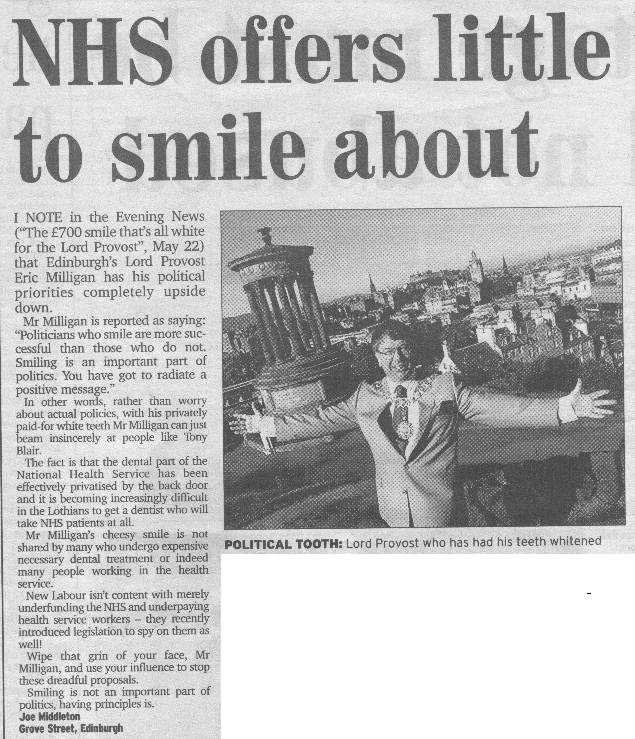
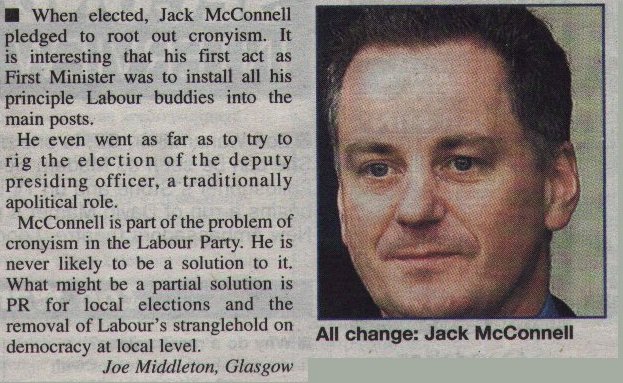
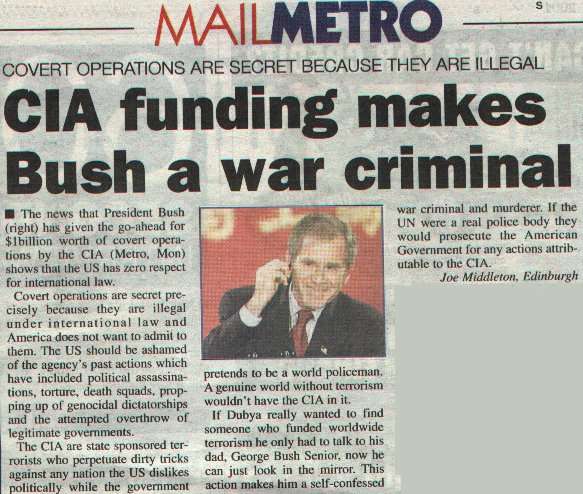
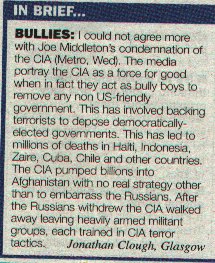
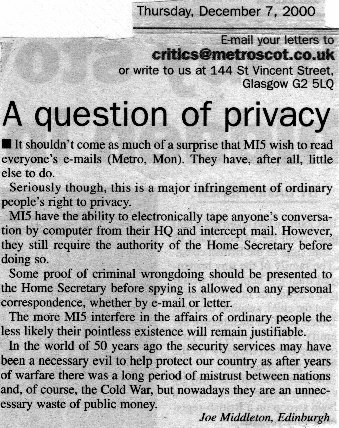
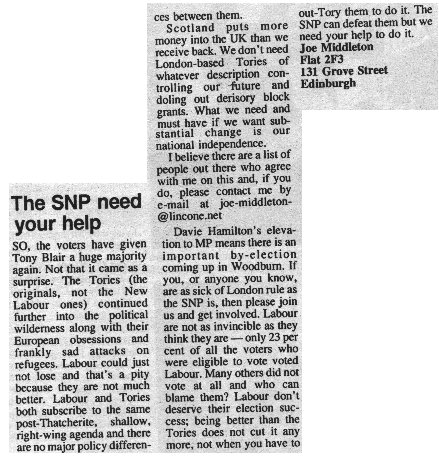
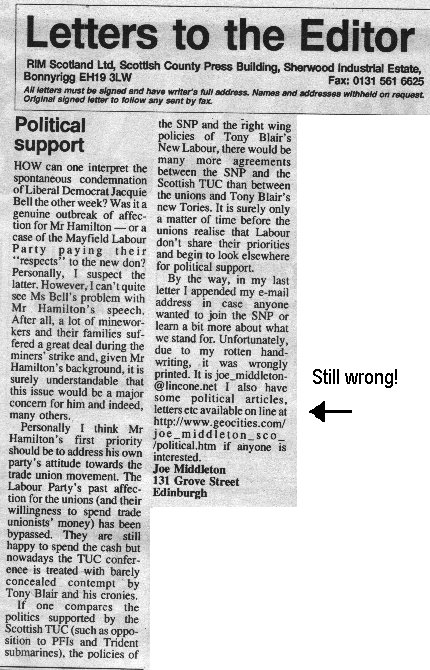
Click on the thumbnails (above) to see the larger pictures and click back on your browser to come back to this page.
There are more letters in the letters archive.
Want to email a letter to a newspaper? Click on the links below :
The Evening News, The Scotsman, The Herald, Scotland on Sunday, The Sun, The Daily Record, The Star The Scots Independent, The Sunday Mail, Press & Journal, The Dundee Courier, Evening Times, Evening Telegraph, The Times, The Daily Telegraph, The Financial Times, The Independent, The Guardian, The Daily Mail, The Metro, The Mirror The Sunday Post, The Sunday Herald, The Sunday Times, Sunday Business, Sunday Telegraph, The Observer Scottish Sunday Express, The Mail on Sunday, The Sunday Mirror, News of the World, Sunday People, Morning Star,
Alternatively email them all at once by clicking here.
Please remember to add your full name and address and a day time phone number. Also put all addresses (if emailing more than one paper) into the Blind Copy (BCC) box (not the default) as papers like to feel they have been written to individually, email me if you have any problems. Cheers! JOE
I was until recently press officer for Midlothian SNP, the following are some of the press releases we have managed to get printed recently in the Advertiser (click on the thumbnails to see the full releases).
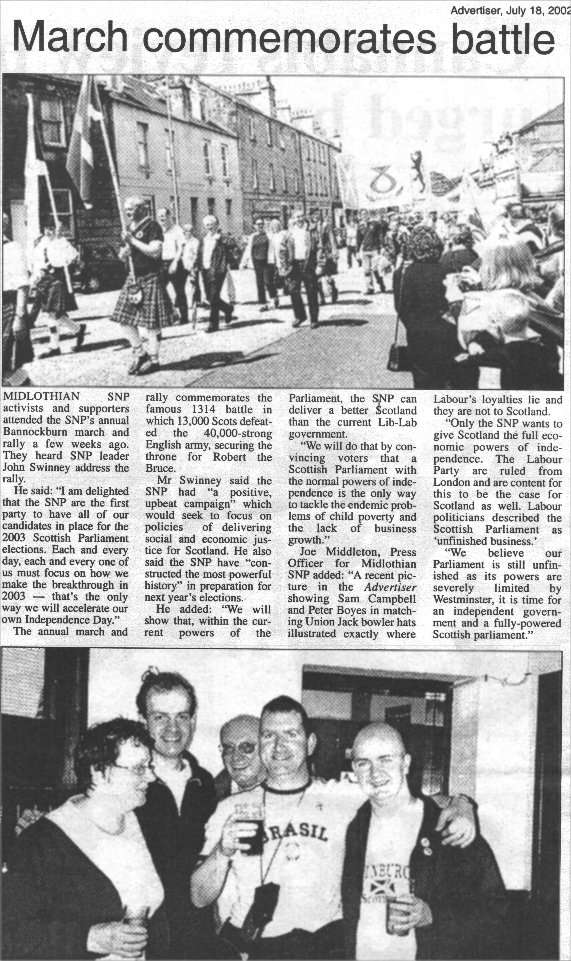
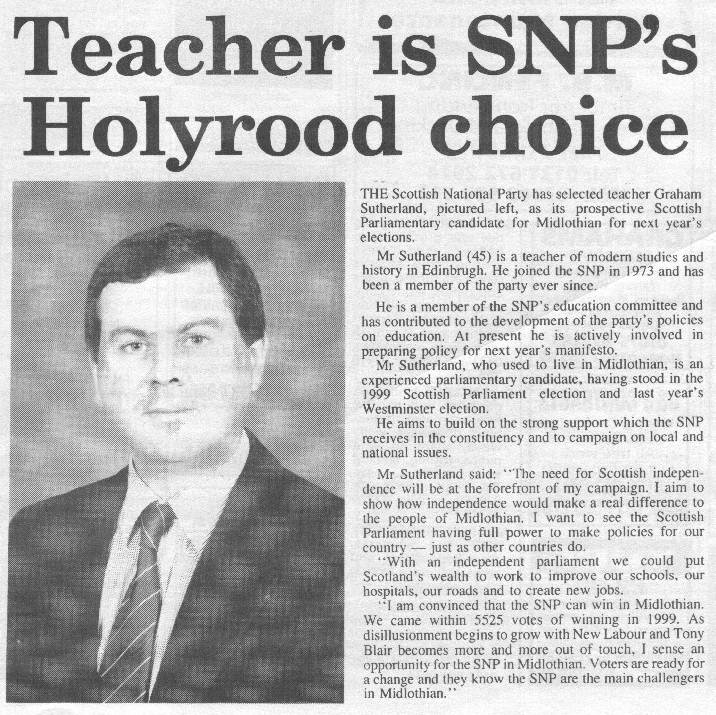
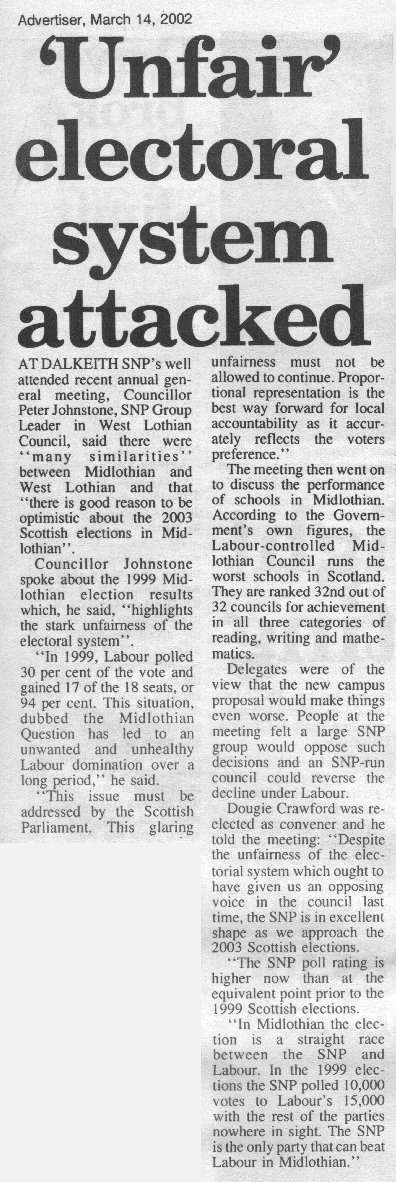
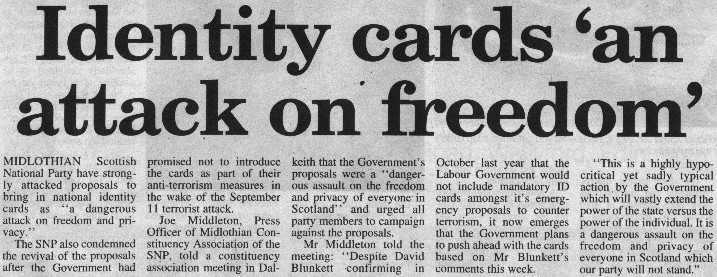
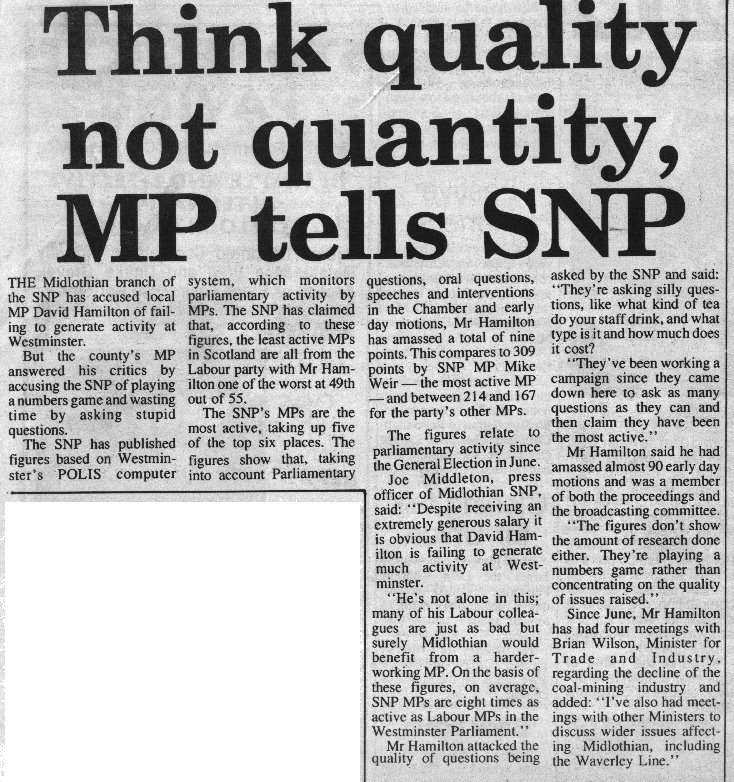
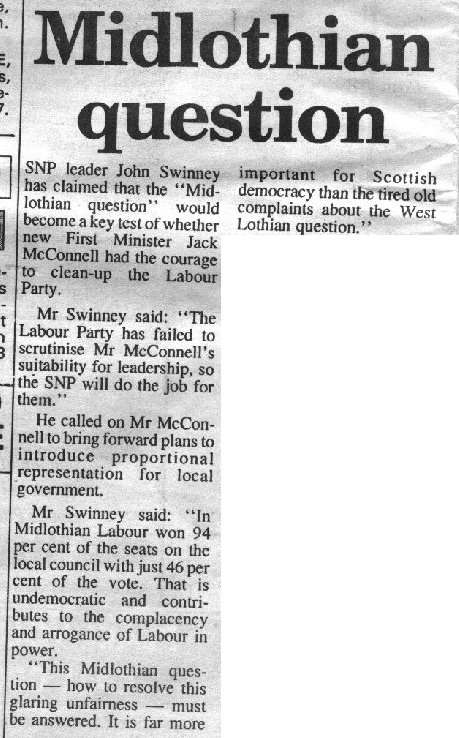
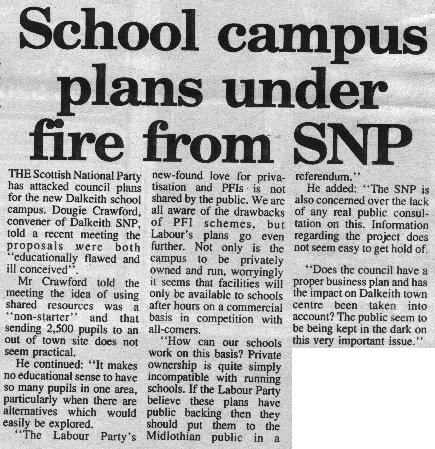
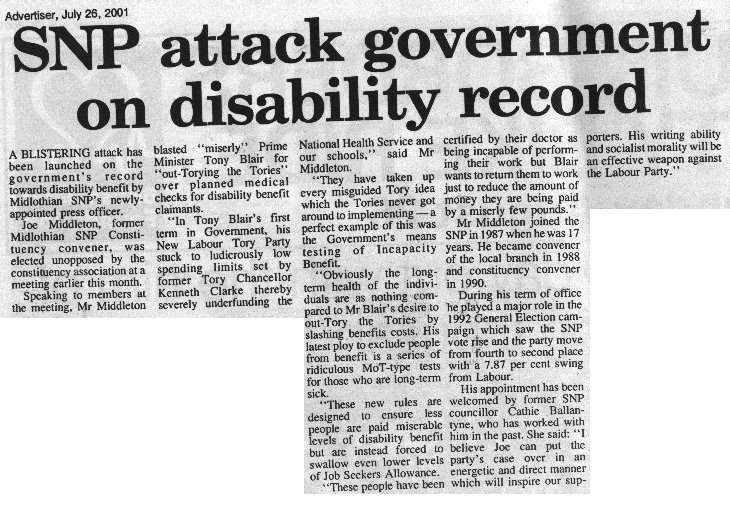
Click on the thumbnails (above) to see the larger pictures and click back on your browser to come back to this page.
See all the recent Midlothian Press Releases
There are more press releases in the Press Release Archive
by Joe Middleton
It seems that home rule is just around the corner. Ill be voting for it but excuse me if I don't start dancing in the streets if we get it. The respective campaigns are bursting forth with all the enthusiasm of a damp squib. Why? Because we've been here before, if not in person, certainly watching archive footage. I was nine when it was going on the last time but the latest devolution referendum still has a depressingly familiar ring of deja vu to it.
Devolution has stunk of hypocrisy throughout its history. Both Tories and Labour have supported it at different times. In opposition they support it, in Government they fail to deliver it.
If the turn out next month is low then it can only reflect the pointless nature of having another referendum at all. Ignoring the 40% wrecking rule, the last result was a victory, albeit a narrow one in 1979. Since then opinion polls have shown strong support in favour. The only party to oppose any form of self-government is the Conservatives and they've been routed. They have no MPs and control no councils. Basically they're not popular, except amongst employers still enjoying paying low wages of course. The disingenuous rumblings from isolated businessmen and the laughable Think Twice campaign, none of whom can fail to hide their Conservative inclinations, are unlikely to convince anyone, any more than the original Tories managed at the General election.
Scotland rumbled the Tories around the time of the Poll Tax fiasco, wed merely suspected they didn't care about us before that time. After that we knew. Post devolution they will get a few MSP's, they can hardly fail to under PR, but they will remain an irrelevant rump politically. Not to say they wont still have power and privilege, they do represent the establishment after all, but their political influence will be limited to easily impressionable types like Tony Blair.
The Conservatives aren't above supporting tax-varying powers when it suits them. They slagged the last parliament for failing to have them. Their concentration on the negative nature of this power, and a very limited power it is, show they have learned nothing at all from their electoral defeats. In comparison to 14.5 billion, power over 450M is very small potatoes. The tax varying power is only there to give the illusion of power by Labour.
Labour has a mandate from the voters, a pledge of unfinished business to the Scottish voters and no real opposition. Hardly the controversy usually associated with referendums. The only legitimate referendum would be multi-choice. Labour promised this in opposition, but since it was only to the common oiks that formed Scotland United they didn't feel honour bound to carry it out. Why bother? They're in power additionally independence has the virtue of being workable, logical and easy to understand. Against any talking shop with limited powers or the discredited status quo it would probably win. In all probability the referendum is a last ditch attempt by the unionists to throw a spanner in the works. Tony Blair's comments on its powers being subservient to him as an English MP seemed deliberately offensive while the question on tax seems almost designed to fail.
Labour often asked during the election what position the SNP would take on their plans. Obviously they hoped to split the party on the issue. However, it was inevitable the SNP would support any devolution bill for three very good reasons.
Firstly, under the second clause of their constitution the party is pledged to the furtherance of all Scottish interests. Devolution is a measure of power and better half a loaf than none at all.
Secondly, to fail to support the creation of the parliament and then expect to get elected to it is such a politically suicidal course of action that only the long dead Scottish Tories could hope to get away with it.
Thirdly, PR will land the SNP with a large amount of MSP's thereby bridging the party's credibility gap. For the uninitiated this is the age-old problem of independence supporters who fail to support the SNP. Despite the party's rise to fairly high levels of the popular vote it is haunted by a minuscule number of MPs under first past the post.
Those Tories who say devolution will lead to independence will deliver this vote initially to devolution and once set up, will further deliver it to the SNP. Tam Dalyell might be worrying Labour with his claims that devolution is constitutionally unstable but he has the virtue of being absolutely correct. Inevitably frustration will arise when the voters realise that devolution doesn't have the power to affect real change. While it may seem to encompass a wide range of subjects, really it is only more democratic control of existing Scottish Office responsibilities. With fiscal power remaining in Westminster, so also will ultimate power. One only needs to look at existing local authority difficulties to see where real power lies.
Once bitten twice shy, the bitter 79 experience will encourage the electorate to grab any power they can get and vote Yes, Yes, even if its without undue enthusiasm. The Tories are such pariahs that the very fact they oppose it will guarantee success and at that point Labours deeper troubles will only have just begun. Hmmm... I guess I might start dancing after all!
The Truth about Public Spending
The current debate or more accurately, phoney war about public spending between Labour and the Conservatives is absolutely pathetic and adequately demonstrates what a bad joke British politics is. Both of the major British unionist parties are guilty of enormous public deception, as neither is what it claims to be.
Labour have pretended for years to believe in public investment, just as they pretended to believe in social justice and representing workers. The Conservatives claim to be the party of low taxation and good economic management. This is why they are a bit reluctant to admit there is still a recession and lets face it, its not the first one is it.
The truth is in the pudding or more precisely in the policies which tell rather a different tale, please allow me to explain.
Labour will give a generous fiver to the pensioners and a minimal increase in child benefit and will fund this by a very modest increase in tax for the reasonably rich (earning somewhere over �30,000 per year).
Labour investment in the NHS, Education and job training (or what will loosely fit that description) will await improvements in the economy.
This therefore renders redundant every Labour attack on the Tories by the venerable Mr Robin Cook MP over under funding of the NHS as Labour clearly don't intend to improve the situation at all. The Sick Kids will still be run on a charitable basis.
The Conservatives masquerade as a tax-cutting party despite increasing overall taxation, including VAT. Most people pay more tax under the Tories, except for the rich of course. Their claim that Labour have higher spending plans than that party admits to gives Labour more credit and credibility than they now deserve.
The figures the Conservatives use are not even remotely accurate but then this hardly comes as any great surprise given their record in this respect.
Labour likes to imply it will spend more money but the truth is they are scared stiff of losing votes by raising taxes, sadly principles and promises are less of a priority than they used to be with Mr Kinnock.
As Harry Ewing correctly pointed out recently, Tory forecasts of Labour public spending and tax-raising plans are "fantasy", sadly the public perception that Labour will spend more on the NHS or tackle unemployment is a "fantasy" also.
The SNP in sharp contrast are committed to a 15% increase in spending on the NHS over three years.
Full Employment would be achieved and low wages eliminated with our Action for Jobs plan in a similar timescale. Both these proposals, amongst many others, are fully costed in our budget for an independent Scotland and achievable without any increase in taxation with additional revenue available with independence.
The Scottish people need not vote for Labour or Tory liars. We can choose a much more exciting future by voting for independence not subservience!
The above article was written in 1991 - for further (up to date) information on this issue see the press release below.
The disturbing case of Liz Davies of Leeds North East is only the latest example of a long running witch hunting campaign by Labour against its own left wing. Their right wing shift has not only been categorised by a ditching of principles and socialist policies but a purge of principled activists who represent a threat to Blair's New Toryism.
Writing an article for any magazine, whether that be Labour Briefing, Marxism Today, Militant, Liberation or whatever should not be a bar from standing for political office. Furthermore being a socialist should not stop candidates from standing for a party that by its name purports to represent the working class. Having a different opinion to Labours NEC, i.e. believing that copying the Conservatives is a less than effective way of opposing their ruthless attacks on the poor, seems to be a sure way to receive the order of the boot however.
If a constituency picks a candidate after hearing all those on other then it is morally wrong for Labours NEC to overturn that decision just because they don't like that persons political views. It is indicative of Labours jump rightwards that they can joyfully accept Alan Howarth, a former Government minister, a supporter of the Poll Tax and a member of the extreme right wing No Turning Back group but they refuse to support a socialist who had the guts to fight the Poll Tax by refusing to pay it.
It would appear that free speech is a limited commodity in New Labour and it brings to mind questions about whether they can be trusted in Government if they don't extend the most basic rights in this area to their own activists.
During the 1950s Joe McCarthy's anti-communist discrimination and witch hunting left a horrible stain on American history. Subsequently that nation has become effectively almost a one party state. There is practically no difference between the Democratic & Republican parties and anyone who is remotely left is branded a Liberal and isolated from public office.
Most people, around 60% don't bother to vote in their elections because they are such a media manipulated joke. The same process is transforming Britain in the same way. Already there is little to choose between the policies of all three of the unionist parties while Labours born again McCarthyism means there is very little hope of real change in Britain in the near future. New Labour is already a party Thatcherites feel comfortable in, how much more right wing can they get?
In Scotland we have one hope of removing ourselves from the right of centre British unionist alliance and guaranteeing full freedom of speech for all political views. That hope is independence.
As Scotland looks forward to the second Scottish Parliament election next May, we need a debate in Edinburgh and throughout Lothian on how our Capital City stands to benefit from the ongoing process of constitutional change.
After nearly 300 years of the Union, Edinburgh has become a centre of political decision making once again. But most folk in the City feel that the benefits of having the Parliament on their doorstep have passed them by.
New Labour�s foolish decision to ignore the popular consensus in favour of building the parliament at Calton Hill � taken before MSP's were even elected � has certainly added to the sense of disappointment.
But the fundamental reason for the Parliament�s limited impact on people�s lives in Edinburgh is its extremely limited powers.
Holyrood sucks resources in � as we all know from its soaring construction costs alone. But because virtually all of the key financial powers remain at Westminster, the Parliament doesn�t have the ability to invest in improving the quality of life for people in Lothian and throughout Scotland.
Devolution has given Edinburgh many of the costs associated with having our own parliament, but few of the tangible benefits.
The Scottish Parliament is only able to control a maximum of 6 per cent of its revenue, by deciding the level of business rates and the �tartan tax�. Westminster retains its grip on 94 per cent of Holyrood�s income.
Yet Edinburgh City Council controls 27 per cent of its revenue through the Council Tax � which it rightly regards as an inadequate level of fiscal independence.
In other words, our national parliament has less than a QUARTER of the financial clout than the city in which it is based. That�s why the story so far has been less what the Parliament has done for Edinburgh, and much more what the people of Edinburgh have given to the Parliament.
Take policing, for example. Since the establishment of the Scottish Parliament, the number of VIPs and foreign dignitaries visiting Edinburgh has soared, and is now averaging two or three a week � including royal trips and tours by foreign heads of state. There are also more demonstrations and the number of consulates in Edinburgh � all requiring police protection � is now over thirty.
The extra policing costs amount to some �700,000 a year � enough to pay for 25 extra officers. But even though this increased price tag is a direct result of the national parliament being in Edinburgh � and should therefore by rights be funded centrally � most of the bill is still picked up locally, by Lothian & Borders Police. No wonder Edinburgh has one of the highest council taxes in Scotland.
The costs of the Scottish Parliament Police Unit itself may now be met from central funds, but the issue and the expense of extra policing needs in the Capital go far wider than that.
The Met gets more resources specifically to police London as a capital city, and the same principle should apply to Edinburgh.
But Edinburgh will only start to be treated like a Capital City, and make the big gains associated with that status, when it becomes a REAL capital � housing a REAL parliament. That�s why Edinburgh needs Independence for Scotland.
And that�s why I want the SNP to mount a major campaign in the run-up to the Scots Parliament election, detailing the benefits of Independence to Scotland�s Capital.
�Independence � it�s a Capital idea�. That sums up the huge boost awaiting Edinburgh by transforming itself into the Capital City of an independent country.
Independence will be good for the whole of Scotland. But it will be best of all for Edinburgh.
At a stroke, Independence will promote Edinburgh to the premier league of European capital cities. And unlike devolution, that WILL deliver real social and economic benefits to the people of Edinburgh, and throughout Lothian.
The process of Independence will create thousands of jobs and opportunities in the City and surrounding area. A look at other European capitals shows the investment that flows in to real decision-making centres.
For example, where Edinburgh has 32 foreign consuls with limited staff and functions, there are 68 fully-fledged embassies and consuls in Dublin, 62 in Copenhagen, and 45 in Oslo � all capitals of nations that are the same size or smaller than Scotland.
With Independence, the economy of Edinburgh and Lothian will gain from a real international diplomatic presence in the City. And many �small nation� European capitals host the headquarters of EU and other international agencies � such as the European Environment Agency and World Health Organisation in Copenhagen Europol and the Europol Drugs Unit in the Hague and the European Centre for Vocational Training in Thessalonica in Greece, which was moved there from Berlin.
All of these institutions generate thousands of highly skilled jobs and training opportunities, and countless spin-offs in private sector employment.
With independent representation in Europe and the wider world, a Scottish Government will have the bargaining power to land a fair share of these top jobs for Edinburgh.
In the 1990s, a report by Mackay Consultants � a leading firm of economic and management experts � estimated that the process of Independence would create up to 11,500 jobs in Scotland. These would come from powerful government departments, embassies, EU and international agencies, broadcasting, oil industry posts, and the boost that this would all provide to the private sector.
As Scotland�s Capital, Edinburgh stands first in line to secure the benefits of Independence.
Real European capitals also have far better transport links than Edinburgh does, both in terms of internal connections and direct air routes.
Yet as part of the UK, Edinburgh may not even achieve a rail link to the city�s airport until after 2010, under the London-based Strategic Rail Authority�s 10-year plan.
In fact, of the 17 major projects in the SRA plan that are geographically-specific, 15 are located south of the Border, and 11 of these are in London and the south of England. Edinburgh and Scotland have been left behind yet again.
Edinburgh is a great and beautiful place � but it can only flower and achieve its full potential as the first city of an independent nation. That�s why the SNP say that Independence is a Capital idea.
Kevin Pringle is head of media for the SNP Westminster Group and was the SNPs candidate for Edinburgh Central in the Scottish Parliament elections.
Please vote for this web site as a 'Top Scottish Political Site' by pressing the button below (Thanks!) Also, please sign my guestbook! Thanks for visiting! JOE


Sign Guestbook - View Guestbook
| Politics | www.joemiddleton.co.nr |