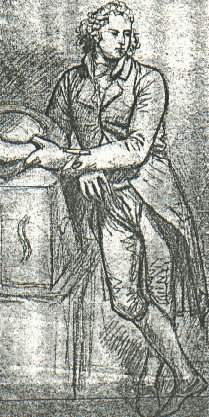
Thomas Muir
The first Convention of the Scottish Friends of the People opened in Edinburgh on 11 December 1792. Over 150 delegates representing 150 societies from 35 towns and villages attended. Their aim was to draw up a petition to send to the British Parliament in support of electoral reform. Thomas Muir, a Glasgow barrister with a reputation as a man of principle, had helped organise many of the societies. He had also, before the Convention, been in contact with the United Irishmen movement, a group of professional men in Dublin also bent on political reform. Against the advice of his colleagues, Muir read an address the United Irishmen had sent which urged the Edinburgh Convention to 'openly, actively and urgently' will Parliamentary reform.
On the last day of the Convention, a Petition to Parliament was read and approved; but it was suggested that the Convention arm itself so as to be able to help magistrates put down riots that might occur in support of reform. An emotional evening session ended with delegates swearing the French oath, 'To live free or die'. The government at Westminster misread the situation. The Home Office files bulged with reports from spies. As informers were paid piece-rate many had put down gossip as fact, and rumour spread that the delegates were preparing themselves for insurrection. The government panicked and on 2 January 1793 arrested Muir. His trial opened in Edinburgh on 30 August 1793. He was accused of making seditious speeches, of circulating Paine's Rights of Man and of defending as well as reading the Address from the United Irishmen. Muir turned down an offer made by Henry Erskine, the Dean of the Faculty of Advocates, to defend him and conducted his own defence:
"I am accused of sedition and yet can prove by thousands of witnesses that I warned the people of that crime, exhorted them to adopt none but measures which were constitutional, and entreated them to connect liberty with knowledge and both with morality."
The trial lasted sixteen hours, the evidence heard by five judges and a jury. But the proceedings were dominated bv Lord Braxfield, of whom Lord Cockburn wrote:
"Strong built and dark, with rough eyebrows, powerful eyes, threatening lips, and a low growling voice, he was like a formidable blacksmith. His accent and his dialect were exaggerated Scotch; his language, like his thoughts, short, strong, and conclusive. He was the Jeffreys of Scotland. 'Let them bring me prisoners, and I'll find them law', used to be openly stated as his suggestion, when an intended political prosecution was marred by anticipated difficulties."
Muir's flowery address to the jury lasted three hours but fell upon deaf ears.
"I have devoted myself to the cause of the people. It is a good cause, it shall ultimately prevail, it shall ultimately triumph."
Braxfield, who had arrogantly dismissed the evidence of Muir's twenty one witnesses, summed up:
"Government in this country is made up of the landed interest, which alone has a right to be represented; as for the rabble, who have nothing but personal property, what hold has the nation of them? what security for the payment of their taxes? They may pack up all their property on their backs, and leave the country in the twinkling of an eye."
The jury found Muir guilty, and Braxfield sentenced him to fourteen years transportation to Botany Bay, a novel sentence then tantamount to the death penalty. After 1783 Britain had looked to Australia as a substitute for the American colonies to take the overflow from Britain's prisons. The first fleet of eleven vessels had carried nearly 800 convicts, and had arrived at Sydney Cove on 26 January 1788. Many subsequent ships sank before reaching Australia; many convicts died of dysentery or typhoid en route, and by the time of Muir's sentence horror stories about Britain's embryo prison colony abounded. Scots were shocked by the sentence. Robert Burns was moved to write, 'Scots Wha Hae' in protest, a song which was immediately banned as seditious. 'The newspapers gave Muir's trial enormous coverage and three editions of the court's proceedings were published, two of them in America. After sentence, Muir was taken to the Tolbooth and on 14 November put on board the Royal George bound for London. His mother and father presented him with a pocket Bible with the inscription, 'To Thomas Muir from his Afflicted Parents'.
The question of his sentence was raised five times in Parliament; but on 13 February, Muir, together with Skirving, Gerrald and Margarot, set sail for Botany Bay. The filthy, stinking, mutinous voyage took nearly six months. Because they were political prisoners Muir and the Edinburgh Martyrs were not obliged to work like the other convicts. Thomas Muir purchased a small farm near Sydney Cove and called it Huntershill, after his father's Scottish home.
On 24 January 1796, the Otter, an American ship from Boston, visited the colony and the night before she set sail Thomas Muir managed to board her. His escape, after just sixteen months in the colony, proved a timely one. Within a month of Muir's bid for freedom, Gerrald died at the age of thirty-six and Skining succumbed to dysentery. After many adventures Muir eventually reached France, where he was given a hero's welcome at Bordeaux, and thence conveyed to Paris where the Revolutionary government held a banquet in his honour. But his last years were marked by sad decline, both physical and intellectual. Although he had not seen Britain's shores for four years, he set himself up as an expert on his country's affairs. Talleyrand, the French Foreign Secretary, allowed him a small pension; but once the French had exhausted Muir's propaganda value he became an irrelevance. He died at Chantilly outside Paris in 1798, more extreme in his views and more full of his own importance than ever.
I heard one anecdote from Muir's trial recently. Some woolly minded liberal member of the Scottish establishment pleaded with Braxfield: "But remember, my Lord, Jesus Christ was a reformer too." "Muckle he made o' that. He was hanget," was Braxfield's retort.
In Edinburgh Library there are many accounts of Scotland's links with Australia. Not all the Scots who found themselves on the other side of the world went as prisoners. The second governor of New South Wales, John Hunter, responsible for consolidating the colony, was a Leith man. There is a memorial to him by the Leith dock gates, near the Malmaison Hotel.
The 5th governor of New South Wales and Australia's greatest Governor Major-General was also Scottish: Major-General Lachlan Macquarie. Macquarie was a Scottish soldier and Governor of the colony of New South Wales from 1810-1821, whose term of office was noted for humanitarian treatment of ex-convicts, encouragement of public works programmes, inland exploration and the creation of new towns. Lachlan Macquarie was born on the tiny island of Ulva, in the Inner Hebrides, Scotland and grew up on the nearby larger island of Mull.
As with other other expatriate communities, these links are much better remembered in Australia than they are in Scotland. The excellent Mitchell Library in New South Wales, for example, has a fine collection of material about Muir.
Thomas Muir of Huntershill
Revolutionary & First Minister of the Scottish
Republic.
By Donald Anderson
Thomas Muir, the Scottish Republican and Revolutionary, was born in Glasgow,
24th August, 1765, the son of "bonnet laird", James Muir. His father was a
second son, with no chance of inheriting the property of Birdston and Hayston
farms near Kirkintilloch. His family had relations in Kent who were prosperous
hop growers James successfully directed his energies and became firmly
established as a hop merchant in the High Street of Glasgow in a flat above his
shop. He was credited with writing a pamphlet on "England's Foreign Trade" and
reached his social summit by the 1780's he purchased the property of Huntershill
house and the adjoining lands.
His house still stands in Bishopbriggs and there is a centre to him there and a
Thomas Muir cafe with a plaque. Bishopbriggs library has a selection of books on
him. George Pratt Insh, Liberal historian, wrote a good book and pamphlet on
him. Lib Dem MP, McLellan wrote a play on Muir, which played down his republican
and revolutionary side and concentrated on his radical reforms, as did Dumbarton
Council on his centenary in 1979. Adam McNaughton, of Adam's Books, folk singer
and writer was commissioned to write the official pamphlet for the Council and
wrote a song to him.
Michael Donnelly produced an excellent pamphlet in 1975, as a forerunner to
his biography on Muir, which he is still researching. He also produced some
excellent magazines under the title, "United Scotsmen". He and his partner,
Elspeth King were cleared from the People's Palace in a coup by Pat Lally, to be
replaced by a tame Labour poodle historian, who complained that the museums in
his native Ireland were full of reminders of defeats. Elspeth and
Michael's former radical exhibitions at the People's Palace have long been
sanitised, erasing our folk memories and radical past. Both are now running the
excellent museum in Stirling.
Muir's middle class background did not stop him sacrificing himself when he
could have had a comfortable lifestyle. He had a private tutor at the age of
five and at 10 entered the Gowned Classes of Glasgow University, still in the
High Street and graduated after five sessions. He then studied divinity for a
while being of the 'Auld licht' of popular party in Scotland. In 1782 he
graduated at the age of 17 as an MA, with a flair for languages. He was greatly
influenced by John Millar of Millheugh, Professor of Civil Law and abandoned
religious studies. He was accepted to Millar's classes in 1783-4. Millar was a
pioneer of sociology and a figure in the Scottish Enlightenment. Millar was a
former pupil of the Scottish Enlightenment figures; Smith, Hume and Lord Kames,
raising his Chair to international status attracting students from Russia,
America, etc.
Millar was Republican and critical of Henry Dundas, England's man in
Scotland. He inspired Muir, who joined student Clubs and societies supporting
American Independence and Burgh reform.
In May 1784 a violent dispute between Professor John Anderson and the faculty
and Principal resulted in Anderson's suspension. Anderson received widespread
support from the Citizens of Glasgow to open his doors to artisans and Glasgow
Trades. The students supported him. He was denied legal representation and Muir
and others accepted "voluntary self expulsion. Anderson is credited with
founding technical colleges and what is now Strathclyde University. He even
invented a gun for Napoleon. Muir completed his study at Edinburgh under Millar,
passed his Bar exams and was admitted to the Faculty of Advocates at the age of
22.
Muir lived in a revolutionary and oppressed climate in support of the French
Revolution. Gaelic, kilts, tartan, pipes and the clarsach were still proscribed
from 1746 till 1791. The majority of the population lived North of the Highland
line before 1750, not counting Gaelic speaking Galloway and South Ayrshire. The
Clearances, were described by Marx as worse than clearing whole villages in
Ireland and compared cleared tracts of the Highlands with areas the size of
German Principalities. Many Highlanders were flocking to the Lowlands at the
beginnings of the Industrial Revolution to the coal and Iron fields and growing
factories.
Historians pretend to be puzzled by the speedy transformation of many
Jacobites to Jacobins. It was no mystery. The Jacobites opposed the
Parliamentary, if not the Regal, Union. King James had to read a proclamation
dissolving the 1707 "Union" upon landing at Peterhead in 1714, and Charles
Edward at Glenfinnon and Edinburgh in 1745, Copies are in the 'Caledonian
Mercury' and other papers of the time. Just as the Irish Royal family was
usurped it was easier to become an Irish Republican than support a foreign
occupying Monarch and Scotland was very much an occupied country. Highland
regiments mutinied and refused to fight in France and full scale riots were a
regular occurrence in Scotland.
Even Wattie Scott was part of Dundas's spy system and paid informers up until
the 1820 Rising, some of whom fought in 1797. Scott not only spied on Burns, but
also researched the records after the Republican and Jacobite poet Burns's death
to prove he sent canons to the French Revolution from his excise seizure of a
ship in Galloway. Scott also, wrongly, is accused of inventing the proscribed
tartans in his revival pageant for George IV in 1824, complaining that many of
the original dyes and setts were lost during the 35 years Proscription Acts. How
can you invent something that was proscribed 76 years earlier and England,
remaining geographically and psychologically divided..
The Scots having a degree of National Unity backed by the general sympathy of
the common people sat uneasy on this new "British Convention", which Muir
described as a "miserable plaything of the English Government". The English
leaders were also sentenced to 14 years transportation.
Eventually Muir Skirving and Palmer were transported on the "Surprise" to Botany
Bay, after Labouring in a Portsmouth chain gang. The three who were charged with
mutiny led by the first mate against the captain's brutality had little
difference in winning their case upon arrival at Port Jackson. Due to their
education and status they were afforded better freedom of movement than
ordinary convicts. Each had with them a considerable sum of money raised by the
wealthy London Whigs before their departure. By December they had spent most of
their cash purchasing plots of land, out of sight of the Governor on the
opposite side of the bay. Palmer settled into farming. Muir plotted escape.
Early on February, 17, 1796 he succeeded in arranging his escape on the American
ship, sent by Washington, the "Otter". Skirving was too weak with yellow fever,
Gerrald was dying of TB and Rev Palmer, refused to leave his side nursing him
till his death. Margarot had been sent to Coventry for his part in the mutiny
allegations. So Muir left with two convict servants exhausted and wet to be
hauled aboard from their small boat.
After many adventures across the uncharted Pacific to Vancouver Island, the
'Otter' dropped anchor in Nookta Sound on June 1796. Because of the presence of
a British man of war, the "Providence" he persuaded a Captain Tovar to break his
regulations and admit foreigners to Spanish territory. He changed vessels down
the coast at Monterrey, California and was introduced to the Governor, Don Diego
Boricia and accommodate with his family in the Presidio. The Viceroy of Mexico
wasn't pleased with Muir's Washington connection and ordered him to be taken
across land to Mexico in a gruelling and dangerous trek across the mountains. He
was held in detention on October 12 to be shipped to Spain on suspicion of being
a spy for the Revolution.
He was shipped from Vera Cruz to Havana to await a convoy to Spain. He attempted
to escape and was imprisoned for three month in the dungeons of La Pricipia
Fortress. French and American agents informed the French Directorate.
On April, 26,1797, Muir's ship the "Ninfa", was confronted by several British
men of war at the entrance to Cadiz Harbour who had been blockading the port for
several weeks. The Ninfa and the Santa Elena was pursued by the British for
three hours. The Elena, carrying bullion was scuttled.
Muir's cheekbone and was smashed and his eyes seriously injured by shrapnel. One
of the crew told the Brits that Muir was on board, but the captain insisted that
he was dead. He was so badly disfigured that he was not recognised and put
ashore with the wounded.
His painful recovery saw a bitter battle between the French for Thomas Muir's
release. The Spanish finally released him on September 1797, declaring him
banished from Spanish territory. He arrived in Bordeaux, from Madrid and San
Sebastian in November accompanied by a French Consulate officer and was hailed
publicly as a hero of the French Republic and martyr of Liberty.
His last portrait shows him with a large patch over his left eye and the loss
of his cheekbone, drooping his face in grimace. He was heralded in the Capital.
David, the French artist and official propagandist, was appointed to welcome
him, in a front page eulogy in the Government journal. "Le Moniteur".
From the outset he insisted that it was his suffering countrymen that was
primary concern. He associated with James Napper Tandy, though he did not get on
well with Wolfe Tone, where he learned of the Scottish Insurrection of 1797-8
and resistance to the Militia Act and urged intervention on behalf of the
Scottish people for Scottish Republic. His chief condfidante was Dr Robert
Watson of Elgin, tutor to Napoleon, and a prominent Scottish Republican, later
murdered
in London. He learned of the arrival of James Kennedy of Paisley and Angus
Cameron of Blair Atholl as delegates to the new Movement.
He died in the village of Chantilly on January 26 1799 and it took an American
Ambassador in the early 20th century to bring his grave to the notice of
Scotland.
"We have achieved a great duty in these critical times. After the destruction
of so many years, we have been the first to revive the spirit of our country and
give it a National Existence".
Thomas Muir. 1798
Thomas Muir of Huntershill
(Words & Music : Adam McNaughton)
My name is Thomas Muir as a lawyer i was trained
(Remember Thomas Muir of Huntershill)
But you've branded me an outlaw, for sedition I'm arraigned
(Remember Thomas Muir of Huntershill)
But I never preached sedition in any shape or form
And against the constitution I have never raised a storm
It's the scoundrels who've corrupted it that I want to reform
(Remember Thomas Muir of Huntershill)
M'lord, you found me guilty before the trial began
And the jury that you've picked are Tory placemen to a man
Yet here I stand for judgement unafraid what may befall
Though your spies were in my parish Kirk and in my father's hall
Not one of them can testify I ever broke a law
Yes, I spoke to Paisley weavers and addressed the city's youth
For neither age nor class should be a barrier to the truth
M'lord, you may chastise them with your vitriolic tongue
You say that books are dangerous to those I moved among
But the future of our land is with the workers and the young
Members of the jury, it's not me who's being tried
200 years in future they will mind what you decide
You may send me to Van Dieman's Land or clap me in the jail
Grant me death or grant me liberty my spirit will not fail
For my cause it is a just one and my cause it will prevail
With quiet words and dignity Muir led his own defence
He appeared completely blameless to those with common sense
When he had finished speaking the courtroom rang with cheers
Lord Braxfield said, "This outburst just confirms our greatest fears"
And he sentenced Thomas Muir to be transported 14 years
Gerrard, Palmer, Skirving, Thomas Muir and Margarot
These are names that every Scottish man and woman ought to know
When you're called for jury service, when your name is drawn by lot
When you vote in an election when you freely voice your thought
Don't take these things for granted, for dearly were they bought

Back to Main Political Page
Go to Midlothian SNP site
| Thomas Muir |