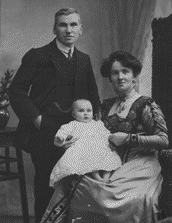
John MacLean & family
All Hail, the Scottish Workers Republic! by John MacLean
MacLean and the Unemployed by Nan Milton
MacLean's Scottish Workers Republican Party (with transcript of Manifesto)
Irish Republican Socialist Party Message to the John MacLean Commemoration - 12 November 2001
John MacLean - Scotland's Socialist Champion
Introduction
(PS: Thanks go to the Scottish Republican Socialist Movement and the Glasgow Digital Library for most of the information on this page)
John MacLean is a figure of immense importance to the left in Scotland. That
is especially true of Republican Socialists who regard him as the founding
father of Scottish Republican Socialism.
It was MacLean, aided by people such as long-term friend and comrade James D. MacDougall, who applied the explicitly Republican Socialism of Edinburgh born
James Connolly to Scottish conditions at the end of the First World War. It led
MacLean to come out fighting for a Scottish Workers Republic as part of a
Socialist International.
The victory of the Bolshevik Revolution in 1917 had radicalised workers across
Europe, and given a huge boost to the anti-war forces exemplified by those such
as MacLean, Connolly, Liebknicht and Luxembourg who had fought against the war
from its start. These genuine internationalists took their stance and were
honoured by the Bolsheviks but all of them were dead by 1923 - such was the fear
they inspired in the ruling class of Europe.
MacLean dedicated his life to the cause of the working class. He toured all over
Scotland, and beyond, lecturing workers in the realities of Capitalism. For
years he taught workers Marxist economics in evening classes around central
Scotland, until in 1916 he realised his dream of founding the Scottish Labour
College, to undertake this work on a full-time basis, and lay down the basis for
a generation of revolutionary trade unionists.
He was imprisoned three times during the War (and twice afterwards) and at it's
end the Government was forced to release him to prevent further social unrest.
But it didn't scare MacLean. Instead it gave impetus to his mission and after he
lost his job as a teacher, he immersed himself totally in the workers struggle.
Influenced by the events of Easter Week, Dublin, 1916 and by the Bolshevik's
support of 'the rights of nations to self-determination', MacLean came to see
that the workers cause was best fought by attacking British Imperialism and
Capitalism at home, through Scottish Republican Socialism.
His work in building the Scottish Workers Republican Party, was hampered by
further imprisonment and persecution by the State. But it didn't deter him and
he kept fighting until the end. Unfortunately the end was not to be far away and
in November 1923 whilst giving an election speech he had to be lifted from his
open-air platform, mortally ill with double pneumonia, and was carried home to
die. At the age of only 44 the workers of Scotland had lost their 'bonny fechter'.
But his spirit lives on and the struggle stays the same. National liberation and
socialist revolution!
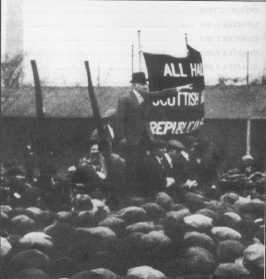 John
MacLean was appointed Soviet Consul in Scotland because of his opposition to the
rival Imperialists' war of 1914-1918. He was acclaimed worldwide as a leading
Marxist. He infuriated the English left, to this day, by declaring for a
'Scottish Workers Republic', as in his banner opposite. Basil Thomson, British
Military Intelligence, declared that he would smear him, and Sylvia Pankurst the
English suffragette, who supported him, by declaring them mad. The English
Nationalist 'left' still support this theory to this day.
John
MacLean was appointed Soviet Consul in Scotland because of his opposition to the
rival Imperialists' war of 1914-1918. He was acclaimed worldwide as a leading
Marxist. He infuriated the English left, to this day, by declaring for a
'Scottish Workers Republic', as in his banner opposite. Basil Thomson, British
Military Intelligence, declared that he would smear him, and Sylvia Pankurst the
English suffragette, who supported him, by declaring them mad. The English
Nationalist 'left' still support this theory to this day.
As evidence they quote the two prison doctors who supervised his force feeding to break his hunger strike in protest against his food being drugged. They also support the evidence of the Prison Wardens and Special Branch Agents who declared him mad because he was complaining that they were paid to spy on him 24 hrs a day, as they were! The Great British left also attacked Edinburgh born James Connolly for taking part in the Irish Easter Rising, failing to understand his support for Irish Nationalism. John's Parents were victims of the Highland Clearances.
His Mother born in Corpach nr. Ben Nevis, his father in the Isle of Mull. He understood only too well the effects of Imperial British rule which ruined others as well as his native land. The Great British left's much vaunted inter-nationalism is flawed by their near racist view of Scottish politics and culture.
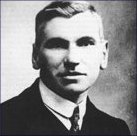
Born in Pollockshaws, then an industrial town outside Glasgow on 24th August 1879 John MacLean was the 6th of 7 children, only 4 of whom survived.
His father, Daniel, was a potter whose family had come from Mull, and his mother Anne's family hailed from Corpach nr Fort William. Both families had been victims of the Highland Clearance, and John was brought up with the stories of injustices at the hands of the landlords.
When John was 8 his father died of silicosis. In order to finish the education that his mother was determined to give him he had to take a number of part-time jobs. After leaving school he attended the Free Church Training School and became a certified teacher. He had been brought up in the religion but had by this time renounced it and remained a devout atheist.
In fact this was to lead to his first brush with authority in his first teaching post under the employment of the Govan School Board (GSB). He was in conflict with the headmaster over the teaching of the Bible to pupils & was ultimately transferred.
While this was going on he was also attending Glasgow Uni as an evening student & completed his MA in this way. Early Work MacLean had already decided on his road in life though, and that was a commitment to class struggle based on the revolutionary Socialism of Karl Marx. He joined the Social Democratic Federation and immediately set about rebuilding the Party after the split of the SLP.
From 1903 onwards he began to take on a massive workload. His first task was to form a Glasgow Press Committee, which was responsible for writing letters to the Press, drafting leaflets, producing manifestos and all election literature. And he also began activities that he was to continue until his dying day, namely to educate, agitate and organise workers in the methods of revolutionary Marxism.
His whole life became consumed with education. After teaching in school during the day he would set about the education of class conscious workers in the evenings. During the winter months he would hold weekly classes in Advanced (Marxian) Economics and Industrial History and by 1908 was taking classes every night of the week.
Whilst his 2 months summer holidays were consumed by grand tours of Scotland, conducting open air meetings from Lerwick in the North, Aberdeen in the East, Hawick in the South and in every centre of industrial central Scotland.
By 1907 he had written his first pamphlet The Greenock Jungle. About butchers supplying diseased carcasses in Greenock which led to the introduction of a meat inspectorate for that town's slaughter house. He was also that year invited to Belfast by Jim Larkin and the Belfast Socialist Society to speak on behalf of workers during the Belfast Transport Workers Strike, which was the beginning of the modern Irish Labour Movement, and MacLean's first experience of a big industrial strike.
He also in this year founded the Pollockshaws Branch of the SDF in which he met James MacDougall, who was to remain a trusted friend as was Peter Petroff, a Russian émigré of the 1905 Revolution, whom MacLean took into his own home and taught to speak English.
Even as early as July 1907 the SDF paper Justice was able to state about MacLean "no better man has ever been produced by the SDF". For the next few years MacLean was to continue with this constant agitation, often holding up to 5 meetings a day on his summer tours and his economics classes continued until his imprisonment in1916, and it was soon to pay dividends.
1911-13
Whilst the build up to War was continuing Industrial life in Britain became embroiled in a series of Strikes from 1911-13. The first major outburst of this in Scotland was the Singer Strike in Clydebank 1911. The Strike was broken but the authorities attempted to break the movement by dispersing the leaders around Glasgow. Far from breaking the mood of the Strikers though all this did was to spread the influence & teaching of MacLean throughout the area, as many of the shop stewards, such as Willie Gallacher, were pupils of his.
In July his tour took him to the Rhonda Valley in South Wales, where he was warmly welcomed for his work amongst the miners in Lanarkshire and Fife. Shortly after this 12,000 men walked out in support of 800 miners locked out by management. The rank and file demanded that the Miners Federation of Great Britain should back them in this issue and extend the strike for a national minimum wage.
MacLean's constant agitation ensured that the Scottish miners were fully behind the strike and in Feb 1912 1 million miners came out on Strike. A Minimum Wage Act was passed by the Liberal Gov. but instead of a national minimum wage it agreed to series of locally decided wages.
The discontent felt by the rank and file at this saw the formation of the first rank and file organisation the South Wales Miners Reform Committee, aided and abetted by MacLean.
War
The period of strikes was conducted against the build up to War and helped mask the great split that was appearing in what was now the British Socialist Party. The 1912 Conference of the 2nd International in Basle, Switzerland had maintained uncompromising opposition to War. However when War was declared the International failed at its first real test.
The International Solidarity of the working class was swept aside in a wave of jingoism and nowhere was this more evident than amongst the leadership of the BSP, under Hyndman (By September they were calling for recruitment). The Labour movement was found wanting and it was up to the Revolutionaries to oppose it.
This opposition centred in Clydeside and there were 2 important factors in it. Firstly the high concentration of heavy industry massing together advanced sections of proletariat – engineers, dockers, shipyard workers & miners. Secondly a large % working-class were either 1st/2nd generation Highland/ Irish immigrants forced from land by Clearance & Famine & so Patriotism was not high.
MacLean issued a damning indictment of the War & was forced from the pages of Justice. Both he and MacDougall immediately set about educating the workers about the real nature of war by taking the message directly to the shipyard gates and at his large Bath Street Sunday night meeting, across from the Army Recruiting Office.
Willie Gallacher wrote "From the first moment he declared his Marxian faith – War against the Warmakers" In February 1915 there was a strike at the munitions factory Weirs of Cathcart. The odds were stacked against them. The Defence of the Realm Act had made strikes illegal and the TUC had made a pledge of industrial peace for the duration of the War and so the Strike was an unofficial, shop steward led strike, (most of whom were pupils of MacLean), in defiance of the Union.
The workers formed rank and file Labour Withholding Committee to conduct the strike but were forced back to work with no strike pay. However this was to prove the start of real militancy on the Clyde.
RENT STRIKE
Since the start of the War the factors (in accordance with other capitalists) had taken the opportunity to push up rents. MacLean helped organise the women, under Mrs Barbour, and in Govan the women refused to pay increased rents. The agitation soon spread to other areas of the city as working class women organised against the factors. MacLean took the fight to the shipyards and factories until the men declared that they were ready to strike to prevent the rises – the political strike. (MacLean campaigned strongly for women's rights and prominent amongst this was the earlier Neilston factory girls strike.)
MUNITIONS ACT passed July 1915
Prevented right to organise/ strike/ move from workshop, the rank & File soon learnt that the unions were preparing to betray them and so took steps to reform LWC. Delegates were sought from every shop across Clydeside & a Manifesto was drawn up, "To organise the workers upon a class basis and to maintain the class struggle until the overthrow of the wages system, the freedom of the workers and industrial democracy have been attained".
The new body became known as the Clyde Workers Committee & it was to play a central role in Clydeside's opposition to War. Many of the delegates were pupils of one of MacLean's classes (the central Glasgow one alone was getting 400 students/week.) John Wheatley said of him at the time, "John's ability and fearlessness have singled him out as one of the great rebel leaders of our time, and consequently one of the first subjects of prosecution.
Our rulers fear MacLean more than they do the whole Labour Party." 1st Arrest As part of the employers offensive MacLean was arrested under DORA and charged with making two statements likely to prejudice recruiting. The statements were (I) "I have been enlisted in the Socialist Army for 15 years, God damn all other armies" and (II) saying that a soldier who shot another soldier was a murderer.
At his trial on 10/11/15 MacLean pled not guilty & stated that it was not the soldiers who were murderers but those who sent them. He had expected a 6 month sentence but the Judge, recognised the farcical nature of the trial & sentenced him to £5 fine or 5 days imprisonment. 16th November Govan School Board called meeting to dismiss MacLean, which they had wanted for some time.
Workers crowded into the meeting, Chairman deserted and Board members fled to Committee rooms where they decided to dismiss MacLean to the outrage of Clydeside workers. 18th November Factors had decided to sue householders to collect increased rents. 18 men summonsed to Sheriff Court. Mrs Barbour organised women to march to Sheriff Court. Govan Shipyards & factories on strike and deputations march to town, one of which marched via Lorn Street School & carried MacLean (who was working under notice of dismissal) shoulder high to Sheriff Court, this was to be his last day as a teacher.
In the town they met deputations from all over the city & MacLean addressed a crowd of 10,000 and demanded that if rent rises were implemented a General Strike should be called. The Sheriff realised the desperate situation & phoned Lloyd George, Minister of Munitions, who told him to stop the case and announce that a RENT RESTRICTION ACT would be passed. MacLean hardly had time to celebrate though because next day he was jailed for refusing to pay his fine.
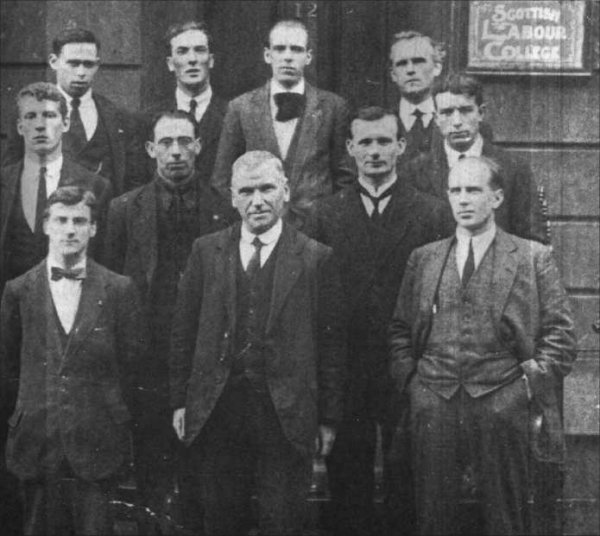
Scottish Labour College Believed that for a successful Revolution workers must be grounded in Marxist principles. His Sunday afternoon class alone, now had 481 students. From his classes he formed the Labour College Committee which planned an Inaugural Conference 12/2/16. It was planned to run a full time course of 3 terms a year, funded by Unions & covering all aspects of Industry, Economy & Labour Laws/ History.
However the Government offensive stepped up. Forward, Vanguard (Launched by Mac 1913), Worker all banned -Petroff arrested and no reason given. -Made criminal act, under DORA, for anyone to impede war production & it was clear that Gov was planning big crackdown. Inevitably MacLean became the first victim of this.
He was arrested 6th Feb and held for a week in Edinburgh Castle, so missing the SLC meeting. Gallacher, Muir and Bell arrested shortly afterwards. Then March - 9 leaders of CWC were seized and deported to Edinburgh, where it was reckoned they would cause fewer problems. Next day Maxton and McDougall urge a general strike at meeting on Glasgow Green, but a mood of fear was creeping over the workers, and this was compounded when Maxton and McDougall were later arrested for sedition.
11/4/16 – MacLean's trial.
6 counts against him connected with statements made that were 'all likely to cause mutiny, sedition and disaffection amongst the civil population, and to impede the production, repair and transport of war material.'
All prosecution evidence came from 18 polis. MacLean gave a valiant defence and the Judge admitted definite conflict of evidence but decided in favour of polis, as to do otherwise would mean that the polis were guilty of conspiracy.
Jury found MacLean guilty on 4 of the charges and he was sentenced to 3 years penal servitude (hard labour) at which point MacLean turned a waved to his wife & the crowd sang the Red Flag. Although the Brit Gov may have temporarily abated the Strike movement on the Clyde the effects were to reverberate internationally.
Sumas Reader, Commander of the Scottish Brigade of the IRA during Irish Civil War agreed with MacLean that "when Jim Connolly saw how things were going on the Clyde he determined on the Easter Rising" (less than week later) Demos held throughout country to protest at treatment of political prisoners as Scottish prison conditions were worst in Europe, McDougall suffered nervous breakdown.
The Feb Russian Rev had helped galvanise revolutionaries position & MacLean was elected to Exec of BSP when Hyndman clique were forced out. Mayday March saw 80,000 marchers & 250,000 lining streets to support the Soviets and demand MacLean's release.
At the end of May 100,000 people demonstrated on Glasgow Green at Lloyd George being given the Freedom of the City & to demand the release of Mac. When Lloyd George came to Glasgow 1000's took to the streets to protest & the Gov. was forced, under intense pressure from the working class to release MacLean to pacify crowds.
As soon as he was released he set about denouncing the War & Capitalism & gathering support for the Soviets. This work was to see him appointed an Honorary President of the First All- Russian Congress of Soviets and appointed Bolshevik Consul for Scotland. The authorities refused to recognise the Soviet Gov. and MacLean's consulate.
They refused to deliver mail addressed to him & he had trouble getting funds to run the newly opened office. His Asst. was arrested and deported to Russia. MacLean saw that the best way to help the Soviet Government was agitation at home – later said that the Sinn Feiners 'though non-Socialists at best' had done more to help the Soviets than Brit labour by keeping Capitalism busy at home.
Willie Gallacher testified to this when he wrote "The work done by MacLean during this winter of 1917-18 has never been equalled by anyone. His educational work would have been sufficient for half a dozen ordinary men, but on top of this, he was carrying a truly terrific propaganda and agitational campaign.
Every minute of his time was devoted to the revolutionary struggle, every ounce of his extraordinary energy was thrown into the fight." & the SLC now had 17 classes with over 1,500 pupils Meanwhile the Americans had joined the war & the British Government feeling assured of victory decided to crush the anti-war movement.
In April 1918 MacLean was arrested on his return from a tour of Durham and was arrested for sedition. The workers took the 1st of May for Mayday celebrations at MacLean's insistence for the first time & after listening to the speeches from 22 platforms on Glasgow Green a huge crowd marched to Barlinnie Prison where MacLean was being held. At his trial on 9th May the Indictment took 10 mins to read & consisted of 11 charges the main one of which that he said the Workers should follow Russia and strike a blow for Revolution.
He conducted his own defence & cross examined 28 witnesses 25 of whom were employed by the polis. Called no witnesses of his own but instead gave an impassioned speech lasting for 75 minutes giving a full & unashamed account of his own activities & beliefs with his famous quote "No human being on the face of the earth, no government, is going to take from me my right to speak, my right to protest against wrong, my right to everything that is for the benefit of mankind."
"I AM NOT HERE, THEN, AS THE ACCUSED: I AM HERE AS THE ACCUSER OF CAPITALISM DRIPPING WITH BLOOD FROM HEAD TO FOOT."
He was sentenced to 5 years penal servitude in Peterhead The Clyde District Defence Committee was formed to protect activists and provide for MacLean's family. Monthly demonstrations on Glasgow Green to demand his release and the July demo was attacked by polis. When his wife Agnes got to visit him in October she found out that he had been on hunger strike since July as he claimed he was being fed drugged food.
Since July he had being force-fed by Warders, a practise which killed the Irish hunger strikers Thomas Ashe in 1917 and Terence McSwinney 1920. Such was the fury of the Labour Movement the Gov, was forced to sit up and take notice. More than anything they feared Social Revolution at home similar to that which had happened in Russia and was happening in Germany and elsewhere. 10,000 marched to demand his release in Finsbury Park, London. Released on Dec 3 less than 7 months into a 5 year sentence.
And launched straight into an election campaign standing for Labour Party but on a revolutionary platform denouncing parliamentary methods. His return to Glasgow is best given in this contemporary account "I do not believe the extraordinary and deeply moving spectacle of that evening will be easily effaced from the memory of those who witnessed it. The slowly moving carriage being dragged through the thronged streets by a score of muscular workers who had taken the place of the horses, the surging, exultant mass of people, the incessant cheering and singing and standing upright in the carriage, supported by friends, was the challenging figure of John MacLean waving a large red banner with an air of triumph and defiance"
Bloody Friday
He then began working again with the miners in Scotland , S.Wales and N.England. The rank & file Reform Movement was revised and MacLean's 'minimum programme' was adopted – 6 hour/day, 5 day week, £1 day. The CWC also adopted this programme in early January 1919 but then formed a Joint Committee with the official trade unions. Sent out a demand for a 40 hour week or there would be a General Strike starting on 27th Jan.
MacLean had asked them to postpone the threatened strike for 1 month so that the miners could come out in support and was in England when the strike took place. On Monday 27th Strike spread rapidly over Industrial Scotland. After a rally on Wednesday at St Andrews Hall the crowd gathered in George Square and a deputation met the Provost. They were told to return in 2 days for an answer.
The workers were confident but the state had a surprise. When the crowds gathered to hear the reply to the workers demands the polis attacked them in George Square. The workers responded with anything they could their hands on & a battle took place. The Riot Act was read and the strike leaders were arrested. The next day Glasgow woke up to find itself occupied by English soldiers who had been told to sort out a Sinn Fein Rebellion. The Scottish regiments had been confined to Maryhill Barracks lest they sympathise with the strikers.
The Government outlawed strikes by the Electrical Trade Union (ETU) and the official unions pulled out. Soviets had been set up from Russia (East) to Limerick in the West, Bavaria, Berlin, Hungary. The Gov's fear was contained in a memorandum from Lloyd George at this time "The whole of Europe is filled with the spirit of Revolution. There is a deep sense not only of discontent, but of anger and revolt amongst the workmen against the pre-war conditions.
The whole existing order in its political, social and economic aspects is questioned by the masses of the population from one end of Europe to another" 1919 MacLean continues constant agitational and educational work around industrial Britain, foresaw that increasing unemployment due to the war ending would weaken revolutionary situation. However this was coupled with a growing disenchantment with the BSP which had come under the influence of people MacLean could not work with. In particular a Lt Col Malone who a year prev. had been member of the Russian Reconstruction Society an anti-revolutionary propaganda body.
They had wanted him to become a full-time organiser of the Hands Off Russia campaign but MacLean saw that the best way to help the Russian Rev was to fight for Rev. at home. He refused and warned against increasing Russian control over International affairs. A warning of the future dangers of Stalinism. At this time he was campaigning for the setting up of unofficial committees to work as Soviets & for them to set up Labour College Classes and he addressed 150,000 workers on Mayday with this message and to demand the release of socialists Eugene Debs (US) and Pete Larkin in Australia.
The SLC went full time in September 1919 and by 1920 had classes Aberdeen, Arbroath, Dundee, East & West Fife, Falkirk, Edinburgh & all around Glasgow Tramps Trust Unlimited MacLean was forced out of the BSP at the Easter Conference 1920 & immediately relaunched Vanguard paper at Mayday rallies. He rallied workers to him with the accompanying leaflet "All Hail The Scottish Communist Republic" and immediately built a small nucleus of dedicated revolutionaries around him.
McDougall, Harry McShane, Peter Marshall and Sandy Ross. All their activities were financed through the sales of literature & collections at mass meetings. They set about agitating around their Fighting Programme – a series of concrete immediate demands for workers. MacLean attended Highland Land League Conference and reported that "there was a general approval of Communism under the control of the industrial workers, fishermen, crofters and other land workers" He then visited Lewis to support the land raiders arguing that this was the application of Bolshevik tactics to the Highlands. It had become clear to him that "Since the British Empire is the biggest obstacle to Communism it is the business of every Communist to break it up at the earliest moment. That is our justification for urging a Communist Republic for Scotland."
The sceptre of unemployment was haunting the workers following the defeat of the 40 hrs strike & MacLean began to organise the Unemployed into local Committees & to lecture them in Marxist economics. By the start of 1921 he was holding twice weekly meetings of 3,500 unemployed workers in the City Halls and in Feb was elected Secretary of the Scottish Provisional Unemployed Committee.
Moves were afoot to create one united Communist Party in each country, as dictated by the 3rd International from Moscow. He had joined the SLP because it remained to all extent & purposes a Scottish Party and he wished to turn it into a pro-independence organisation. MacLean issued a call for a Scottish Communist Party because he believed it would further the cause of Revolution, that conditions in Scotland were more advanced & open to Revolution. But he also objected to the increasing Moscow domination of the new International – "We stand for the Marxian method applied to British conditions. The less Russians interfere with the internal affairs of other countries at this juncture, the better for the cause of Revolution in those countries".
In so doing he was representing a strain of thought which emphasised a fundamental belief in humanitarian Socialism. He did not trust many of those now calling themselves Marxist & grouped around the new CPGB. Still the Capitalists offensive continued the mines had been re-privatised and the miners locked out and there were round-ups of Sinn Feiners in Glasgow.
MacLean & Sandy Ross were soon to fall foul of the authorities and were arrested in Airdrie on 11 counts of "addressing an audience of the civil population and using language calculated and likely to cause sedition and disaffection amongst His Majesties forces and the civil pop" -At his trial Mac was asked what he meanttt by Revolution.
He held out both hands, one above the other; he said this represents the two classes in society, the top one being the capitalist class. He then swung his hands round to the reverse position and said this is revolution. -Both Mac & Ross sentenced to 3 months imprisonment.
MacLean threatened hunger strike for political status and was granted it, which was unprecedented in Scotland. -Whilst in jail both men were chosen as candidates for the municipal elections by the Unemployed Committees and on their release were back into the thick of political action. However it was not for long as both men were to be arrested again for "telling the unemployed to take food rather than starve".
McDougall had already been sentenced to 60 days for this. Both men denied charges. MacLean in his trial stated "All I am out for is food for my class & I am not afraid to say it… I am glad of this prosecution today because it has brought out that John MacLean is not prepared to see human beings die of starvation." 12 months in Barlinnie although he was granted political status, which allowed him books, papers and 1 hours exercise a day & he beat the Labour candidate from his cell. Release 25th October 1922 Changed days. No huge crowd. No wife/family. No pay from SLC – voluntary basis now. Penniless & out of pocket for election expenses.
Jimmie McDougall was out of action for some years due to prison experiences, Sandy Ross emigrated after his 2nd term in prison, Harry McShane had, along most of the left, joined the CPGB so only Peter Marshall was left with MacLean. The CPGB had taken over the Unemployed Movement & MacLean had left the SLP over its refusal to back independence. Announces plans to stand against "traitor" Barnes in Gorbals election.
Barnes stands down and eventually Buchanan decides to stand. MacLean used the election as an opportunity to give a straightforward account of his Marxist principles. He also reissued under a different name 'All Hail the Scottish Workers Republic' & explained that in order to carry out the work necessary to achieve a SWR he would adopt the Sinn Fein tactics and would not go to the House of Commons staying in Scotland, helping the unemployed and workers, educating in the SLC & carrying revolutionary propaganda the length & breadth of Scotland, and beyond.
He came second but was well beaten as Labour candidates swept across Central Scotland. In Glasgow 10 ILPers were elected and the night they left St Enoch's Station was a scene of great rejoicing. Jimmie Maxton declared that "the Clyde would get the better of the HoC… we are not leaving Glasgow as individuals but as a team working towards an ultimate goal. the abolition of poverty". 18 months later Maxton was to declare MacLean had been right, that the Clydesiders should return to the Clyde & take up the challenge of creating a Scottish Socialist Commonwealth as nothing could be won from Westminster. Scottish Workers Republican Party MacLean did not rest though.
He set about the task of building a new revolutionary party, the Scottish Workers Republican Party. He set about building it round the remnants of the Unemployed Movement that hadn't joined with the CPGB. Once again he set about the resurgence of the SLC which lacking his drive had stagnated during his last imprisonment.
The SWRP stood in various municipal elections often defeating the Labour candidates & letting the Moderates win. With the left grouped together in a United Front, MacLean remained the sole pole of attraction for those Socialists who could see the dangers of Parliamentary methods & wished to keep the spirit of independent working class activity alive.
However this United Front of LP/ILP/CPGB got the SLC to ban teachers from political activity in an obvious attempt to silence MacLean. MacLean announced that he would stand again in the Gorbals at that the SWRP would stand in all the Glasgow seats, and in this election he was aided by Sylvia Pankhurst the famous suffragette, whose Workers Dreadnought organisation also stayed outside the CPGB. His Republican Manifesto warned of the wrongs of reformism & also the coming danger of Fascism. But he was in a bad way, his health was deteriorating and he had no source of income.
Whilst in the past he had received an income from large meetings, his work was now concentrated amongst the Unemployed. His wife, Agnes, had returned to him to find him chronically sick, but still out agitating every night of the week in the cold November fog. His only overcoat he had given to a Jamaican comrade whom he typically believed needed it more than him. Eventually the years of merciless activity and state persecution took its toll.
Whilst giving an election speech he had to be lifted from his open-air platform, mortally ill with double pneumonia, and was carried home to die.
FUNERAL
5000 took part in the Funeral procession on the 4 miles from Eglington Toll to Eastwood Cemetery & many thousands more lined the streets to pay tribute to this greatest fighter of the working class.
SPIRIT LIVES ON
Annual march every year until 1947 1948 25th Anniversary – Mass Meeting of Scottish-USSR Society Both Maxton & McDougall attempted biographies but felt they could not do him justice. First biographies came from official communist sources Bell & Gallacher – which both had there own reasons for denouncing MacLean as mad.
Gallacher's Revolt on the Clyde was written solely to discredit Peter Petroff, who had left Stalinist Russia & moved to Germany, which being of Jewish origin he left before Hitler came to power & wrote a damning account of the role of the CP in the rise of fascism. Gallacher by now a faithful communist set out to discredit both him & MacLean, who must have been 'mad' for not joining the CPGB.
Recently released Gov Papers show that Basil Thompson head of Brit Military Intelligence believed MacLean most dangerous man in Britain & stated that he would smear both MacLean & Pankhurst by spreading rumours that they were mad. These papers also show that at least two members of the newly formed CPGB Central Committee were British Intelligence Agents. Kept alive in folk culture by Hamish Henderson, Matt McGinn and none more so than Hugh MacDiarmid.
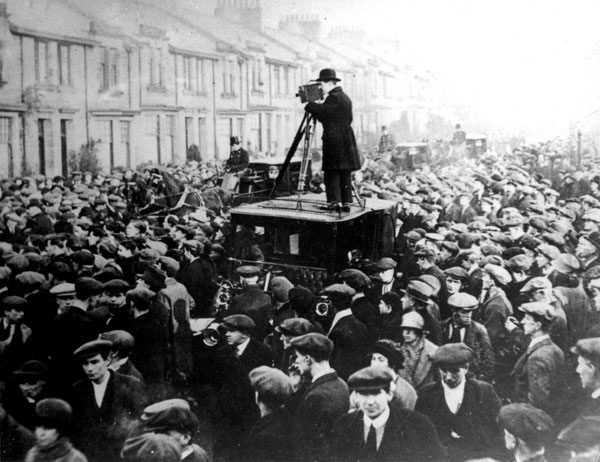
Photograph of John Maclean's casket being removed from his home in Pollockshaws on the day of his funeral.
John Maclean died on 30 November 1923 at his home in Pollockshaws aged 44, his health ruined by a mixture of his constant political activity, five terms of imprisonment and his period on hunger strike.
John Maclean's funeral march, led by the Clyde Workers' Band, was followed by 10,000 people on its way through the south side of the city to Maclean's burial in Eastwood cemetery.
Maclean's funeral procession was filmed and later shown in cinemas throughout the Clydeside area. The film of Maclean's funeral has not been seen since the 1930s and its present whereabouts is unknown.
"It has been said that they cannot fathom my motive. For the full period of my active life I have been a teacher of economics to the working classes, and my contention has always been that capitalism is rotten to its foundations, and must give place to a new society.
I had a lecture, the principal heading of which was "Thou shalt not steal; thou shalt not kill", and I pointed out that as a consequence of the robbery that goes on in all civilised countries today, our respective countries have had to keep armies, and that inevitably our armies must clash together. On that and on other grounds, I consider capitalism the most infamous, bloody and evil system that mankind has ever witnessed.
My language is regarded as extravagant language, but the events of the past four years have proved my contention."
John Maclean - Speech from the Dock.
All Hail, the Scottish Workers Republic! by John MacLean
First issued as All Hail, the Scottish Communist Republic in Aug 1920, and subsequently reissued along with Nov 1922 election address.
For some time past the feeling has been growing that Scotland should strike out for national independence, as well as Ireland and other lands. This has recently been strengthened by the English Government's intention to rely mainly on Scottish troops to murder the Irish race.
Genuine Scotsmen recently asked themselves the question: "Are we Scots to be used as the bloody tools of the English against our brother Celts of Erin?" And naturally the instinctive response was - No!
Again the land seizures by Highland crofters are arousing the blood of Highland men driven south to the Clyde Valley for work. Especially the filthy tactics of Lord Leverhume (an English capitalist), who has dismissed Stornoway wage slaves as a means of beating the Lewis raiders who seized the farms of Coll and Gress. Divide and conquer again!
Scottish students of history now realise that Edinburgh lawyers and politicians sold Scottish independence in 1707, although most blame has fallen on the Earl of Stair.
Many of us are convinced that ever since 1707 the Edinburgh kings' and queens' councils and politicians have been in the regular pay of London to keep Scotland as the base tool of the English government. These scoundrels in the eighteenth century helped to ruin Burns, the peasants' and people's poet.
The "rebellion" of 1715 and 1745 were natural reactions against the treacherous deed of 1707, but these unfortunate outbursts but gave the English the excuse and chance to subdue the Highland chiefs and then corrupt them with an English education at Oxford and Cambridge.
Since 1790 the chiefs became Englishmen in outlook, and used their clansmen to defend English capitalism against the revolution started in Paris in 1789. Since the Napoleonic wars the Highland regiments have been used to defend the stolen lands of England all over the globe, and have largely helped to extend the English empire.
Whilst doing this, the Dukes of Sutherland and Argyll and other chiefs proceeded with the English landlord policy of land clearances. The friends of the fighters were chased of their native heath into the lowlands or out to Canada and Australia.
Now the reaction is beginning - inspired by Ireland and Russia.
Scotland must again have independence, but not to be ruled over by traitor chiefs and politicians. The communism of the clans must be re-established on a modern basis. (Bolshevism, to put it roughly, is but the modern expression of the communism of the mir.) Scotland must therefore work itself into a communism embracing the whole country as a unit. The country must have but one clan, as it were - a united people working in co-operationnn and co-operatively, using the wealth that is created.
We can safely say, then: back to communism and forward to communism.
The control must be in the hands of the workers only, male and female alike, each workshop and industry sending delegates to district councils and the National Council.
The National Council must be based in or near Glasgow, as half the population lives within a radius of twenty miles from Glasgow.
In the period of transition a wage-earners dictatorship must guide production, and the adoption of the machinery and methods of production, to communist methods.
Many Irishmen live in Scotland, and, as they are Celts like the Scots, and are out for Irish independence, and as wage-earners have been champion fighters for working class rights, we expect them to ally themselves with us, and help us to attain our Scottish Communist Republic, as long as they live in Scotland. Irishmen must remember that communism prevailed amongst the Irish clans as amongst the Scottish clans, so that, in lining up with Scotsmen they are but carrying forward the traditions and instincts of the Celtic race.
All hail the Scottish Workers' Republic!
MacLean and the Unemployed by Nan Milton
(Originally Published in the 'Scottish Workers Republic')
"Socialists everywhere when unemployed, ought to organise, lecture, and drill the unemployed, and so create a mighty menace to capitalism".
John MacLean, January 1919
A certain degree of unemployment has always been an integral part of the capitalist system. To put it very simply, the worker is not paid for his labour, but only for his labour-power, as John MacLean described in his famous defence speech at his 1918 trial:
"What is the position of the worker? This country is not a free country. The worker is deprived of land or access to the land; he is deprived of workshops or access to the materials and tools of production; the worker has only one thing to do in the market, and that is to sell his labour-power. The Capitalist purchases that labour-power, and when he gets the worker inside the workshop, his business is to extract as much of that labour-power out of him as possible. On the other hand, when it comes to wages, the employer applies the principle of 'ca canny'…. "
The difference between the amount of wealth the worker actually produces and the amount he is paid in wages is the source of all unearned income -profit, rent, interest etc. - and one of the causes of unemployment. The working class as a whole cannot buy back all the goods they produce, and so they pile up unsold. In the early days when Britain WAS the workshop of the world mass unemployment was not such a problem; the British Empire was being built. Another quote from the 1918 speech:
"I have pointed out at my Economic Classes that, owing to the surplus created by the workers, It was necessary to create a market outside the country, because of the liability of the workers to purchase the wealth they create. You must have markets abroad, and in order to have these markets, you must have empire... "
However, until the goods were sold abroad, there were slumps with many bankruptcies and thousands of workers unemployed. Such a slump took place in 1907, and was especially bad in Glasgow, at that time the second city of the British Empire and one of the most highly industrialised cities in the world. At that period there was neither government or municipal assistance for the thousands of unfortunates who could not find work, and in Scotland there was no parish relief either. The English Poor Law embowered Parish Councils, etc. to give relief to able-bodied unemployed, even if only to send them to the workhouse, but the Scottish Poor Law allowed assistance only to the chronic sick, the disabled, and the old. Help to the able-bodied unemployed was strictly forbidden, and stiff penalties could be imposed on any authority which flouted the law. So in Scotland unemployment meant for the majority destitution and starvation.
It was in this situation that John MacLean received his first experience of fighting for the unemployed, The great slogan was "WORK OR MAINTENANCE", and big demonstrations were held all over the city, An amusing incident took place during one such demonstration led by MacLean; when it passed near the Stock Exchange it occurred to MacLean that it would be a good move to invade the sacred precincts, and as the head of the procession came to the entrance, it suddenly wheeled to the right, marched up the steps, passed inside the building right round the floor, and out into the streets again. Glasgow's financiers were horrified, and after that day the doors of the Stock Exchange were kept shut whenever there was trouble around.
Although mass unemployment did not hit the country until the end of 1920 immediately after the war socialists could see what was coming, A great technical revolution, spurred on by the necessity of producing large quantities of munitions, had taken place, and now one man could do the work that it had hitherto taken three or more men to do. And the demobilised soldiers were coming home to find they weren't needed! The famous 40-hour strike of January 1918 which demanded a shorter 40-hour week to forestall the looming problem of unemployment, ended disastrously with Glasgow like an armed camp, full of English soldiers with tanks and machine-guns, It was then that MacLean called on socialists everywhere, when unemployed, to "organise, lecture and drill the unemployed" and "so create a mighty menace to capitalism". (THE CALL, 30th January 1919), In the autumn of 1920 the condition of thousands of people, including many ex-servicemen, was so desperate that MacLean realised that he would have to carry out his injunction of January 1919, and the Glasgow Unemployed Workers' Movement was founded. Soon "John MacLean's Ragged Army" was to be found marching and demonstrating all over the city, Some of the demands made by a deputation to Glasgow Town Council demonstrate the kind of suffering being endured -
"We demanded food at municipal restaurants as the most urgent question of all. Then work on farm colonies at trade union rates of pay, with representation on all committees employing the unemployed. We requested houses to shelter full families on the colonies. We urged the Corporation to proceed with all available work of a new and repair character…. Finally, we requested use of a city hall in which the unemployed might meet and comfortably discuss the situation ". (Page 252 JOHN MACLEAN by Milton)
In the event only the last request was granted, and as MacLean described in his "Open Letter to Lenin" (THE SOCIALIST 30 January 1921) -
"Three thousand five hundred unemployed meet twice a week in the City Hall so that we may discuss principles and tactics applied to the present situation from a Marxian point of view ".
The late Charles Doran, who participated in some of these activities told me about the kind of demonstrations that were held, and his description is included in JOHN MACLEAN on page 263. One victory for the movement was the passing of emergency regulations at the end of April 1921 empowering poor law authorities in Scotland to grant relief to the destitute employed. However, many of the Parish Councils were reluctant to grant adequate amounts and the late Peter Marshall told me about the big demonstrations that were held by the G.U.W.M. outside Parish Councils all over central Scotland (and in Dundee, where there was a big movement also), with great success. Another trick was the refusal to grant assistance to the wife and family of an unemployed man unless he himself went into the Poorhouse (Barnhill in the Glasgow area). Charles Doran told me about one such case which 1 have described on page 263 of JOHN MACLEAN.
"Matthew Foy, one of Bridgeton 's down-and-outs during the tragic slump days, speaking to me one day after John's death, could hardly control his emotion as he told me of the morning he went to John 's house in Newlands to seek his help against the Parish Authorities who offered the Poorhouse to Matthew and outdoor assistance to his wife and family. John took Matthew by tramcar up to the Chambers at George Square. As John entered the Council Offices, several clerks hailed him with "Good morning Mr MacLean!" John brushed all that aside and demanded 'Send Raynard to me!' Mr. Raynard was the Chief Officer. He came along, and John told him 'Here is this man you know about him as you consigned him to the poorhouse when you refused outdoor relief'.
Reynard tried to argue in terms of law. John was quite brusque, and threatened a demonstration. That was enough for Reynard, as he was well aware that John MacLean could organise a gigantic demonstration, as he had done on previous occasions. So Matthew Foy was sent at once to the Cashier with an authorisation from Reynard for a cash payment!
It was this kind of work on behalf of the unemployed that led to MacLean's arrest in October 1921, when he was charged with telling the unemployed to take food rather than starve. He made a long defence speech, with a graphic account of all the activities of the G.U.W.M., all constitutional, and while defending Sandy Ross, who was charged along with him, he said "Ross was associated with me in exhausting every constitutional means in getting food for the unemployed. I said so far as this was concerned If it was a case of death by starvation, or the taking of food, I urged the taking of food rather than death by starvation, and from that I will not recoil".
One part of the trial report demonstrates another aspect of the suffering of the unemployed: eviction for inability to pay rent,
Sheriff: "What is your explanation in leading these people to the churches; do you suggest these methods were altogether peaceful?
MacLean: "The motive was to let the church people really see those who were starving.
Sheriff : "What about the Cathedral and the Infirmary?"
MacLean: "I led the unemployed up to the Cathedral to get shelter there, for those who were lying out in George Square and elsewhere."
He was sentenced to one year's imprisonment, during which the Communist Party took over the Glasgow Unemployed Workers' Movement, which eventually became part of Wal Hannington's National Unemployed Workers' Movement.
Scottish Workers Republican Party
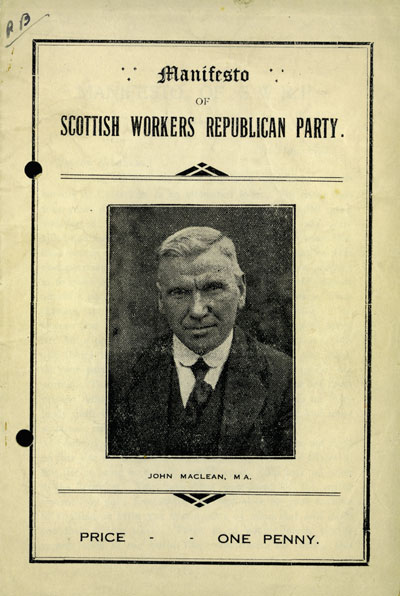
Front Cover of the Manifesto of the Scottish Workers Republican Party issued by the Executive Committee of the SWRP in 1925. (Picture is taken from the Gallagher Memorial Library)
The SWRP was founded by John Maclean in 1923 and advocated an independent Scotland in the form of a communist republic.
Maclean's call for a Communist Republic of Scotland was based on the belief that traditional Scottish society was structured along the lines of "Celtic communism". He argued that "the communism of the clans must be re-established on a modern basis" and raised the slogan "back to communism and forward to communism".
The manifesto is reprinted in full below:
"Fellow Electors,
I come before you as the nominee of the Scottish Workers' Republican Party at the Election to be held on Thursday, 6th December.
My attitude and policy arise out of my view of the world situation and the trend of world events, as do those of Mr. Baldwin. He claims that a high tax on foreign goods and a lower one, or none at all, on colonial goods will help the colonies, and so revive industry here that the unemployed and the employed alike will get a better chance to live.
That I deny. Nothing Mr. Baldwin or any other capitalist politician can do will bring enlarged markets to Britain. His imperial trade preference can but pull the empire more closely together for a bigger and bloodier war than the last.
Mr. Baldwin admits that the European markets are more likely to shrink than expand. Agreed.
Mr. Ll. George and Mr. Asquith in the Liberal manifestos claim that the late Conservative Government has lost the Near East Market by signing the Treaty of Lausanne in favour of the Turks. Agreed, but with the addition that Mr. Ll. George himself began the ruin.
The Mediterranean trade is likely to be reduced, and Britain may be challenged to hand over Gibraltar to Spain and Malta to Italy when Italy, France and Spain get into alliance with one another. Already Italy and Spain are embracing one another.
So far as the Far East markets, the markets of the yellow races of Asia, are concerned, last year I tried to impress on you the importance of a trade conference of all countries bordering on the Pacific Ocean called by the United States of America. This conference was to lay the basis of American supremacy in the Far East markets. The struggle for that supremacy is about to begin. This year America has been busy building factories. Next year these factories will turn out floods of goods for the Far East markets, England will be steadily squeezed out. America, in September 19922, passed the Fordney Tariff Bill giving power to tax certain European imports as much as 50 per cent. of their value.
During the last election Mr. Bonar Law proposed the Imperial Trade Conference, which has just ended, as a reply to the above-mentioned Pan-Pacific conference. Of course he made no reference to the American one, so that people would miss the meaning of his proposal.
As was clearly indicated at the opening of the Imperial Trade Conference, England's only assured markets were in the colonies. By preference given to goods coming from the colonies it is asserted that the colonies will flourish and trade here will revive. Work will be found for the unemployed. Wages will rise. Baldwin, therefore, seizes his chance to test the electors on the New Imperialism.
I see America aspiring to command not only the Asiatic markets but also those of all America as well. I see America's ally, France, pinning down England in Europe and gathering allies and strength to capture the Near East, Mediterranean and African markets. I see England in desperation gathering her imperial resources together for a dying kick in the form of a war with America for supremacy of the Pacific Ocean. Admiral Jellicoe has been in New Zealand preparing the naval defences from Australia round the South Pacific to Cape Horn in South America. Now Singapore has to be a naval base for the fleet to defend India.
As Rosyth was got ready against Germany, so Singapore is being got ready against America in the external fight for market supremacy.
The war with America is rapidly rushing upon us.
For the wage-earning class there is but one alternative to a capitalist war for world markets. The root of all trouble in society at present is the inevitable robbery of the workers by the propertied class, simply because it is the propertied class. To end that robbery would be to end the social troubles of modern society. The way to end that robbery is the transfer of the land and the means of production and transport from the present possessors to the community. Community ownership is Communism. The transfer is a Social Revolution, not the bloodshed that may or may not accompany the transfer.
Russia could not produce the World Revolution. Neither can we in the Gorbals, in Scotland, in Great Britain. Before England is ready I am sure the next war will be on us. I therefore consider that Scotland's wisest policy is to declare for a Republic of Scotland, so that the youths of Scotland will not be forced to die for England's markets.
I accordingly stand out as a Scottish Republican candidate, feeling sure that if Scotland had to elect a Parliament to sit in Glasgow it would vote for a Working-Class Parliament.
Such a Parliament would have to use the might of the workers to force the land and the means of production in Scotland out of the grasp of the brutal few who control them, and place them at the full disposal of the community. The Social Revolution s possible sooner in Scotland than in England.
If Baldwin's capitalist policy is to bind the Empire closer together to fight American capitalism and incidentally keep the workers enslaved, then the working-class policy ought to be to break up the Empire to avert war and enable the workers to triumph in every country and colony. Scottish separation is part of the process of England's Imperial disintegration and is a help towards the ultimate triumph of the workers of the world.
My policy of a Workers' Republic in Scotland debars me from going to John Bull's London Parliament. Last year I told you I would not go, as I could get nothing there. So you sent George Buchanan too get your rents back. Buchanan and his friends have spent a fruitless year and have returned home empty of hand. So, after all, I was right. Had the Labour men stayed in Glasgow and started a Scottish Parliament, as did the genuine Irish in Dublin in 1918, England would have set up and made concessions to Scotland just to keep her ramshackle Empire intact to bluff other countries. The curious feature in the Gorbals was that the block Irish vote sent Buchanan into the Parliament of the "Hated English" whilst the Irish chorus was being sung "Ireland a Nation Once Again".
It is the Irish vote that prevents Scotland being a Nation once again and prevents us all as slaves getting our freedom. I appeal to Irishmen not to be led any longer by the old Nationalist wirepullers, but to think out the situation clearly and calmly. Ireland will only get her Republic when Scotland gets hers.
Neither Free Trade nor Protection is of use to the Workers. Taxation of land or capital, including the Capital Levy, is of no use to the workers.
No housing or other social reform is really possible whilst industry is paralysed and the earnings of the workers are ever shrinking. The only possible hope of the working class is Community Ownership of the means of production. The increasing poverty and misery in Gorbals ought to convince the most conservative workers that all the "Woolworth" pottering of the petty politicians of all the "practical" parties (the Labour Party included) has brought no improvement into the life of the citizens of the Gorbals. Your only course now is to back me up for the complete change in the ownership of the world. Every vote cast against me is one cast for World War and the further starvation of the world's workers.
Every vote cast for me is for World Peace and Eternal Economic Security for the Human Family."
John Maclean - 1925
IRSP Message to the John MacLean
Commemoration 12 November 2001
Greetings of solidarity from the Irish Republican Socialist Party and the Irish
Republican Socialist Committees of North America on the occasion of this
celebration of the contribution of that towering figure of Scottish socialism,
John MacLean.
Too often in recent times, MacLean has been either dismissed, slandered, or
misrepresented by those who would prefer to silence his position that it is
Scotland's continued union with England that stands as an obstacle to the
achievement of socialism by Scottish workers. Yet MacLean's insight on this
issue should not be forgotten, for it remains true today, as it did in MacLean's
time, that the Scottish and Welsh working classes continue to find themselves
restrained by English workers whose class consciousness has undergone the
inevitable stunting that accompanies association with the imperialist strivings
of the ruling class, while the Irish working class remains impeded by the forced
partition and occupation of Ireland by British imperialism.
The revitalised struggle for an independent socialist republic of Scotland, if
it succeeds, may have more than the liberation Scottish workers to offer to the
world.
This national liberation struggle, grounded in working class consciousness,
also offers the opportunity for workers with the unionist community of Ireland's
occupied six counties -- who have long more closely identified with Scotland
rather than England -- to come to a recognition that the sundering of Britain is
not to be feared, but welcomed. It holds the potential to assist these women and
men who see themselves as a British working class in Ireland, to recognise that
their traditional association with British imperialism is an obstacle to their
own liberation and with that recognition, to recognise that their greatest ally,
as workers in Ireland, is the Irish working class; to move beyond the confusion
of the PUP, who want to be socialists, yet embrace the feudal anachronism of the
British monarchy and the imperialist monster that is the British Army. If
Scottish workers can show the way to liberation to their class sisters and
brothers across the Irish Sea, they will not only move towards their own
liberation, but will provide a service to the revolutionary movement in Ireland
beyond estimation.
What remains certain -- as MacLean recognised long ago -- is that without
breaking the connection to Britain, Scottish workers are burdened by
circumstances outside of their own control, which will hold back the fight for
socialism immeasurably. In striving for an independent Scottish workers'
republic, Scottish socialists do not abandon their sisters and brothers in the
English working class; rather they advance the struggle for socialism on the
island of Britain and speed the collapse of the ancient regime known as the
"United Kingdom" or "Great Britain", which perpetuates institutions that should
have fallen with feudalism. Such developments cannot fail to pull behind them
the struggle for socialism in England, in a way that they could not hope to
accomplish in continued union.
Today, the members of the Irish Republican Socialist Movement join you honouring
John MacLean, who like that other Scottish born socialist leader, James
Connolly, provided the working classes of these islands with two of the greatest
figures of their day within the world socialist movement. The Bolsheviks
recognised MacLean's revolutionary prominence and often mentioned him in the
company of other leading Marxists of his day, such as Rosa Luxemburg and Karl
Liebknecht.
In the IRSP, we have recently recognised the Revolutionary Shop Stewards
movement he helped to foster as a shining example for trade union work today. It
is only appropriate that John MacLean be given the recognition he deserves by
those who remain committed to socialism in his native land and we join with you
in celebrating his contribution to revolutionary socialism today.
Long Live the Memory of John MacLean and James Connolly!
Long Live the Solidarity Between the Irish and Scottish Working Classes!
by Tommy Sheridan MSP
from the International Socialist issue 1, Winter 1998
November 30th, 1998, will be the 75th anniversary of the death of one of Scotland's greatest socialists, John MacLean.
John MacLean was born in Pollockshaws, Glasgow, on August 14th, 1879. He was the 6th of seven children born to mother Ann and father Daniel. Unfortunately three of Ann's children died at birth, as was the sad norm of the day given the primitive medical assistance available. David MacLean died at the age of 43 when son John was only 9 years of age. It presented Ann, John’s, mother, with a task of Herculean proportions to try and feed, clothe and raise 4 children on her own. This struggle for very existence helped shape the political outlook of the young John MacLean.
It is a terrible tragedy that the life of John MacLean does not feature on the curriculum of our schools. Here is a man who rose from humble beginnings to become a world figure on the stage of politics. In a period of time when telecommunications and thus inter-country communications was difficult and inefficient here was a man whose name commanded respect throughout Europe and reached the shores of the world's first workers state in the Soviet Union in 1917. Lenin's Bolshevik government named John MacLean the Bolshevik consul in Britain, a tremendous honour at the time it was bestowed.
John MacLean was to be imprisoned 5 times during his life for political crimes. He was to be released early 3 times on the back of popular pressure. He was subjected to food poisoning, sensory deprivation and earned the title of 'Britains most dangerous man' from none other than Lloyd George, one of the Prime Ministers’s in power during his period of political agitations and actions. John's life was cut tragically short when he died at the early age of 44. His body had been so badly battered and bruised during hunger strikes, cold cells, sleep denial and forced feeding through stomach pumps that he eventually succumbed to pneumonia on St Andrews day, November 30th 1923. His life and times deserves the fullest possible analysis, attentions and celebration by all international socialists and indeed any human being who admires the twin pillars of integrity and principle. For John MacLean was a rich source of both, a source who can provide much inspiration, not to mention guidance, to a whole new generation of international socialists today.
It is impossible in a contribution of this size to give only a mere glimmer of the life of MacLean. Several books and pamphlets have been written about him. Personally I would recommend the 1977 collection of writings called "In the Rapids of Revolution' as the most informative and inspiring as it contains MacLean's speeches and articles rather than someone else's commentary. Although his daughter, Nan Milton, does provide an excellent introduction to her father's life in her 1973 account entitled 'John MacLean'.
In early life MacLean was obsessed with education, a trait he later transferred to the heart of the labour movements in Scotland. Although his mother Ann was forced to return to her former trade as a weaver, and John had to take on various jobs to assist the meagre family income, he still found the time, with his mother's encouragement, to read and educate himself. He chose the teaching profession as his goal and satisfied this goal regardless of how difficult it was in those days for a working class boy.
During his studies MacLean discovered Karl Marx. Although most of Marx's writings were unavailable in English at this time his main work, 'Capital' was translated and MacLean studied it and many other articles written in support of Marxian theory and philosophy. Like so many others, then and now, the works of Karl Marx provided MacLean with a logical explanation of society and acted as a set of keys opening many doors to allow understanding of politics. economics, history and philosophy.
Marx studied capitalist society and through his analysis was able to expose the class nature of society and indeed history itself. "The whole history of society has proved that society moves forward as a consequence of an under class overcoming the resistance of a class on top of them", MacLean declared his famous ‘speech from the dock' in the Edinburgh High Court on May 8th, 1918. This was a tremendous condemnation of both capitalism and war and was made in the most intimidating of surroundings and circumstances, standing before the very core of the ruling class bedecked in their wigs and stockings and with the power over MacLean's very life at their disposal. He was charged with sedition. "It has been said that they cannot fathom my motive. For the full period of my active life I have been a teacher of Economics to the working classes, and my contention has always been that capitalism is rotten to it's foundations, and must give place to a new society". He proceeded to condemn the carnage and horror of war and said, "on that and on other grounds, I consider capitalism the most infamous, bloody and evil system that mankind has ever witnessed. My language is regarded as extravagant language, but the events of the past four years have proved my contention".
The horrible loss of millions of lives during the 1914-18 1st world war served as the backdrop to this famous speech. MacLean brought the reality of war and capitalism into the lion's den of the Edinburgh High Court and refused to be intimidated or coerced in any way. He was eventually sentenced to 5 years hard labour. He served only 5 months. He was released on the back of mass popular pressure, which included strikes, marches, demonstrations and huge public rallies for his release. He was out in time to contest the Gorbals seat as the official Labour candidate in the general election of 1918.
John MacLean joined the Marxist party of his day in 1899. He joined the Social Democratic Federation at a time when the term social democrat was synonymous with Marxism; certainly not it's depiction today. Keir Hardie and Ramsay MacDonald's Independent Labour Party was also attractive to MacLean but he considered himself a Marxist and the SDF of Hyndman, Narin and others was avowedly Marxist.
Throughout the first years of our century MacLean toured Glasgow and Scotland with his interpretation of Marxian economics and class politics. From factory gates to street corners and public parks MacLean's classes became legendary. He also toured England and Wales and encouraged the trade unionisation of industrial workers as much as possible. He spoke to miners, shipyard workers and engineers. He assisted women weavers and developed a tremendous reputation as an incorruptible and committed socialist. Incredibly he also found time to meet and marry Agnes, with whom he had two children, Jean and Nan. Wars put ideas and individuals to the sternest of tests. The theory of class unity and human solidarity is fine in isolation but faced with state-sponsored jingoism and mass propaganda many a socialist has succumbed and lost their bottle. So it was for the bulk of the 2nd International grouping of socialists which contained the best of Europe’s socialists of the day.
To stand out against war could be very lonely, not to say dangerous. John MacLean did not flinch. He campaigned against the murder of German workers and British workers alike. As well as opposing the war he actively opposed it's many consequences. The super-exploitation of the munitions workers to feed the insatiable greed for profits of the war mongering factory owners. The bloodthirsty private landlords who attempted to take advantage of the increased demand for homes in Glasgow to increase rents. They were decisively beaten by the Rent Strikes of 1915, which led to the Rent Restriction Act of 1916.
MacLean was the perfect socialist role model during this period. Always willing to "dirty his hands" in the most immediate struggles of the day he also missed no opportunity to raise the wider and more permanent solution of socialist revolution.
He strenuously supported the struggles of Irish workers to overthrow the yoke of British imperialism and condemned the over proportionate use of working class lads in the British wars against Ireland and Germany. He learned of the Bolsheviks in Russia and their attempts to overthrow the Tzar and end the war. He became an enthusiastic and articulate supporter. After the 1917 Revolution in October MacLean helped organise the 'Hands off Russia' campaign, His anti-war activities and socialist campaigning had brought him to the attention of Lenin, leader, along with Trotsky, of the Bolshevik Party in Russia. In 1918 MacLean was named the Bolshevik consul in Britain.
From 1918 the question of tactics and strategy for the socialist movement became more complicated. MacLean's SDF had become the British Socialist Party in 1909. On the back of the Russian revolution, however, pressure to create communist parties in every part of the globe grew.
Throughout the years leading to the Communist Party of Britain's foundation in 1921 many heated arguments ensued over the nature and character of a new revolutionary party. MacLean was convinced by now that the best way to assist the world's first worker's government was not merely to assemble communist parties of the same mould and shape, to cheer-lead, but to confront the need for socialism in every other country of the world. In other words, MacLean remained true to his international socialism but saw the best way to assist world revolution was through the revolutionary break-up of the British state and the establishment of a Scottish Worker's Republic.
Some accused MacLean of nationalism and others accused him of being of unbalanced mind. This was the case particularly in Communist Party circles. How else could they explain that this giant of the Labour movement in Scotland was refusing to join the newly formed Communist Party of Great Britain. In retrospect the impact of the GPGB and of MacLean could have been even greater had MacLean joined. The need for a united Communist Party at the time was obvious. He was not opposed to the principle of a revolutionary party. He was clearly a Bolshevik and supported 100% the Bolshevik Party of Lenin and Trotsky.
The all-powerful and un-questionable authority of the Comintern became a serious problem for the work socialist movement after Stalin and his cohorts were able to conquer control of the Bolshevik part from Lenin and Trotsky. Stalin wielded the authority of the Comintern to terrible effect in Germany 1923, Spain 1927 Germany again in 1933 and China in 1927 to name but a few of the most significant examples.
John MacLean's final years were spent building his Scottish Workers Republican Party. They campaigned against unemployment and stood in general and municipal elections. Much of their manifesto is still applicable today.
Perhaps the call for a Scottish Workers Republic is even more relevant today than it was in the 1920's. Remember the British Empire was still dominant throughout the world in that period. Being part of that Empire carried material benefits for many workers. As we approach the new millennium that Empire is greatly reduced, almost to the status of America's 51st state. The benefits materially of such a united Britain are much less apparent. The argument for international socialists that the break-up of the United Kingdom and the promotion of socialism in Scotland as part of a socialist "commonwealth" of states throughout Europe and the world is relevant and very potent today.
To stand against an independent Scotland would be to line up with the ruling class and the most conservative layers in our society today. But to support an independent Scotland on it's own in not enough. We must support an independent socialist Scotland, linking ourselves with the struggles of socialists throughout the rest of Britain and the world. Recognizing the futility of an isolated socialist Scotland and therefore the necessity of world socialism. While also recognizing, however, that the most powerful contribution to the crusade for world socialism is the struggle for socialism here in Scotland.
These are arguments we must develop within our movement over the coming months. The legacy of John MacLean and his ideas might just be very useful in the course of that debate. Certainly an attempt to match MacLean's principles, integrity and courage over the coming period would make our movement all the more powerful.
I look forward to the MacLean story on the big screen. It would more than match Collins, Wallace or Malcolm X for excitement content and message. I leave the last words to John MacLean.
"I am a socialist, and have been fighting, and will fight for an absolute reconstruction of society for the benefit of all. I am proud of my conduct. I have squared my conduct with my intellect and if everyone had done so this war (1914-18) would not have taken place. I act square and clean for my principles. I have nothing to retract. I have nothing to be ashamed of. Your class position (the Judges) is against my class position... my appeal is to the working class. I appeal exclusively to them because they and only they can bring about the time when the whole world will be one brotherhood, on a sound economic foundation. That and that alone, can be the means of bringing about a reorganisation of society. That can only be obtained when the people of the world get the world, and retain the world."
There certainly was "none like John MacLean, the fighting Dominie".
For More History of the Red Clydesiders and Information re John MacLean follow the links below:
http://gdl.cdlr.strath.ac.uk/redclyde/docs/rcpeojohnmaclean.htm
http://gdl.cdlr.strath.ac.uk/redclyde/rcevents.html
Read the definitive biography of John MacLean by buying his daughter Nan Milton's book from the link below (the other links are to various articles about and written by MacLean, including the one reprinted above):
http://srsm.port5.com/macleanarchive/milton.html
http://srsm.port5.com/macleanarchive/writings_and_s.html
http://www.marxists.org/archive/maclean/

Back to Main Political Page
Go to Midlothian SNP site
| John MacLean |