PART 8
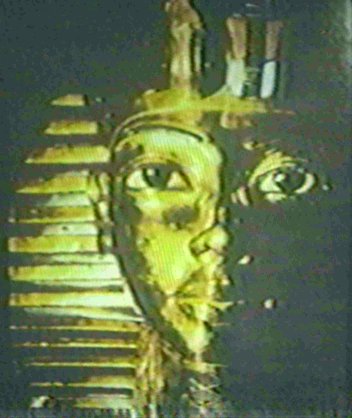
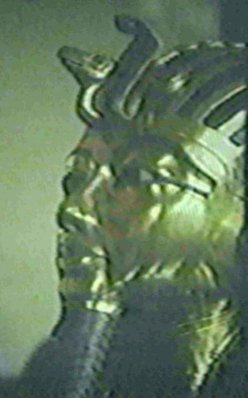
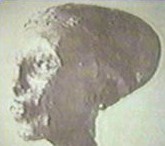
This is a picture of Amenhotep II on the left and middle, the grandfather of King Tut and Pharaoh Akhenaten. On the right is the nurse of Amenhotep II. Notice that both are portrayed as Black people in the pictures. What is being done is an attempt to give you more of a family portrait.
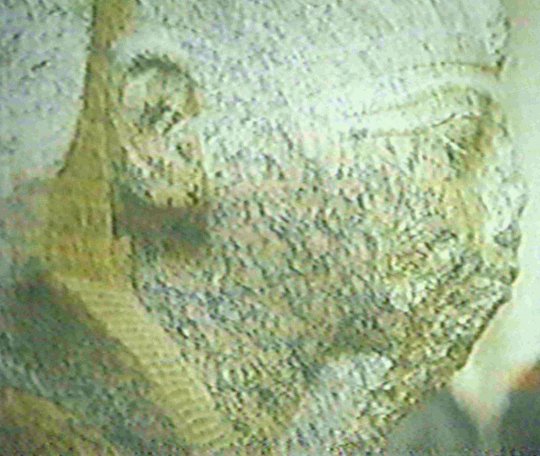
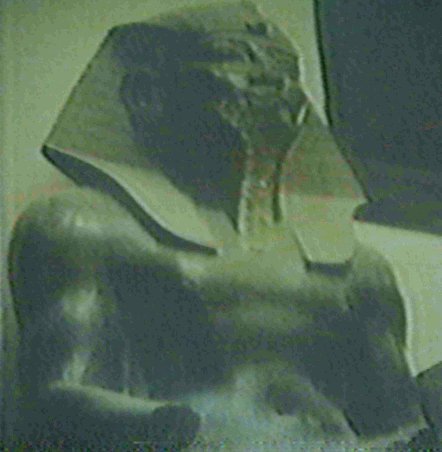
What is the attitude of the people at the Cairo museum regarding the racial makeup of ancient Egypt?
You usually don't get a chance to see most of the people who work at the Cairo museum. The guides are the ones that the average person will come into contact with. But if you get the chance to talk to some of the people in the Cairo museum or its director who, on a question like this doesn't seem to think that it's important whether it was a Black or a white person. It doesn't come up as often with the people who are presently in charge.
It has mainly to do with the current racial make up of the Egyptian population which is highly mixed where you have in one family, people who are very light and very dark in the same family, so for them the whole racial issue generally takes on a different kind of meaning.
You might also want to comment on who are the people currently living in Egypt?
The people presently living in Egypt are settler populations just like the population of the United States is a settler population. Europeans who left home and came to the United States are the dominant population of the United States, but you would not connect Europeans to the ancient history of the United States. So the Arabic population came in after Islam was established in the 7th century, and that's clearly after the whole of Egyptian history had been completed, even the Greco-Roman part had been completed by that time. These people then are what you would probably call middle easterners, but what we have to remember is that this was also a mixed population; the people who were in Saudi Arabia, the ones who were in Persia, the ones who were in Syria, that population had from almost the beginning of Kemetic times the benefit of Africans who had moved out of Africa and mixed with those populations who had come from both Europe and Asia. So everyone understands that the population of the Middle East is clearly a mixed population.
So if the ancient Egyptians were to look at President Mubarak of Egypt they would not consider him an Egyptian?
No, in fact if you were to look on the monuments for people who had that physical type, they were always shown as prisoners.
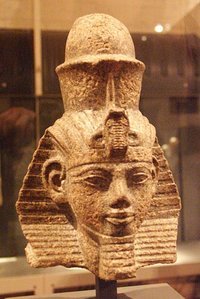
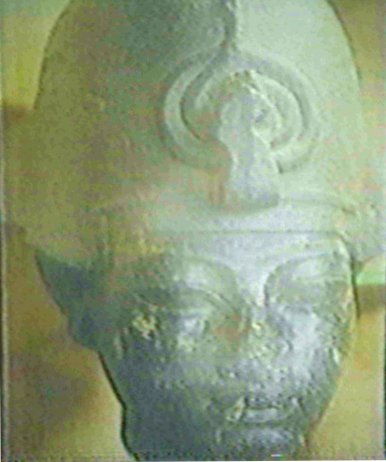 This would be Amenhotep III, the father of Pharaoh Akhenaten and also the father of King Tut.
Now there was some argument as to whether King Tut's father and Akhenaten's father were the same which would make King Tut and Akhenaten brothers, but there is a red granite lion in the British museum on which King Tut said, "my father was Amenhotep III".
This would be Amenhotep III, the father of Pharaoh Akhenaten and also the father of King Tut.
Now there was some argument as to whether King Tut's father and Akhenaten's father were the same which would make King Tut and Akhenaten brothers, but there is a red granite lion in the British museum on which King Tut said, "my father was Amenhotep III".
The Greeks changed his name to Amenophis.
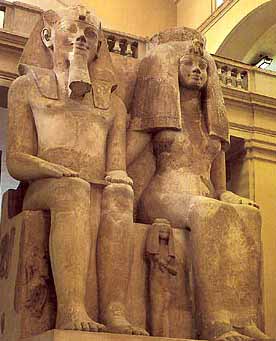 Here is Amenhotep III with his wife Queen Tiy /Tiye. We are not sure if she is Tut's mother but she is Akhenaten's mother, so King Tut and Akhenaten would at least be half brothers. Notice that both are native Africans.
Notice that the man and woman are shown or portrayed as equals. She sits right beside him and in fact she has her hand around his back, and it's in a playful attitude that this carving comes to life.
This emphasizes the point that there was great equality of the sexes in the ancient Egyptian culture when women and men held equally prominent roles in the culture.
This is a close up of Queen Tiy who clearly was a very beautiful Black woman, the mother of Pharaoh Akhenaten and perhaps also the mother of King Tut.
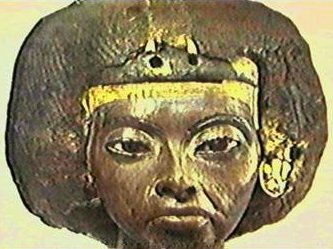
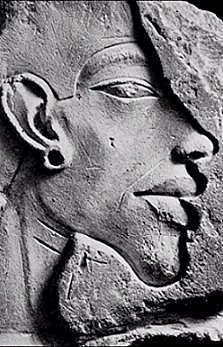
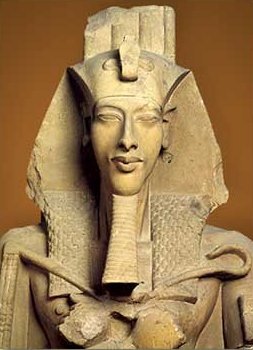
Here are some pictures of Akhenaten. In another picture from the San Francisco Chronicle (not shown here) there was a piece of writing showing that the writer was concerned with Akhenaten's physical appearance, and even commented on the fact that he had "swollen lips," that is, puckered lips and a fleshy nose. In other words, they were talking about his Negroid features as if they indicated illness. That was on the paper that had done a report on the exhibit.
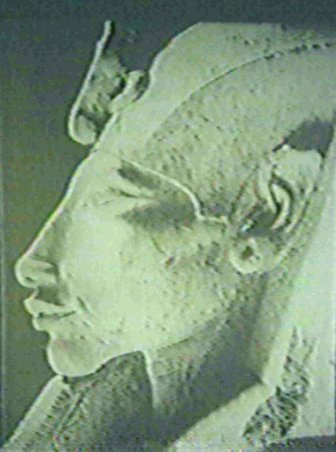
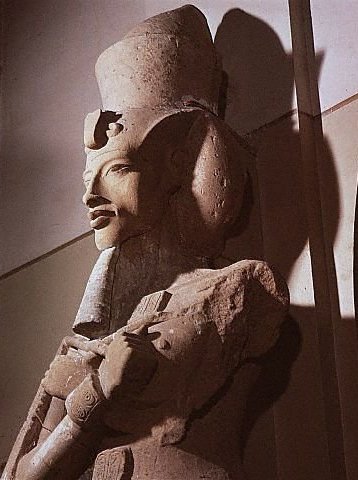
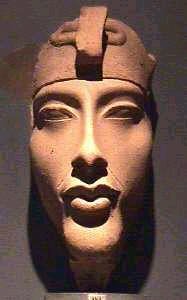
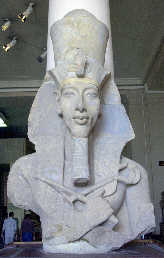
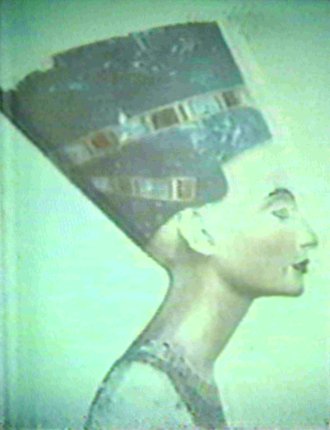 This is a famous picture of his wife Nefertiti that is known all over the world. She was a foreigner. During the 18th dynastic period in particular, the pharaohs, especially the Thutmosis went to Asia and Syria and married the daughters of kings as a way of solidifying the empire which was a political move. There were many Asian women who were brought in and who were wed to the ruling pharaohs in Egypt. So this particular picture of Nefertiti seems less Africoid.
Of course this is the one that is shown in the Berlin museum. There is one thing that should be noted about this head, it does not have Nefertiti's name on it. It was found in an artist's workshop on the floor, and so the assumption was that it must have been Nefertiti because it had a royal head dress, but it could just as easily have been one of the daughters of Nefertiti and pharaoh Akhenaten.
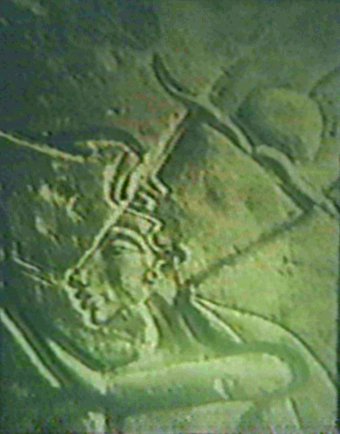 This is another picture of Nefertiti that is not shown all over the world like the first famous one, but which we know to be that of Nefertiti because it is in her temple. Notice she has the same kind of "sickness" that her husband had. The "sickness" that he was supposed to have been suffering from was frolic syndrome. According to some doctors, that would make a European swell around the lips and so on, but the problem with this explanation was that frolic syndrome makes you sterile, and Akhenaten had six daughters, so he was anything but sterile.
At any rate, you will notice that the physical features that are shown of Nefertiti in her temple show her to be like all the other native Africans. This is the Nefertiti that we know to be Akhenaten's wife that was found carved into the wall of her tomb.
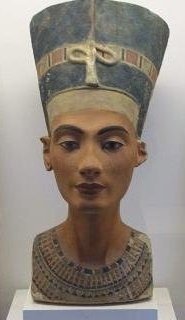
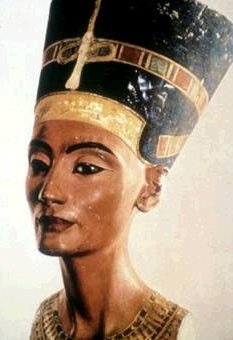
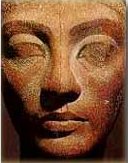
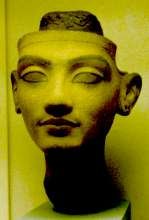
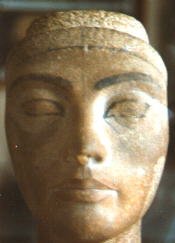
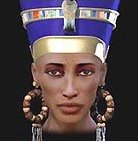
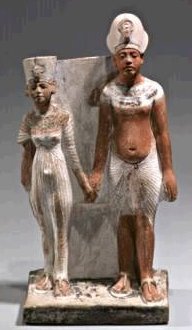 Here is Akhenaten and wife Nefertiti. Akhenaten is the one who was given the credit for starting monotheism or the belief in one God but as indicated earlier, this is totally an error.
If you pick up The Book of the Dead or "The Book of Coming Forth from Darkness into Light" which is the oldest religious literature in the world, you will find that it comes from a total position of monotheism. In fact, there is no point in Egyptian history where there was not the one great God who has many manifestations and who is reflected with many powers.
So what Akhenaten gave to the world was not the concept of monotheism, but the concept of a particular kind of monotheism which was then picked up and seen as alien. In other words there was a group of priests at Luxor who were called the priests of Amon (Amen/Amun), so the name of the hidden God was Amon. Akhenaten turned that monotheism into a new type of monotheism and chooses the sun as its symbol. He worships Aten, so that meant that the old bishops were being put out of power, and you can imagine what would happen in the Baptist Church, the Methodist Church or the Catholic Church for example, if you suddenly got a new religion that would put all the priests out of power.
So there was an internal warfare over this move by Akhenaten which was really a move to dominate the country politically, and in fact it is believed that Akhenaten may have been assassinated because he seemed to have met an untimely death, due to the fact that he was taking the country in another direction religiously.
What does this have to do with Black folks today?
We Black people call ourselves monotheist and today Black people are the most religious people on the face of the earth, and knowledge of the history of the religion that we hold is essential to understanding the religion. For example, the idea that Africans were not monotheists before the Hebrew religion or the Christian religion is completely false. We have always been monotheist. The idea that we had no religion is totally false and that someone had to come and save Africans, therefore we have an eternal debt of gratitude to pay to people for coming into Africa from Europe or other places is totally false and misleading.
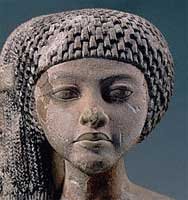 This is Meritaten, one of the daughters of Akhenaten and Nefertiti. Notice the hairdo.
When you see the wigs on the heads like this in the Cairo museum, the actual royal wigs, they look as if you had taken those huge afros that were worn in the 60's, even to the extent that they had peppercorn curls on the wigs.
But the wigs were very typical and they showed the native Africans hairdo.
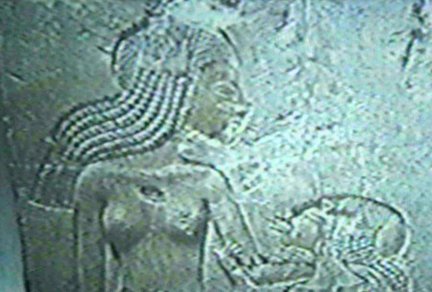 This is another picture of another of Akhenaten and Nefertiti's daughters.
Now whenever you begin to dig up mummies that are Black or carvings that have big noses and big lips, carvings that have peppercorn hair on them, carvings such as these that have elongated heads that suggest something "abnormal" for a European but actually typical for an African, rather than admit that they are Africans, scholars will frequently come back and give explanations to say that these were deformed Europeans as they said about these daughters.
Well Akhenaten was supposed to be "deformed" because of his mis-shapen body and the certain features of his face. Well these daughters were supposed to be "deformed" because of their elongated heads, and it was said that no normal person has a head that would be elongated like that.
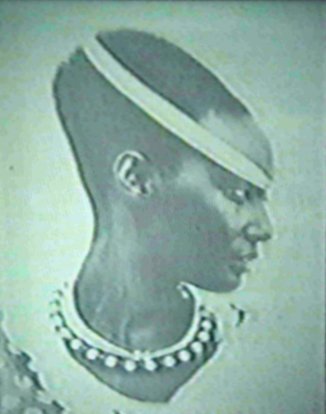
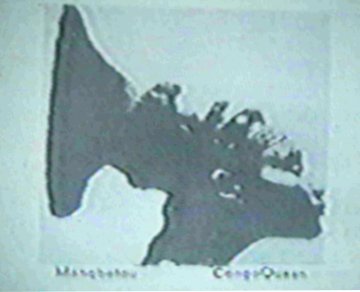
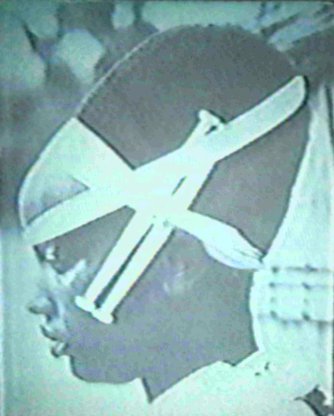
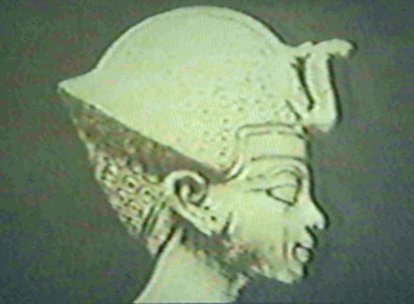
Well, all over the African Nile Valley, and in fact with most African people all over the world, this is the most typical head shape among African (Black) people, if you observe the head shape.
These images were taken from different parts of the continent of Africa, in West Africa in the Congo. This would be true of almost any Black person that you look at for example, so it is not even necessary to go anywhere out of the Valley to explain what you are seeing on the monuments.
 This is Akhenaten's brother, King Tut, who as a young boy took over somewhere around the age of 9, and when he became a teenager it appears as though the priesthood might have gotten to him too, because we notice that he started out believing in the religion that his brother had started, the religion that was symbolized by the sun or the religion of Aten.
He then changed his name from Tutenaten to Tutenkamen which meant that he went back to the old religion. His brother had backslid from Amen to Aten. Tut goes back to Amen which means that the Amon priesthood that was centred in the 18th dynasty at that city of Luxor was back in power again, and shortly afterwards we find King Tut's uncle coming to the throne, his uncle Ay.
Now let's take a look at his mummy on the right, and notice that he has the same head "problem" that his little sisters had. Then look at the Golden Mask of King Tut.
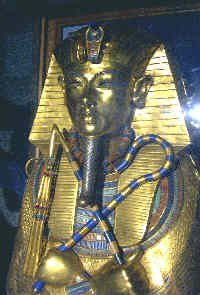
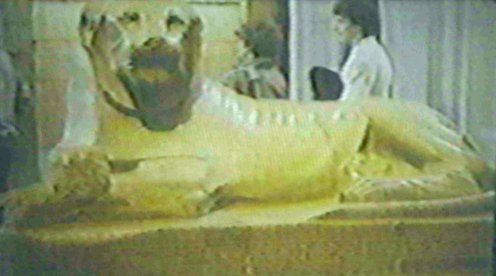 This is the red granite lion in the British museum, mentioned earlier.
The inscriptions on this lion say that his father was Amenhotep III, therefore his brother would then be Amenhotep IV because both of them had the same father.
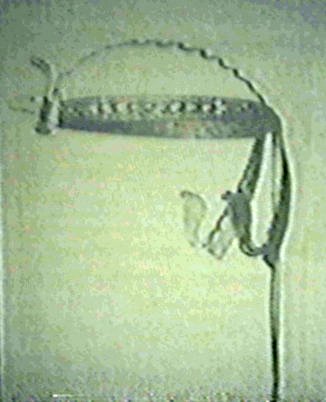 This is the crown that was part of King Tut's jewellery. Notice the snake and the vulture. Everything in ancient Africa was symbolic. For example, the vulture can assimilate diversity; it eats a lot of different kinds of dead things and assimilates it or turns it into something. The snake symbolizes the splitting function which leaves you compelled to wonder if they didn't have some indication of how the brain worked when you notice that one side integrates like a vulture and the other side disintegrates or dissects like a snake which has a forked tongue, and also a forked penis. You will also notice the snake's body going across the top of the head which approximates some of the sutras that go across the top of the brain dividing it into two hemispheres so that we have the left brain and the right brain functions which can be associated symbolically with these two animals both of which, when the crown is worn, will appear right above the third eye or the pineal gland on the head of the king.
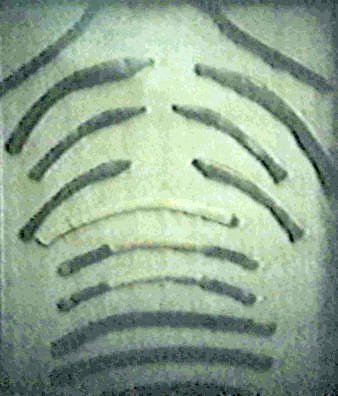 Here are some boomerangs that came out of the tomb of King Tut which dates back to the 18th dynastic period.
Many people are inclined to believe that the boomerang was indigenous to Australia with aboriginal or native populations of Australia which may be the case, but these were found here in Kemet even earlier than they may have been found in Australia, suggesting maybe a cultural connection between Australia and Africa.
Again here is a copy of the golden mask of King Tut the way he looked to his artist. Keep this image in mind when you view the next picture, because the next image will be a picture of a news advertisement for the king Tut exhibit in Los Angeles, coming out of the Los Angeles Times.
I wanted you to see the real thing and then what an artist does, which will give you an indication as to why we should never accept artists sketches. We should always ask for the original document or carving if you could possibly see it.
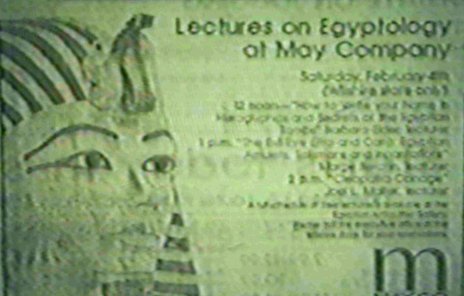 Now here is King Tut the way he looked to the artist in the Los Angeles Times, he becomes Caucasoid, white, and this happens frequently with the Egyptian figures whenever they appear in sketches. For this reason, the use of sketches in text books is not recommended. Wherever possible it is better to have photographs and even better than that the actual objects, since even in photographs it is possible that the colour is not a true rendition of the original colour. In black and white you really don't pick up the natural colour of the statue as it appears, so it's really better to have a colour picture.
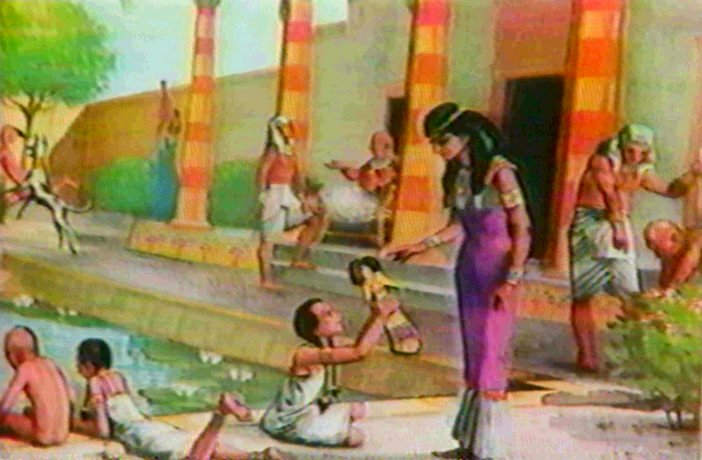
Now look at how the Egyptians are portrayed in books and so on to the children. They are now all white.

 |
 |
 |
 |
 |


